
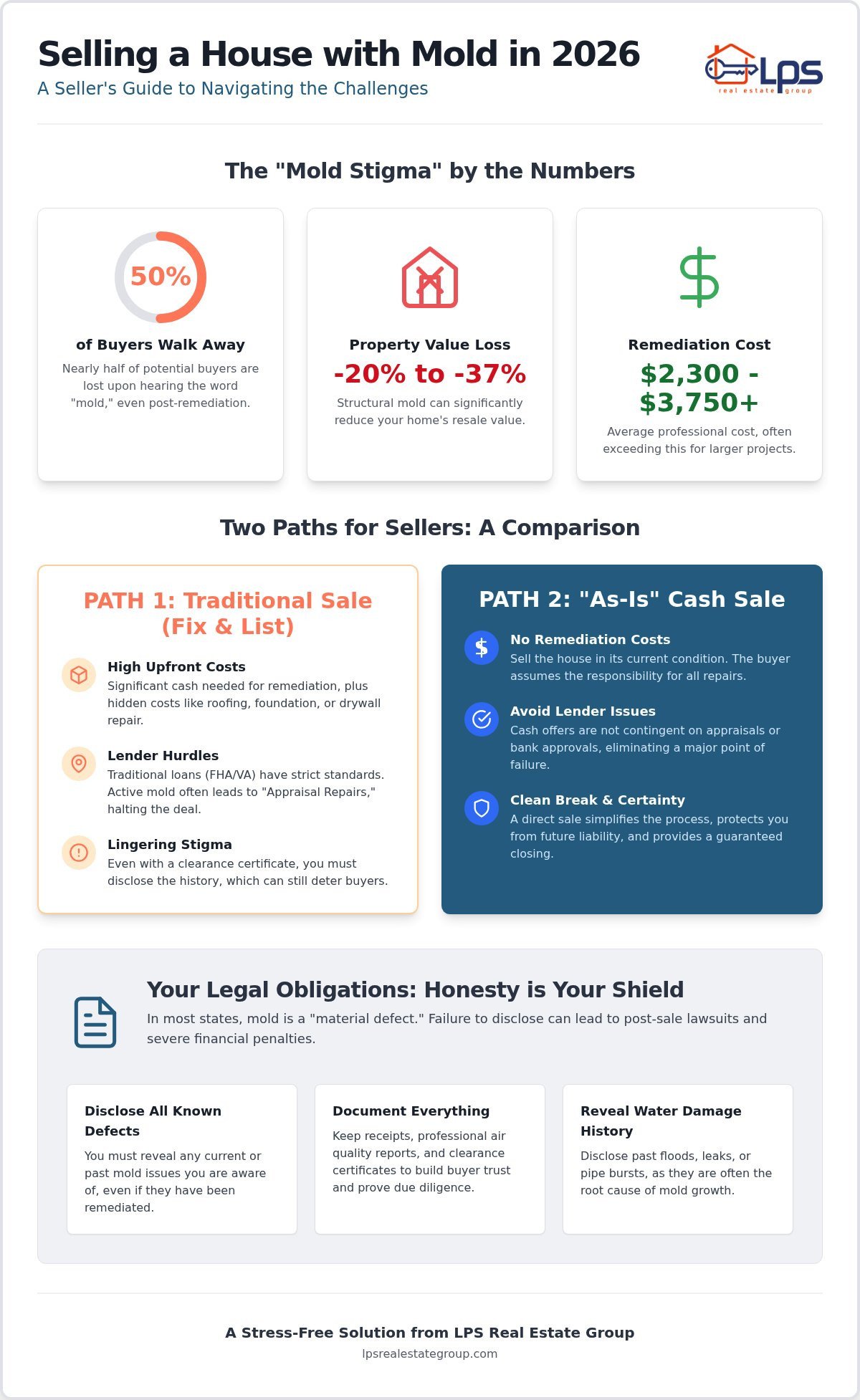
Did you know that nearly 50% of potential buyers will walk away from a home deal the moment they hear the word “mold,” even if the issue was professionally fixed? It’s a frustrating reality in 2026. When you need to sell house with mold issues, the stress often feels overwhelming. You might worry about the potential 20% to 37% hit to your property value or the daunting prospect of professional remediation. It’s completely natural to feel stuck between a rock and a damp place, wondering if you’ll ever find a fair exit from a difficult situation.
We understand that you want a fair outcome without the endless cycle of contractors and legal paperwork. You deserve a path forward that protects you from future liability while securing your financial stability. This guide provides a clear, manageable roadmap to help you navigate legal disclosures and logistical hurdles. We will explore how to manage the “black mold” stigma and why an “as-is” cash sale might be your most reliable solution for a truly stress-free transition. Our goal is to help you move forward with the confidence that your property and your peace of mind are being handled with integrity and care.
Key Takeaways
- Understand your 2026 legal obligations regarding mandatory mold disclosures to protect yourself from future liability and lawsuits.
- Weigh the high cost of professional remediation against the potential market value impact to decide if fixing the home is worth the investment.
- Learn the specific steps to prepare and sell house with mold issues, including why a professional air quality report is essential for building buyer trust.
- Compare the traditional listing process with an as-is acquisition to determine which path best fits your current timeline and financial needs.
- Explore how a direct cash offer can eliminate the need for contractors and inspections, providing an immediate solution for complex property situations.
Understanding Mold Issues and Your Legal Obligations
Selling a home is already a complex process, but discovering mold adds a layer of anxiety that many homeowners find overwhelming. To sell house with mold issues successfully, you first need to understand exactly what you’re dealing with. Not all mold is the same. Surface mildew in a bathroom is a common maintenance item that usually doesn’t scare away buyers. However, systemic structural mold, which often hides behind drywall or under floorboards, can reduce your home’s resale value by 20% to 37%.
Buyers are particularly sensitive to Stachybotrys chartarum (black mold) because of its association with water-damaged buildings and potential respiratory health effects. This stigma is why nearly half of all buyers will walk away from a deal if they suspect a history of moisture problems. Attempting to paint over the issue or ignore it won’t work in 2026; modern home inspections now use advanced VOC detectors and thermal imaging to find hidden dampness that the naked eye might miss.
The EPA Guidelines and Health Standards
The EPA suggests that any mold growth covering more than 10 square feet generally requires professional intervention rather than simple DIY cleaning. Modern environmental health standards focus heavily on “microbial volatile organic compounds” (mVOCs) that degrade indoor air quality even when mold isn’t visible. In 2026 terminology, toxic mold refers to any fungal growth that produces secondary metabolites capable of causing adverse health reactions in sensitive populations through prolonged exposure.
Disclosure Laws: What You Must Reveal
Honesty is your best legal shield. Most states require you to disclose “material defects,” and mold clearly fits that category. If you try to hide a known issue, you risk post-sale lawsuits and heavy financial penalties years after the closing. Transparency actually protects your equity by preventing future legal claims that could cost far more than the initial repair.
- The “Known Defect” Rule: You must disclose any mold issues you’re aware of, even if they’ve been remediated in the past.
- Documentation: Keep all receipts for professional air testing and clearance certificates to build buyer trust and prove the problem was handled.
- Water Damage History: Disclose past floods or pipe bursts, as these are often the root cause of recurring mold growth.
Failing to disclose these facts can lead to a judge voiding the sale or ordering you to pay for the buyer’s future remediation costs. Being upfront about the home’s history ensures a clean break and protects your peace of mind throughout the transaction.
The High Cost of Remediation vs. Market Value Impact
When you try to sell house with mold issues, the financial math can quickly become discouraging. Professional remediation is rarely a simple surface scrub; it’s a specialized project that involves air quality testing and containment. National data from 2026 shows that the average cost for professional remediation typically ranges between $2,300 and $2,400, though larger projects often reach $3,750 or more. Many homeowners attempt to save money with DIY sprays or bleach, but these efforts usually fail to pass a professional clearance test. Without that certificate of clearance, you’ll find it difficult to convince a buyer or their lender that the home is safe.
Why Traditional Lenders Say No to Mold
Traditional mortgage lenders, particularly those handling FHA or VA loans, have strict health and safety standards that mold often violates. If an appraiser identifies active mold or evidence of significant moisture, the loan is usually flagged for “Appraisal Repairs.” This creates a frustrating cycle where the bank won’t release funds until the mold is gone, but the buyer won’t close until the bank approves the loan. This gap often kills deals at the finish line because most buyers don’t have the extra cash to fix a property they don’t yet own, and sellers may not have the liquidity to fund repairs on a tight timeline.
Hidden Costs of the Remediation Process
The actual removal of the fungal growth is only one part of the total bill. According to EPA mold cleanup guidelines, you cannot effectively solve a mold problem without first fixing the underlying moisture source. This might mean you’re suddenly responsible for a new roof, a foundation repair, or an expensive HVAC overhaul. Once the remediation team finishes their work, you’re often left with a home that has been “gutted” to the studs. You’ll need to account for the additional cost of replacing drywall, insulation, and flooring, which can easily double your initial repair budget. If the treatment is extensive, you may even need to pay for temporary housing while the home is being professionally scrubbed.
Even after the work is finished, the “Stigma Discount” can linger. Approximately 50% of potential buyers will walk away from a home with a history of mold, even if it’s been professionally fixed. Those who stay often expect a significant price reduction to compensate for the perceived risk. If the prospect of managing contractors and lender requirements feels overwhelming, exploring an as-is property acquisition can provide a much simpler path forward. Choosing a direct sale allows you to bypass the repair cycle entirely and move on with your peace of mind intact.
Selling As-Is vs. Fixing Before Listing: A Comparison
Deciding whether to invest in repairs or sell your home in its current state is a pivotal choice. To successfully sell house with mold issues, you must balance your financial expectations with your actual capacity for a long, technical project. While a retail buyer usually expects a move-in ready home, professional investors look at the underlying potential of the property, regardless of its current condition.
A professional remediation project is rarely a quick fix. It requires significant liquid cash and a flexible timeline that can stretch into months. According to the EPA Mold Remediation Guide, moisture control is the only effective way to manage mold growth. This means you aren’t just paying for mold removal; you’re likely paying for major plumbing, roofing, or foundation repairs before the cleanup even starts. This financial strain, coupled with the psychological weight of managing contractors, can be a heavy burden for many families.
The Pros and Cons of Professional Remediation
The primary benefit of fixing the issue is the potential for a higher retail price on the open market. By obtaining a professional clearance certificate, you open the property to the widest possible pool of buyers, including those using traditional financing. However, the cons include significant upfront capital risk and the high probability of “scope creep.” Once a contractor opens up a water-damaged wall, they often find structural rot or outdated wiring that must be addressed to meet 2026 building codes, leading to unexpected delays and costs.
The Benefits of an As-Is Sale to a Cash Buyer
Choosing a direct sale provides immediate relief from the logistical and financial hurdles of an environmental cleanup. This path is often the most reliable way to secure a fair price without the typical listing headaches.
- Speed: You can often finalize the sale in a matter of days, bypassing the weeks of waiting for professional air quality testing and clearance certificates.
- Certainty: Since cash buyers don’t rely on traditional mortgages, you won’t have to worry about a lender killing the deal at the last minute because of a failed inspection or environmental flag.
- Simplicity: You have the freedom to walk away from the moisture problems and the cleanup entirely, leaving the repairs and the stress to the new owner while you move forward with your life.
Steps to Prepare Your Mold-Impacted Home for Sale
Preparation is the key to maintaining control during a difficult transaction. When you need to sell house with mold issues, your goal isn’t to mask the problem with a fresh coat of paint or temporary cleaning solutions. Instead, you should aim to define the problem so clearly that it no longer feels like a mystery to a potential buyer. A structured approach helps remove the emotional weight of the situation and replaces it with a logical, step-by-step path forward.
- Step 1: Obtain a professional air quality and mold inspection report to establish a technical baseline.
- Step 2: Clearly define the scope of the issue, including the square footage affected and the specific moisture source.
- Step 3: Gather all maintenance records for your roof, plumbing, and HVAC systems to show you’ve been a responsible steward of the home.
- Step 4: Develop a pricing strategy that accounts for realistic repair credits based on actual contractor quotes.
- Step 5: Choose a sales channel that matches the severity of the damage, whether that’s the open market or a direct as-is acquisition.
Documentation is Your Best Defense
Vague descriptions are the enemy of a successful sale. If you tell a buyer there’s “some mold in the basement,” their imagination will often invent a scenario far worse than reality. A professional inspection report provides a concrete boundary for their fears. This documentation proves that the moisture issue wasn’t the result of long-term neglect but perhaps a sudden, isolated event. Being transparent about the “worst-case scenario” actually attracts the right kind of buyer, specifically those who have the resources to handle environmental repairs. For a deeper look at how to handle these technical disclosures, you can read our Selling Your House As-Is: The Complete 2026 Homeowner’s Guide. Providing this level of detail builds immediate trust and protects you from future claims of “buyer’s remorse.”
Pricing for the ‘As-Is’ Market
Setting the right price requires a balance of fairness and market awareness. You’ll need to calculate a repair credit that reflects actual remediation quotes rather than just guessing. Overpricing a home with known mold issues often leads to what we call “market rot,” where the listing sits for months, gaining a negative reputation that results in even lower offers later on. Since traditional bank financing is often off the table for these properties, your pricing should target cash buyers or professional investors who don’t rely on lender approval. If you want to avoid the complexities of pricing for the open market, you can request a direct cash offer to see how a professional acquisition group evaluates your property’s current value. This ensures you receive a fair price without the stress of a long, public listing process.
The LPS Real Estate Group Approach: A Clean Break from Mold
Facing the reality of mold in your home can feel like a heavy weight that never lifts. At LPS Real Estate Group, we specialize in lifting that burden by offering a straightforward path to sell house with mold issues without the typical stress. We don’t see a property as ruined by moisture or environmental concerns. Instead, we see an opportunity to provide a clean break for a homeowner who’s ready to move forward. Our approach is rooted in quiet confidence; we rely on our extensive experience with as-is property acquisition to handle the complications that often cause traditional retail deals to fall apart.
While traditional agents may hesitate to list a home with significant air quality issues, we specialize in the properties they turn away. We understand that your priority is immediate liquidity and a transition to a healthier environment. By removing the need for bank appraisals and environmental inspections, we provide a sense of relief that the open market simply cannot match. You don’t have to worry about a buyer walking away at the last minute because our commitment is grounded in our own ability to manage the remediation process after the sale is complete.
No Repairs, No Contractors, No Stress
The most exhausting part of dealing with mold is the endless cycle of contractors and the financial risk of remediation. When you work with us, we take on that risk entirely. You won’t need to fund expensive “scrubbing” projects or wait for a clearance certificate that may or may not pass. This transparency is a core part of being one of the Companies That Buy Houses for Cash: A Homeowner’s 2026 Guide to Selling Fast. We buy your home exactly as it stands today, allowing you to focus on your future rather than managing a construction site.
Get Your Fair Cash Offer Today
Our process is designed to be as low-stress as the outcome. It begins with a simple consultation where we listen to your needs and understand the property’s history. From there, we follow a clear, three-step sequence to help you move forward:
- Step 1: Reach out to share the basic details of your property and the extent of the moisture issues.
- Step 2: Receive a fair, no-obligation cash offer based on the current condition of the home.
- Step 3: Choose a closing timeline that works for your schedule, whether you need to move in a few days or several weeks.
This tailored exit strategy ensures that your specific circumstances are respected and handled with integrity. Whether you’re dealing with an inherited property or a sudden structural failure, we provide a reliable solution that prioritizes your peace of mind. For law enforcement officers or families facing property crises due to disaster, Blue Line Relief provides dedicated support and financial assistance. You can walk away from the mold issues for good, knowing you’ve secured a fair price and a fresh start.
We’ve explored how modern disclosure laws prioritize transparency and why the high cost of professional remediation can often complicate a traditional sale. Choosing to sell house with mold issues doesn’t have to mean sacrificing your peace of mind or your financial stability. By understanding your legal obligations and evaluating the actual return on repair investments, you can make a decision that serves your long-term goals. Whether you choose to manage the repairs yourself or seek a faster exit, having a clear roadmap ensures you stay in control of the transition.
LPS Real Estate Group specializes in as-is property acquisitions, providing immediate liquidity for even the most complex environmental situations. We offer transparent, no-obligation cash offers that allow you to bypass contractors and lender-required repairs entirely. Get a fair, as-is cash offer for your house today; mold and all. You deserve a fresh start that isn’t weighed down by structural or air quality concerns. Let’s work together to find the best path forward for your unique situation.
Frequently Asked Questions
Can I sell a house with mold without fixing it first?
Yes, you can sell your property in its current condition. Many homeowners choose an as-is property acquisition to avoid the high costs and stress of managing professional contractors. While a traditional retail buyer might feel hesitant, professional investment firms look for the underlying potential of a home regardless of environmental issues. You must still disclose the mold to remain legally compliant, but you aren’t required to perform the remediation yourself before the sale.
How much does mold usually devalue a home’s sale price?
Mold can decrease a property’s resale value by 20% to 37% depending on the severity and location of the growth. Even moderate cases often see a reduction of 10% to 30% because buyers factor in the cost of professional removal and potential structural damage. In severe cases involving whole-house contamination, the value might drop by 50% or more as the pool of eligible buyers and lenders willing to finance the property shrinks significantly.
Is it illegal to sell a house with mold and not tell the buyer?
While there is no federal law, most states require the disclosure of “material defects,” and mold is almost always classified as one. Intentionally hiding mold or water damage can lead to significant legal liability and post-sale lawsuits years after the closing. Honesty protects your equity and your peace of mind. It’s best to document any past issues and remediation efforts clearly to build trust and ensure a clean legal break.
Will a bank give a mortgage for a house that has mold issues?
Traditional lenders, especially those for FHA or VA loans, often refuse to finance homes with active mold or evidence of significant moisture. These issues are typically flagged during the appraisal process as health and safety hazards. If the bank requires remediation as a condition of the loan, the deal may stall unless the seller pays for repairs upfront. This is a common reason why many people choose to sell house with mold issues to cash buyers.
What is the fastest way to sell a house that needs mold remediation?
The most efficient path is a direct cash purchase from an investment firm like LPS Real Estate Group. This method bypasses the weeks spent waiting for professional air testing, contractor schedules, and lender approvals. You can often close in a matter of days rather than months. To sell house with mold issues quickly, eliminating financing contingencies allows you to walk away from the environmental cleanup and the associated logistical headaches immediately.
Should I clean the mold myself before trying to sell the property?
DIY cleaning is generally only recommended for small areas under 10 square feet. For larger issues, professional remediation is the standard for passing a rigorous home inspection. Using bleach or over-the-counter sprays often masks the problem without solving the underlying moisture source. Buyers in 2026 are increasingly savvy and may view DIY repairs as a red flag, potentially leading to more rigorous testing and lower offers during the negotiation process.
Do cash buyers like LPS Real Estate Group buy houses with black mold?
Yes, LPS Real Estate Group specializes in as-is acquisitions, which includes homes with black mold or extensive water damage. We take on the remediation risk and the repair costs so the homeowner doesn’t have to. Our process focuses on providing immediate liquidity and a transparent, no-obligation offer. This allows you to transition to your next home without the burden of picking up a hammer or managing specialized environmental cleanup crews yourself.
What happens if mold is found during the home inspection process?
If an inspector discovers mold, the buyer will typically request a professional remediation credit or ask you to fix the issue before the closing date. This often triggers a new round of negotiations and may lead to lender rejection if the buyer is using a traditional mortgage. To keep the deal alive, you’ll likely need to provide an air quality clearance report from a certified professional, which can add significant delays to your timeline.