

A bright orange notice on your front door isn’t a final legal verdict; it’s a signal that it’s time for a new strategy. You’re likely feeling a heavy mix of stress and uncertainty right now. It’s completely normal to worry about looming city fines or the social stigma of owning a blighted building, especially when you don’t have the tens of thousands of dollars required for mandated structural repairs. You aren’t alone in this, and you don’t have to be stuck.
The truth is that selling a house with a condemned notice is entirely possible when you understand the 2026 legal and financial landscape. We’ve designed this guide to help you discover how to legally and profitably move on from a distressed property without the burden of costly renovations. We’ll walk through the current mortgage habitability standards, the reality of 2026 demolition costs, and the specific steps you can take to secure a fair price for your land. By the end, you’ll see a clear path toward a fast, hassle-free closing that protects your financial future and your peace of mind.
Key Takeaways
- Learn why a condemnation notice doesn’t mean you lose your property and how you can still legally sell the deed in 2026.
- Understand the critical difference between “as-is” sales and mandatory disclosure laws to protect yourself from post-sale legal disputes.
- Discover why selling a house with a condemned notice on the open market is often impossible and how specialized cash buyers offer a guaranteed path forward.
- Get a clear, five-step roadmap for organizing your paperwork and finding a partner who can close quickly without requiring any repairs.
- See how to avoid mounting daily city fines by opting for an as-is acquisition that shifts the burden of code compliance away from you.
What Does a Condemned Notice Really Mean for a Homeowner?
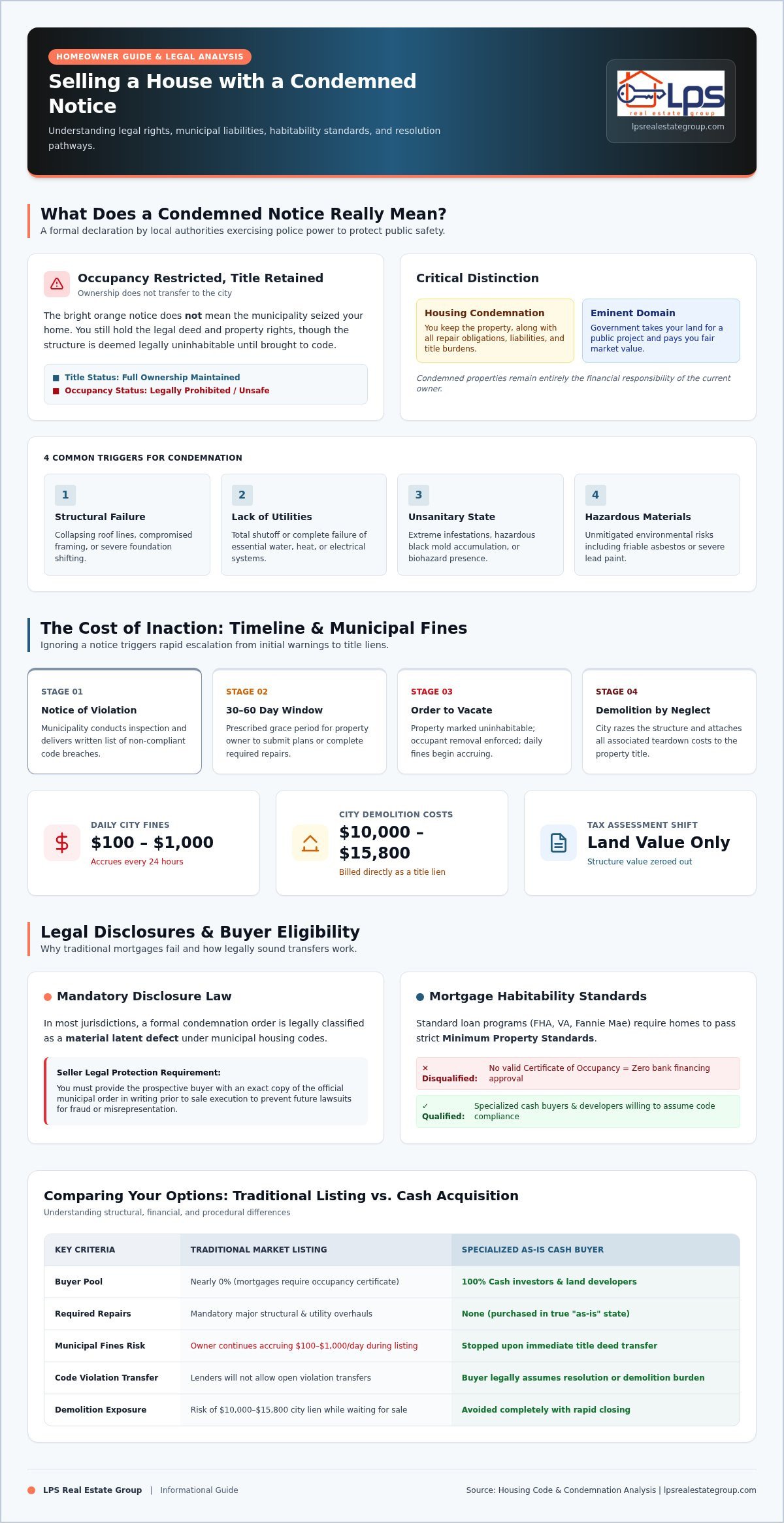
A condemned notice is a formal declaration by a local municipality that a structure is no longer safe or fit for human occupancy. While the bright orange sticker on the door feels like a final judgment, it’s technically an exercise of “police power” intended to protect public safety. Receiving this notice doesn’t mean the city now owns your home; you still hold the legal title and the right to pursue selling a house with a condemned notice. However, it does mean the property has reached a critical state where the authorities believe it poses a risk to the inhabitants or the surrounding neighborhood.
Common triggers for this status include:
- Severe structural failure, such as a collapsing roof or foundation shifts.
- A complete lack of essential utilities like water, heat, or electricity.
- Extreme unsanitary conditions, including major pest infestations or hazardous mold.
- Environmental hazards like lead paint or asbestos that haven’t been mitigated.
The legal timeline typically starts with an initial inspection, followed by a notice of violation. If the required repairs aren’t made within a set window, usually 30 to 60 days, the city issues an “Order to Vacate.” It’s vital to distinguish this from eminent domain. In eminent domain, the government takes your land for a public project and pays you for it. With a housing code condemnation, you keep the property, but you also keep all the legal and financial burdens that come with it.
The Difference Between Code Violations and Condemnation
Most homeowners deal with minor code violations at some point, like a broken fence or a neglected lawn. These are simple fixes. The definition of a condemned property involves a much higher threshold where the home is legally uninhabitable. This tipping point usually occurs when the structural integrity is compromised or the cost of repairs is overwhelming. Once a home is flagged, your property insurance may be canceled, and your property tax assessment might change to reflect only the land value.
The Financial Consequences of Ignoring a Condemned Notice
Ignoring the situation won’t make it go away; it usually makes it much more expensive. Municipalities often impose daily fines that can range from $100 to $1,000 until the issues are resolved. If the property continues to deteriorate, the city may issue a “demolition by neglect” order. This allows the city to tear down the house and bill you for the costs, which in 2026 can average between $10,000 and $15,800. These costs become a lien against your title, making the process of selling a house with a condemned notice significantly more complex if you wait too long to act.
Can You Legally Sell a House with a Condemned Notice?
Yes, you can legally sell. Many owners fear the city has taken control of their property, but the legal process of condemnation usually only restricts occupancy, not your ownership rights. In 2026, you retain the full right to transfer the title to a new party, provided you follow specific legal protocols. The sale essentially transfers the “cloud” on the title to the buyer, who then becomes responsible for resolving the code violations or proceeding with a demolition.
However, the pool of buyers is significantly limited. Traditional mortgage lenders, including those for FHA and VA loans, require a home to meet Minimum Property Standards. A condemned home, by its very nature, fails these tests. Since a bank won’t lend on a property without a valid Certificate of Occupancy, you’re almost exclusively looking at cash investors or developers. If you’re feeling overwhelmed by these restrictions, reaching out to an as-is property acquisition expert can simplify the process.
Disclosure Obligations: What You Must Tell the Buyer
Transparency is your best legal defense. When selling a house with a condemned notice, you’re legally required to provide the buyer with a copy of the actual city order. This isn’t just a courtesy; it’s a necessity to avoid future lawsuits for misrepresentation or fraud. By documenting that the buyer was fully aware of the structural or sanitary issues, you shield yourself from liability after the closing. In most jurisdictions, a formal condemnation order is classified as a material latent defect under local municipal housing codes that must be disclosed in writing.
Why Traditional Buyers Avoid Condemned Homes
Most families searching for a home are looking for a place to live immediately. A condemned property represents a massive psychological and financial barrier. Without a Certificate of Occupancy, a buyer cannot legally move in, even if they have the cash to purchase the home.
The math often doesn’t work for a typical homeowner. Between 2026 labor rates and material costs, the price to bring a condemned building up to code often exceeds the eventual market value. This “negative equity” trap, combined with the stress of dealing with city inspectors, means selling a house with a condemned notice to a retail buyer is rarely a viable exit strategy. Most successful sales in this category happen off-market with professional entities that have the resources to handle the legal and structural heavy lifting.
Comparing Your Options: Traditional Listing vs. Cash Home Buyers
Choosing the right exit strategy is the most critical decision you’ll make after receiving a city notice. Most homeowners instinctively think of the open market, but the traditional listing process is built for homes that meet standard safety codes. When you’re selling a house with a condemned notice, a “For Sale” sign on the front lawn often acts as a warning rather than an invitation. Traditional buyers need mortgages, and banks simply won’t fund a property that lacks a Certificate of Occupancy. This leaves you with two primary paths: attempting a complex renovation or seeking a direct cash sale.
Professional investors approach these properties differently than families do. They aren’t looking for a dream home; they’re looking at the land value and the structural bones. They factor in the cost of clearing city liens and the risk of unknown structural failures. This specialized perspective allows them to provide a certain exit where the retail market offers only stagnation. If a property sits on the MLS for months, it becomes a target for vandals and further city scrutiny, which only decreases your eventual takeaway.
The Hidden Costs of Renovating a Condemned House
Attempting to fix and flip your own property sounds profitable on paper, but the reality is often a financial sinkhole. In 2026, the cost of labor and materials remains high, and city permit fees for major structural work can be staggering. You’ll likely need to hire an architect and a structural engineer before you even swing a hammer. These upfront costs come with no guarantee that you’ll recoup the investment.
Beyond the repairs, you must account for carrying costs. While the house sits empty for 6 to 12 months of construction, you’re still responsible for property taxes, specialized vacant-home insurance, and any existing mortgage. You also have to navigate federal disclosure requirements regarding environmental hazards like lead paint, which add another layer of compliance costs. If the stress of a long-term project feels overwhelming, it’s often more practical to sell house as is and let a professional handle the risk.
Selling for Cash: The Path of Least Resistance
A direct sale to a cash buyer removes the hurdles that cause traditional deals to collapse. There are no bank appraisals to wait for and no inspections that can kill the deal at the last minute. This is the fastest way to stop the clock on compounding city fines. Most cash acquisitions can close in as little as 7 to 14 days. For a homeowner, this represents a clean break from a stressful situation. You walk away with a fair price for the property’s current state, and the buyer takes on the full responsibility for city negotiations and future repairs. This path prioritizes your peace of mind and financial stability over the gamble of a DIY renovation.
The 5-Step Process to Selling Your Condemned Property in 2026
Moving from a state of uncertainty to a successful closing requires a methodical approach. When you’re selling a house with a condemned notice, the process differs significantly from a standard home sale because the city is a silent, often difficult, third party in the transaction. You aren’t just selling a structure; you’re transferring a legal responsibility. Following a structured sequence helps ensure that you don’t miss critical deadlines that could lead to increased fines or city-ordered demolition.
- Gather all documentation: Start by organizing the original condemnation notice, your most recent property tax bills, and any title information you have. Having these ready allows a buyer to assess the situation quickly.
- Identify the right buyer: Look for companies that buy houses for cash. These entities specialize in high-risk properties and have the liquid capital to close without bank approval.
- Request an “as-is” offer: Ensure the offer explicitly states the buyer is aware of the condemned status and will handle all existing code violations. This protects you from future claims.
- Verify the buyer’s capability: Ask how they plan to handle the legal paperwork with the city. A reputable buyer should have experience communicating with building inspectors and clearing title clouds.
- Close the sale: Once the deed is transferred, the liability for the property’s condition and any future city actions moves to the new owner. This provides you with the “clean break” you need.
Evaluating Cash Offers for Distressed Real Estate
When you receive an offer, don’t let the headline price be your only metric. Look closely at the closing date and the specific terms. You need a buyer who is willing to take the property with all its “baggage,” including any trash or hazardous materials left behind. A fair offer in 2026 accounts for the significant demolition or repair costs while still ensuring you receive a reasonable value for the land and existing utility connections. If a buyer asks you to fix anything before closing, they likely aren’t the right fit for a condemned property.
Navigating Title and Legal Hurdles
It’s common for condemned homes to have additional complications, such as tax liens or unpaid utility bills. These “clouds” on the title can stop a traditional sale, but they don’t have to stop yours. Utilizing creative real estate exit strategies can help resolve complex cases where the debt on the property is high. A reputable title company experienced in distressed sales is essential to ensure that all liens are paid out of the sale proceeds, leaving you with a clear conscience and a fresh start. If you’re ready to see how these steps apply to your specific situation, get a straightforward assessment of your property today.
How LPS Real Estate Group Resolves Condemnation Situations
Facing a city mandate to vacate or repair a property is an isolating experience. At LPS Real Estate Group, we believe that a property’s current condition shouldn’t define your financial future. We utilize an “Empathy First” approach, which means we start by listening to your specific circumstances before we ever talk about numbers. We understand the weight of city pressure and the fear of legal penalties; our goal is to provide a sense of relief through a transparent, reliable partnership. We don’t just buy buildings; we help people move past complex real estate hurdles with their dignity and finances intact.
When you work with us, the physical state of the home is never a barrier. We specialize in as-is property acquisition, meaning we buy the structure exactly as it stands. You don’t need to hire cleaners, haul away debris, or attempt to fix code violations that are beyond your budget. We’ve refined our valuation process to be as straightforward as possible. When we calculate an offer for selling a house with a condemned notice, we share our data with you. We factor in the current land value and the projected costs of remediation to arrive at a price that is fair and honest.
- Zero Repairs: We take the property with every structural and sanitary issue included.
- Lien Resolution: We work with title experts to handle city fines or tax liens at closing.
- Immediate Assumption of Risk: The moment we close, the orange notice and all city correspondence become our responsibility.
A Streamlined Alternative to the Traditional Market
The traditional real estate market is often closed to distressed properties. By choosing a direct sale, you bypass the need for open houses and the stress of finding a buyer who can actually secure a mortgage. We provide immediate liquidity for homeowners who need to settle their affairs quickly to avoid mounting daily fines. Our process focuses on certainty. We perform our own due diligence, which allows us to offer a fast closing that works on your timeline, not a bank’s schedule.
Your Next Steps: Getting a No-Obligation Offer
Starting the process is simple and requires only basic information about the property and the current status of the city notice. We’ll perform a quiet, professional evaluation and present you with a clear path forward. There is never any pressure to accept our offer; we’re here to serve as a trusted advisor as you weigh your options. We want you to feel fully informed and comfortable at every stage of the narrative. Reach out to LPS Real Estate Group today for a fair assessment of your property and take the first step toward selling a house with a condemned notice without the typical stress of the retail market.
Moving Forward with Confidence and Clarity
A bright orange notice on your door marks the beginning of a new chapter, not the end of your property ownership. By now, you understand that while traditional buyers and lenders are restricted from these properties, you still hold a valuable asset in the land and the potential of the site. Choosing a direct sale allows you to bypass the overwhelming costs of 2026 renovations and the persistent stress of city inspections. Selling a house with a condemned notice becomes a manageable process when you partner with experts who specialize in resolving complex code violations and condemnation notices.
At LPS Real Estate Group, we’re here to provide the “clean break” you deserve. We offer transparent, as-is purchases with no hidden fees or commissions, ensuring that the entire burden of the property’s condition moves to us at closing. You don’t have to face the city’s legal pressure or mounting fines alone. We’re ready to listen to your story and help you find the best possible outcome for your specific situation.
Get a Fair Cash Offer for Your Condemned Property Today. You have the power to resolve this situation and start fresh, and we’re here to guide you every step of the way with patience and integrity.
Frequently Asked Questions
Is it illegal to live in a house with a condemned notice?
It is typically illegal to occupy a home once a municipality issues a formal vacate order. The notice signifies that the structure is hazardous or lacks basic utilities, making it a safety risk for residents. If you remain in the property after the deadline, you may face legal penalties or forced removal by local authorities. The goal of the notice is to protect you from structural failures or health hazards like mold or gas leaks.
Can the city tear down my house if it is condemned?
Yes, the city has the authority to order a demolition if the property remains a public safety hazard and the owner fails to submit a remediation plan. This is often called “demolition by neglect.” If the municipality carries out the teardown, they will typically place a priority lien on the property deed for the costs. In 2026, residential demolition averages between $10,000 and $15,800, which must be paid before you receive any sale proceeds.
Will I still owe my mortgage if the house is condemned?
You are still legally responsible for your mortgage balance even if the home is declared uninhabitable. The condemnation notice does not cancel your contract with the lender. In fact, most mortgage agreements include a maintenance covenant that requires you to keep the home in good repair. A condemned status may trigger a default, making it essential to pursue an as-is sale quickly to pay off the debt and protect your credit score from foreclosure.
Do I have to pay for repairs before selling to a cash buyer?
No, you don’t have to perform any repairs or cleaning when selling to a specialized cash buyer. Firms like LPS Real Estate Group focus on as-is property acquisition, meaning they take on the structural issues and code violations themselves. This is a significant advantage when selling a house with a condemned notice because it allows you to walk away without spending a dime on renovations or hazardous material abatement.
How long do I have to sell my house after receiving a notice?
Most municipal building departments provide a window of 30 to 60 days to either file an appeal or present a structural engineering plan. If you miss this deadline, the city may begin imposing daily fines ranging from $100 to $1,000. While you can still sell after this window, the accruing fines and potential demolition liens will reduce your final payout. Acting within the first month is the best way to ensure a smooth closing.
Can I sell a condemned house that I inherited?
Yes, you can sell an inherited property that has been condemned, though the process usually involves a probate step first. Inherited homes often fall into disrepair when they sit vacant, leading to city citations. We specialize in probate and inherited property buyouts, helping heirs navigate the legal paperwork required to transfer the title. This allows you to liquidate the estate’s physical assets quickly without having to personally manage the structural repairs or city negotiations.
What happens to the code violations when I sell the property?
When you sell to a professional as-is buyer, the responsibility for the existing code violations transfers to the new owner upon closing. The buyer assumes the legal obligation to either bring the structure up to code or demolish it. However, any fines that accrued during your ownership are typically paid out of the sale proceeds at the time of closing. This ensures that the title is cleared for the buyer while providing you with a clean legal break.
How is the value of a condemned house calculated?
The value is primarily based on the land and the existing utility connections rather than the structure itself. To calculate a fair offer when selling a house with a condemned notice, we look at the market value of similar vacant lots and subtract the estimated costs for demolition or major structural remediation. We also factor in the risk of clearing city liens and the time required to navigate municipal permits, ensuring the final price is transparent and fair.