

A clean exit starts with the contract, not a confrontation. If you’re searching how to get out of a realtor contract as a seller, you may be frustrated with the relationship and worried about the fine print: the cancellation process, agreement end date, or a possible commission or expense. Those concerns are reasonable, but ending the relationship doesn’t always erase obligations already set out in the agreement.
This guide will help you review the terms, make a clear written request for a release, and understand what to consider if the agent or broker says no. Pay close attention to any language about marketing expenses, buyers introduced during the listing period, and what happens after termination. You’ll also learn how to compare practical next steps, including waiting for the agreement to expire, pausing the sale, or exploring a direct sale. The right choice depends on your contract, circumstances, and priorities. Start with the paperwork, keep communication documented, and seek legal advice if you need help understanding your obligations. That’s a steadier path than making a decision in the heat of the moment.
Key Takeaways
- To understand how to get out of a realtor contract as a seller, start by checking the agreement’s cancellation terms, end date, and any obligations that may continue after termination.
- Make a clear, written release request that explains what you’re asking for and when you want it to take effect.
- Before ending the relationship, consider how a mutual release, waiting for expiration, or a dispute could affect fees, commission, and your sale plans.
- Compare continuing with your agent, relisting, pausing the sale, or exploring a direct sale by timing, preparation, conditions, and expected proceeds.
- Keep a signed release and written details about showings, listing status, keys, and marketing materials so your next steps are clear.
How to Get Out of a Realtor Contract as a Seller: Start with the Listing Agreement
Changing plans or feeling unheard can make a signed listing agreement feel stressful. Before you act, take a breath and read the document you signed. A listing agreement is a contract that sets the seller-agent relationship, the services involved, and how long the arrangement lasts. It may also explain how the property will be marketed, including through a Multiple Listing Service (MLS), a tool agents use to share property listings with other participants.
Whether you can cancel a listing agreement, and what it may cost, depends on the agreement’s wording and applicable state rules. That’s why the signed document, not assumptions about standard industry practice, should guide your first steps. Ending the agent relationship also isn’t the same as ending your plans to sell. You may decide to continue with a different arrangement, pause the sale, or consider another route after understanding any existing obligations. If you’re researching how to get out of a realtor contract as a seller, start by identifying what you agreed to and what the agreement says about ending it.
Which parts of a seller listing agreement should you check first?
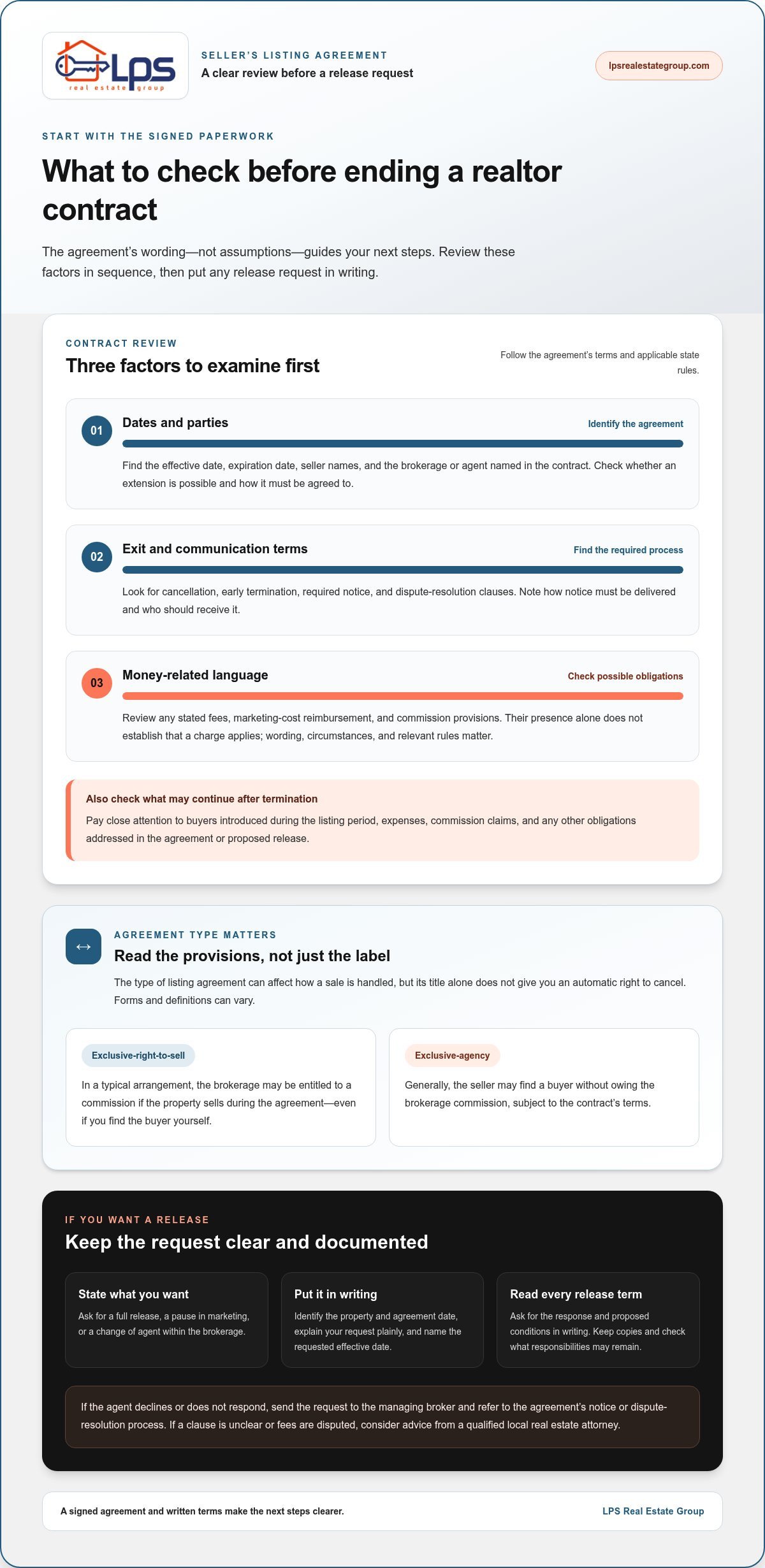
Gather the complete signed agreement and any attached forms or amendments. Look for:
- Dates and parties: Note the effective date, expiration date, seller names, and brokerage or agent named in the contract. Check whether it can be extended and how an extension must be agreed to.
- Exit and communication terms: Find clauses covering cancellation, early termination, required notice, and dispute resolution. Pay attention to how notice must be delivered and to whom.
- Money-related language: Review any stated fees, marketing-cost reimbursement, or commission provisions. Their presence doesn’t by itself establish that a charge applies; the wording, circumstances, and relevant rules matter.
If a clause is unclear, mark it and seek advice from a qualified real estate attorney in your state before relying on an interpretation.
Does the type of listing agreement change your options?
It can affect how the agreement addresses a sale, but the label alone doesn’t give you an automatic right to cancel. In a typical exclusive-right-to-sell arrangement, the brokerage may be entitled to a commission if the property sells during the agreement, even if you find the buyer yourself. An exclusive-agency agreement generally allows the seller to find a buyer without owing the brokerage commission, subject to the contract’s terms. Forms and definitions can vary, so read the actual provisions rather than relying on the title.
How to Request a Release from a Realtor Contract Step by Step
A calm, documented request gives you and the brokerage a clearer starting point. Before reaching out, reread the agreement’s notice and cancellation terms, then decide what outcome you want: a full release, a pause in marketing, or a change of agent within the brokerage. Knowing your preferred effective date can help keep the conversation focused.
How should you make a written cancellation request?
Contact your agent first, using a brief call or message to explain that you’d like to discuss the agreement. Then put the request in writing. Identify the property and agreement date, state your reason plainly, and name the outcome you’re requesting. Avoid threats or legal conclusions; if performance concerns are part of the issue, describe specific events and dates factually.
You could write: “I’m requesting a full release from the listing agreement for [property address], signed on [date], effective [requested date]. Please confirm whether the brokerage agrees and send any proposed release terms in writing.” If you’re seeking a pause or a different agent instead, say so directly. Ask for a written response and keep copies of messages and documents.
What if the agent or broker does not agree to release you?
The brokerage may need to be involved, since it may be a party to the agreement. If the agent declines or doesn’t respond, send your request to the managing broker and refer to the agreement’s notice or dispute-resolution process. Ask for the reason and any proposed conditions in writing. If your concern relates to professional conduct, the National Association of REALTORS® Code of Ethics describes standards for REALTORS® who are members; it doesn’t, by itself, determine whether your contract can be ended.
Before signing a release, read every term. Check whether it addresses fees, expenses, commission claims, buyers already introduced to the property, and any other obligations that could continue after the relationship ends. Don’t assume a proposed release removes every responsibility unless its wording says so. If the terms are unclear, significant fees are disputed, or the parties disagree about their duties, consider advice from a qualified local real estate attorney.
Once you understand your current obligations, you can weigh a different sale plan without treating the release as settled before it’s in writing. If a direct sale is one route you’re considering, explore another way to sell your house and compare written terms, timing, and conditions with your priorities.
What Happens If You Leave a Realtor Contract Early? Fees, Commission, and Risk
Leaving before the agreement ends can have different consequences depending on how the relationship ends and what the contract says. A mutual release, expiration, disagreement, or decision to keep the listing active aren’t interchangeable. The table below outlines common possibilities, not guaranteed outcomes.
| Option | What it may mean | What to check |
|---|---|---|
| Mutual release | You and the brokerage agree in writing to end the arrangement, possibly on stated conditions. | Confirm the effective date and whether any fees, commission claims, or other obligations remain. |
| Contract expiration | The agreement reaches its stated end date. Some terms may address events or buyers connected to the listing period. | Review expiration, extension, and any post-term provisions. |
| Possible breach dispute | The seller and brokerage disagree about whether the agreement was ended properly or an obligation was breached. | Check the dispute process and get any claim and its contractual basis in writing. |
| Continue the listing | You keep working with the current agent under the existing agreement. | Clarify expectations and any changes to the plan in writing. |
A written release documents an agreed end to the relationship; stopping communication or marketing does not, by itself, confirm that the agreement has ended. If you’re weighing how to get out of a realtor contract as a seller, don’t assume that changing your sale plan cancels responsibilities under the current agreement.
Could you owe a fee or commission after ending the agreement?
Read the compensation and expense provisions carefully. The agreement may discuss commission, marketing-cost reimbursement, a protection period after expiration, or buyers introduced during the listing. These are clauses to review, not charges that automatically apply in every case. The wording, what happened during the listing, and applicable law can all matter. If the brokerage says you owe money, request the amount and the specific contractual basis in writing before deciding how to respond.
When should a seller seek legal advice?
Consider speaking with a qualified real estate attorney if there’s a disputed commission demand, an allegation that you breached the agreement, unclear contract language, or a time-sensitive decision about selling. Real estate contract law and procedures vary by state, so general guidance can’t resolve every seller’s situation.
Some contract disputes may involve negotiation or a process described in the agreement. Federal procurement rules include a Contract Settlement by Determination, but that rule applies to government contracts, not private real estate listings. Use the dispute terms in your own agreement and get advice specific to your circumstances.
Compare Your Options After Ending or Changing a Listing Agreement
Once you understand your current agreement and any release terms, consider what you want the next stage of the sale to look like. A change in agent may address communication or marketing concerns, while a pause may fit changed plans. A direct sale can offer a different process, but no route is automatically best. Compare the practical trade-offs before deciding.
| Option | Timing and preparation | Marketing, certainty, and obligations |
|---|---|---|
| Continue with your current agent | May avoid the transition involved in changing representation. You can discuss adjustments to the strategy or communication. | The home may continue to be marketed under the existing agreement. Clarify any revised expectations and costs in writing. |
| Seek a release and relist | Requires resolving the current agreement before starting a new one. A new listing plan may involve fresh preparation. | Marketing approach and terms depend on the new agreement. Make sure the release and any replacement agreement are documented before proceeding. |
| Pause the sale | Can give you time to reconsider timing or circumstances, though restarting later may require more preparation. | If the listing agreement is still active, pausing marketing may require the brokerage’s agreement. Get the pause terms in writing. |
| Explore a direct sale | A direct buyer may consider an as-is property, which could reduce the need to prepare for a traditional listing. The process and timing depend on the property and transaction. | Compare written offer terms, conditions, expected proceeds, and any continuing obligations under your current agreement. |
Should you stay with your agent, switch agents, or pause the sale?
Match the choice to the problem. If communication is the main concern, a clear conversation about expectations may help. If the strategy no longer fits, discuss revisions or a release. If your timing has changed, ask whether the listing can be paused under the agreement. Before switching agents, get the release in writing and review any new agreement before signing. If you’re still deciding how to get out of a realtor contract as a seller, keep the contract obligations separate from your preferred sale plan.
When might a direct sale be worth comparing?
A direct acquisition may be worth considering if you prioritize an as-is sale or want to compare a different selling process. Review the written terms and estimated proceeds alongside the preparation, marketing, costs, and timing involved in your other options. For more on selling a house for cash, selling a house as-is, and creative real estate exit strategies, explore these guides. If a direct sale seems like a fit, compare direct-sale options after you’ve reviewed your current agreement.
Your Next Steps: Get the Release in Writing and Choose a Sale Plan
A clear paper trail can make the transition easier to manage. Before changing how you plan to sell, keep the signed release or revised agreement with your original listing documents, and confirm how the change affects the property’s marketing and access.
What should your written release or revised agreement clarify?
Read the full document before signing. Check that it identifies the correct parties and property, states the effective date, and explains the scope of the release. Look for any terms that continue after it takes effect, including compensation, expenses, or provisions related to buyers introduced during the listing.
Also confirm in writing what happens to:
- Showings and listing status: Are appointments ending, and when will the listing be removed or changed?
- Keys and access: Who has keys, codes, or other access items, and how will they be returned or updated?
- Marketing materials: What happens to photos, signs, and other materials connected to the listing?
Keep a complete copy of the signed release or revised agreement, along with related emails and messages. If a term is unclear, pause and get advice before signing. A careful review is a practical part of understanding how to get out of a realtor contract as a seller without overlooking an obligation that may remain.
How can you choose the next step with less uncertainty?
Decide what matters most to you: timing, the home’s condition, preparation, how involved you want to be, and the proceeds you hope to keep. Then compare your options: continuing with an agent, signing a new listing agreement after a release, pausing the sale, or considering a direct sale. Each route has different requirements and trade-offs, and none is right for every seller.
Use documented terms rather than relying only on verbal estimates or broad promises. Compare expected proceeds after relevant costs, conditions, preparation needs, and timing. Before signing with a new agent or accepting another sale arrangement, make sure you understand any obligations under the existing agreement and have the release or revised terms in hand.
If you’d like to compare a direct home-sale option as part of your next steps, discuss a direct home-sale option with LPS Real Estate Group. You can consider the information alongside your other choices without committing before you’ve reviewed them.
Choose Your Next Move With a Clear Plan
The first step in how to get out of a realtor contract as a seller is to understand the agreement you signed. Review its end date, cancellation terms, and any possible ongoing obligations, then make a clear written request and keep the response and any signed release. Before moving on, compare your options based on timing, preparation, and expected proceeds.
You don’t have to choose the same path as every other seller. Continuing with an agent, pausing the sale, or considering a direct sale may each suit different priorities. LPS buys residential properties directly from owners, with as-is acquisition and creative finance options available as alternative approaches to selling. Compare written terms and conditions alongside your needs, and make sure you understand your current agreement before entering a new arrangement.
If you’re considering a direct sale, discuss a home-sale option with LPS. Take the next step at your own pace, with a plan that fits your circumstances.
Frequently Asked Questions
Can I cancel a listing agreement as a seller?
Possibly, but your options depend on the agreement’s cancellation terms and applicable state rules. Start by checking the contract’s end date, required notice, early termination language, and any terms about expenses or commission. You can ask the agent or brokerage for a written release, but don’t assume that signing a listing agreement gives you an automatic right to cancel whenever you choose. If a clause is unclear, seek legal advice before acting.
How do I ask my realtor to release me from a contract?
Make a calm, written request that identifies the property and agreement date. Explain briefly why you’re asking, then specify whether you want a full release, a pause, or a different agent, and state your requested effective date. Ask the agent or broker to respond in writing and provide any proposed release terms. Keep copies of the agreement, request, response, and any signed documents for your records.
What happens if my realtor refuses to cancel the listing agreement?
A refusal doesn’t automatically resolve the issue or end the contract. Review the agreement’s notice and dispute-resolution terms, then ask the agent or brokerage to explain its position in writing. The brokerage may need to participate in the decision. If you’re facing a disputed fee, an allegation of breach, or unclear contract language, consult a qualified real estate attorney in your state before deciding what to do next.
Can I switch realtors before my listing agreement expires?
You may be able to switch if the brokerage agrees to release you or the agreement provides a way to end or transfer the arrangement. Don’t assume you can sign with a new agent while the current agreement remains active. Read the cancellation terms, get any release in writing, and review possible continuing obligations before entering a new listing agreement. Contract language and applicable rules can affect your options.
Do I have to pay commission if I cancel my listing agreement?
Not necessarily, but don’t assume cancellation means no commission or other costs are owed. Check the agreement for compensation terms, expense reimbursement, protection periods, and provisions involving buyers introduced during the listing. Whether a term applies depends on its wording, what happened, and applicable law. If the brokerage claims you owe money, request the amount and the specific contract language supporting the claim in writing.
What happens when a realtor contract expires?
When the agreement reaches its stated end date, the listing relationship may end according to its terms. However, expiration doesn’t necessarily answer every question about buyers introduced during the listing, expenses, or other provisions that may continue. Review the full agreement, including any extension or post-expiration language, and get clarification in writing if needed. Before relisting or choosing another sale route, make sure you understand any obligations that remain.
Can I sell my house directly after ending a realtor contract?
You can consider a direct sale, but first confirm that your listing agreement has ended or been released and review any obligations that could affect a sale. Don’t assume changing the selling method removes terms from the existing contract. LPS Real Estate Group buys residential properties directly from owners and offers as-is acquisition and creative finance options. Compare written terms, conditions, timing, and expected proceeds with your other choices before deciding.