

What if the terms that make a seller-financed deal safer for you also make it too costly for the buyer to manage? Learning how to structure a seller financing deal means balancing both sides: setting a workable price, down payment, interest rate, and repayment schedule, then deciding how payments will be secured and what happens if the buyer falls behind.
Flexibility can be useful, but it doesn’t remove the need to protect your interests. The details matter, from how the buyer’s payment is documented to what happens if you still owe money on an existing mortgage. Before anyone signs, consider the agreement, the property’s obligations, and the potential tax and legal requirements.
This guide explains how the main terms fit together and which protections and contingencies to consider. You’ll also see how seller financing compares with other sale paths, so you can weigh the trade-offs against your circumstances. Comparing the proposed terms with a direct purchase or another creative-finance option can help clarify your next step. The goal is a clear, workable arrangement, not a one-size-fits-all answer.
Key Takeaways
- Understand how purchase price, down payment, interest rate, payment amount, and term work together when considering how to structure a seller financing deal.
- Start with your goals, property obligations, and the amount you need at closing before discussing a proposal.
- Plan how payments will be secured and what happens if the buyer misses one, then have the agreement reviewed before signing.
- Compare seller financing with a conventional buyer-funded sale and a direct cash purchase, including when you receive proceeds and what obligations continue after closing.
- Consider seller financing alongside direct purchases, as-is sales, and other creative finance solutions.
What a Seller Financing Deal Means for a Homeowner
In a seller-financed home sale, the seller lets the buyer pay some or all of the purchase price over time instead of receiving the full amount at closing. The buyer makes scheduled payments under written terms, and the seller acts as the creditor for the financed portion. This arrangement can give both parties room to negotiate, but the seller may wait for some proceeds and depends on the buyer to repay.
Seller financing describes a broad approach, not one fixed contract. The buyer’s finances, the seller’s goals, the property’s obligations, and the signed documents all affect the arrangement. Some deals include a down payment and financing for the remaining balance; others use different payment terms. A general overview appears in What is Seller Financing?, but the documents for a specific home sale should reflect that transaction and applicable requirements.
The central trade-off is flexibility for the buyer in exchange for repayment risk for the seller. If the buyer misses payments, the seller may need to use the remedies in the agreement and follow applicable legal procedures. Before exploring how to structure a seller financing deal, consider whether receiving payments over time fits your plans better than getting sale proceeds upfront through a conventional lender-funded purchase or an all-cash sale.
How seller financing differs from a conventional mortgage
With a conventional mortgage, a lender provides the buyer’s loan funds, and the buyer generally repays that lender. In a seller-financed arrangement, the seller provides credit for an agreed portion of the purchase price and receives payments from the buyer. A title professional, closing agent, or lender may also be involved, depending on the transaction. The agreement and legal structure can vary, so don’t assume every seller-financed sale works the same way.
When a homeowner might consider financing a buyer
A buyer and seller might explore flexible terms when the buyer’s available lender financing doesn’t fit the purchase, or when both parties see value in negotiating payments over time. That possibility isn’t a recommendation or a promise that a deal will succeed. A seller should consider the buyer’s ability to pay, the protections in the documents, and the steps that may follow if payments stop.
Think through your cash needs first. If you need most of the sale proceeds to buy another home, pay obligations, or cover near-term expenses, delayed payments may not suit you. If you can accept proceeds over time, seller financing may be one option to compare with other sale paths. Discussing your goals and having qualified legal and tax professionals review the proposed documents can help you understand the commitments before signing.
How to Set Seller Financing Terms That Fit the Deal
Good terms balance two needs: the buyer must be able to make the scheduled payments, and the seller needs a workable path to repayment. Price, down payment, interest, monthly payment, and repayment length are connected. Changing one can shift the others, so agree on the overall goals before negotiating individual terms. The right structure depends on the parties, the property, any existing financing, and applicable law.
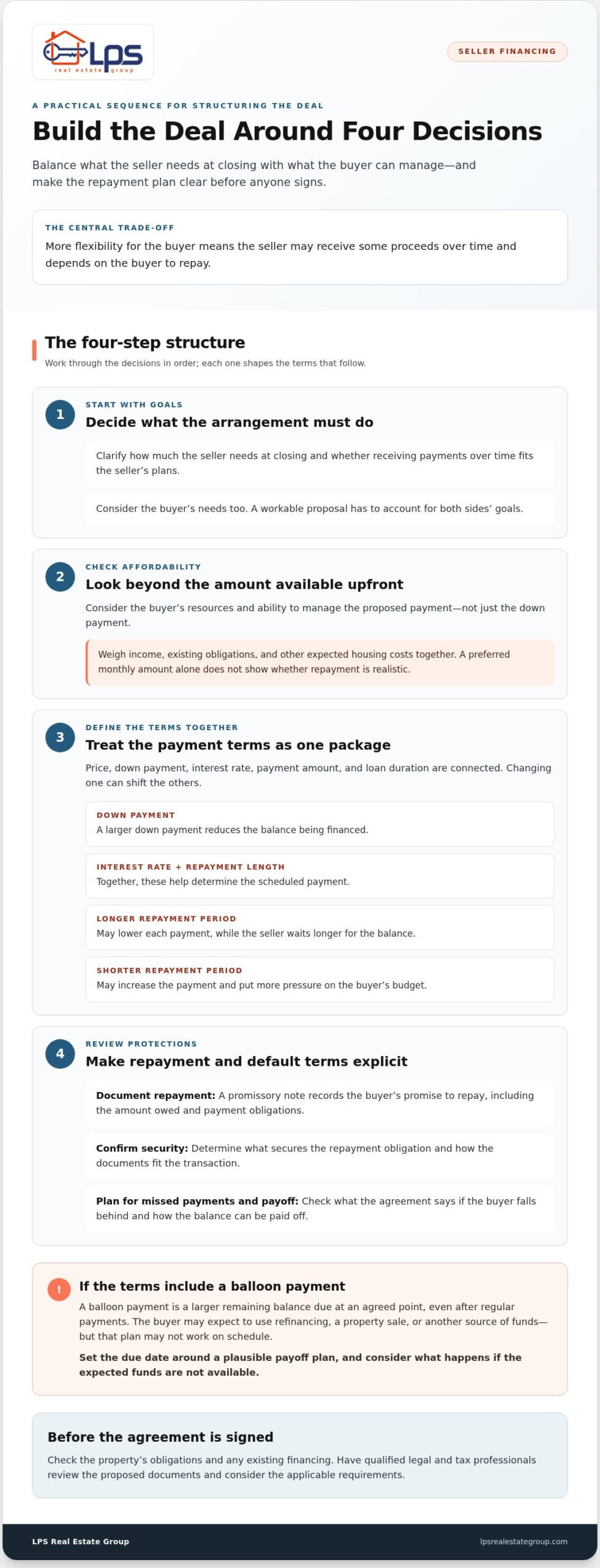
Use this sequence to keep the discussion organized:
- Set the goals. Clarify how much the seller needs at closing, whether payments over time are acceptable, and what the buyer needs to make the purchase workable.
- Assess affordability. Consider the buyer’s resources and ability to manage the proposed payment, not just the amount available upfront.
- Define the terms. Work through price, down payment, interest rate, payment amount, and loan duration as a package.
- Review protections. Confirm how the repayment obligation will be documented, what secures it, and what the agreement says about missed payments and payoff.
Choose payment terms with affordability and repayment in mind
A larger down payment reduces the balance being financed, while the interest rate and repayment length help determine the scheduled payment. A longer repayment period may lower each payment but leave the seller waiting longer for the balance. A shorter period may increase the payment and put more pressure on the buyer’s budget. Compare the full payment schedule with what the buyer can realistically afford and the proceeds the seller needs.
Don’t rely on an estimate based only on the buyer’s preferred monthly amount. Consider income, existing obligations, and other expected housing costs together. No single rate, down payment, or term fits every transaction. Terms that look attractive on paper may not support reliable repayment if the payment doesn’t fit the buyer’s finances.
Decide whether a balloon payment fits the timeline
A balloon payment is a larger remaining balance due at an agreed point, even if the buyer has made regular payments before then. It can give the seller a defined payoff date, but the buyer may rely on refinancing, selling the property, or another source of funds to pay it. Those plans may not work out on schedule.
Before agreeing, consider what happens if the expected funds aren’t available by the due date. Set a balloon date around a plausible payoff plan, rather than choosing an endpoint simply because it is convenient for the seller.
Match security documents to the transaction
A promissory note records the buyer’s promise to repay, including the amount owed and payment obligations. A mortgage or deed of trust may secure that repayment against the property, depending on the transaction and applicable law. These documents have different roles, and the proper structure can vary. Have a qualified real estate attorney review the proposed documents and applicable requirements before either party signs.
Clear terms matter, but the best structure is also one both parties can carry through. If you’re weighing seller financing against a direct purchase or another creative-finance alternative, LPS Real Estate Group’s sale options offer ways to compare those approaches.
Seller Financing Risks and Alternatives: What to Compare
Seller financing doesn’t mean receiving the full sale proceeds at closing. The seller receives a down payment, then relies on the buyer’s scheduled payments for the financed balance. That can create flexibility, but it also leaves the seller exposed to missed payments and ongoing involvement. By contrast, a conventional buyer-funded sale typically pays the seller through the buyer’s lender at closing, while a direct cash purchase doesn’t depend on the buyer obtaining a mortgage. Each path has its own timing, conditions, and responsibilities.
As you consider how to structure a seller financing deal, compare more than the proposed price. Look at when you’ll receive the money, what could delay payment, and how much uncertainty you’re comfortable carrying.
Assess missed-payment and default exposure
If payments stop, the seller may need to use the remedies in the signed documents and follow applicable legal procedures. That can take time and may create additional costs. The process isn’t automatically simple or quick. Keep organized records of payments and communications, and make sure the agreement clearly addresses payment dates, missed payments, notices, and default remedies. The documents and governing law affect what steps are available, so don’t rely on informal promises or assumptions about recovery.
Compare financing with other ways to sell
These options differ in how proceeds arrive and what may remain to manage after closing. Actual timing and certainty depend on the transaction and its conditions.
| Sale path | Timing of proceeds | Payment uncertainty | Complexity and ongoing involvement |
|---|---|---|---|
| Seller financing | Down payment at closing, then payments over time | Seller depends on the buyer’s repayment | Requires written repayment terms, security arrangements, and continued attention to payments |
| Conventional buyer-funded sale | Typically paid through the buyer’s lender at closing | Depends on the buyer’s loan approval and the transaction meeting its conditions | Involves lender requirements and closing steps, with less ongoing repayment involvement for the seller after completion |
| Direct cash purchase | Proceeds are generally paid at closing, subject to the agreed transaction terms | Doesn’t rely on the buyer obtaining a mortgage | Can avoid buyer-lender financing steps, though closing requirements still apply |
No option is automatically best for every homeowner. For a broader look at possible sale paths and trade-offs, explore these creative real estate exit strategies.
Check for existing loans and other property obligations
An existing mortgage deserves particular attention. A mortgage may include a due-on-sale provision that could affect a transfer, so don’t assume you can leave the loan in place while a buyer makes payments to you. The loan language and proposed transaction matter. Have a qualified real estate attorney review the situation before proceeding. Also identify liens, property taxes, insurance requirements, and title issues. Don’t assume these obligations will transfer, disappear, or be resolved automatically at closing.
These checks help reveal whether the proposed arrangement fits the property as well as the buyer and seller. Resolve questions about outstanding obligations and repayment risk before signing, rather than relying on a plan that depends on everything going smoothly.
How to Prepare and Review a Seller Financing Proposal
A useful proposal starts with your needs, not just a buyer’s suggested payment. Before negotiating, clarify your sale goals, property obligations, and how much you need to receive at closing. Then put the proposed terms in one place so you can assess whether the price, funds due at closing, and payments over time fit together.
Keep financial questions separate from legal and tax review. You can assess whether the proposed proceeds and payment schedule suit your plans, but this guide isn’t legal, tax, or financial advice. Qualified professionals can review how the documents work and how the transaction may affect you.
Gather property and payoff information before negotiating
Collect ownership and title information, mortgage payoff details, lien records, property tax information, and insurance requirements. These records help you understand existing obligations that could affect the transaction. Also write down your preferred timing and the minimum proceeds you need at closing. If receiving proceeds upfront is a priority, compare the proposal with a sale of your house for cash before deciding whether payments over time fit your situation.
Once you understand your starting point, organize the proposal so each term can be reviewed on its own and against the others:
- Purchase price: The agreed amount for the property.
- Funds at closing: What the seller receives upfront and how outstanding obligations will be addressed.
- Payment schedule: The amount, due dates, and frequency of payments.
- Term and payoff: How long scheduled payments continue and whether a separate final payoff date applies.
- Security: The documents intended to record and secure the buyer’s repayment obligation.
Review the written agreement and closing process
Check that the parties, property description, purchase price, and payment terms match across the proposal and final documents. Look for mismatches, such as a payment schedule that doesn’t reconcile with the stated balance or a payoff date that isn’t explained. A title and closing process can help document the transaction and coordinate necessary paperwork, but the exact steps depend on the deal. Have a qualified real estate attorney review the agreement before signing, and ask a tax professional to assess the tax treatment.
Plan for payment records and ongoing administration
Agree on how payments will be received, recorded, and reconciled, and how the parties will communicate about questions, late payments, or a final payoff. Keep the signed documents, payment history, notices, and payoff calculations together. Clear records make it easier to track what has been paid and what remains due.
Before signing, use this checklist to flag terms that are missing or inconsistent:
- Do the price, funds due at closing, and financed balance add up clearly?
- Are payment amounts, due dates, term, and any final payoff date stated consistently?
- Do the documents explain the security and what happens if a payment is late?
- Have existing loans, liens, taxes, insurance, and title questions been addressed?
If you’re comparing a seller-financed proposal with a direct purchase or another sale path, explore LPS Real Estate Group’s home-sale options to weigh the approaches against your priorities.
Compare Seller Financing With LPS Real Estate Group’s Sale Options
Seller financing is one possible way to arrange a home sale, not a default choice for every homeowner. It can offer room to agree on payment terms, but the seller receives proceeds over time and remains exposed to whether the buyer pays as agreed. LPS Real Estate Group offers direct property acquisitions, cash purchases, as-is sales, and creative finance solutions. Compare these paths by what matters most to you: timing of proceeds, the property’s condition, certainty, and how much financial involvement you’re willing to continue carrying.
When seller financing may align with a homeowner’s priorities
Seller financing may be worth considering if receiving payments over time fits your financial plans and negotiated terms could help make a sale workable for both parties. That flexibility comes with continued responsibility: you’ll need to track payments and consider what happens if the buyer falls behind. Whether it suits you depends on your proceeds needs, property obligations, proposed terms, and comfort with repayment exposure. Review the details rather than assuming the structure is a fit.
When a direct or creative-finance sale may be worth comparing
A direct acquisition or cash purchase offers an alternative to carrying a buyer’s repayment obligation. An as-is acquisition may suit you if you’d prefer not to prepare or renovate the property before selling. Proceeds and closing details depend on the individual transaction, so compare the proposed terms with your priorities rather than assuming every sale path offers the same timing or certainty. For another overview of this route, explore these companies that buy houses for cash.
Creative finance solutions are another path when a straightforward sale doesn’t address a homeowner’s circumstances. The phrase covers different possible approaches, so focus on the written terms and what they mean for your proceeds, obligations, and involvement. If you’re learning how to structure a seller financing deal, apply the same careful comparison: look beyond the purchase price to when funds arrive and what responsibilities remain afterward.
Take a clear next step without rushing the decision
Before weighing options, write down your priorities: how soon you need proceeds, whether the property needs work, what obligations are tied to it, and how much ongoing payment exposure you can accept. Add any questions about documents, timing, or the buyer’s proposed terms. This gives you a practical starting point for comparing a financed sale with a direct purchase or another approach.
You don’t need to settle on a structure before understanding the trade-offs. Explore your home-selling options and discuss your circumstances with LPS Real Estate Group. A clear conversation can help you compare possible paths without pressure to choose one before it makes sense for you.
Choose a Sale Path That Fits Your Next Step
Start by defining what a workable sale needs to do for you. Write down your priorities, including how soon you need proceeds, how much uncertainty you’re comfortable with, and whether you can take on ongoing payment responsibilities. Then use those priorities to assess how to structure a seller financing deal or whether another approach deserves consideration. A clear decision doesn’t require rushing. It requires understanding the trade-offs that matter in your circumstances.
LPS Real Estate Group focuses on tailored exit strategies and a transparent process, so you can discuss your situation and compare possible paths without treating seller financing as the automatic answer. Bring your questions and the property details that may affect your decision. A focused conversation can help you identify what to consider next.
Explore your home-selling options with LPS Real Estate Group to discuss a direct cash purchase, an as-is sale, or another creative finance solution that fits your priorities.
Frequently Asked Questions
Is seller financing legal in every state?
Seller financing can be used in many U.S. home sales, but rules and requirements aren’t identical in every state or transaction. Federal and state lending, disclosure, and contract rules may apply, and the seller’s circumstances can affect which requirements matter. Before making an offer or signing, have a qualified real estate attorney review the proposed arrangement for the property’s location and the parties involved. Don’t assume a document used elsewhere will work for your sale.
How are taxes handled when a seller finances a home sale?
Tax treatment depends on the sale terms and the seller’s situation. A sale paid over time may qualify for installment-sale reporting, where eligible gain is generally reported as payments are received; interest received is generally treated separately from the sale price. Eligibility and calculations can be complicated, especially if the seller has depreciation or other tax factors. Ask a tax professional to review the proposed terms before closing, rather than relying on a general estimate.
Can a seller-financed home sale involve a title company?
Yes. A title company or closing professional may help with tasks such as examining title, coordinating documents, and handling the closing process. The company’s role and services vary, so the parties should understand who is responsible for preparing, signing, and recording each document. Involving a title professional doesn’t replace legal review of the financing agreement, but it can help keep the transfer and related paperwork organized.
Can a seller finance only part of a home purchase?
Yes. A buyer might pay part of the purchase price at closing using savings or other funds, while the seller finances an agreed portion of the remaining balance. State clearly how much is paid upfront, what amount the seller finances, and how that balance is repaid. As you consider how to structure a seller financing deal, also account for any other loan involved and whether its terms affect the proposed arrangement.
What happens to seller financing if the buyer sells the home?
Selling the home doesn’t automatically erase the buyer’s repayment obligation. The note and security documents may require the balance to be paid when ownership transfers, or they may address whether another buyer can assume the debt and under what conditions. The existing mortgage, if any, can also affect a later sale. Review the documents before agreeing to a transfer, and get legal advice on how a proposed sale affects the seller’s rights.
Should seller-financing payments be handled through a loan servicer?
A loan servicer isn’t always required, but using one may help organize payment collection and account records, especially if the seller doesn’t want to manage each payment directly. Clarify who tracks the balance, shares payment information, and provides payoff figures. If the parties handle payments themselves, agree on a consistent process and keep reliable records. Consider the arrangement’s cost and responsibilities before deciding, and include the chosen process in the written terms.