

What if selling your home meant collecting payments over time instead of receiving the full proceeds at closing? If you’re looking for “seller financing for my home explained,” the key trade-off is clear: you may reach buyers who need another way to pay, but you also take on ongoing responsibilities and the risk that payments stop.
Before considering this arrangement, get clear on when ownership transfers, what secures the buyer’s promise to pay, and what happens if they default. Those details depend on the structure and need to be set out in the transaction documents.
This guide explains common seller-financing structures, how payment and ownership terms can work, and what responsibilities may remain yours. It also covers risks, paperwork, servicing, and tax and legal questions to review with qualified professionals before agreeing to terms.
Most importantly, you’ll have a clearer basis for comparing ongoing payments with other exit strategies, including a direct cash sale or a creative-finance alternative. The right path depends on your priorities, such as receiving proceeds at closing, collecting payments over time, or finding a tailored way to sell.
Key Takeaways
- Seller financing can make installment payments possible, but it also means taking on responsibilities beyond a standard sale.
- The agreement’s structure determines how ownership transfers, how payments are collected, and what rights you have if the buyer stops paying.
- Compare a financed sale with a cash sale by weighing payment timing, ongoing administration, buyer qualification, and risk.
- Before agreeing, consider how much money you need upfront, whether delayed payments fit your plans, and how you’ll assess the buyer’s ability to repay.
- Compare a conventional buyer-financed sale and a direct property purchase with seller financing to see which option best fits your priorities.
What seller financing for your home means when you are the seller
Installment payments can sound appealing, especially if a buyer is interested but can’t secure a conventional mortgage. The trade-off is that you may take on responsibilities usually handled by a lender: setting repayment terms, documenting the debt, and managing payments over time. The important point is that the sale may not end your involvement when the buyer takes possession.
Seller financing is an arrangement in which the seller finances some or all of the buyer’s purchase instead of relying solely on a conventional lender.
In a cash sale, the buyer pays the agreed amount at closing, subject to the transaction’s terms. With a conventional mortgage, a lender provides the buyer’s financing. With seller financing, you agree to receive some or all of the purchase price later, according to the written agreement. This gives a buyer another way to pay, but it doesn’t guarantee a sale or remove your exposure if payments aren’t made.
The details matter more than the label. The signed documents and applicable law determine how title transfers, what secures repayment, and what steps are available if the buyer defaults. What is Seller Financing? offers a general overview, but it isn’t a substitute for having qualified professionals review the actual transaction documents.
Who receives payments, and when does ownership transfer?
The buyer makes payments on the schedule set out in the agreement. You may receive them directly, or a separate servicing company may collect payments, maintain records, and pass funds along. A servicer handles administration, but it doesn’t become the lender or change who is owed the debt. The documents should identify the parties and explain how payments are handled.
Ownership and security depend on the structure. In some arrangements, the buyer receives legal title at closing while a mortgage or deed of trust secures the debt. Other structures may delay title transfer until specified conditions are met. Don’t assume the deed changes hands at the same point in every deal. The contract and applicable law control.
Seller financing, owner financing, and purchase-money financing
People often use “seller financing” and “owner financing” to describe similar arrangements, while “purchase-money financing” may have a more specific meaning in a particular document or legal context. Focus on what the signed papers require, not just the name used in conversation.
A promissory note is the buyer’s written promise to repay under stated terms. Depending on state law and the chosen structure, a mortgage or deed of trust may secure that promise. Together, these documents define the payment obligation and the seller’s rights if the buyer fails to pay. Have the arrangement drafted and reviewed for your circumstances before signing. A handshake or informal payment plan leaves key questions unresolved.
How seller-financed home sales are structured and paid
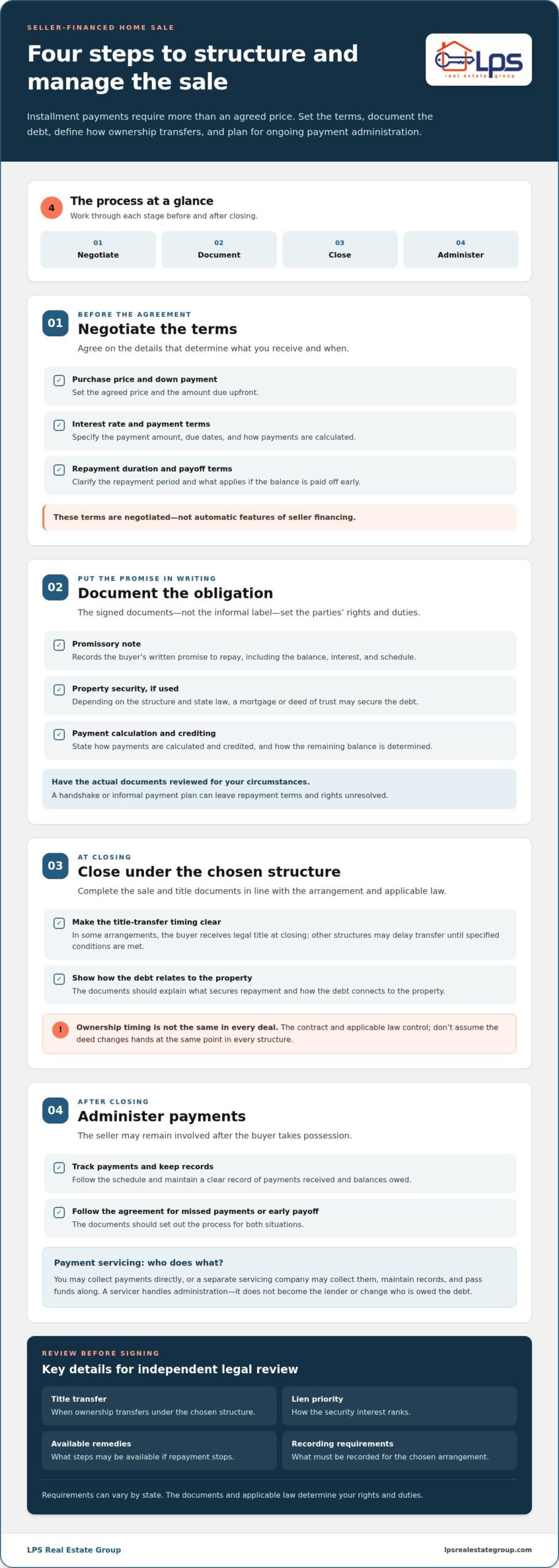
A seller-financed sale needs more than an agreed price and a promise to pay. The parties must decide how the transaction will work and put those decisions in the final paperwork. A clear process helps you understand what you’ll receive, what you’ll administer, and what happens if the buyer misses payments.
- Negotiate the terms. Agree on the purchase price, down payment, interest rate, payment amount and dates, repayment duration, and payoff terms. These are terms to negotiate, not automatic features of seller financing.
- Document the obligation. Put the buyer’s repayment promise and any property security into properly prepared documents. Specify how payments are calculated and credited.
- Close under the chosen structure. Complete the sale and title documents according to the arrangement and applicable law. The documents should show how the debt relates to the property.
- Administer payments. Track payments, maintain records, and follow the agreement’s process for missed payments or early payoff.
The signed documents, not the informal label, set the parties’ rights and duties. Even an arrangement casually described as “owner financing” needs careful review of the actual terms. A state regulator’s Seller Financing Regulations resource is one example of guidance on alternative financing and the importance of legal counsel. Requirements can vary, so guidance for one state should not be treated as a rule for every transaction.
Promissory notes and property-secured arrangements
A promissory note records the buyer’s promise to repay, including the agreed balance, interest, and schedule. A separate security document may connect that debt to the property. Depending on the structure and state law, that document may be a mortgage or deed of trust, with different procedures for recording and enforcing it.
Before signing, get independent legal review of title transfer, lien priority, available remedies, and recording requirements. These details can affect both your rights and the steps you may take if repayment stops. Don’t assume a standard form covers the needs of your particular sale.
Installments, servicing, and balloon-payment terms
The payment schedule should make clear how much goes toward principal and interest, when each payment is due, and how the remaining balance is calculated. For example, the documents can state whether payments are due on a specific day each month and how the balance changes as payments are credited. Clear accounting helps both parties identify a missed or misapplied payment early.
A payment servicer can handle administrative tasks such as collecting payments and keeping records. That may reduce day-to-day work, but it doesn’t replace buyer due diligence, careful documentation, or your responsibility to understand the agreement. You may still carry financial and legal exposure.
A balloon payment means a larger remaining balance is due at a specified point. It can make earlier payments smaller, but the buyer may not be able to pay or refinance when the final amount comes due. When comparing seller financing for my home explained with other ways to sell, consider whether delayed repayment and that uncertainty fit your plans. You can also explore direct property purchase options as a different exit strategy.
Seller financing versus a cash sale: benefits, trade-offs, and risks
Seller financing may give a buyer another way to pay, but it changes what you receive and what remains yours to manage after closing. In a cash sale, you generally receive the agreed proceeds at closing. With seller financing, some or all of the price arrives over time. The better fit depends on how much you need upfront and how comfortable you are carrying repayment risk.
| Consideration | Seller-financed sale | Cash sale |
|---|---|---|
| Payment timing | Some proceeds may arrive at closing, with the remaining balance paid over time. | Agreed proceeds are generally paid at closing, subject to the transaction terms. |
| Continued administration | You or a servicer may need to track payments and maintain records. | There are usually no ongoing buyer-loan payments for you to collect after closing. |
| Buyer qualification | You assess repayment ability, following applicable requirements. | The buyer uses available funds rather than a conventional mortgage for the purchase. |
| Seller exposure | Late payments, default, and enforcement can affect your finances and require further action. | You avoid the risk of collecting a buyer’s future installments, though the sale still has closing terms to meet. |
What a seller may gain from financing the buyer
Offering payment terms may appeal to a buyer who can’t use conventional financing, potentially creating another path to agreement. You can negotiate the down payment, interest, payment schedule, and payoff structure rather than relying on a lender’s standard loan terms. That flexibility may help address a buyer’s needs, but it doesn’t guarantee buyer demand, a higher sale price, or dependable income.
Installments aren’t the same as having the full sale proceeds available at closing. If you need funds to buy another home, pay debts, or cover expenses, payments spread over time may not meet that need. Consider the cash you’ll receive upfront separately from the total amount the buyer is scheduled to pay.
What the seller still carries after closing
Financing doesn’t make repayment risk disappear. You may need to monitor payments, keep accurate records, respond to missed installments, and pursue remedies under the agreement if the buyer defaults. A missed payment can disrupt the cash flow you expected, while legal enforcement may take time and add costs. A payment servicer can assist with administration, but it can’t ensure the buyer will pay.
An existing mortgage can add another layer of risk, including potential complications under the loan’s terms. Review the FAQ below about seller financing when you still have a mortgage before proceeding. Tax treatment, payment security, and consumer-protection rules depend on the transaction’s facts and current law, so have qualified legal and tax professionals review the arrangement. When weighing seller financing for my home explained against a simpler exit, ask whether ongoing payments are worth the responsibility and uncertainty they bring.
How to decide whether financing your home sale fits your situation
Seller financing can be workable when delayed payments fit your plans and you’re prepared to manage the responsibilities that come with them. Look beyond the proposed monthly amount. Consider how much cash you need at closing, whether you can absorb a missed payment, and what you’d do if the buyer falls behind. Deciding whether the arrangement suits your circumstances is the practical side of understanding seller financing.
Questions to answer before agreeing to installments
Use this checklist to weigh your needs against the work involved:
- Set your upfront cash needs. List expenses or plans that depend on sale proceeds. Decide how much you need at closing and how much, if any, you can receive over time.
- Test your tolerance for delays. Consider what a late or missed payment would mean for your household budget and other obligations. Don’t treat scheduled payments as cash already in hand.
- Assess the buyer’s ability to repay. Use lawful, documented, and appropriate due diligence to evaluate income, debts, assets, and other relevant information. Apply fair, consistent criteria and follow applicable lending and consumer-protection rules.
- Assign the ongoing tasks. Identify who will track the balance and payments, keep records, handle notices, and address insurance and property-tax responsibilities under the agreement.
- Compare other exit paths. A conventional buyer-financed sale or direct purchase may better match a need for proceeds at closing or less payment administration. Review creative real estate exit strategies as you compare the trade-offs.
If the buyer’s repayment capacity is difficult to assess, or a missed payment would put important plans at risk, pause before committing. Flexibility for the buyer doesn’t necessarily mean financial security for you. Be realistic about how much uncertainty you can carry.
Documents and professional review to arrange
Before signing, have a qualified real estate attorney draft or review the transaction documents. Ask a tax professional how the proposed structure may affect tax reporting and the timing of taxable income. Federal and state requirements can depend on the facts and current law, so qualified professionals should identify which rules apply to your transaction.
Review the details that shape your rights and responsibilities: title transfer, existing liens and lien priority, how the debt is secured, insurance duties, payment records, default procedures, and required disclosures. Confirm that the agreement explains who handles each task and what happens if payments stop. Clear documents won’t remove every risk, but they can reduce confusion about what each party agreed to do.
If you’re comparing ongoing installments with a direct sale, explore a direct property purchase. LPS Real Estate Group buys residential properties directly and considers cash or creative-finance solutions, with options shaped around the property and seller’s circumstances.
Alternatives to seller financing and a clear next step
Seller financing is one way to structure a home sale, but it isn’t the only option if a buyer can’t rely on conventional financing or you want a different arrangement. A conventional buyer-financed sale, seller financing, and a direct property purchase each involve different payment timing, responsibilities, and uncertainties. Compare the written terms against what matters most to you rather than assuming one option is always better.
When a direct property sale may better match your priorities
If you need sale proceeds at closing, compare a direct purchase with installments that arrive over time. A direct sale can avoid the ongoing work of collecting and tracking a buyer’s loan payments, though the transaction still depends on its terms and successful closing. It doesn’t guarantee a higher price, faster timeline, or particular outcome.
Property condition may also shape your choice. A direct as-is acquisition may suit an owner who would rather avoid renovation work before selling. Explore what’s involved in selling a house for cash or selling a house as-is as you compare these alternatives with a financed sale. Each approach has its own terms and trade-offs, so consider the property, your timing, and how much responsibility you’re comfortable retaining.
Explore an exit strategy without rushing the decision
Before choosing, compare each option in writing. Look at the proceeds you’d receive at closing, any later payments, your responsibilities after the sale, the expected timing, and the risks if plans change. A conventional buyer-financed sale uses a lender to fund the buyer’s purchase, while seller financing means you receive some or all of the purchase price over time. A direct property purchase is another structure to consider.
LPS Real Estate Group buys residential properties directly and considers cash purchases or creative-finance solutions for sellers’ circumstances. The right comparison starts with your priorities and the property, not with a promise that one path will suit everyone. Take time to understand the payment terms and responsibilities before committing to seller financing.
A calm conversation can help you organize the options without rushing your decision. Bring the details that matter most, such as your preferred timing, property condition, and need for proceeds at closing, and discuss your home-selling options.
Choose the home-sale path that fits your next move
Before committing to any structure, define what a successful sale would let you do next. How much do you need available at closing? How much responsibility are you willing to carry after the sale? Which uncertainties can you manage, and which would make you uncomfortable? Clear answers can make the trade-offs easier to compare.
Understanding the mechanics is only part of the decision. The terms also need to fit your finances, timeline, and property. LPS Real Estate Group buys residential properties directly through cash offers and creative-finance solutions. An as-is acquisition may help homeowners avoid listing or repair work, depending on the situation.
You don’t have to settle on a path before exploring the possibilities. Share what matters most in your sale and consider the options at your own pace. Discuss your home-selling options with LPS Real Estate Group to take the next step with greater clarity.
Frequently Asked Questions
Can I seller-finance my home if I still have a mortgage?
Possibly, but an existing mortgage can affect whether and how you can finance a sale. Some loan documents include a due-on-sale clause, which may have consequences if you transfer an interest in the property. Don’t assume the lender’s consent isn’t needed or that a particular structure avoids the issue. Have a real estate attorney review your mortgage documents and proposed transaction before signing anything.
Is seller financing legal in every state?
Seller financing is used in the United States, but the rules can depend on the transaction, the parties, and the state. Federal requirements may also apply, including rules concerning consumer credit and disclosures. For example, an arrangement involving a homebuyer’s primary residence may raise different questions than another type of transaction. A qualified real estate attorney can review the proposed structure and documents against current requirements.
Do I have to report seller-financed payments on my taxes?
Seller-financed payments may have tax consequences, and how and when you report them depends on the sale and your circumstances. Don’t assume installments are treated exactly like a lump-sum payment or that every dollar received is taxable income. Keep the closing statement, payment records, note, and records of your property’s tax basis. A tax professional can explain how the sale price, interest, and payment schedule apply to you.
What happens if a buyer stops making seller-financed payments?
Your next steps depend on the signed documents, the security arrangement, and applicable state law. You may need to provide notices and follow legal procedures to enforce your rights. Don’t change locks, remove belongings, or take possession on your own without legal advice. If a payment is missed, document the date and amount, review the agreement’s notice provisions, and consult a real estate attorney before acting.
Can I use a company to collect seller-financing payments?
A loan servicer may be able to collect payments and maintain records, depending on the arrangement and applicable rules. Before payments begin, make sure the written instructions identify where the buyer should pay, how receipts and account statements will be handled, and who will flag a missed payment. A servicer can reduce routine administration, but you still need to understand the agreement and stay informed about its performance.
Does seller financing mean I receive the full sale proceeds at closing?
Usually, no. Some of the purchase price may be paid at closing, with the balance arriving through later installments. The amounts depend on the negotiated terms. Keep this distinction in mind: future payments aren’t cash available today. Build your budget around the proceeds actually due at closing, and consider how a delay or dispute could affect expenses you need to cover now.