

A clouded title doesn’t automatically make a home unsellable. Selling a house with a clouded title may still be possible, but unresolved liens, ownership disputes, and recording errors can delay or prevent a conventional sale. Buyers and title companies may require the issue to be resolved before closing.
A title problem can feel like the end of a sale, but the first step is to identify the specific defect and find out whether it can be corrected with a lien release, an updated deed, or court action. LPS Real Estate Group works with homeowners navigating these complex situations to help determine the right approach based on what the title records show.
This guide explains common causes of title clouds, how property sellers may address liens and property disputes, and when a quiet title action may be needed. It also covers what title insurance can and can’t do, so you can understand how to move toward a sale and help protect against future title problems.
Key Takeaways
- Start by identifying the specific title issue, such as an unpaid lien, an ownership dispute, or a recording error, because the remedy depends on its cause.
- Learn when a creditor’s release or payment may resolve a mechanic’s lien, and when a quiet title action may be needed to address a disputed claim.
- Understand how corrective deeds, quitclaim deeds, and deeds of reconveyance differ, and why the right document depends on the title defect.
- See how a survey can help clarify disputed boundaries or encroachments, and what title problems can mean for a sale or refinancing.
- Explore the factors that shape resolution costs and how title insurance may help protect against certain future claims.
How Does Someone Remove a Cloud on Title From a Mechanic’s Lien?
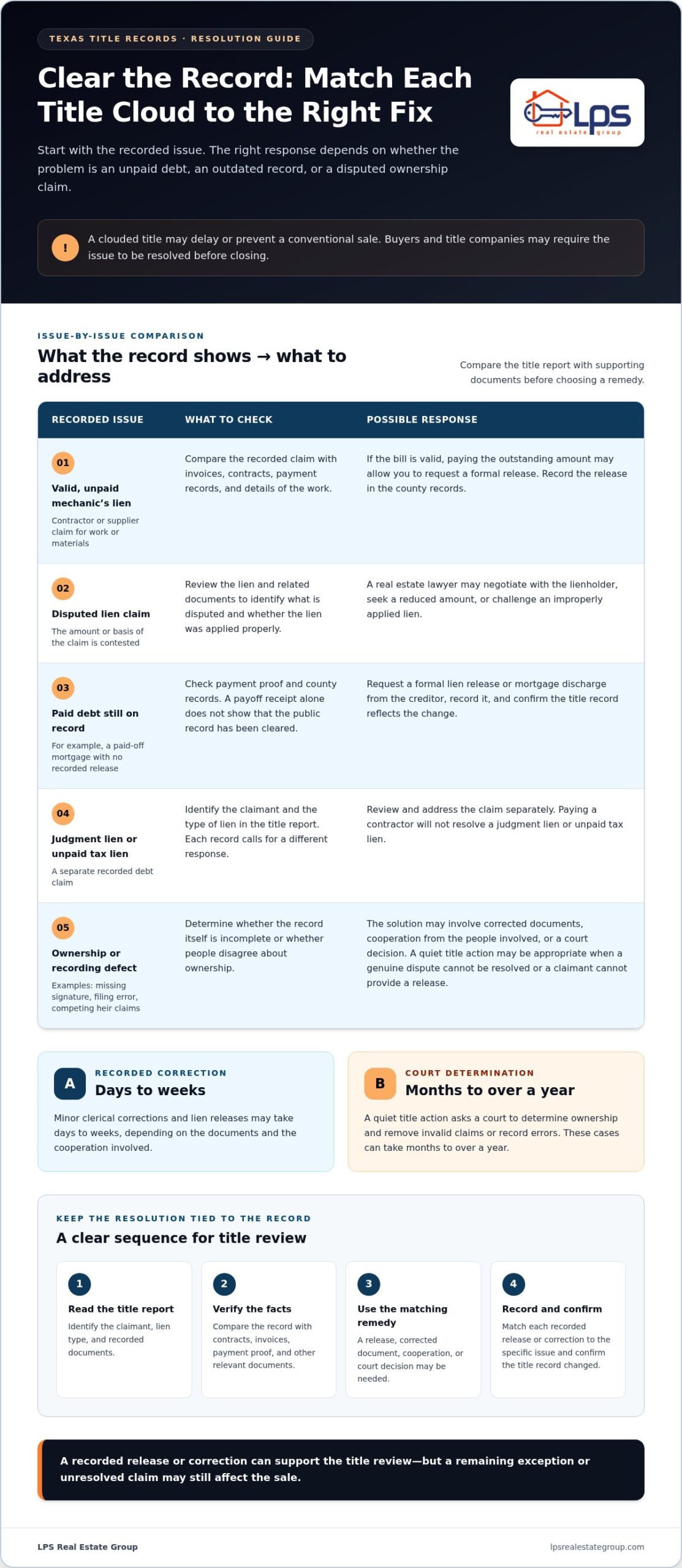
A mechanic’s lien can cloud a Texas title when a contractor or supplier records a claim for unpaid work or materials. The next step depends on whether the debt is valid, paid, disputed, or connected to a separate ownership issue.
Start with the title report. Identify the claimant, type of lien, and recorded documents. A contractor’s lien may involve unpaid work, while a judgment lien enforces a court-awarded debt. Unpaid property taxes, an unreleased mortgage, or an undisclosed heir’s ownership claim can also cloud title. Each record calls for a different response, so first determine what it represents.
Unpaid Debts and Service-Provider Liens
A mechanic’s lien is a claim a contractor or supplier may file for unpaid work or materials provided to a property. It can remain attached to the property and create a title obstacle even when the owner wants to sell. For example, an unpaid supplier’s claim may need to be addressed before a title company will insure the transfer.
Compare the recorded claim with invoices, contracts, payment records, and details of the work. If the bill is valid, paying the outstanding amount may allow you to request a formal release. If you dispute the amount or basis, a real estate lawyer can negotiate with the lienholder or challenge an improperly applied lien. A judgment lien or unpaid tax lien needs separate review. Paying a contractor won’t resolve those claims.
Releasing or Disputing Liens and Mortgages
A lien release or mortgage discharge is a recorded document showing that a secured claim has been cleared. It matters because a paid debt can still appear in county records if the release was never recorded. For example, a mortgage paid off years ago may remain on the title until the creditor provides a formal release and it is recorded.
For an old mortgage or mechanic’s lien in Texas, request a formal release from the creditor and record it in the county records. Keep the payment proof and recorded document together, then confirm the title record reflects the change. If a creditor disputes payment or the lien’s validity, an attorney may negotiate a settlement, seek a reduced amount, or contest the claim. Don’t treat a payoff receipt alone as proof that the public record has been cleared.
Some title clouds come from records, not an unpaid bill. A missing signature on an earlier transfer, a filing error, or competing heir claims may leave ownership unclear. Paying a lien won’t fix these defects. The solution may involve corrected documents, cooperation from the people involved, or a court decision.
A quiet title action asks a court to determine ownership and remove invalid claims or record errors. It may be appropriate when the parties can’t resolve a genuine dispute or a claimant can’t provide a release. These cases can take months to over a year. Minor clerical corrections and lien releases may take days to weeks, depending on the documents and cooperation involved.
Once a release or correction is recorded, the seller can provide the updated records for the title review. A remaining exception or unresolved claim can still affect the sale, so match each recorded document to the specific lien or ownership issue it addresses.
How Do Property Titles Become Clouded?
A clouded title is a defect in the property’s ownership record that creates uncertainty about ownership or legal claims. In Texas, a title search may uncover issues that interrupt a sale, refinancing, or transfer, even if the current owner believes the paperwork is complete.
Some defects begin with old records. A misspelled name, incorrect legal description, missing signature, or filing error can create conflicts between documents. A forged deed may make ownership appear to have changed, while an unfinished foreclosure can leave the record unclear. An estate that wasn’t fully settled after an owner’s death may also leave heirs with competing claims. Each issue affects the documents that show who owns the property.
Other title clouds involve property rights or debts, such as unpaid property taxes, an easement, a boundary dispute, or a lien tied to financing. A local government may place a tax lien on a property for unpaid taxes, and tax liens take priority over other claims. A buyer planning to use a mortgage may be unable to complete the purchase if the title remains unclear.
The title defect can affect a sale before the parties reach closing. Most Texas buyers and lenders won’t proceed until title issues are resolved. A title company may require releases, affidavits, or other curative documents before issuing insurance. If the issue is discovered after an offer is accepted, those requirements can delay closing, lead to a contract cancellation, or reduce buyer interest. A cloud can also complicate refinancing because the lender needs confidence that its security interest will be recorded against the correct owner.
A property may sometimes be sold before every issue is cleared, but buyers’ financing and title insurance options may be limited. A cash buyer willing to accept the risk may consider an as-is purchase, though an unresolved defect can bring later legal complications and affect the sale price. Selling as-is doesn’t erase the title problem or establish who holds valid ownership rights.
Foreclosure adds another timing concern. During foreclosure proceedings, a delinquent borrower may be prevented from selling to a third party. If foreclosure is underway, a foreclosure prevention purchase may offer a path to consider alongside understanding the title issue. The timing and effect depend on the proceeding and the property’s recorded claims.
A Texas title cloud can delay a sale for weeks or months. Its effect on value depends on the defect, the work and time needed to resolve it, and whether buyers can obtain financing or title insurance. A current title report helps identify the recorded problem and guide the next decision.
Quitclaim deeds and deeds of reconveyance
These deeds address different title-record problems. A quitclaim deed transfers the signer’s ownership interest, while a deed of reconveyance records a lender’s transfer after loan repayment. Choosing a document that matches the defect matters: neither one automatically resolves every claim against a property.
A quitclaim deed transfers whatever ownership interest the signer holds. In Texas, it may help correct a record when someone needs to transfer their interest to the proper owner. For example, a person named in an earlier deed might sign a quitclaim deed to clarify the transfer of their interest. The deed doesn’t prove the signer had valid ownership or remove other liens.
That limitation matters. A quitclaim deed doesn’t necessarily clear a title cloud. If an unpaid mortgage, tax lien, or contractor claim remains recorded, changing the named owner won’t release it. A buyer may acquire legal rights through a quitclaim deed, but the document alone doesn’t establish that no one else has a competing interest. The title records still need review.
A deed of reconveyance serves a different purpose. After a loan is paid off, the lender can use this document to transfer title back to the owner and clear the mortgage from the record. If the loan was repaid but the discharge wasn’t recorded, request the reconveyance document from the lender and ensure it is filed in the county records. A payoff receipt shows payment; a recorded release updates the public record.
A corrective deed may address an error in an earlier deed, such as an omitted detail or mistake in the recorded information. In Texas, it can fix some defects when the parties involved are available and cooperative. If the legal description contains a typo, the correction must address that specific error. A corrective deed won’t settle an ownership dispute or resolve a party’s refusal to participate.
Before relying on a deed, compare it with the title report and the document that created the problem. Identify whose signature or action is needed, whether the issue concerns ownership or a paid loan, and which county record needs correction. Quitclaim or corrective deeds may take weeks to obtain when parties need to coordinate signatures or resolve errors. A real estate attorney can prepare documents or work with local records offices to address clerical or recording mistakes.
After recording, compare the updated title information with the original defect. A quitclaim deed may clarify an ownership transfer, a reconveyance may clear a paid mortgage, and a corrective deed may fix a specific error. Any remaining claims need separate resolution before the record reflects the property’s full ownership picture.
Boundary disputes, encroachments, and surveys
A fence, garage, easement, or inheritance disagreement can cloud a Texas property title. Each raises a different question: where a property line lies, what access rights exist, or who holds ownership. The documents and people involved determine what needs clarification.
Consider a neighbor’s garage that crosses the apparent boundary. It may create an encroachment dispute, especially if the deed’s legal description and visible fence line don’t match. A new survey can compare the recorded description with physical measurements to help clarify property lines. It provides useful evidence for discussion, but doesn’t settle a disagreement between owners or change recorded ownership.
Easements raise a different kind of boundary concern. An easement may grant access across part of a property, such as a shared driveway crossing one lot to reach another. A buyer reviewing the title may need to understand where the right applies and how it affects use of the property. Compare the easement document with the survey and recorded legal description. If they appear inconsistent, the discrepancy can complicate a transfer or title insurance review.
Inheritance can also leave ownership unclear. For example, an owner may die before the estate is fully resolved, leaving heirs with competing claims to the house. When someone dies without a will, state law determines who inherits the property. In Texas, probate or an affidavit of heirship may be needed to establish ownership when a deceased owner or missing heirs affect the title. The appropriate record depends on the estate’s history and ownership documents.
Disputes can arise when heirs disagree about who can sell or an earlier transfer lacks a required signature. A title review can show where the ownership chain becomes uncertain. Gather prior deeds, estate records, and documents naming heirs, then compare them with the current title information. If the records conflict, resolving ownership may require participation from those claiming an interest or court involvement.
Keep boundary evidence separate from ownership evidence. A survey can help explain a fence or structure’s location, while probate records or an affidavit of heirship may address who inherited the property. Neither automatically cures every title defect. Match each document to the specific claim, rather than relying on a survey to settle an inheritance dispute or estate paperwork to resolve an encroachment.
Unresolved boundary or inheritance claims can delay closing if the buyer or title company needs clearer records. A survey may clarify physical lines, probate documents may establish heirs’ interests, and a court action may be needed for an ownership dispute. Identify the claim affecting the title rather than treating every disagreement as a boundary problem.
How much does it cost to clear a clouded title?
There isn’t one standard cost to clear a Texas title cloud. The total depends on the defect, the records involved, whether ownership is disputed, and whether court action is needed. A simple recording correction and a contested ownership case require different work, documents, and filing steps.
Begin with a current title search to identify the specific issue. A search of property records can cost hundreds of dollars. The report can show whether the problem involves an unreleased mortgage, unpaid lien, deed error, or competing ownership claim. Identifying the exact record matters: paying a debt won’t correct a clerical mistake, and a corrected deed won’t settle an unpaid lien.
Next, consider what work is needed to resolve the defect. A creditor may need to provide a release, which must then be recorded in county records. If a deed contains an error, the parties involved may need to prepare and record a corrective document. A real estate lawyer’s fees and the cost of filing papers with a court or county may add to the total. Negotiating or seeking court intervention involves different work from obtaining a straightforward release.
The number of parties can also affect the process. An old mortgage may require action from the lender, while an inheritance dispute may involve several heirs and estate records. If a lienholder disputes payment, negotiation or a legal challenge may be needed. A quiet title action can take months to over a year, while minor clerical corrections and lien releases may take days to weeks. The steps and time required affect the overall expense.
Title insurance can add another cost consideration. A title company may require curative documents, impose exceptions, or charge higher premiums when a defect affects the transaction. Insurance doesn’t cover known defects already discovered, so resolving the issue and obtaining updated records may matter before closing. The outstanding claim and required documents shape the title company’s response.
To understand likely cost drivers, organize the title report, relevant deeds, lien notices, mortgage payoff records, and payment receipts. Match each document to the defect, then separate debts to pay from errors to correct and claims to dispute. This gives you a clearer basis for estimating legal work, recording steps, and title insurance changes, without assuming every cloud needs a lawsuit.
If resolving the title issue changes your plans for the property, review your property sale options before choosing the next step.
LPS Real Estate Group: Cash Home Buying
LPS Real Estate Group offers cash home buying and as-is property acquisition for homeowners considering a sale while addressing title concerns. If resolving liens, ownership questions, or property records makes a traditional sale difficult, these options may offer another route to discuss. Creative finance solutions may also fit some property-sale situations, while a foreclosure prevention purchase may be relevant when foreclosure pressure is part of the picture.
A sale doesn’t erase a title defect. Recorded claims and ownership documents still affect the transfer, so identify what remains and how it may affect closing. LPS Real Estate Group buys residential properties directly, giving homeowners an option that doesn’t require preparing the home for a traditional listing.
For a calm conversation about your property and possible next steps, contact LPS Real Estate Group.
Choose Your Next Step With Confidence
Before choosing how to move forward, consider your priority: resolving the title issue before listing, avoiding additional property work, or addressing foreclosure pressure. Selling a house with a clouded title may require careful coordination, but the title concern doesn’t have to be the only factor in your decision.
LPS Real Estate Group offers direct cash purchases and creative offers for homeowners considering a sale. The company buys properties as-is, so repairs or cleaning aren’t required. There are no commissions or hidden costs. When foreclosure is part of the situation, its foreclosure prevention purchase may also be relevant.
If you’re weighing a sale against further title work, take the next step with the details you have and ask what options fit your situation. Contact LPS Real Estate Group to discuss your property and possible next steps. A clear conversation can help you move forward at your own pace.
Frequently Asked Questions
Can You Sell a House With a Clouded Title in Texas?
Yes, a Texas home with a clouded title can sometimes be sold, but the defect may affect whether the buyer can close. A conventional buyer using a mortgage may have difficulty obtaining financing or title insurance while the issue remains unresolved. A cash sale may be possible if the buyer accepts the known defect and the ownership transfer can be documented. Identify the specific claim before agreeing to sale terms.
So Your Real Estate Title Is Clouded: What Now?
Get a current title report and use it to guide your next decision. Note the document connected to the issue, the person or creditor named, and whether it concerns ownership, a debt, or a property right. Gather related deeds, payment records, estate papers, or lien notices. Comparing these records can reveal what conflicts and what evidence may support correcting, releasing, or challenging the claim.
What does it mean to have a clouded title on a house?
A clouded title means a record or claim creates uncertainty about ownership or another legal interest in the home. For example, a deed may name an earlier owner differently from a later transfer, or a recorded claim may remain after the underlying debt was paid. This affects confidence in the property’s ownership history. It doesn’t automatically mean the current owner has no rights, but it can complicate a transfer.
What are common causes of a clouded title?
Common causes include unpaid liens, a mortgage without a recorded discharge, conflicting heir claims, forged deeds, and mistakes in recorded documents. A typo in the legal description can also create a mismatch between the property and its deed. An estate left unresolved after an owner’s death, for instance, may leave several relatives claiming an interest. The right remedy depends on whether the problem concerns debt, identity, boundaries, or inheritance.
Can you sell a house with a clouded title in the United States?
Sometimes, but the outcome depends on the title defect, the buyer’s plans, and state requirements. A buyer relying on a mortgage commonly needs clear title or an acceptable resolution before funding. A cash buyer may consider a property with an unresolved issue, but the claim can affect the transfer and later ownership. Disclosure requirements for title defects vary by state, so account for applicable local rules.
How do you clear a clouded title before selling a house?
First, identify the exact recorded defect instead of treating the entire title as one problem. Match the remedy to the record: request a creditor’s release for a cleared debt, correct a deed error with the parties involved, or address an ownership conflict through legal action. Keep proof of payment, signed documents, and recorded updates together. A title company’s review can help determine whether the corrected records address the issue.
How long does it take to resolve a title defect?
Timing depends on the remedy and the cooperation of everyone involved. Minor clerical corrections and lien releases may take days to weeks. A quiet title action can take months to over a year, particularly when ownership is disputed or court involvement is needed. Delays can also arise while locating heirs, obtaining signatures, or receiving documents from a creditor. Identifying the defect early helps show which process applies.
Can you sell a house with a clouded title to a cash buyer or investor?
Yes, a cash buyer or investor may consider purchasing a property with a title issue, but the defect still affects the transfer. LPS Real Estate Group offers Cash Home Buying and As-Is Property Acquisition. Its process begins with property details, followed by a no-obligation cash or creative offer, then a closing date chosen by the homeowner. Repairs aren’t required, and the company charges no commissions or hidden costs.