

A quiet title action is a civil lawsuit that asks a court to clarify legal ownership of a property and resolve competing claims or title defects. After a successful case, the judgment should be recorded in the county’s real estate records. If you’re asking what a quiet title action is and how long it takes, the timeline can range from as little as 30 days to more than a year, depending on the dispute and whether anyone contests it.
It’s understandable to want a clear answer before deciding what to do: a title problem can complicate a sale, transfer, or other plans for a property. This article explains what a quiet title action can resolve, how courts handle a case, what affects its timing and cost, and when a title dispute may call for a different approach.
Key Takeaways
- A quiet title action asks a court to clarify property ownership and resolve competing claims, but it doesn’t erase valid mortgages or liens.
- Timing can range from 30 days to more than one year, with contested claims and difficulties notifying interested parties adding time.
- Boundary conflicts may involve encroachments or adverse possession, so understanding the claim and the applicable state rules is essential.
- If a title dispute complicates plans to sell or keep a property, consider whether an as-is sale or another property purchase option fits your situation.
What Is a Quiet Title Action?
A quiet title action is a civil lawsuit asking a court to decide who holds legal ownership of real estate. It can address competing ownership claims or a defect that clouds title, but its reach depends on the claim and applicable state law.
Limits of a Quiet Title Judgment
A quiet title judgment resolves the ownership claims properly before the court; it does not erase every recorded interest affecting a property. For example, it cannot eliminate a valid mortgage or lien the owner agreed to. Some jurisdictions also limit which title defects or disputes this lawsuit can address, so identifying the specific claim matters before filing.
The distinction is practical: a judgment resolving a conflicting ownership claim may clear title as to that issue, while a separate valid debt can remain attached to the property. A real estate attorney can review the recorded documents and the nature of the dispute to determine whether a quiet title action is appropriate.
Court Adjudication and Final Judgment
Court adjudication means reviewing the parties’ claims and evidence before issuing a decision about ownership. The court considers the legal interests raised in the lawsuit, such as a competing claim tied to a recorded document, and determines which claim prevails.
The final judgment states the court’s decision and can establish the plaintiff’s ownership against the claims addressed in the case. A successful plaintiff is typically entitled to full possession without further claims against the property from the parties whose claims were resolved. The decision’s scope matters: it settles the claims before the court, not unrelated obligations.
Title and deed are related but distinct. Title means the legal rights to property; a deed is a document used to transfer an interest. A quitclaim deed, for example, transfers only the grantor’s claim. It does not establish that no other person or entity has a competing claim, so receiving a deed alone may not settle a title question.
The lawsuit is brought by a plaintiff asserting a superior ownership right. People or entities that may claim an interest can be named as defendants. Some disputes concern a specific document that clouds title, while others involve broader uncertainty about who may have a claim. State procedures and the type of defect shape what the court can decide.
Washington’s Chapter 7.28 RCW covers ejectment and quieting title, according to the Washington State Legislature. That statutory reference illustrates why the property’s location matters: quiet title rules and procedures are not identical across the United States. The appropriate court and legal framework depend on the property’s jurisdiction and the dispute involved.
After a successful quiet title action, the final judgment should be recorded in the county’s real estate records. Recording makes the court’s decision part of the property’s public record and helps show how the claim was resolved. The judgment and recorded documents can then be reviewed together if an ownership question arises later.
Boundary disputes and encroachments
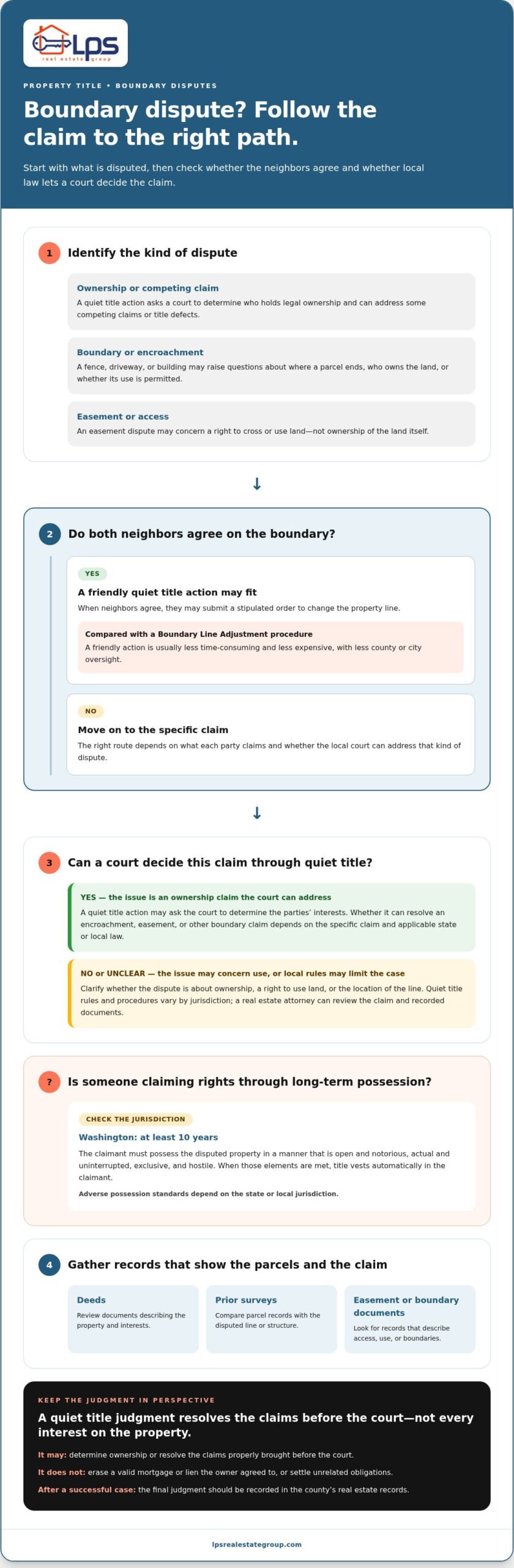
A quiet title action can address competing claims about ownership, including some disputes over where one property ends and another begins. It may help resolve a claim involving an encroachment or an easement, but whether the court can decide the issue depends on the applicable jurisdiction and the specific claim.
A fence, driveway, or building that crosses a perceived boundary can create a contested ownership question. Property owners may disagree about whether the structure sits on one parcel, whether an easement permits its use, or whether someone has acquired rights through long-term possession. When the dispute concerns title, a quiet title action can ask a court to determine the parties’ interests.
Adverse possession is a distinct issue. In Washington, a claimant must possess disputed property for at least 10 years in a manner that is open and notorious, actual and uninterrupted, exclusive, and hostile. When those elements are met, title vests automatically in the claimant, even if the public record does not reflect the transfer. Adverse possession standards depend on the state or local jurisdiction.
An easement dispute may concern a right to cross or use another person’s land rather than ownership of the land itself. For example, neighbors might disagree about whether a path across one parcel provides access to another. The key questions are what interest each party claims and whether the quiet title proceeding can resolve that type of claim under local law.
When both neighbors agree on the boundary, a friendly quiet title action may allow them to submit a stipulated order changing the property line. This differs from a Boundary Line Adjustment procedure, which may involve county or city oversight. A friendly action is usually less time-consuming and less expensive, with less county or city oversight, than a Boundary Line Adjustment procedure.
Before choosing a route, clarify the disagreement and gather records describing the parcels. Useful materials may include deeds, prior surveys, and documents referring to an easement or boundary. Comparing those records with the disputed fence or access route helps identify whether the conflict concerns ownership, use, or the location of the line.
A court judgment can settle claims presented in the case, but it does not make every boundary disagreement suitable for quiet title. If the dispute also complicates plans to sell or keep the property, an as-is property acquisition may be a separate option to consider; it does not replace resolving ownership rights.
The court process for filing and resolving a quiet title action
Quiet title procedures vary by state because laws set the claims, court, and notice process. How do quiet title laws and timelines vary by state? Georgia requires filing in the superior court where the property is located, while case timelines across the United States range from 30 days to more than one year.
Steps in the Filing Process
The filing process moves from identifying the claim to serving defendants and obtaining a court decision. The complaint explains the plaintiff’s ownership claim and names people or entities who may claim an interest. Notice must then be served, giving defendants an opportunity to respond. These steps matter because the court needs the claim and affected parties before it can resolve ownership.
In Georgia, a quiet title action begins with a petition in the superior court of the county where the property is located. For an action against all the world, the court appoints a special master, and the petitioner must obtain and file a property survey. Legal notice must also appear in the county’s legal newspaper. The special master is a private attorney who lives in that county and has real estate experience.
State Laws and Timelines
State laws determine which title disputes qualify, where a case is filed, and what notice is required. This variation matters because a process used in one state may not fit a property claim in another. In Georgia, an action against all the world includes a special master, survey, and published notice; other states follow their own procedures.
After filing, the case can take different paths. If defendants don’t respond within the required time, the court may enter a default judgment for the plaintiff. If a defendant responds, the parties may settle outside court or proceed through litigation. A contested quiet title action may take several months or over a year, depending on the jurisdiction and case.
Some cases move more quickly when claims are straightforward and notice reaches the relevant parties. A quiet title action in the United States may take as little as 30 days, while complex disputes can extend beyond one year. In Georgia, a case against all the world can take more time when many people or entities may claim an interest.
The court’s final decision resolves the ownership claims presented in the lawsuit. A successful plaintiff should record the judgment in the county’s real estate records so the public record reflects the court’s decision. In an estate matter, for example, identifying all potential claimants and serving proper notice can affect how smoothly the case proceeds.
Typical quiet title action costs
The state and complexity of the claim influence the total. A case involving a clear ownership issue may require less work than a contested lawsuit involving several parties, disputed documents, or competing claims.
Legal costs can include attorney work, court filing, serving defendants, and preparing evidence. The amount of work depends on the property records and the questions the court must resolve. For example, a dispute over one recorded document may involve fewer issues than a case where multiple parties claim ownership.
Contested cases can become as expensive and time-consuming as other lawsuits. If a defendant responds, the parties may need to exchange evidence, address disputed facts, and continue through litigation. Each added issue can require more legal work. A case that settles without full litigation may involve fewer steps than one requiring a court decision.
That example shows why a broad national range can’t predict the details of an individual case. The location, type of claim, number of parties, and whether anyone contests ownership all affect the work involved.
Some procedures also require additional documents or participants. For example, a Georgia quiet title action against all the world requires a property survey, published legal notice, and a court-appointed special master. If many people or entities may claim an interest, the action can take more time and cost more. Those requirements add steps beyond resolving a dispute between identified parties.
Possession and the final judgment also matter to the practical value of the case. The court’s decision addresses the claims presented, and a successful plaintiff should record the judgment in the county’s real estate records. Preparing accurate documents and identifying relevant parties helps define what the lawsuit must address, though it doesn’t remove valid mortgages or liens.
To understand likely cost drivers, break the claim into practical parts: which ownership interest is disputed, who may assert a claim, and what evidence the court needs. A deed dispute, for instance, may require different preparation from a case involving several claimants and a survey. The more issues that are contested, the more litigation may be required.
Use the national range as a starting point, not a quote for a particular property. The main cost distinction is whether the parties resolve a straightforward claim or pursue contested litigation. State procedures, required notices, supporting documents, and the number of interested parties shape the work and expense involved.
Quiet title action definition
A quiet title action is a lawsuit in which a plaintiff asks a court to determine competing legal claims to real estate. “Quiet” describes the goal: settle the ownership question through a judgment, not through private negotiation alone. Homeowners often ask, “What is a quiet title action and how long does it take?” The answer starts with understanding what the lawsuit can decide.
That distinction helps identify whether the lawsuit matches the problem. A deed is a document, while title refers to legal rights in the property. For example, a quitclaim deed transfers only the grantor’s claim. It doesn’t establish that no other person has an interest, so the recipient may still face a competing claim requiring resolution.
The plaintiff brings the action against people or entities who may claim an interest. A recorded document might create uncertainty about ownership, or an adverse possession claim might raise a question about who owns a portion of land. Boundary disputes can also involve ownership claims, though disagreements about use or an easement may raise different issues.
State law shapes the action’s purpose and reach. In Georgia, a conventional quiet title action addressing a specific document that clouds title is brought under OCGA § 23-3-40. An action against all the world is brought under OCGA § 23-3-60. These distinct routes show why identifying the type of claim matters before a plaintiff files.
A judgment can resolve the title claims presented to the court, but it doesn’t erase every obligation attached to the property. For example, a valid mortgage or lien that the owner agreed to remains in place. A lender’s interest therefore differs from a disputed ownership claim, and a quiet title action cannot simply remove a valid debt.
The action also differs from a general lawsuit over property condition. Quiet title actions generally address ownership disputes rather than claims about property problems. An attorney can help distinguish that kind of dispute from a claim about who holds title.
For an owner assessing next steps, the question “What is a quiet title action and how long does it take?” combines two separate concerns: the type of claim the court can decide and the time needed to resolve it. Naming the exact claim, such as a deed, adverse possession, or boundary line, helps clarify what judgment would address. If a title issue is affecting plans to sell the property, you can explore an as-is property sale as a separate option.
LPS Real Estate Group: Cash Home Buying
LPS Real Estate Group buys homes for cash or through creative offers, and acquires properties as-is. If a title dispute has made a traditional sale difficult, a direct property sale may be an option to consider alongside resolving the legal claim. The sale process requires no repairs, commissions, or hidden costs. A sale does not replace a quiet title judgment or remove valid liens, so understand which title issues remain before deciding how to proceed.
For inherited properties or foreclosure concerns, LPS Real Estate Group also offers inherited property buyouts and foreclosure prevention purchases. Creative finance solutions provide another path when a cash sale does not suit the homeowner’s needs. The right option depends on the property and the seller’s circumstances.
If you’re considering a property sale, contact LPS Real Estate Group or visit lpsrealestategroup.com to discuss your situation.
Choose the next step that fits your property plans
Understanding what a quiet title action is and how long it takes can help you separate a legal ownership issue from a decision about what to do with the property. A court process addresses claims to title; a sale is a separate path for owners ready to move on. Keeping those decisions distinct can make your next step clearer.
If selling is part of your plan, LPS Real Estate Group offers cash home buying, foreclosure prevention purchases, and as-is property acquisition. These options may fit when you’re considering a sale rather than continuing to hold the property. There are no repairs, commissions, or hidden costs, and a sale does not replace resolving a title dispute through the appropriate legal process.
When you’re ready to discuss a property sale, contact LPS Real Estate Group. You can take the next step at your own pace and choose the path that best fits your circumstances.
Frequently Asked Questions
How Long Will it Take and How Much Will it Cost?
These figures describe the court action, not a property purchase. A case involving several claimants or disputed evidence generally requires more legal work than an uncontested matter. The property’s state and the steps its procedures require also affect timing and total expense.
How Long Does it Take?
A straightforward action can take as little as 30 days, while a contested lawsuit can last several months or over a year. In North Dakota and Minnesota, a simple action may take a few months to settle. The calendar depends on the court’s process, whether defendants respond, how many parties need notice, and whether the dispute settles or proceeds through litigation.
What factors affect the timeline of a quiet title action?
The number of possible claimants, service of notice, state procedures, and whether a defendant contests the complaint all affect timing. For example, a Georgia action against all the world includes a court-appointed special master, a property survey, and legal notice published in the county’s legal newspaper. Identifying relevant parties and preparing required documents early helps avoid preventable delays in those steps.
How much does a quiet title action cost, including attorney and court fees?
The total can include attorney work, court-related expenses, service of notice, and documents required for the case. A contested lawsuit can require substantially more work than a simple matter that settles without full litigation.
What evidence and documents are needed to file a quiet title action?
The complaint must identify the property, explain the plaintiff’s ownership claim, and name parties who may claim an interest. Relevant records can include deeds and the document creating the title dispute. A Georgia action against all the world requires a property survey, and legal notice must appear in the county’s legal newspaper. The court’s requirements depend on the type of action and state procedure.
What happens if someone contests a quiet title action?
If a defendant responds to the complaint, the case proceeds through litigation or may settle outside court. The parties then address the competing claims and evidence before the court resolves the ownership issue. For instance, a defendant disputing the plaintiff’s deed may raise questions about the recorded documents or claimed interest. Contesting a case can extend the process and increase expense compared with an uncontested resolution.