

The buyout amount is not simply the home’s full appraised value. When selling a house with a difficult co-owner, the ownership shares and any mortgage balance help determine what the departing owner may receive.
Owners can agree on a buyout or sale, but a dispute in Pennsylvania may lead to a partition action. If the property cannot practically be divided, the court may order a sale. Divorce is different: married couples cannot use partition to liquidate real estate as part of a divorce, because Pennsylvania divorce laws set out the applicable procedures.
When co-owners disagree, it is understandable to want a fair figure and a clear way forward. This article explains how ownership shares, appraisals, mortgage responsibility, and property expenses can affect a buyout, then reviews options for a Pennsylvania co-ownership dispute and explains how divorce proceedings differ from partition.
Key Takeaways
- Review the deed to understand how the owners hold title, since ownership type can affect whether one person may transfer a share.
- When estimating a buyout, account for ownership percentages, the mortgage, and property expenses rather than relying on the home’s value alone.
- Compare a negotiated buyout, an agreed sale, and a partition action; the right path depends on ownership documents and whether the property can be divided.
- In Florida, an eligible cotenant has 45 days after notice to elect to buy the interests of cotenants who requested a partition sale, according to the Florida Legislature.
1. Appraisals and buyout amounts
Yes. One co-owner can buy out another if they agree on the transfer and amount. A professional appraisal can help establish fair market value; Pennsylvania courts typically require one in a partition action.
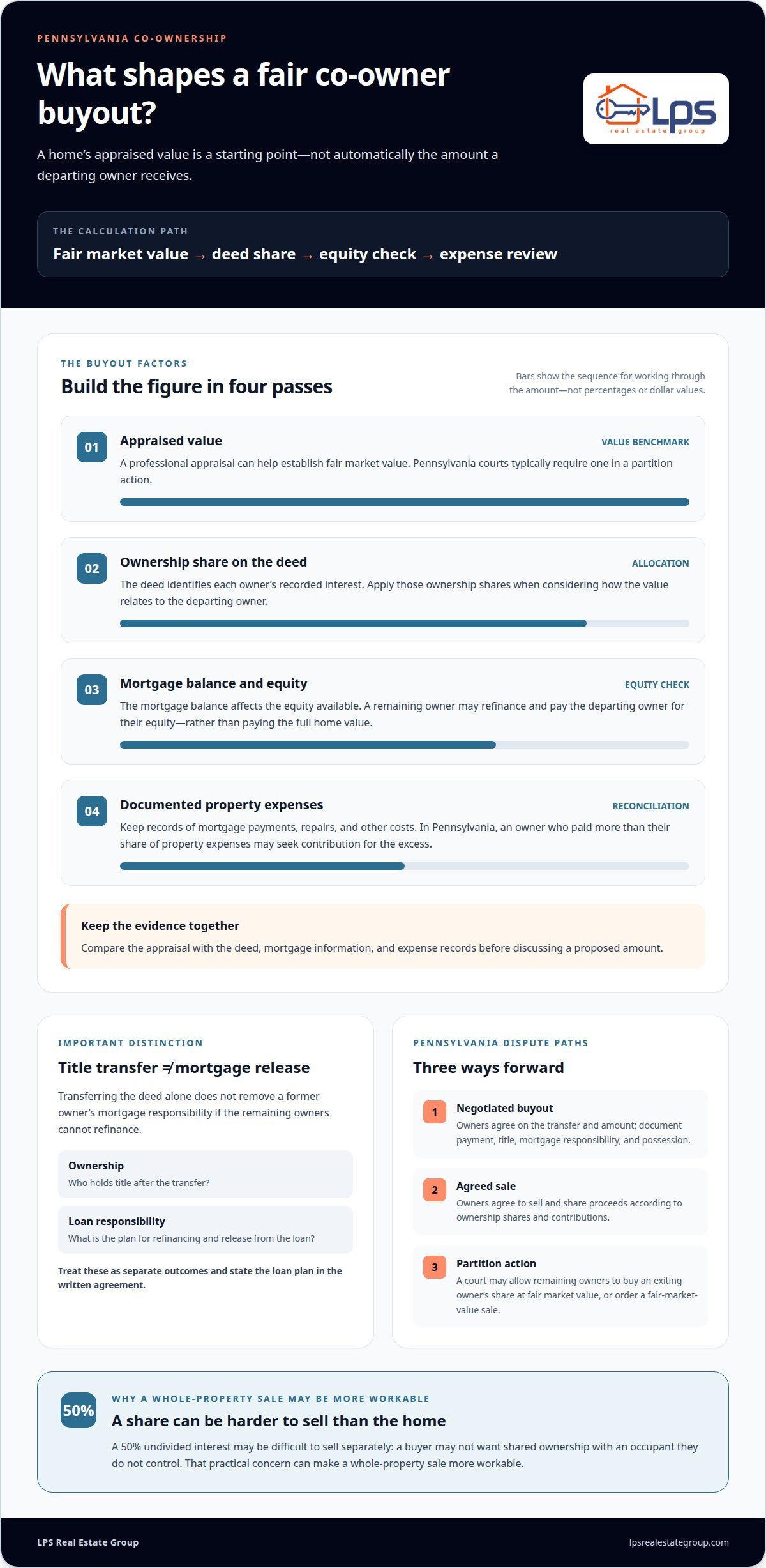
Start with the appraised value, then account for each owner’s documented share. The example shows why the home’s full value is not the same as the combined buyout amount for departing owners.
Next, distinguish the property’s value from its equity. A buyout may involve the remaining owner refinancing the mortgage and paying the departing owner for their equity. The mortgage balance affects the equity available, while the deed shows the starting ownership shares. Pennsylvania co-owners who pay more than their share of property expenses may seek contribution from the others for the excess. Keep records of mortgage payments, repairs, and other costs when discussing a proposed amount.
In Pennsylvania, a partition court may allow the remaining owners to buy an exiting owner’s share at fair market value, or order a sale at fair market value. A 50% undivided interest may be difficult to sell separately because a buyer may not want shared ownership with an occupant they don’t control. That practical concern can make a whole-property sale more workable than selling one share.
In a Florida partition action, if the court orders an appraisal, the Florida Legislature says it must appoint a disinterested real estate appraiser licensed in the state. Before agreeing on a buyout, compare the appraisal with deed shares, mortgage information, and expense records. This helps clarify how the proposed amount relates to the departing owner’s equity.
2. What Is Co-Ownership of Property?
Pennsylvania co-owners generally may possess and use the entire property, as long as one owner’s use does not interfere with another’s rights or the property’s purpose. For example, one owner cannot claim exclusive use of shared access if that prevents another owner from using the home. Ongoing costs, including mortgage payments, repairs, and utilities, may be shared according to ownership percentages.
The deed identifies how the owners hold title, often as joint tenants or tenants in common. In Pennsylvania, a tenant in common may transfer their share without the other owners’ consent. A joint tenant may also transfer a share, usually changing the ownership to a tenancy in common. Spouses holding title as tenants by the entirety generally need each other’s consent to transfer an interest.
To resolve a dispute without going to court, review the deed, mortgage, and any written agreement, then discuss a buyout or sale. Put the agreed value, ownership shares, expense adjustments, and transfer terms in writing so each owner understands the proposed separation.
Owners who agree to separate their interests may divide the property physically if feasible, or sell it and share the proceeds according to their ownership shares and contributions. A house that cannot practically be divided may be better suited to a mutually agreed sale. In Pennsylvania, one owner generally cannot sell the entire jointly owned property without the others’ consent, though a co-owner may transfer an eligible individual share.
For a sale discussion, record each owner’s proposed value and the basis for it, then address how mortgage obligations and shared expenses affect the division. If inherited ownership makes agreement difficult, a direct property sale may offer a route to consider. Keep any agreement consistent with the deed and the owners’ documented contributions.
4. Buying out a co-owner
A buyout lets one owner leave shared title while another keeps the property. Start with the deed to identify each owner’s recorded interest. Then record the proposed value, each share, the mortgage balance, and any agreed adjustments. These figures give both sides a common starting point for negotiating payment.
Next, calculate the departing owner’s equity rather than treating the home’s full value as the payment. A remaining sibling might need to buy out several relatives, not just one. Separate the proposed buyout payment from the mortgage payoff, and show the figures behind each amount. If owners dispute a figure, identify the specific item in question before changing the offer.
Put the agreement in writing before arranging a transfer of ownership. Name the owner leaving and the owner staying, and state the payment amount and date. Specify who pays property costs until the transfer and who may occupy the home during that period. Include what happens if the remaining owner cannot complete the planned refinancing. Clear terms can prevent later disputes over utilities, repairs, possession, or timing.
Transferring a deed alone does not remove a former owner’s mortgage responsibility if the remaining co-owners cannot refinance. A departing owner could give up title but remain responsible for the loan. Treat the ownership transfer and mortgage release as separate outcomes. State the loan plan explicitly in the written agreement rather than assuming one automatically follows the other.
Before completing the buyout, compare the final terms with the deed, mortgage documents, and written agreements between owners. Keep payment records and copies of each agreed adjustment. If owners share the property during the transition, specify how they will handle expenses and access. Settle payment, title, mortgage responsibility, and possession as distinct parts of the transaction.
4. What legal options are available when co-owners disagree about selling a house?
Start by reviewing the deed, mortgage, and any written agreement. These documents clarify ownership shares, loan obligations, and existing commitments. The common options are a negotiated buyout, a sale agreed to by all owners, or a partition action. A written proposal can set out the sale terms, proposed value, and division of proceeds before the disagreement escalates.
In Pennsylvania, co-owners who cannot agree on separating their interests may file a partition action. The court can order a sale when a house cannot practically be divided, then distribute the proceeds according to ownership percentages. A partition action can take at least a couple of years to move through the court system, so compare that timeline with a negotiated sale or buyout. A co-owner who remains in possession may receive a credit that generally increases their share by one-half of certain costs incurred.
Florida has a separate procedure for eligible heirs property. Under Florida law, an eligible cotenant has 45 days after notice to elect to buy the interests of cotenants who requested a partition sale, according to the Florida Legislature. If heirs property can’t be divided in kind, the court is directed to prefer an open-market sale listed by a real estate agent over a courthouse-steps sale. These rules are specific to Florida and shouldn’t be treated as Pennsylvania procedure.
Divorce also changes the legal route in Pennsylvania. Married couples can’t use a partition action to liquidate real estate in a divorce setting, because divorce laws establish the applicable procedures. For other co-ownership disputes, organize the deed, mortgage, expense records, and proposed resolution before deciding which path fits. A sale may be worth discussing when agreement has stalled; discuss a property sale option for a home with unresolved co-owner issues.
If a co-owner refuses to agree to a sale, the others may file a partition action. If the house cannot practically be divided, the court can order a sale and distribute the proceeds according to ownership percentages.
LPS Real Estate Group: Cash Home Buying
LPS Real Estate Group buys homes directly from owners for cash or through creative offers, without a traditional listing. If co-owners agree to sell, an as-is purchase can suit a home that needs work or is difficult to prepare for sale. There are no repairs required, no agent commissions, and no hidden costs. The company also offers creative finance solutions when a direct cash sale is not the preferred option.
For inherited property, LPS Real Estate Group also handles probate and inherited property buyouts. These options may suit co-owners who inherited a property and want to explore a sale rather than continue sharing ownership. The next step depends on whether the owners agree to sell and how the property will be transferred.
To discuss a property sale with LPS Real Estate Group, visit the LPS Real Estate Group website.
Choose a Practical Next Step
Before moving forward, decide what outcome you can realistically pursue with the other owner: continued negotiation, a transfer of ownership, or a sale. Keep the next conversation focused on a specific decision, such as whether everyone is willing to sell or whether one owner intends to stay. That clarity can help move the discussion forward instead of repeating the same disagreement.
If selling a house with a difficult co-owner has become a question of finding a workable sale path, consider which type of transaction fits the property and your circumstances. LPS Real Estate Group offers cash home buying, foreclosure prevention purchases, and as-is property acquisitions. These options may fit when a sale is being considered, including when the home needs work or foreclosure is a concern. LPS buys properties as-is, with no repairs required, no commissions, and no hidden costs.
Share your situation and explore whether a sale option fits your next step. Contact LPS Real Estate Group to start the conversation. You can move forward thoughtfully, with a clearer sense of the choices available.
Frequently Asked Questions
How Does A Buyout Work With Multiple Owners?
A buyout transfers one or more owners’ interests to the owner who will remain. With several owners, identify exactly whose shares are being purchased and how much each departing owner will receive. For example, a written agreement can specify separate payments and the date each transfer takes effect. Keep the payment terms consistent with the deed and any existing agreement among the owners.
How To Force A Sale When One Owner Wants To Sell A House As Is?
In Pennsylvania, one co-owner generally cannot sell the entire jointly owned house without the others’ consent. When selling a house with a difficult co-owner, a partition action may let you ask the court to order a sale if the property cannot practically be divided. Preferring an as-is sale does not resolve the dispute by itself. Document the home’s condition and the points owners disagree on before considering this route.
If You Can’t Sell A House Fast, Can You Sell Your Share To Someone Else?
In Pennsylvania, a tenant in common may sell or transfer their ownership share without the other co-owners’ consent. Finding a buyer may still be difficult, as a purchaser may not want shared ownership with someone living in the house. First review the deed to identify the form of title. A joint tenant’s transfer usually converts the joint tenancy into a tenancy in common.
Is Going To Court The Best Solution For Everyone?
No. A negotiated buyout or mutually agreed sale may resolve the disagreement without a partition case. For someone selling a house with a difficult co-owner, the time involved in a Pennsylvania partition action matters: it can take at least a couple of years to move through the court system. Consider whether the owners can agree on value and terms, whether the property can be divided, and how long they can manage ongoing shared responsibilities.
What Is Co-Ownership of Property?
Co-ownership means two or more people hold ownership interests in the same property. In Pennsylvania, co-owners generally may possess and use the entire property, provided one person’s use doesn’t interfere with another owner’s rights or conflict with the property’s purpose. For instance, an owner’s recorded share doesn’t automatically give them exclusive use of a particular room or area.
How do co-ownership type and title documents affect the right to sell a house?
The deed identifies how owners hold title, and that form can affect whether an individual share may be transferred. In Pennsylvania, a tenant by the entirety, a form available to spouses, generally cannot transfer an interest without the other spouse’s consent. Married couples also cannot use partition to liquidate real estate as part of a divorce; Pennsylvania divorce laws set out the applicable procedures.