
A deed in lieu may avoid foreclosure, but it does not put sale proceeds in your hands. A cash sale can provide proceeds if the price covers the mortgage and other costs. In the choice between a deed in lieu of foreclosure vs cash sale, the key difference is whether you transfer the property to your lender or sell it to a buyer. The mortgage balance and any remaining debt still matter.
It is understandable to focus on the quickest way forward when mortgage payments become difficult. The financial outcome can also depend on the home’s value, other liens, lender approval, and possible tax consequences. This article compares the two options, explains when a deed in lieu may be considered, and outlines alternatives to foreclosure. The amount of debt forgiven, if any, deserves attention alongside the immediate outcome.
Key Takeaways
- Compare transferring the home to your lender with selling it for cash, and weigh how the mortgage balance and property value affect the outcome.
- Before considering a deed in lieu, understand the factors lenders weigh, including payment delinquency, estimated property value, and other liens.
- Treat forgiven mortgage debt as a potential tax issue, and learn which exceptions may apply to your circumstances.
- Compare a lender-approved short sale and a traditional sale as alternatives, paying close attention to approval requirements and any remaining debt.
Deed in Lieu of Foreclosure: Is It Right for You?
A deed in lieu transfers ownership voluntarily to the lender; a cash sale transfers it to a buyer. The better fit depends on lender approval, property value, liens, and what happens to any unpaid mortgage balance.
Lender Approval Factors
A lender weighs your payment delinquency, the home’s estimated value, and whether you’ve made a good-faith effort to sell. Some lenders commonly want the property listed for at least 3 to 4 months before considering a deed in lieu. If you’re seeking approval for a deed in lieu or short sale, you must demonstrate financial hardship and inability to make mortgage payments.
Reasons for Acceptance or Rejection
A lender may accept a deed in lieu to avoid foreclosure, including when the mortgage balance exceeds the home’s fair market value. The lender’s decision may also depend on payment history and the property’s estimated value. A request can be rejected when other mortgages or liens complicate the transfer of clear ownership, or when the lender prefers another resolution. An unsold listing may support a request, but does not ensure acceptance.
Mortgage Debt, Liens, and Deficiency Balances
A deficiency is the amount by which the loan balance exceeds proceeds from a sale or foreclosure auction. In a cash sale, proceeds can pay the mortgage and liens; if they fall short, a deficiency may remain. With a deed in lieu, the lender takes ownership, but the agreement should clarify whether any balance is forgiven. Where borrowers can owe a deficiency, request a waiver and get any agreed debt forgiveness in writing.
State-Specific Rules
State laws shape foreclosure procedures and whether a lender can pursue a deficiency after a sale or foreclosure. In Arizona, anti-deficiency protection under A.R.S. 33-814 doesn’t automatically apply to a deed in lieu. The Arizona State Legislature bars a deficiency action after a trustee’s sale of qualifying residential trust property of two and one-half acres or less. That rule concerns qualifying trustee’s sales, not every deed-in-lieu transfer or cash sale.
Tax consequences of forgiven mortgage debt
Mortgage debt disappearing does not always end the financial impact. Consider tax treatment alongside any debt release, loan modification, or forbearance.
Tax Treatment of Forgiven Debt
Forgiven debt can count as taxable income, even when a lender cancels a deficiency instead of receiving payment. In the United States, forgiven mortgage deficiency debt exceeding $600 is considered income by the IRS, and lenders report forgiven debt using Form 1099-C. Insolvency is an exception described in the tax rules: a borrower is insolvent when total debts exceed total assets. The tax outcome can depend on the debt, property, and timing.
Deficiency Balances and Debt Release
A deficiency is the amount by which a mortgage balance exceeds sale or foreclosure proceeds. If a lender releases that balance, the cancelled amount may create taxable income. For a cash sale that falls short, distinguish the sale proceeds from any debt the lender later forgives. Keep written release terms and tax forms together to clarify what was cancelled and when.
Loan modification and mortgage forbearance can change payment terms without transferring the home. A modification may adjust the loan, while forbearance pauses or reduces payments for an agreed period. Neither term alone means the lender has forgiven principal. Ask what happens to missed payments and whether any amount will be cancelled, since a later debt release can have separate tax consequences.
The Mortgage Forgiveness Debt Relief Act, identified as H.R. 3648, provided certain exceptions for tax years 2007 to 2012. Historical rules allowed up to $2 million of eligible forgiven debt from certain primary-residence loans to be excluded for the 2007, 2008, and 2009 tax years. The exclusion expired for debt discharged after December 31, 2025, unless forgiveness came from a written arrangement signed before that date. Exceptions also covered some loans made between 2007 and 2017.
For a home at risk of foreclosure, compare the debt outcome with payment alternatives. Foreclosure prevention options may help homeowners consider a purchase instead of a deed transfer or continued mortgage distress.
Comparing alternatives to foreclosure
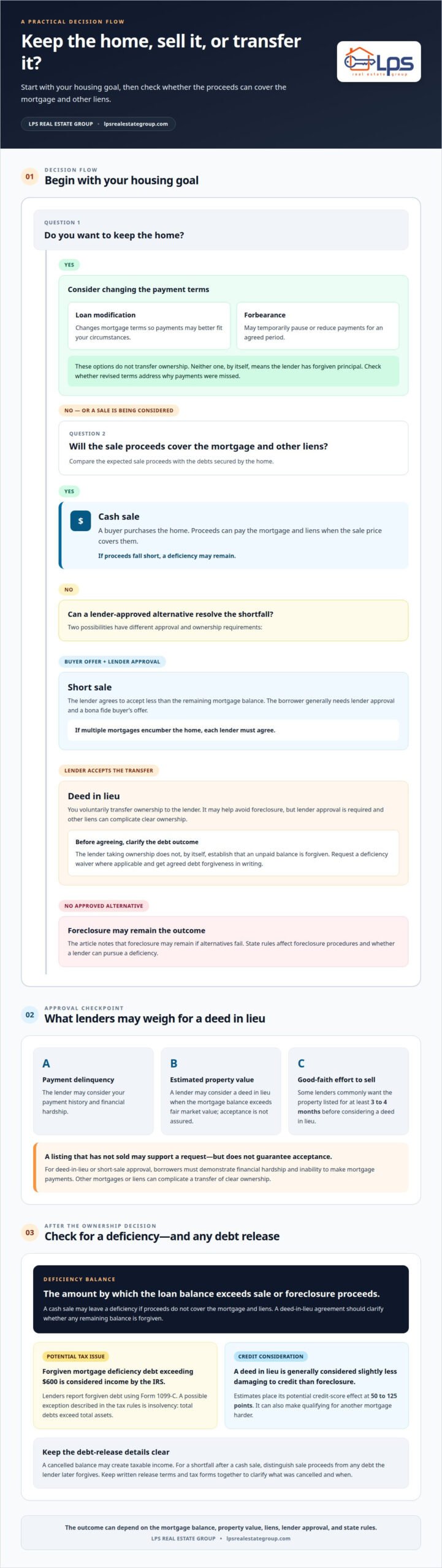
A deed in lieu, short sale, cash sale, loan modification, and forbearance affect ownership and mortgage debt differently. Before choosing how to avoid foreclosure, compare how each option handles the loan balance, possible deficiency, credit history, and housing plans.
A loan modification changes mortgage terms so payments may better fit the homeowner’s circumstances. Forbearance may temporarily pause or reduce payments, but it does not transfer ownership or mean the lender has forgiven debt. These options may suit homeowners who want to keep the home and can manage revised payments. Their value depends on whether the changed terms address the reason payments were missed.
A short sale is an agreement with the lender to sell a home for less than the remaining mortgage balance. The borrower generally needs lender approval and a bona fide buyer’s offer before proposing the sale. If multiple mortgages encumber the home, each lender must agree. This makes the distinction between a short sale and a cash sale important: a cash sale at a price that covers debts can pay them from the proceeds, while a short sale requires the lender to agree to accept less.
A deed in lieu transfers the property to the lender voluntarily. It may help avoid foreclosure, but the lender must accept it, and additional liens can complicate the transfer. A deed in lieu is generally considered slightly less damaging to credit than foreclosure. Estimates place its potential credit-score effect at 50 to 125 points, and it can make qualifying for another mortgage harder.
Foreclosure may remain the outcome if alternatives fail, with a different credit impact. Foreclosure can affect credit, and both foreclosure and a deed in lieu can remain on a credit report for an extended period. These estimates aren’t a personal prediction, but they show why credit and future borrowing belong in the comparison.
Compare likely proceeds with mortgage balances and sale expenses. A homeowner with equity may favor a sale that pays debts and preserves the remaining proceeds. If the home is worth less than the debt, compare a lender-approved short sale with a deed in lieu, including written deficiency terms. The right alternative depends on whether keeping ownership, selling, or transferring the home addresses the financial problem.
Deed in lieu versus traditional sale
A traditional sale can turn home equity into proceeds; a deed in lieu transfers ownership to the lender. The financial difference depends on the sale price, mortgage debt, and any remaining balance.
Timelines and Credit Impacts
A deed in lieu requires lender review and acceptance, while a sale depends on finding a buyer and completing the transaction. Neither has a fixed timeline, and foreclosure timing varies by state and process. A deed in lieu generally affects credit less than foreclosure, while a completed sale avoids a foreclosure transfer. Mortgage arrears or unpaid debt can still affect credit.
Steps and Typical Costs
For a sale, establish the home’s value, review the mortgage payoff, accept a buyer’s offer, then complete closing. Costs can include sale-related expenses and any property work needed to prepare the home. For a deed in lieu, submit financial hardship information, provide requested property details, and review the lender’s written terms. Compare transaction expenses and debt relief before deciding.
A homeowner can sell for cash below the mortgage balance, but the sale price alone will not clear the debt. The lender generally must approve a short sale, and any agreement to waive the deficiency should be in writing.
Consider a borrower whose home is worth more than the remaining mortgage debt. A sale may pay the loan and leave proceeds after expenses. If the home’s value falls short, a deed in lieu could transfer ownership, but only with lender acceptance and clear terms for any remaining debt. A cash buyer does not replace lender approval when proceeds will not cover the payoff.
Compare the net sale proceeds with the lender’s proposed debt release and transfer terms. If a purchase could help address foreclosure risk, explore a foreclosure prevention purchase.
LPS Real Estate Group: Cash Home Buying
LPS Real Estate Group offers Cash Home Buying for homeowners weighing a sale against transferring a property to a lender. If foreclosure pressure or the home’s condition makes a traditional sale difficult, its Foreclosure Prevention Purchase and As-Is Property Acquisition may offer another way to consider selling. Creative Finance Solutions can also provide an alternative structure for a property transaction.
The right path depends on the mortgage payoff, property value, liens, and any deficiency terms. A buyer’s purchase does not automatically settle mortgage debt or replace lender approval when sale proceeds fall short. Compare the proposed transaction with the lender’s written terms before deciding.
If you’re considering a property sale as an alternative to a deed in lieu, contact LPS Real Estate Group to discuss your situation.
Choose a Path That Supports Your Next Step
Choosing between a deed in lieu of foreclosure vs cash sale also means considering how you want to move forward after leaving the property. Think about what matters most in your next chapter, such as a clear transition, keeping potential sale proceeds, or reducing the strain of managing a home during financial difficulty. A decision grounded in your priorities can help you approach discussions with greater clarity.
LPS Real Estate Group offers cash purchases, Foreclosure Prevention Purchase, and As-Is Property Acquisition. These options may be relevant when foreclosure concerns or the home’s condition make a conventional sale challenging. You can share your property details, review a no-obligation offer, and choose a closing date that works for you. No repairs, commissions, or hidden costs are required.
Contact LPS Real Estate Group today to talk through a possible property sale. You can take the next step at your own pace, with a clearer sense of the path ahead.
Frequently Asked Questions
What are the drawbacks?
In a deed in lieu of foreclosure vs cash sale decision, each option has different tradeoffs. A deed in lieu means giving up ownership, and the lender can decline the proposal. Existing liens may prevent the transfer. A cash sale may not cover mortgage payoffs and sale expenses. For example, a home needing substantial repairs may attract offers below the amount needed to clear its debt.
What if you have more than one loan?
Multiple loans can complicate either option because each loan may create a claim against the property. A lender may not accept a deed in lieu if other mortgages or liens remain. For a short sale, the homeowner needs agreement from the mortgage lenders involved. If a cash buyer’s offer covers the loan payoffs, those debts can be addressed from the sale proceeds.
What is a Deficiency Judgment?
A deficiency judgment is a court judgment requiring a borrower to pay a mortgage shortfall after the property’s sale or foreclosure. The shortfall is the difference between the remaining loan balance and the amount recovered from the property. Whether a lender can pursue one depends on state law and the transaction. Distinguish a written debt waiver from simply handing over the home.
What is a deed in lieu of foreclosure?
A deed in lieu is a voluntary transfer of home ownership to the mortgage lender as an alternative to foreclosure. The borrower gives up the property, and the lender takes title under agreed terms. Before signing, understand whether the agreement releases you from the remaining mortgage debt. A written agreement matters because transferring the deed alone does not explain what happens to any unpaid balance.
What is a cash sale of a home?
A cash sale is a home purchase where the buyer pays cash rather than relying on a mortgage to fund the purchase. The seller transfers ownership at closing, and sale proceeds are applied to the mortgage payoff and other amounts due. If proceeds exceed the debts and transaction expenses, the seller may receive the remainder. A cash offer does not itself erase a shortfall.
How does a deed in lieu compare with a cash sale for a homeowner facing foreclosure?
For a homeowner comparing a deed in lieu of foreclosure vs cash sale, the central difference is who receives the property and how the mortgage is addressed. A deed in lieu transfers it to the lender; a cash sale transfers it to a buyer, with proceeds applied to debt. If proceeds fall short, lender approval and written deficiency terms matter. Also consider your housing plans and future borrowing.