

A single unpermitted room or an outdated electrical system shouldn’t feel like a financial life sentence; however, the daily fines from the city often make it feel that way. If you need to sell house with code violations, you’ve likely discovered that traditional banks and buyers aren’t always willing to take on the risk. We know how exhausting it is to watch penalties accumulate while you’re stuck with a property that feels impossible to move.
You deserve a path forward that doesn’t involve expensive renovations or legal uncertainty. This guide will help you manage municipal fines, understand the latest 2026 disclosure requirements, and handle safety violations so you can sell your property legally. We’ll explore how to stop the cycle of fines and close the deal without making a single repair; we will also explain why these issues make traditional financing difficult and how to find a more direct solution that provides the relief you need.
Key Takeaways
- Identify the specific differences between unpermitted work and active safety violations to determine the best path for your property.
- Understand how daily municipal fines and liens can erode your equity and why they often lead to mortgage rejections from traditional lenders.
- Learn about the 2026 legal disclosure requirements that protect you from future litigation when transferring a property with known defects.
- Discover how to sell house with code violations to a professional buyer who can settle city paperwork and take over the repair burden for you.
- Compare the timelines and costs of a traditional listing versus an as-is acquisition to see which option provides the fastest financial relief.
What Does It Mean to Sell a House with Code Violations?
A code violation occurs when a property fails to meet the safety or construction standards set by your local municipality. These rules, often based on a standard Building code, exist to ensure that every home is safe for its occupants and the surrounding community. When you attempt to sell house with code violations, you’re managing a legal status that affects the property’s title and its eligibility for traditional financing. It isn’t just about a broken window or a messy yard; it’s about the legal compliance of the structure itself.
In 2026, we’ve seen a shift toward more rigorous municipal enforcement. Local governments are using updated digital records and more frequent inspections to identify issues that might’ve been overlooked in years past. This means that “grandfathered” issues are becoming rarer. For example, California property owners now face strict deadlines for balcony and deck inspections under SB 721, with daily fines ranging from $100 to $500 for non-compliance as of January 1, 2026. These stricter rules are designed for safety, but they can create a significant financial burden for sellers caught off guard.
The Most Common Violations in 2026
Many homeowners are surprised by what triggers a citation. We often see properties flagged for issues that were meant to be improvements but were completed incorrectly. Common examples include:
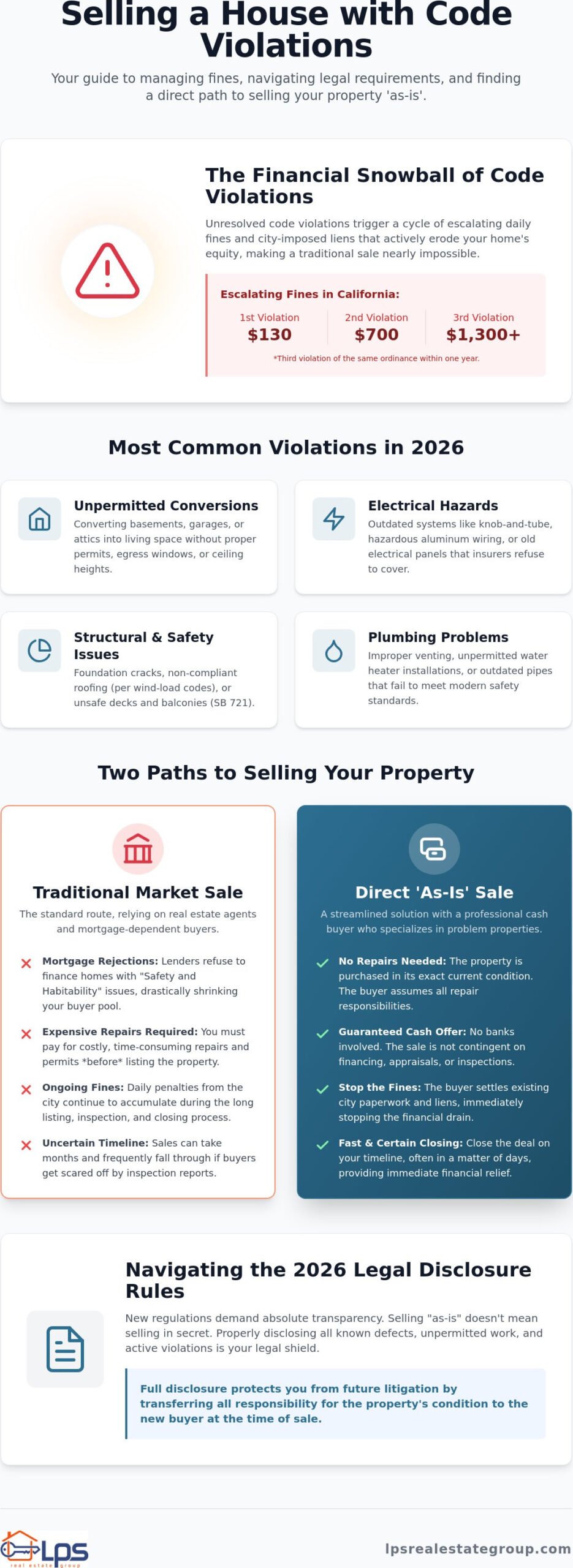
- Unpermitted Conversions: Basements or attics turned into bedrooms without proper egress windows or ceiling heights.
- Electrical Hazards: Outdated panels, hazardous aluminum wiring, or knob-and-tube systems that most modern insurance companies won’t cover.
- Structural Integrity: Foundation cracks or roofing that violates modern wind-load codes, which is a high priority for inspectors in 2026.
- Plumbing Issues: Improper venting or unpermitted water heater installations that don’t meet current safety standards.
Active vs. Passive Code Issues
It’s helpful to distinguish between issues the city knows about and those that are still “under the radar.” Active violations mean the city has already issued a formal notice. In California, these fines are structured to escalate quickly; a first violation might be $130, but a third violation of the same ordinance within a year can reach $1,300. These are often tied to the property’s title as a lien, making a clean transfer difficult.
Passive issues are unpermitted works or safety hazards that haven’t been flagged yet. While you might not be paying daily fines, these issues still make it difficult to sell house with code violations through a traditional real estate agent. Most buyers will require an inspection, and once these problems are discovered, traditional lenders will typically refuse to fund the loan until the work is permitted and corrected. Whether active or passive, these violations require a clear strategy to resolve before a successful sale can happen.
The Hidden Costs: Fines, Liens, and Mortgage Rejections
When you realize you need to sell house with code violations, the most immediate threat isn’t the repair itself. It’s the financial snowball that starts rolling the moment a city inspector files a report. These daily fines don’t just sit on a ledger; they actively eat away at your home equity. In California, for example, a third violation of the same ordinance within a single year can cost up to $1,300. If multiple issues exist, these penalties can quickly reach tens of thousands of dollars. This financial pressure often forces sellers into a corner where they feel they have no choice but to accept a low-ball offer.
Why Traditional Buyers Can’t Close
Most buyers in 2026 rely on traditional financing, with the national average 30-year fixed mortgage rate sitting at 6.4% as of May. At these rates, buyers are incredibly selective and usually look for “move-in ready” homes. More importantly, lenders have strict “Safety and Habitability” thresholds that most properties with violations simply cannot meet. FHA and VA loans require a property to be safe, sound, and secure. If an inspector finds hazardous wiring or a roof that doesn’t meet current wind-load codes, the bank will likely deny the loan. Lenders won’t risk their capital on a property with active safety hazards.
Buyers also fear the “30-day fix” rule. Many municipalities require new owners to bring violations up to code within a month of the purchase date. Most families don’t have the cash reserves to handle a major plumbing overhaul immediately after paying a down payment. This narrows your pool of potential buyers to those who can pay cash. Even then, active municipal liens can stop a closing in its tracks. These liens cloud the title, meaning you can’t legally transfer the property until the debt is settled with the city.
The Escalation of Municipal Fines
The process usually begins with a “Notice of Violation.” This document provides a small grace period, but once that window closes, the “fine clock” starts. If the property is eventually declared “Unfit for Human Habitation,” the city may even move toward a forced demolition or receivership. Beyond local rules, you must also consider Federal Lead Hazard Disclosure Rules if your home was built before 1978. Failing to handle these disclosures correctly adds significant legal risk to your existing financial ones. Properties that have also suffered fire damage face an especially complex set of overlapping violations; if this applies to your situation, understanding how to sell a fire damaged house can help you navigate both the insurance and municipal compliance challenges at once.
Managing these complexities while watching your equity disappear is incredibly stressful. If you’re feeling overwhelmed by city paperwork and mounting penalties, it’s helpful to speak with a specialist who understands as-is property acquisition. Finding a partner who can take over the violations and the fines provides a clear, manageable path to financial relief.
Traditional Listing vs. Selling to a Direct Cash Buyer
Choosing how to sell your property is a major decision, especially when the clock is ticking on municipal fines. Listing on the Multiple Listing Service (MLS) is the standard route, but it often clashes with the reality of a distressed property. When you try to sell house with code violations through an agent, you’re competing with move-in ready homes in a market where inventory has grown to a 4.6-month supply as of June 2026. This competition often leads to months of waiting while your holding costs and city penalties continue to climb.
The Reality of the Open Market
Even if you list a property “as-is,” traditional buyers are often deterred by the legal complexities and safety risks. Legal obligations, such as the State Disclosure of Material Facts, require you to be transparent about every defect. This transparency is necessary, but it gives retail buyers leverage to demand deep discounts or walk away entirely during the inspection phase. While a house sits on the market for an average of six months, you’re still responsible for utilities, insurance, and property taxes. If you need a different path that prioritizes speed, you might consider how to sell my house fast for cash as a way to bypass the traditional waiting game.
Benefits of a Direct Professional Acquisition
Direct sales offer a level of certainty that the open market cannot match. Instead of managing a rotating door of contractors, inspectors, and nervous buyers, a professional acquisition involves a single walkthrough. You don’t have to worry about selling a house without cleaning it or fixing that unpermitted basement conversion. The professional buyer assumes the responsibility for the repairs and, more importantly, the negotiations with city officials to settle existing liens and stop the accumulation of fines. This is especially relevant for structural concerns like foundation cracks, where homeowners who need to sell house with foundation issues face the same lender walls and financing rejections that make a direct cash sale the most practical option.
This route typically closes in 7 to 14 days, providing a rapid exit from a stressful situation. By eliminating agent commissions and standard closing costs, you can often preserve more of your remaining equity than you would after months of price drops and holding costs on the open market. It’s a straightforward, empathetic solution for those who want to resolve their property issues and move forward without the burden of a long-term renovation project. When you sell house with code violations directly, you’re trading the uncertainty of the market for the reliability of a guaranteed closing.
Legal Requirements: Disclosure and Transferring Responsibility
When you decide to sell house with code violations, you might think an “as-is” contract protects you from all future responsibility. However, the legal reality is more nuanced. Even in an as-is sale, you’re legally required to disclose any known material defects that could affect the property’s value or safety. In 2026, state laws have become even more specific. For example, California now requires sellers to disclose third-hand smoke residue and the presence of gas-powered appliances. Failing to mention a major structural violation or an unpermitted addition can leave you vulnerable to post-sale litigation, which is often more expensive than the repairs themselves.
Navigating the Disclosure Statement
Your disclosure statement is your best defense. It’s a formal document where you list every known issue, from outdated knob-and-tube wiring to that unpermitted basement apartment. Being 100% transparent doesn’t just protect you legally; it also helps build trust with a potential buyer. If you’re working with a professional buyer, they’ll use this information to create a fair offer that accounts for the cost of bringing the home up to code. It’s better to document unpermitted work now than to have a buyer’s attorney discover it six months after the closing date. The same principle applies when you need to sell a fire damaged house with existing code violations, where thorough disclosure of both the fire damage and any pre-existing compliance issues is essential to protecting yourself legally.
Closing with Open Violations
Transferring a property with active municipal liens requires a title company that understands how to settle these debts at the closing table. In traditional sales, a lender might demand an “escrow holdback,” where a portion of your sale proceeds is kept in an account until the violations are fixed. This often fails because the cost of repairs is hard to estimate accurately. For properties with heavy fines or complex title issues, creative finance strategies like “Subject-To” acquisitions can be a lifesaver. This allows a professional buyer to take over the existing debt and the responsibility for the property, providing you with a clean exit even if the house is currently “un-financeable.”
We believe in doing the right thing by ensuring every transaction is handled with integrity and total transparency. If you’re worried about the legal hurdles of your property’s history, we can help you navigate the paperwork and provide a clear path forward. To see how we can take the burden of repairs off your plate, you can get a fair as-is offer from our team today. We specialize in settling municipal debts so you can move on with peace of mind.
Navigating a Fast Sale with LPS Real Estate Group
Managing a property that the city has flagged can feel like a full-time job you never applied for. Between the certified mail and the mounting fees, the pressure is constant. At LPS Real Estate Group, we specialize in as-is property acquisition for exactly these types of complex situations. When you choose to sell house with code violations to us, we step in to handle the municipal negotiations and stop the fine clock immediately. We don’t just buy the physical structure; we take on the legal and financial weight that has been keeping you up at night.
Our “As-Is” promise means we accept the property exactly as it stands today. You won’t need to pull permits for that unfinished basement or replace an outdated electrical panel to satisfy a bank’s inspector. We work directly with city officials to understand the scope of the violations and settle any outstanding liens at the closing table. This process ensures that the burden of repair and the responsibility for compliance transfer fully to us, giving you a clean break from the property’s history.
Our Compassionate Approach to Distressed Property
We believe in a listener-first approach. Every homeowner’s situation is different, and we treat your circumstances with the integrity they deserve. Our team acts as a trusted advisor, walking you through a transparent offer calculation. This isn’t a generic estimate. It’s a clear breakdown that accounts for the cost of bringing the property into compliance while ensuring you receive a fair outcome. We focus on providing immediate relief from municipal pressure, helping you avoid the risk of your property being declared unfit for habitation.
For properties where the accumulated fines or mortgage debt exceed the current market value, we offer creative finance solutions. Strategies like “Subject-To” acquisitions allow us to take over the existing debt and the responsibility for the violations, even when equity is low. This provides a path forward for debt-heavy properties that would be impossible to sell through traditional channels.
Getting Your Fair Cash Offer Today
The traditional market is full of hurdles like bank appraisals and invasive inspections. We’ve removed those barriers. Our process is designed for speed and certainty, often closing in as little as 7 to 14 days. We manage all the paperwork and coordinate with the necessary departments to resolve your code violation headache. You don’t have to hire a single contractor or answer another city notice. Contact us to see how we can help you settle your municipal debts and move forward with a guaranteed, stress-free closing.
Resolve Your Property Violations and Move Forward
You don’t have to let municipal fines and unpermitted work dictate your financial future. While the 2026 housing market and stricter city enforcement create real challenges, there is a clear path to relief. We’ve explored how legal disclosures protect you from future risk and why traditional financing often fails for properties with safety concerns. The most important takeaway is that you have options beyond expensive renovations or endless city paperwork.
If you want to sell house with code violations without the stress of contractors or bank rejections, we’re here to help. As national creative finance experts and direct cash buyers, we specialize in as-is acquisitions. We take on the repair burden and the city negotiations; because we buy directly, you won’t pay any agent fees or commissions. Our goal is to provide the transparency and speed you need to close this chapter with peace of mind.
Ready to stop the daily fines and secure a certain closing? Get a Fair Cash Offer for Your Property with Code Violations today. You’ve carried this burden long enough; let’s find the solution that works for you.
Common Questions About Selling Property with Violations
Can I sell a house with active municipal fines?
Yes, you can sell a property with active fines, but they typically appear as liens on the title. These debts must be settled during the closing process, often by deducting the amount from your sale proceeds. If you choose to sell house with code violations to a professional buyer, they can often coordinate with city officials to ensure the debt is handled correctly at the closing table.
Do I have to fix code violations before selling my home?
No, you aren’t legally obligated to make repairs before a sale. You can choose to list the property “as-is,” which means the buyer accepts the responsibility for bringing the home up to current standards. However, you must be completely transparent about any known issues to protect yourself from future legal claims. This approach is often the fastest way to stop the accumulation of daily municipal penalties.
What happens if I don’t disclose a code violation to a buyer?
Failing to disclose a known violation can lead to expensive lawsuits for “nondisclosure of material defects.” Even in an “as-is” sale, most states require you to be honest about safety hazards or unpermitted work. If a buyer discovers these issues after closing, they may have the right to sue you for the cost of repairs or even seek to rescind the entire sale.
Will a bank lend on a house with unpermitted work?
Most traditional banks will refuse to provide a mortgage for a home with significant unpermitted work or safety violations. Lenders require properties to meet specific habitability standards to protect their investment. Because of this, houses with major code issues are often considered “un-financeable,” which limits your pool of potential buyers to those who can pay with cash or provide creative financing solutions.
How do I stop the city from fining me while I try to sell?
The most effective way to stop municipal fines is to transfer the property to a new owner who can pull the necessary permits and start repairs. Once a professional buyer takes over, they can often work with the building department to pause the fine clock. This provides immediate relief for you while ensuring the city that the safety issues are finally being addressed by a capable partner.
Can a cash buyer take over my municipal liens?
Yes, a professional cash buyer can take over municipal liens as part of the acquisition process. During the title search, any outstanding debts to the city will be identified and settled using the sale proceeds. This ensures the title is cleared for the new owner while relieving you of the personal responsibility for those mounting financial penalties.
Is it better to fix the violations or sell the house as-is?
It depends on your financial situation and how much time you have. Fixing violations yourself might increase the final sale price, but it requires upfront capital and months of managing contractors. If daily fines are eroding your equity, it’s often more practical to sell the house as-is. This choice eliminates the stress of renovations and provides a faster exit from a high-pressure situation.
What is the fastest way to sell a house with structural code issues?
The fastest way to sell house with code violations involving structural issues is through a direct cash sale. Traditional buyers are usually scared off by foundation cracks or roofing problems, and their lenders won’t approve the deal anyway. A direct professional buyer has the experience to assess the risk and the cash on hand to close in as little as 7 to 14 days. If your property has significant foundation damage specifically, learning more about how to sell house with foundation issues to a cash buyer can help you understand the full scope of your options and what to expect during the process.
2 Responses