

Imagine standing on your sidewalk, looking at a home that used to be a sanctuary but now feels like a weight you can’t carry. Between the lingering smell of smoke and the stacks of paperwork from insurance adjusters, the path forward feels impossible. You’re likely exhausted by the thought of professional remediation, which currently averages over $27,000, and the fear of making a mistake that could lead to a non-disclosure lawsuit later. It’s completely normal to feel overwhelmed when you just want to sell fire damaged house and start fresh.
We’re here to help you find that clean break. This guide explains how to navigate the complex world of 2026 real estate, from understanding new casualty loss tax deductions to choosing an exit strategy that protects your equity. We’ll walk through the steps of maximizing your total financial recovery, comparing the reality of a six-month renovation against the speed of an as-is sale. You’ll learn how to handle the mess of the property without losing your peace of mind or your financial future. Our goal is to provide you with the clarity needed to move from a place of stress to a position of stability.
Key Takeaways
- Differentiate between cosmetic smoke damage and structural charring to determine if the high costs of restoration will actually protect your equity.
- Understand your legal obligation to disclose fire history and learn how to navigate an open insurance claim during the sale process.
- Follow a methodical approach to securing your property and obtaining a detailed “Scope of Loss” from your insurance company.
- Explore how to sell fire damaged house through a direct cash sale to avoid months of renovation and the stress of repeated inspections.
- Calculate your potential net proceeds to decide between a long-term rebuild or an immediate, as-is liquidation for a faster financial recovery.
Understanding Your Options: What to Do After a House Fire
After the fire department leaves, the silence that follows can feel heavy. You’re looking at a home that represents years of memories, now covered in soot or worse. To sell fire damaged house effectively, you first need to understand exactly what you’re dealing with. In real estate terms, a fire-damaged property is any home that has suffered from smoke infiltration, soot accumulation, or structural charring. While the damage might look like a total loss, the reality often falls into specific categories that dictate your next steps.
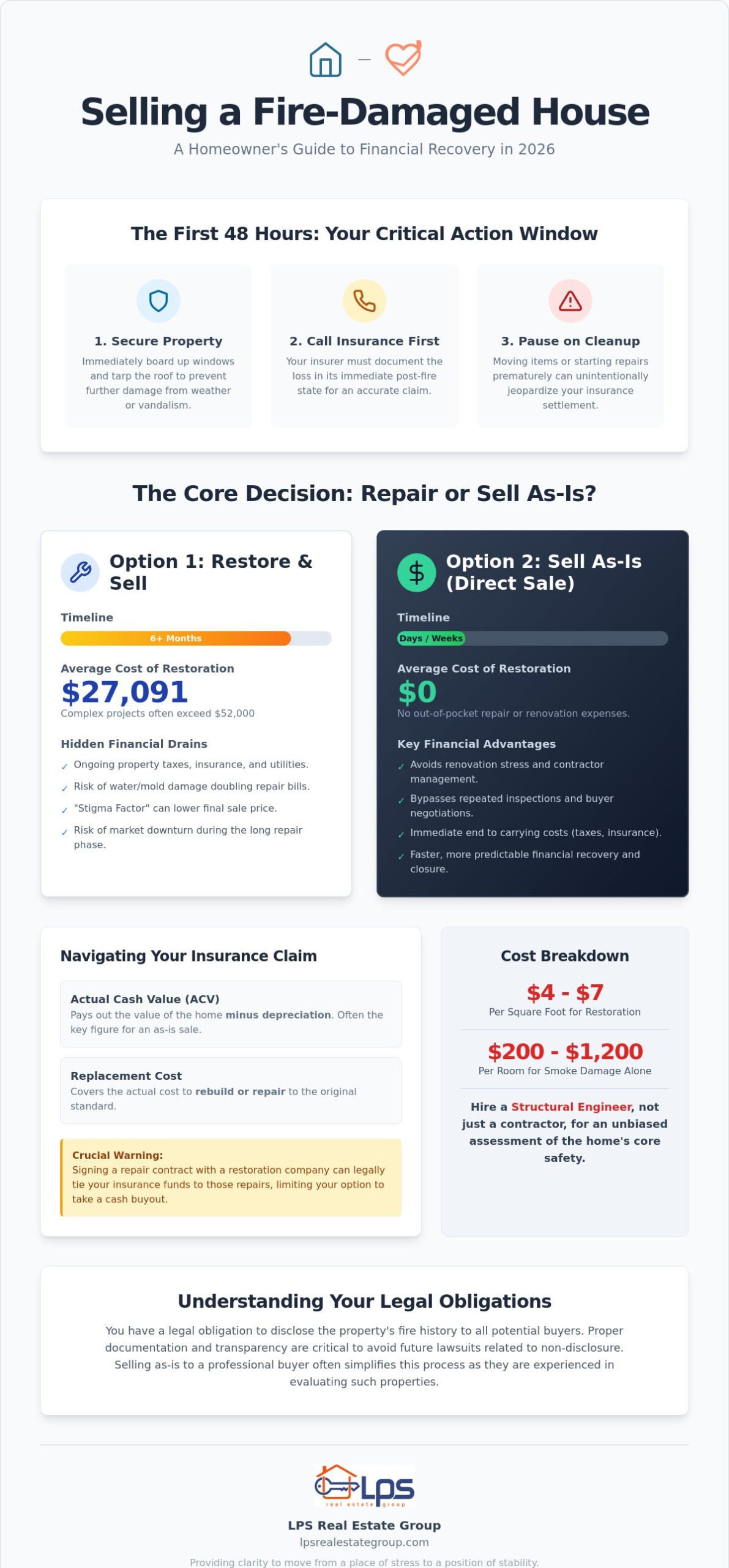
The first 48 hours are a critical window for your financial recovery. This is often called the “48-Hour Rule” because securing the property immediately is the only way to prevent further property damage from weather, vandalism, or theft. You should focus on boarding up broken windows and tarping the roof as soon as the fire marshal clears the site. It’s tempting to call a restoration contractor right away, but your very first call should always be to your insurance company. They need to see the home in its immediate post-fire state to document the loss accurately. If you start cleaning or moving things too soon, you might accidentally jeopardize your claim.
Assessing the Scope of Fire Damage
Damage generally falls into three levels. Minor damage involves smoke and soot that hasn’t penetrated the walls. Moderate damage includes charring on surfaces like flooring or drywall. A total loss occurs when the fire compromises the home’s core safety. To get an honest assessment, hire a structural engineer rather than a general contractor. In the context of fire-damaged real estate, structural integrity refers to the ability of the building’s load-bearing components to safely support the weight of the structure and its occupants without risk of collapse. An engineer provides a neutral report that is vital if you choose to sell fire damaged house without making repairs first.
The Role of the Insurance Adjuster
Your insurance settlement is the foundation of your exit strategy. You’ll likely hear terms like “Actual Cash Value” (ACV) and “Replacement Cost.” ACV pays out the value of the home minus depreciation, while Replacement Cost covers what it actually takes to rebuild. If you intend to sell the property as-is, the ACV payout is often the more relevant figure for your pocketbook. A common trap for sellers is signing a repair contract with a restoration company before they’ve decided whether to stay or leave. Once you sign that contract, your insurance funds may be legally tied to those specific repairs, making it much harder to take a cash buyout and move on to a new chapter.
Evaluating the Financial Impact: Repair vs. Selling As-Is
Deciding whether to rebuild or walk away is a significant financial crossroad. To make an informed choice, you must calculate your “Net Proceeds” for both options. This means looking beyond the surface numbers to see what actually ends up in your bank account. While restoration might seem like it preserves your equity, the hidden costs often tell a different story. Beyond the physical repairs, you have to account for carrying costs like property taxes, utilities, and insurance premiums that continue while the house sits empty. If you choose to sell your home directly, you bypass these mounting expenses and the interest on any financing needed for the project.
There is also a “stigma factor” to consider in the 2026 real estate market. Even a beautifully restored home often sells for less than a house that never experienced a fire. Buyers are naturally cautious, and many will demand a discount to account for the perceived risk of lingering smoke odors or hidden structural issues. With the 2026 market showing slower home price appreciation, spending six months on a restoration might mean finishing your project in a less favorable selling environment. Speed often provides a more predictable financial recovery than a long-term construction project. When Navigating Insurance Claims, it’s helpful to remember that you have the right to settle your claim and sell house as is and move on to your next chapter without completing costly repairs.
The Cost of Fire Restoration
In July 2026, the national average cost for fire damage restoration is approximately $27,091, with complex projects frequently reaching over $52,000. These figures generally fall between $4 and $7 per square foot. However, these estimates often miss the “hidden” water damage caused by fire hoses, which can lead to mold and double your repair bill. Smoke damage restoration alone adds $200 to $1,200 per room. You also face the risk of “scope creep,” where contractors discover more issues once they open up the walls, quickly eating away at your expected profit.
Calculating Your Home’s “Burned” Value
To determine your property’s current worth, use this formula: take the pre-fire market value, subtract the total estimated repair costs, and then subtract a “risk discount” of 10-20%. This discount represents what a buyer expects for taking on the project. In many neighborhoods, a vacant lot where a home was destroyed can still retain 60-80% of its pre-fire value. If the fire resulted in selling a house with code violations, your pool of traditional buyers will shrink significantly. In these cases, the land value often becomes the most stable floor for your sale price. It’s often simpler to sell fire damaged house in its current state rather than managing a complex rebuild that may not return your full investment.
Navigating Insurance Claims and Legal Disclosures
Transparency is your best defense against future legal headaches. When you decide to sell fire damaged house, you must follow the “Golden Rule” of real estate: disclose everything. Even if you’ve scrubbed every inch of soot and the house looks brand new, the history of the fire must be shared with any potential buyer. In 2026, legal standards for disclosure are more stringent than ever. For example, California Civil Code Section 1102 mandates that sellers provide a Transfer Disclosure Statement (TDS) specifically detailing fire history. Failing to mention a fire, even a small one, can lead to the buyer rescinding the sale or pursuing civil liability years after the papers are signed.
A common question homeowners ask is whether they can keep the insurance payout and still sell the property. The answer is usually yes, but it requires careful coordination. If you keep the funds to pay off your mortgage or use them as a down payment on a new home, the sale price of your current house will naturally be lower. This is because the buyer is taking on the financial burden of the repairs themselves. It’s a trade-off between immediate liquidity and a higher final sale price. For those looking for a Step-by-Step Guide to Selling, understanding this balance is the first step toward a successful transaction.
Disclosure Requirements for Fire Damage
Under 2026 real estate regulations, an “as-is” sale doesn’t mean you’re exempt from sharing the property’s history. You need to be specific in your documentation. List things like soot accumulation in the HVAC ducts, melted electrical insulation behind walls, or mold growth caused by the thousands of gallons of water used to extinguish the flames. If your property is in a High Fire Hazard Severity Zone, you may also need to provide documentation of home hardening inspections required by laws like AB 38. Transparency actually increases buyer trust in distressed sales because it removes the fear of the unknown and shows you’re an honest partner in the transaction.
Coordinating with Your Mortgage Lender
Your mortgage lender has a legal interest in the property, and their name will likely be on the insurance check. This usually triggers a “Loss Draft” process where the bank holds the funds in a restricted escrow account. If you plan to sell fire damaged house without repairing it, you’ll need to negotiate with the lender to release those funds to pay down the mortgage balance. If the insurance payout combined with the sale price doesn’t cover what you owe, you might find yourself in a difficult “short sale” scenario. However, a direct cash offer can often simplify this process, providing a clear path to satisfy the lender and allow you to walk away with a clean slate.
Step-by-Step Guide to Selling a Fire-Damaged Property
Moving from the shock of a fire to a successful sale requires a clear, methodical plan. Taking things one step at a time helps reduce the emotional weight of the process and ensures you don’t miss critical financial protections. When you decide to sell fire damaged house, following a structured path allows you to regain control of your timeline and your equity.
- Secure the site and clear belongings: Once the fire marshal gives the all-clear, focus on safety. Board up windows and doors to prevent trespassing. Remove any personal items that are still salvageable, as this helps clear the “mental clutter” and prepares the space for assessments.
- Obtain a detailed “Scope of Loss”: This document from your insurance company is your most valuable tool. It outlines exactly what the insurer believes it will cost to return the home to its pre-fire condition. This report serves as a baseline for your home’s valuation.
- Decide on your exit strategy: You have two primary paths. You can list the property traditionally, which often requires significant cleanup and waiting for a specific type of buyer, or you can choose a direct sale. A direct sale provides immediate liquidity and removes the burden of managing a construction site.
- Prepare the “Distressed Sale” marketing package: Honesty is your best asset here. Your package should include clear photos of the damage, the structural engineer’s report, and the full disclosure of the fire’s origin. This transparency builds trust with professional buyers.
- Review offers with a focus on “Proof of Funds”: Many traditional buyers will struggle to get a mortgage for a burned property. Look for offers that don’t rely on bank financing and have minimal inspection contingencies to ensure the deal actually closes.
Preparing the Property for Viewings
You don’t need to perform a deep scrub to show a fire-damaged home, but you do need to ensure it’s safe for people to enter. Focus on removing loose debris and ensuring floors are stable. For practical advice on managing this stage, you can read our guide on how to sell a house without cleaning it. The most persistent issue is often the smoke odor. While you won’t eliminate it entirely without a full restoration, using professional-grade charcoal bags or ozone machines for a few days before a walkthrough can make the experience much more comfortable for potential buyers.
Finding the Right Buyer for a Burned Home
The buyer pool for a fire-damaged property is smaller than a standard sale. Traditional families usually avoid these homes because conventional lenders and FHA programs often reject properties with significant structural or safety issues. This leaves you with “Fix-and-Flip” investors or professional home buying companies. The benefit of working with companies that buy houses for cash is that they use private capital. They aren’t waiting on a bank’s approval, which means they can see the value in the land and the potential of the structure exactly as it stands today. If you’re looking for a simple, honest way to move forward, you can request a fair cash offer to see if an as-is sale is the right fit for your situation.
Why a Direct Cash Sale is Often the Best Path Forward
After a fire, the mental and physical toll is often as exhausting as the flames themselves. You’ve spent weeks talking to adjusters and engineers, and the thought of managing a six-month restoration project can feel like a secondary disaster. Choosing to sell fire damaged house to a direct buyer acts as a relief valve. It allows you to bypass the “inspection headache” that typically stalls traditional real estate transactions. While a standard buyer’s lender will likely panic at the sight of charred beams or smoke-stained drywall, a direct cash buyer looks at the underlying value and the potential of the land. Just as homeowners who need to sell a house with foundation issues often hit a lender wall with traditional buyers, fire-damaged property owners face the same financing barriers that make a cash sale the most practical path forward.
Speed is a significant form of relief in these situations. In the 2026 market, a professional restoration can easily take half a year when you factor in permitting and contractor backlogs. A direct sale can often close in as little as 7 to 14 days. This speed to liquidity provides the funds you need to secure a new home and move your family forward without the weight of an uninhabitable property. Because there are no real estate agent commissions or closing costs, you keep a larger portion of the combined insurance payout and sale price, ensuring your financial recovery is as complete as possible. If you want to understand all the strategic advantages of bypassing repairs entirely, our complete 2026 guide to selling your house as is walks through every consideration in detail.
The LPS “As-Is” Advantage
At LPS Real Estate Group, we specialize in properties that others might consider too difficult to handle. We have the expertise to acquire homes with severe structural damage that many iBuyers and traditional investors won’t touch. We don’t ask you to clear out the remaining debris or resolve complex code violations before we close. Our team handles the logistics and the “mess” so you don’t have to step foot back inside the property if you don’t want to. You can learn more about how we simplify the transaction in our definitive 2026 homebuyer’s guide.
Creative Solutions for Low-Equity Situations
If the fire was severe and your insurance payout doesn’t fully cover your mortgage, you might find yourself in a low-equity or “underwater” situation. Traditional sales often fail here because there isn’t enough cash to pay off the bank. We offer creative financing solutions, such as “Subject-To” acquisitions, where we can take over the responsibility of the mortgage payments. This strategy protects your credit score and solves the mortgage problem without requiring you to bring cash to the closing table. We’re committed to finding an ethical, patient solution that respects your specific circumstances. Get a fair, empathetic offer for your fire-damaged house today.
Moving Forward with Confidence
Recovering from a property fire is about more than just rebuilding walls; it’s about reclaiming your peace of mind. You now have the tools to evaluate whether a months-long restoration or an immediate sale serves your family best. Remember that transparency in your disclosures and a clear understanding of your insurance payout are the keys to a successful transition. Whether you’re dealing with minor smoke or significant structural charring, you don’t have to carry the burden of the property’s condition alone.
If the thought of managing contractors and inspections feels like too much, we’re here to offer a simpler path. You can Request a Fair Cash Offer for Your Fire Damaged House to see how an as-is sale can provide the clean break you deserve. We specialize in helping homeowners sell fire damaged house without the need for any repairs. Our process is designed to be transparent and low-stress, allowing you to close in as little as 7 days with zero commissions or hidden fees. You’ve been through a difficult season, but a fresh start is closer than it feels. We’re ready to listen and help you find the best way forward.
Frequently Asked Questions
Can I sell my house if it has lingering smoke damage but no fire charring?
Yes, you can sell a property that only has smoke damage. Even without structural charring, smoke particles penetrate drywall, upholstery, and insulation, often requiring professional remediation that costs between $200 and $1,200 per room. You must disclose this history to potential buyers to protect yourself from future liability. A cash buyer can often take on this specialized cleaning for you, allowing you to walk away without managing the restoration process.
Do I have to pay my mortgage if my house is uninhabitable due to fire?
You are still legally required to make your mortgage payments even if the home is currently uninhabitable. Your mortgage is a contract with the lender that remains active regardless of the property’s condition. However, you can often use your insurance payout to pay down the balance or negotiate a “forbearance” with your lender. If the debt becomes a burden, seeking a direct sale is a common way to satisfy the bank and move on.
Can I keep the insurance money and sell the house “as-is” to an investor?
You can typically keep the insurance settlement and sell the property in its current state, provided your mortgage lender approves the arrangement. Since the lender has a financial interest in the home, they are usually named on the insurance check. By choosing to sell fire damaged house to an investor, you accept a lower sale price in exchange for keeping the insurance funds for your next home or other recovery needs.
Will a traditional bank provide a mortgage for a buyer of a fire-damaged home?
Most traditional banks will not issue a mortgage for a house with significant fire or structural damage. Lenders require a property to be safe, secure, and habitable before they will release funds. This reality significantly limits your buyer pool to those who can pay cash or use private financing. These buyers don’t rely on conventional appraisals, which is why they can close on properties that traditional buyers cannot touch.
How much does fire damage typically reduce a home’s market value?
Fire damage generally reduces a home’s value by the estimated cost of repairs plus a “risk discount” that often ranges from 10% to 20%. This discount compensates the buyer for taking on the uncertainty of hidden issues like soot in the HVAC or water damage behind the walls. In many desirable neighborhoods, a vacant lot where a home once stood can still retain 60% to 80% of its original pre-fire market value.
What documents do I need to provide when selling a house after a fire?
You should provide a detailed “Scope of Loss” from your insurance company and any structural engineering reports you’ve obtained. Legally, you must complete a Transfer Disclosure Statement (TDS) that details the fire’s history and the extent of the damage. Providing these documents upfront builds trust with buyers and ensures that the transaction remains transparent, reducing the likelihood of legal disputes after the sale is finalized.
How long does it take to close on a fire-damaged house with a cash buyer?
Closing with a cash buyer typically takes between 7 and 14 days. This timeline is much faster than a traditional sale because there is no need for bank-mandated appraisals or lengthy mortgage underwriting. When you sell fire damaged house directly, you skip the hurdles that usually stall a closing. This speed allows you to access your equity quickly so you can focus on your family’s relocation and recovery.
Is it better to demolish a fire-damaged house before selling the land?
It isn’t always financially beneficial to demolish the house yourself. Professional lot clearing and debris removal can cost between $20,000 and $50,000. Many professional buyers prefer to handle the demolition as part of their own construction process. Selling the home in its current state saves you the upfront cost and the logistical stress of hiring contractors and pulling demolition permits during an already difficult time.