

What if the biggest barrier to your home sale isn’t actually the crack in your basement wall, but the bank’s stack of paperwork? When you try to sell house with foundation issues, you often hit a “lender wall” where traditional buyers simply can’t get financing, no matter how much they love your home. It’s a frustrating cycle that leaves many homeowners feeling trapped by repair estimates that can easily soar past $30,000 in 2026. You shouldn’t have to choose between a massive renovation project and a failed sale.
We understand that seeing those structural reports can feel overwhelming, especially when you just want to move on to your next chapter. This guide will show you how to manage these complexities without losing your shirt or your sanity. We’ll break down the real costs of 2026 repairs, explain your legal disclosure requirements, and explore how to sell your property as-is for a fair price. You’ll find a clear path forward that prioritizes your peace of mind and provides the fresh start you deserve.
Key Takeaways
- Learn why traditional mortgages often fail for homes with structural cracks and how you can bypass these common financing hurdles.
- Discover how to sell house with foundation issues without spending tens of thousands on major repairs like piering or slab jacking.
- Understand your 2026 legal disclosure requirements to protect yourself from future lawsuits while maintaining full transparency.
- Use a simple framework to decide if repairing your home offers a real return on investment or if it leads into a “repair trap.”
- Explore as-is acquisition solutions that allow you to walk away with a fair price and a fresh start, regardless of the home’s condition.
Recognizing Foundation Issues and Their Impact on Your Sale
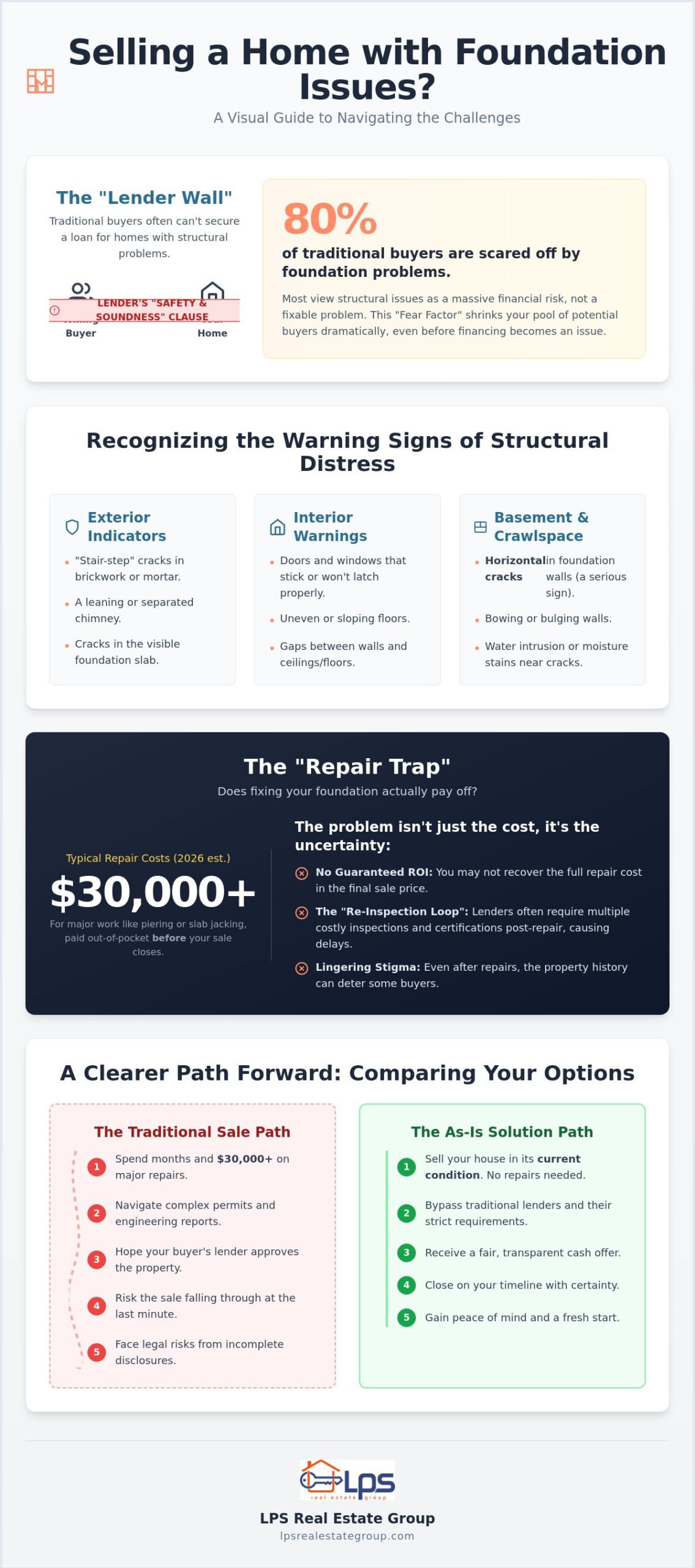
Discovering a crack in your foundation often feels like a heavy weight on your shoulders. It’s helpful to understand that foundation issues exist on a broad spectrum. Some homes experience minor settling cracks that are purely cosmetic, while others face major structural shifts that require immediate intervention. To understand the root of these changes, it’s useful to ask: What is foundation settlement? This natural process occurs when the soil beneath your home shifts, but when that movement becomes uneven, the “Red Flag” effect begins. Real estate data suggests that foundation problems scare off roughly 80% of traditional buyers, who often view structural issues as an endless money pit rather than a fixable problem.
The impact goes beyond just finding a buyer. Structural integrity is the literal bedrock of your home equity. When you try to sell house with foundation issues, the appraised value often takes a sharp hit. Appraisers must account for the cost of repairs and the perceived risk to the next owner, which can lead to deductions that feel unfair given the years of care you’ve put into the property. Living with known structural distress also carries a significant emotional toll. Every time a door sticks or a new gap appears in the drywall, it serves as a stressful reminder of a problem that feels too big to solve alone.
Common Signs of Structural Distress
- Exterior indicators: Look for “stair-step” cracks in your brickwork or mortar. A leaning chimney is another serious sign that the ground is shifting beneath the home’s footprint.
- Interior warnings: Pay attention to doors that suddenly stick or won’t latch. Uneven floors, gaps between the wall and the ceiling, and fresh cracks in the drywall are common red flags.
- Basement and crawlspace clues: Horizontal cracks are particularly concerning as they often indicate that the walls are beginning to bow inward.
The Financial Reality of Foundation Problems
Traditional appraisals often take a “worst-case scenario” approach to structural defects. Rather than calculating the exact cost of a fix, they may apply a blanket percentage deduction to the home’s value to account for the risk. This financial hit is compounded by the hidden costs of waiting. Minor hairline cracks can allow moisture to seep in, leading to expensive mold remediation or water damage that wasn’t there a year ago. Much of this damage is driven by a specific environmental force. Hydrostatic pressure is the force exerted by stagnant water against your foundation walls, which often leads to bowing, cracking, and eventual structural failure. When you sell house with foundation issues to a traditional buyer, these technical problems often become insurmountable hurdles for their lenders, even if the buyer is personally willing to take on the project. Homeowners in this situation often find that their property qualifies as a distressed property that can still be sold quickly and fairly without funding major renovations out of pocket.
The Lender Wall: Why Traditional Buyers Can’t Close
You’ve found a buyer who loves your home’s character. They’ve made a great offer, and you’re already starting to pack your boxes. Then, the appraisal report arrives. In many cases, a willing buyer doesn’t guarantee a successful closing because the lender has the final say. When you try to sell house with foundation issues, you’re not just selling to a person; you’re selling to a bank’s risk department. If the property doesn’t meet their strict criteria, the deal can vanish overnight.
Underwriters rely heavily on what’s known as the “Safety and Soundness” clause. This rule requires the property to be structurally sound to serve as viable collateral for the mortgage. If an appraiser notes significant cracks, bowing walls, or active shifting, the loan application often hits a dead end. This is a primary reason why traditional buyers can’t close on homes with structural damage. The bank sees a potential liability that could cost more than the home’s down payment, and they’re rarely willing to take that gamble.
FHA, VA, and USDA Loan Requirements
Government-backed loans are popular with first-time buyers, but they carry the strictest structural standards. In 2026, HUD-approved appraisals (which typically cost between $300 and $600) specifically look for signs of foundation failure. If the appraiser marks the file “subject to repairs,” the lender won’t release funds until a licensed professional completes the work and provides a certification. This creates a frustrating “re-inspection loop” where you’re forced to pay for repairs out of pocket before you’ve even received your sale proceeds.
Buyer Psychology and the “Fear Factor”
A foundation report can turn a “dream home” into a “money pit” in a matter of minutes. Most conventional buyers use their savings for the down payment and don’t have an extra $25,000 sitting in the bank for structural piers. There’s also a common misconception that listing a home “as-is” on the MLS bypasses these lender rules. While “as-is” warns the buyer, it doesn’t waive the bank’s requirements for a safe and sound structure. If you want to avoid the stress of deals falling through at the last minute, you might consider an as-is property acquisition to bypass the lender wall entirely. This allows you to move forward without waiting for a bank’s permission to sell your own property.
Repair vs. Sell As-Is: A Decision Framework
Deciding whether to fix structural problems or list your property in its current state is a deeply personal choice. It’s helpful to look at this as a balance between the potential for a higher sale price and the very real risks of a major construction project. Calculating the Return on Investment (ROI) for foundation repairs isn’t as simple as adding the repair bill to your asking price. While a structural fix might make the home eligible for traditional financing, it doesn’t always translate to a dollar-for-dollar increase in equity. In many cases, the “Repair Trap” becomes a reality. This happens when a contractor begins work on a foundation wall only to discover secondary, expensive issues like collapsed sewer lines or electrical damage hidden behind the drywall.
Your personal timeline should be a primary factor in your decision. In 2026, the lead time for reputable structural contractors and the necessary city permits can easily stretch your selling timeline by 3 to 6 months. If you are relocating for a new job or need to settle an estate quickly, this delay represents a significant emotional and financial cost. Choosing to sell house with foundation issues as-is provides a level of certainty that a construction project cannot match. A lower as-is price is often more profitable in the long run because it eliminates the risk of cost overruns and the holding costs of a house that sits off the market for half a year.
When Repairing Makes Sense
There are specific scenarios where making the repair is the logical path forward. If the issues are minor, such as small settling cracks that can be fixed with epoxy injections for under $1,000, the boost in marketability is usually worth the effort. Additionally, if you choose a contractor who offers a lifetime transferable warranty, you provide a powerful safety net for traditional buyers. Before you sign any contracts, it’s wise to hire an independent structural engineer. They provide an unbiased report on what actually needs to be fixed, ensuring you don’t pay for unnecessary “upgrades” suggested by a repair company.
The Advantages of an As-Is Cash Sale
An as-is cash sale offers a streamlined exit strategy that prioritizes your peace of mind. By working with a direct buyer, you eliminate the need for traditional inspections, bank appraisals, and the endless loop of contractor bids. This path also removes the burden of selling a house without cleaning it or spending your weekends making cosmetic fixes to mask structural flaws. When you sell house with foundation issues to a cash acquisition group, you can often close in a matter of days. This allows you to walk away from the stress of the property and move on to your next chapter with your equity in hand and your schedule intact. If you want a deeper understanding of this approach, our complete guide to selling your house as is in 2026 walks through every step of the process and what to expect at closing.
Navigating Legalities: Disclosure and Inspections
When you decide to sell house with foundation issues, your first priority should be total transparency. In 2026, real estate disclosure laws are strictly enforced to protect consumers and lenders. You have a legal obligation to provide a written statement listing known material defects, including structural problems, before a buyer signs an offer. Failing to do so can lead to lawsuits for breach of contract or fraud. While it might feel counterintuitive to highlight your home’s flaws, full disclosure is actually your strongest shield against future litigation. It builds a foundation of trust that keeps the transaction moving forward.
Professional buyers and investors appreciate honesty. By creating a comprehensive disclosure packet, you show that you aren’t hiding anything. This packet should include any repair quotes you’ve received, historical photos of the cracks, and most importantly, an official report from a licensed professional. Providing this information upfront prevents the “surprise” factor that often causes traditional deals to collapse during the inspection period.
The Structural Engineer vs. Foundation Contractor
It’s helpful to understand the difference between a contractor and an engineer. A foundation repair company is often motivated by a sales commission. They might suggest $30,000 in piering when a simpler solution exists. In contrast, a structural engineer provides an unbiased assessment because they don’t perform the actual repair work. Paying for an engineer’s report first allows you to justify your asking price with data rather than guesswork. You can present this report to potential buyers to show exactly what’s happening beneath the floorboards, which removes the “fear of the unknown” that often kills deals.
Protecting Yourself Post-Sale
Once you find a buyer, your sales contract must include a clear “As-Is” clause. This statement confirms that the buyer is aware of the structural distress and accepts the property in its current condition. Much like selling a house with code violations, providing a paper trail of transparency is your best defense. You should have the buyer initial every page of your disclosure report. This ensures they can’t claim later that they weren’t informed about the specific issues. Homeowners who choose to sell house as is often find that a well-documented disclosure packet dramatically reduces their legal exposure after closing. If you’d like to skip the stress of legal paperwork and engineering reports, you can request a fair cash offer for your property today. We handle the heavy lifting and look past the structural challenges to find the value in your home, allowing you to sell house with foundation issues without the typical legal headaches.
Strategic Solutions with LPS Real Estate Group
LPS Real Estate Group views a foundation crack as a solvable puzzle rather than a deal-breaker. When you choose to sell house with foundation issues to us, you’re partnering with a team that looks past the structural distress to the potential of the property. Our “Compassionate Expert” approach means we take the time to listen to your goals first. We understand that you aren’t just selling a building; you’re looking for relief from a stressful situation. By taking on the repairs ourselves, we buy the house and the problems that come with it, allowing you to walk away with your equity and your peace of mind intact.
Many homeowners worry that an as-is offer means leaving too much money on the table. However, it’s helpful to look at your “net” profit. Once you subtract a $25,000 repair bill, 6% realtor commissions, and several months of holding costs, a traditional sale often puts less money in your pocket than our direct offer. We pride ourselves on total transparency. This means you won’t face hidden fees, surprise commissions, or last-minute price drops once the contract is signed. Our goal is to provide a sense of relief, not more paperwork.
Our Direct Cash Purchase Process
We’ve designed our acquisition process to be as low-stress as possible. It moves at your pace, not the bank’s. This eliminates the uncertainty that often plagues traditional sales.
- Step 1: Simple Consultation. We start with a conversation to understand your specific situation and the home’s current condition. There’s no need to clean or make cosmetic fixes before we talk.
- Step 2: Data-Driven Offer. We provide a fair offer based on current market data that accounts for the foundation in its current state. You’ll see exactly how we reached our numbers.
- Step 3: Fast Closing. Because we use private funds, we don’t have to wait for lender approval or government-backed appraisals. We close on your timeline, whether that’s in ten days or two months.
Creative Finance: A Path to a Better Price
Sometimes, a standard cash offer isn’t the best fit for your financial goals, especially if you have high equity but don’t want to accept a fire-sale price. We specialize in creative finance solutions that most traditional buyers don’t understand. For example, a “Subject-To” purchase or seller financing can often net you a higher total price than a cash buyout. These strategies allow us to work around the high cost of repairs by structuring the deal to provide you with ongoing income or a larger final payout. This personalized exit strategy is designed to respect your financial needs while solving the structural hurdles that have kept other buyers away. If you’re ready to sell house with foundation issues without the traditional headaches, we’re here to help you find the right path forward.
Your Path to a Fresh Start
Structural challenges don’t have to define your home’s future or your financial stability. As we’ve explored, the key is understanding your options and choosing the route that best fits your timeline and goals. Whether you decide to navigate the traditional market with a structural engineer’s report or seek the speed of a direct sale, you now have the tools to make an informed choice. You don’t have to stay stuck in a cycle of contractor bids and lender denials.
LPS Real Estate Group is here to act as your trusted advisor throughout this transition. We specialize in complex structural and probate situations, offering direct property acquisitions that require no repairs or cleaning from you. Our process is built on transparent, no-pressure consultations designed to find the best outcome for your specific needs. When you’re ready to sell house with foundation issues without the typical stress, we’re ready to listen and help you move forward.
Take the first step toward your next chapter today. Get a fair as-is offer for your house today and discover how simple a structural sale can actually be. You deserve a clear path forward and a partner who values your peace of mind as much as you do.
Frequently Asked Questions
Do I have to fix foundation issues before selling my house?
No, you aren’t legally required to make repairs before selling your home. You have the right to sell the property in its current condition, though you must provide a full written disclosure of the issues to any potential buyer. Many homeowners choose to sell as-is to avoid the stress of managing contractors and the risk of repair costs spiraling beyond their initial budget.
How much do foundation repairs typically cost in 2026?
In 2026, the national average for foundation repair is approximately $5,179, with most projects falling between $2,224 and $8,134. However, major structural work is much more expensive. If your home requires the installation of piers, you should expect costs to range from $15,000 to $30,000. These prices have risen by roughly 15-25% since 2020 due to higher labor and material costs.
Can a buyer get a mortgage on a house with foundation problems?
Securing a traditional mortgage for a home with structural damage is a significant challenge. Lenders for FHA, VA, and USDA loans require the property to be structurally sound to protect their investment. If an appraiser identifies foundation failure, the loan will likely be denied or marked “subject to repairs.” This means the sale cannot close until a licensed professional completes the work and provides a certification.
Will homeowners insurance cover the cost of foundation repair?
Standard homeowners insurance policies rarely cover foundation repairs. Most insurance providers view foundation shifts as a result of natural settling or earth movement, which are typically excluded from coverage. You might only receive assistance if the damage was the direct result of a sudden, covered event, such as a major plumbing leak or a fire. It’s best to review your specific policy with your agent.
How much does a foundation issue devalue a home?
A foundation problem typically reduces a home’s market value by 10% to 25%. This reduction is often greater than the actual cost of the repair itself. Buyers expect a discount to compensate them for the risk, the time spent managing construction, and the difficulty of obtaining financing. When you sell house with foundation issues, pricing the home accurately from day one is essential to attract serious interest.
What is the best way to sell a house with a cracked foundation fast?
The fastest method is to sell house with foundation issues to a cash acquisition group. This strategy removes the need for traditional appraisals and the strict structural requirements of mortgage lenders. You can often close the sale in a matter of days rather than months. It’s a straightforward solution for homeowners who want to move on without the burden of construction projects or deal-killing inspections. If your home has multiple challenges beyond the foundation, learning how to sell a distressed property quickly and fairly can open up additional options that traditional buyers and agents rarely discuss.
Is it illegal to sell a house with foundation issues without disclosing them?
Yes, failing to disclose known structural defects is illegal in all fifty states. Even if you sell the property “as-is,” you’re legally required to inform the buyer about any foundation problems you’re aware of. Deliberately concealing these issues can lead to lawsuits for misrepresentation or fraud. In some states, you could even be held liable for triple the amount of the damages if a court finds you acted in bad faith.
What happens if a home inspection reveals foundation issues during a sale?
If an inspection reveals foundation cracks, the buyer will typically pause the transaction to seek a structural engineer’s opinion. They may then ask for a price reduction or require you to pay for the repairs before the deal moves forward. This often leads to a “re-inspection loop” where the sale is delayed for weeks while you negotiate the costs and find a reputable contractor to perform the work.