

What if the most effective way to protect your future isn’t winning an argument about the listing price, but finding a path that offers you both a clean break? When you decide to sell house during divorce, it often feels like every decision is a potential battleground. You’re likely worried about making mortgage payments while the legal process drags on, or perhaps you’re anxious that the property will sit on the market for months while the conflict grows. It’s a heavy burden to carry when you’re already trying to process a major life transition.
We believe that your home should be a source of stability, not a source of stress. This 2026 guide is designed to help you handle the legal, financial, and emotional complexities of this transition while protecting your credit and your equity. We will explore how to manage the latest tax implications, account for mortgage interest rates currently averaging between 6.58% and 6.75%, and evaluate options like as-is sales that allow you to skip the stress of open houses and repairs entirely. By the end of this article, you’ll have a clear roadmap for a fair distribution of equity and a fresh start.
Key Takeaways
- Understand how your state’s property laws and your specific divorce decree impact the timeline and division of your home’s equity.
- Compare the long-term financial reality of a spousal buyout against the emotional relief of a “clean break” through a total sale.
- Learn how to manage capital gains tax exclusions and mortgage releases so you can safely sell house during divorce without damaging your credit.
- Discover how selling your property “as-is” eliminates arguments over repair costs and the stress of managing open houses with an ex-spouse.
- See how working with a neutral, direct buyer can simplify the logistics of your equity split, allowing you to focus on your family’s next chapter.
Understanding Your Real Estate Options in a Divorce Decree
The family home is rarely just a building; it’s a collection of memories and a significant financial pillar. In 2026, with the national median home price reaching $429,300, the stakes of a property division have never been higher. When you prepare to sell house during divorce, the first step is understanding the legal framework of your state. Most states follow the principle of equitable distribution, where assets are divided fairly but not always equally. However, if you live in one of the Community Property States, marital assets are typically split 50/50.
Your divorce decree will serve as the roadmap for this transition. It doesn’t just say who gets what; it often dictates a strict timeline for the sale. This might include a deadline to list the property or a specific date by which one spouse must buy out the other. In 2026, the house remains the most complex asset to liquidate because of current market conditions. With 30-year mortgage rates hovering between 6.58% and 6.75%, many couples find that the cost of maintaining two separate households while waiting for a traditional sale is financially draining. This pressure often makes a quick, efficient sale the most logical path forward.
The presence of children adds another layer of complexity. Courts often prioritize the “best interests of the child,” which might mean allowing the primary caregiver to remain in the home for a set period. This can delay the equity split for years, tying up capital that both parties might need to start their new lives. Balancing these emotional needs with the financial reality of the property is a delicate process that requires clear communication and professional guidance.
Marital vs. Separate Property: Who Owns the Equity?
Determining who owns the equity starts with when the home was purchased. If one spouse owned the home before the wedding, it might be considered separate property. This distinction often blurs over time. If you used joint bank accounts to make mortgage payments or paid for a 2025 renovation with marital funds, you’ve “commingled” the asset. This often transforms separate property into a marital asset that must be divided between both parties.
Court-Ordered Sales: What Happens When You Can’t Agree?
If you and your ex-spouse cannot reach an agreement on the listing price or the choice of an agent, a judge may intervene. This usually results in a court-ordered partition sale. These sales are often less than ideal because they strip away your control over the process and can lead to higher legal fees. A voluntary sale to a neutral third-party buyer is often a better path. It prevents further legal escalation and ensures both parties receive their share of the equity without the public spectacle of a court mandate.
Selling vs. Buying Out Your Spouse: Weighing the Pros and Cons
Deciding whether to stay or go is one of the most emotional hurdles you’ll face. While one spouse might feel a deep attachment to the property, the financial landscape of 2026 makes a buyout more challenging than in previous years. To sell house during divorce is often the most direct path to a “Clean Break,” allowing both parties to liquidate their equity and move forward without lingering financial ties. This strategy eliminates the need for ongoing negotiations over mortgage payments or property maintenance.
A spousal buyout involves one person paying the other for their share of the home’s equity. This sounds simple but usually requires refinancing the entire mortgage into a single name. With 30-year fixed rates currently between 6.58% and 6.75%, the monthly payment on a new loan could be significantly higher than your original joint mortgage. You must also consider the tax implications. According to IRS Publication 523, the capital gains exclusion limits, $250,000 for individuals or $500,000 for married couples, depend heavily on the timing of your sale and your residency status. If you sell after the divorce is finalized, you might lose the higher joint exclusion.
The Spousal Buyout: Can You Afford to Stay?
Refinancing in today’s market requires a strong solo credit score and enough income to cover the new, higher interest rates alone. Many people underestimate the hidden costs of being a single homeowner. Property taxes, insurance, and the national average real estate commission of 5.7% are heavy burdens on a single income. If the numbers don’t add up, looking into creative finance solutions can help you find a middle ground that respects both parties’ needs without the stress of a traditional bank loan.
Deferred Sale: When Keeping the House Makes Sense
Sometimes, couples choose a deferred sale, often called a “Bird’s Nest” arrangement, where the children stay in the home and the parents rotate in and out. While this provides stability for kids, it keeps your credit scores linked. Co-owning a property after the divorce is finalized carries high risks. If your ex-spouse misses a payment or fails to maintain the property, your financial future remains at risk. It’s vital to set a firm future sale date within your legal agreement to ensure this arrangement doesn’t become a permanent source of conflict.
Navigating Legal and Financial Hurdles of a Divorce Sale
Separating your life from a shared property involves more than just finding a buyer. It requires untangling a web of legal obligations and financial ties that can haunt your credit for years if handled incorrectly. When you sell house during divorce, you must distinguish between the title, which defines who owns the house, and the mortgage, which defines who owes the debt. These are two separate legal entities. Many couples overlook the fact that a court order to sell doesn’t automatically release you from your contract with the bank. Clear communication with your lender is the only way to ensure your financial health remains protected throughout the transition.
You also need to check for liens or judgments that might be attached to only one spouse. In 2026, lenders are increasingly strict about financial transparency during a separation. If one partner has unpaid debt or a legal judgment against them, it could prevent the sale from closing or significantly reduce the equity intended for the other spouse. Identifying these hurdles early allows you to address them before they derail a potential sale. Handling these obstacles with transparency ensures that both parties can walk away with their financial reputations intact.
The Quitclaim Deed Trap
A common mistake is believing that a quitclaim deed solves the problem. Signing this document removes your name from the property title, but it does nothing to remove your liability for the mortgage loan. If your ex-spouse stays in the home and misses a payment, your credit score will suffer the consequences. To truly protect yourself, you need a full mortgage assumption or a complete payoff through a sale. Seeking real estate guidance for divorce sales early in the process ensures you don’t fall into these common traps.
Tax Implications: Protecting Your Equity
The IRS offers a significant benefit known as the Section 121 exclusion, but the timing of your divorce decree can change how much you keep. For 2026, the IRS allows an exclusion of up to $250,000 in capital gains for a single filer and up to $500,000 for a married couple filing jointly. If you finalize the divorce before the sale is complete, you might only qualify for the lower individual limit. Timing the sale to occur while you are still legally married can often save you thousands of dollars in taxes. It’s a practical step that ensures more of your hard-earned equity stays in your pocket as you move toward your future.
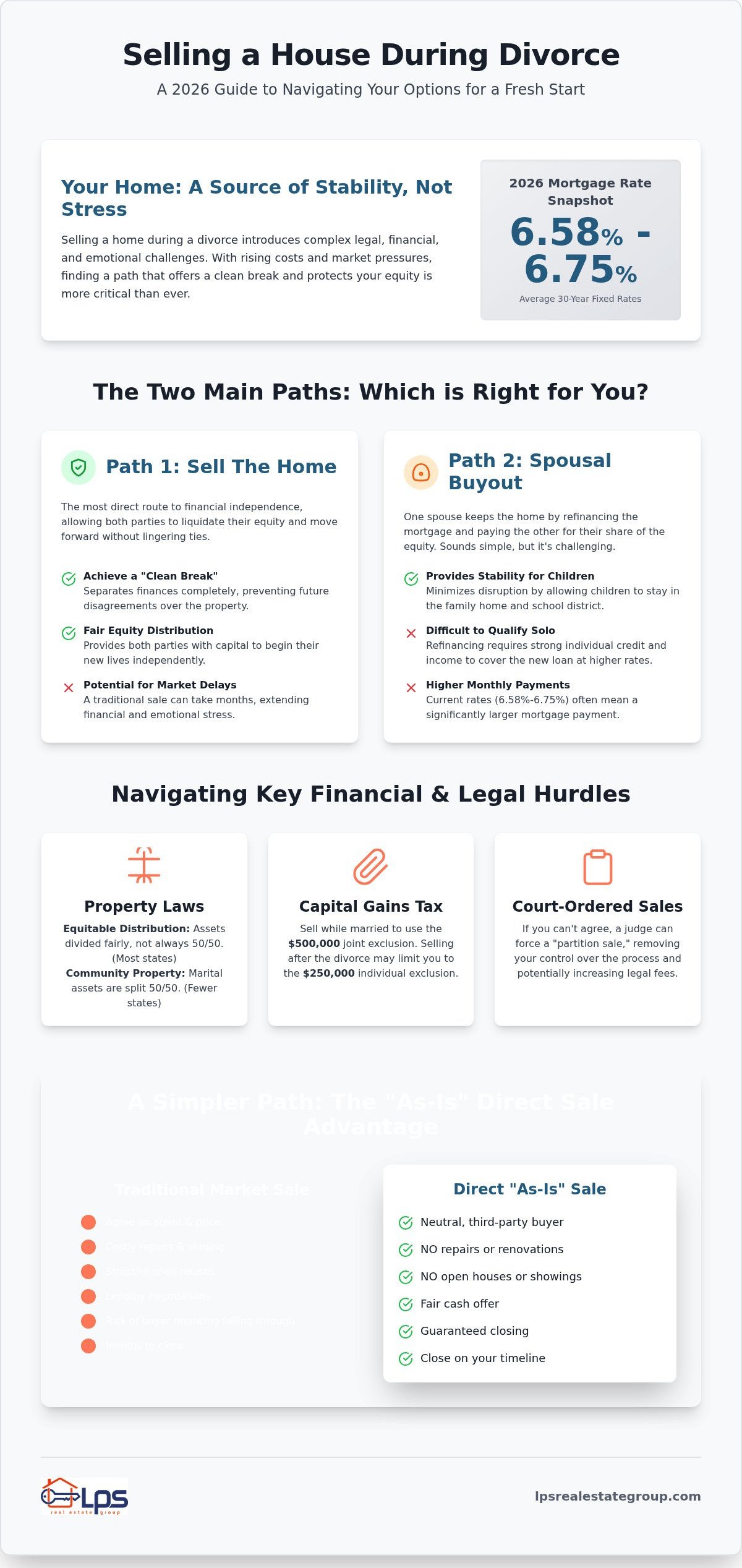
Why a Direct Sale Often Outperforms the Traditional Market During Divorce
Traditional real estate transactions are designed for unified households, not for parties in the midst of a legal separation. When you choose to sell house during divorce through the open market, you’re essentially entering into a high-stakes business partnership with someone you are trying to distance yourself from. This often results in listing friction, where every decision, from the choice of paint color to the dates of an open house, becomes a potential point of contention. The process requires a level of daily cooperation that many couples simply find impossible to maintain during a stressful move.
In July 2026, the housing market shows a 4.5-month supply of inventory. This means the average home sits much longer than it did in previous years. For a divorcing couple, four or five months of holding costs like property taxes, insurance, and mortgage interest can eat away at the equity you’re trying to split. A direct sale bypasses this waiting period and offers total privacy. There are no “For Sale” signs in the front yard to alert the neighbors, and no public MLS history showing the interior of your home during a vulnerable time. This allows you to close the chapter in weeks rather than months.
Repairs are frequently the largest source of conflict in a divorce sale. If the HVAC system fails or the roof needs work, deciding who pays for those upgrades can stall the legal process. By choosing selling your house as-is, you bypass these debates entirely. The property is purchased in its current condition, which means no arguments over repair bills and no need for the average 5.7% agent commission. It’s a straightforward path that prioritizes your peace of mind over a lengthy renovation project.
Avoiding the Listing Friction
Open houses can quickly become flashpoints for marital conflict, especially when one spouse is still living in the home while the other has moved out. A direct sale removes the need for constant communication between estranged parties regarding cleaning schedules and visitor access. Instead of managing multiple fickle buyers who may ask for credits or repairs, you deal with a single, certain offer. This simplicity reduces the emotional toll on everyone involved, including children who may be sensitive to the disruption of frequent showings.
Financial Certainty in a Volatile 2026 Market
With 30-year mortgage rates averaging 6.58% to 6.75% in mid-2026, many retail buyers are struggling to secure financing. A guaranteed cash offer removes the risk of a deal falling through at the last minute because of a buyer’s loan denial. This provides your legal team with a concrete equity figure to work with, making the final settlement much simpler to calculate and finalize. If you are looking for a neutral and reliable exit, you can request a direct cash offer to see how a simplified sale can help you move forward.
Moving Forward: How LPS Real Estate Group Simplifies Your Transition
When you’re ready to sell house during divorce, the last thing you need is another person to negotiate with or a mountain of extra paperwork. LPS Real Estate Group provides a transparent and empathetic alternative to the traditional market. We understand that this isn’t just a business transaction; it’s a major life transition that requires patience and integrity. Our goal is to provide a sense of relief by acting as a reliable, capable partner that handles the heavy lifting so you can focus on your family’s future.
We specialize in as-is property acquisition, which means you don’t have to worry about cleaning, staging, or making expensive repairs before you move. In a 2026 market where homes are sitting for an average of four to five months, a direct cash offer provides the speed and certainty you need to finalize your equity split. Even if your situation involves low equity or complex debt, we offer creative finance solutions designed to help both parties walk away with a fair outcome and their credit scores intact.
A Neutral Third-Party for a Clean Break
Working with a direct buyer eliminates the friction that often comes with choosing an agent or setting a listing price. We act as a neutral third party, providing a clear and documented process that both spouses can review and trust. Because we buy properties directly, you avoid the national average 5.7% commission and the typical closing costs that eat into your final proceeds. This ensures that a larger portion of the home’s value stays with you and your ex-spouse. If you’re exploring your options, it’s helpful to research companies that buy houses for cash to see how a streamlined sale can protect your financial interests.
Next Steps: Get Your Fair Offer Today
Our process is designed to be steady and methodical, ensuring you never feel rushed or overwhelmed. It starts with a simple conversation where we listen to your specific needs and evaluate the property’s current condition. You’ll receive a straightforward offer without the pressure of open houses or fickle buyers. When you choose to sell house during divorce with a direct buyer, you gain the peace of mind that comes with a certain closing date and a clean break from the property. You don’t have to navigate this real estate hurdle alone; we’re here to provide the clarity and personalized care you deserve as you move toward your next chapter.
Taking the Next Step Toward Your Fresh Start
Deciding how to sell house during divorce is a significant milestone in reclaiming your independence. Throughout this guide, we’ve looked at the importance of understanding your state’s property laws and the 2026 tax implications to protect your equity. Whether you choose a spousal buyout or a total sale, prioritizing your financial health and emotional well-being is essential. By choosing a path that reduces conflict, such as a direct sale, you can avoid the stress of repairs and the uncertainty of the traditional market.
LPS Real Estate Group is here to act as your trusted advisor during this complex time. We specialize in resolving complex real estate hurdles and offer direct as-is acquisitions that require no repairs or showings. Our fast, transparent closing process provides the stability you need to move forward with confidence. Get a fair, no-obligation cash offer for your home today to simplify your transition. You don’t have to carry this burden alone; a brighter, simpler chapter is waiting for you.
Frequently Asked Questions
Can I sell the house if my spouse doesn’t want to?
You generally cannot sell a shared home without your spouse’s consent if both of your names are on the title. If you’re unable to reach an agreement, you may need to seek a court order for a partition sale. This legal process allows a judge to mandate the sale of the property so the equity can be divided according to your divorce decree.
Do we have to fix up the house before selling during a divorce?
You don’t have to perform any repairs or upgrades if you choose the right buyer. While traditional buyers often demand a move-in ready home, a direct sale allows you to sell house during divorce in its current condition. This “as-is” approach prevents arguments over who should pay for renovations and stops the property from sitting on the market while you wait for contractors.
How is the money from the house sale divided?
The division of proceeds is determined by your state’s laws and your specific legal agreement. In community property states, the equity is usually split 50/50. In equitable distribution states, the split is based on what a judge deems fair, which might account for each person’s financial contributions or the length of the marriage.
What happens to the mortgage during a divorce?
Both spouses remain legally liable for the mortgage until the debt is fully paid off or the loan is refinanced into one person’s name. Even if a judge orders one spouse to make the payments, the bank can still hold both parties responsible. If a payment is missed during the legal process, it will negatively impact the credit scores of both individuals.
Is it better to sell the house before or after the divorce is final?
Selling before the divorce is finalized often provides a larger tax advantage. In 2026, married couples filing jointly can exclude up to $500,000 in capital gains from the sale of a primary residence. If you wait until after the divorce is final, you’ll likely be limited to the $250,000 individual exclusion, which could result in a higher tax bill.
Can one spouse sign a quitclaim deed and be off the mortgage?
No, a quitclaim deed only removes your name from the property title, not the mortgage contract. The bank still views you as a responsible party for the debt even if you no longer own the home. To be completely removed from the financial obligation, the mortgage must be assumed by your ex-spouse or paid off entirely through a sale.
How fast can we close a sale to settle our divorce decree?
A traditional sale in 2026 can take several months given the current 4.5-month inventory supply, but a direct sale can often close in just a few weeks. This accelerated timeline is ideal when you need to sell house during divorce to meet a court-ordered deadline. Closing quickly helps you settle the marital estate and stop the drain of shared monthly expenses.
What are the tax consequences of selling a home in a divorce?
The main tax consideration is the capital gains tax on the profit from your sale. You must meet the IRS “ownership and use” rules to qualify for the Section 121 exclusion. Because the timing of your final decree impacts whether you qualify for the $250,000 or $500,000 exclusion, it’s vital to coordinate the sale date with your legal and tax advisors.