

The job offer is everything you worked for, but the start date is six weeks away and you still own a house in another state. That’s the quiet crisis at the heart of selling house due to job relocation, and it’s one that a standard home listing process was never really designed to solve. Traditional sales move on the market’s timeline, not yours, and every week that passes is another week you’re covering two mortgages, managing showings from a distance, and hoping a buyer doesn’t walk away at the last minute.
You already know the stakes. Missing your start date isn’t an option, and the thought of carrying your old home as a financial anchor while you’re trying to build a new life somewhere else is genuinely stressful. That’s a completely fair thing to feel, and it’s exactly why this guide was written.
Here, you’ll find a clear, practical strategy for turning your home sale into a certainty rather than a gamble. We’ll walk through your real options, what each one means for your timeline and equity, and how to protect yourself from the last-minute deal collapses that derail so many relocation sales.
Key Takeaways
- Selling house due to job relocation puts your career start date in direct conflict with the market’s timeline — understanding that tension is the first step to resolving it without financial damage.
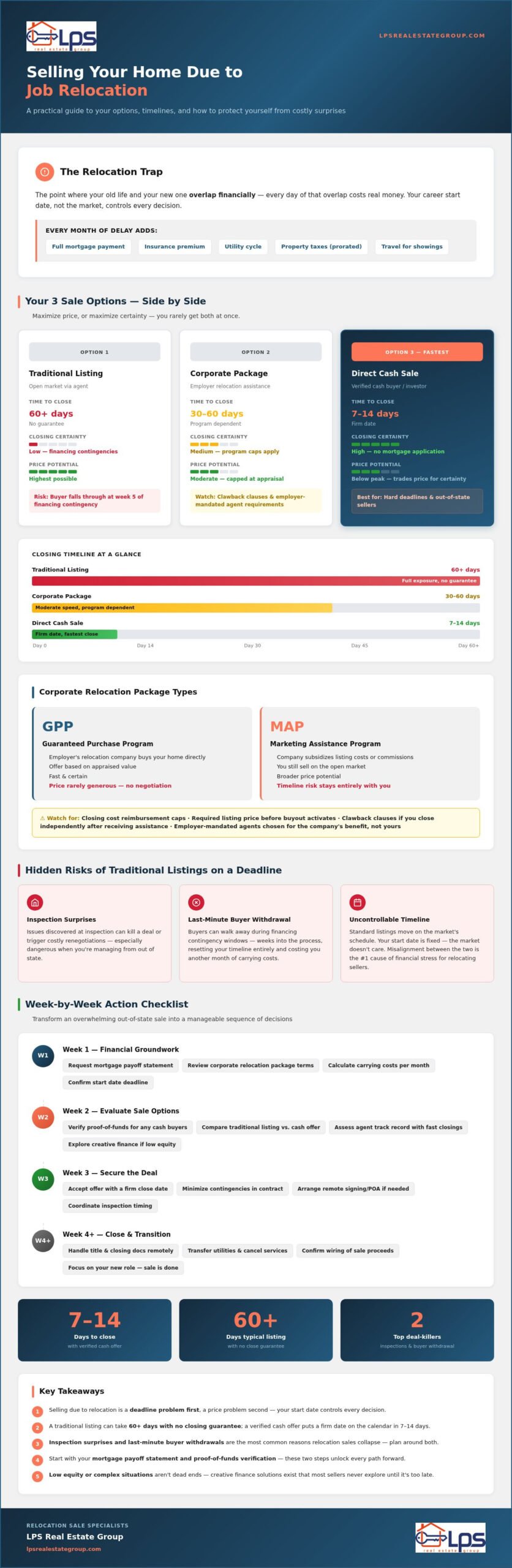
- Not all sale options are equal: a traditional listing can take 60 or more days with no guarantee of closing, while a verified cash offer can put a firm date on the calendar in as little as 7–14 days.
- Inspection surprises and last-minute buyer withdrawals are the most common reasons relocation sales collapse — and there are specific, practical ways to protect yourself from both.
- A week-by-week action checklist can transform an overwhelming out-of-state sale into a manageable sequence of decisions, starting with your mortgage payoff statement and proof-of-funds verification.
- Homeowners with little equity or complex situations aren’t out of options — creative finance solutions exist that most sellers never think to explore until it’s almost too late.
Navigating the Pressure of Selling Your House for a Job Relocation
There’s a specific kind of financial pressure that comes with selling house due to job relocation, and it’s different from any other home sale you’ve experienced. It’s not just about getting the best price. It’s about getting a done deal by a date that isn’t negotiable. Miss that window, and the consequences ripple outward in every direction.
This is what’s sometimes called the Relocation Trap: the point where your old life and your new one overlap financially, and every day of that overlap costs real money. You’re paying a mortgage on a home you no longer live in. You’re covering utilities, homeowner’s insurance, and property taxes on a property that’s sitting empty. Add in the cost of flying back for showings, inspections, or closing, and the math gets uncomfortable quickly.
Why Timing is Your Biggest Financial Risk
Carrying costs are the ongoing expenses of owning a home that generates no income and serves no daily purpose, and during a relocation they become your most urgent financial threat. A single month of delay can mean absorbing another full mortgage payment, insurance premium, utility cycle, and potentially a prorated tax installment, all while your new salary hasn’t had time to build a cushion. A 30-day slip in closing doesn’t just feel frustrating. It can functionally erase several weeks of earnings from your new role before you’ve even settled in.
Your career start date, not the market, is the variable that controls every other decision. That date sets a hard ceiling on how long you can afford to wait for the right buyer, negotiate repairs, or sit through a financing contingency that falls apart in week five.
Understanding Your Corporate Relocation Package
If your employer is offering relocation assistance, the first thing to understand is exactly what kind. The two most common structures are fundamentally different in what they protect you from:
- Guaranteed Purchase Programs: The employer’s relocation management company buys your home directly at an appraised value. It’s certain and fast, but the offer price is rarely generous, and you typically forfeit the right to negotiate.
- Marketing Assistance Programs: The company subsidizes your listing costs or covers agent commissions, but you’re still selling on the open market. The timeline risk stays entirely with you.
Employer-mandated agents are another layer to examine carefully. These agents are often pre-vetted by the relocation company, not chosen for their knowledge of your specific neighborhood or their track record with fast closings. Their incentive structure may not align with your need for speed.
Corporate buyout programs also frequently include strings worth reading closely: caps on closing cost reimbursements, requirements to list at a specific price before the buyout activates, and clawback clauses if you close independently after receiving assistance.
Beyond the corporate path, homeowners selling house due to job relocation have two other clear routes: a traditional market listing, which offers maximum exposure but unpredictable timing, or a direct cash sale, which trades some price ceiling for a firm, fast close. Understanding which path fits your actual deadline, not your ideal outcome, is where a clear-headed strategy begins.
Comparing Your Sale Options: Traditional, Relocation Packages, and Cash Offers
Every homeowner selling house due to job relocation faces the same fundamental fork in the road: maximize price, or maximize certainty. The honest truth is that you rarely get both at the same time, and understanding that trade-off clearly is what separates a smooth transition from a financially painful one.
Here’s a direct comparison of what each path actually delivers on the metrics that matter most to a relocating seller.
| Factor | Traditional Listing | Corporate Package | Direct Cash Sale |
|---|---|---|---|
| Time to Close | 60+ days (no guarantee) | 30–60 days (program dependent) | 7–14 days (firm date) |
| Closing Certainty | Low (financing contingencies) | Medium (program caps apply) | High (no mortgage approval required) |
| Prep Required | Staging, repairs, showings | Appraisal-dependent | None; purchased as-is |
| Net Cost to Seller | 5–6% agent commissions plus prep | Varies; clawbacks possible | No commissions; no repair costs |
The Traditional Market Route
A traditional listing makes the most sense when you have four or more months of lead time and a high-equity property in a competitive local market. Those conditions let you absorb the timeline risk without it becoming a financial emergency. But in 2026’s interest rate environment, buyer financing is less predictable than it was two years ago. A buyer can be pre-approved in week one and lose their rate lock or debt-to-income qualification by week seven. That’s a deal collapse with no warning, and it sends you back to square one.
This is also why selling your house as is is often a smarter move for relocating homeowners even within a traditional sale context. Skipping repairs and staging removes weeks of prep time and eliminates the risk of a buyer requesting credits after inspection.
The Direct Cash Sale Advantage
A verified cash buyer removes the single biggest variable in any home sale: the financing chain. There’s no lender approval, no appraisal gap, and no mortgage contingency sitting between you and a closed deal. The closing date you agree to is the date you can plan your move around.
Skipping the showing phase is a practical benefit that’s easy to underestimate. Managing access to an empty property from another state, coordinating with a lockbox, and fielding feedback from buyers who aren’t serious costs real time and energy during a period when your focus belongs on your new role.
When evaluating companies that buy houses for cash, ask for proof of funds before you go further in any conversation. A reputable buyer will provide this without hesitation. Check for verifiable reviews, a clear purchase agreement with no hidden assignment clauses, and a transparent explanation of how they calculated their offer.
If your timeline is tight and you need a firm closing date you can actually build your relocation around, exploring a direct cash sale is a practical first step worth taking early.
The Hidden Risks of Traditional Listings When You’re on a Deadline
A traditional listing looks reasonable on paper until you’re three days from closing and your buyer’s inspector has just flagged a 20-year-old water heater, a hairline crack in the foundation, and a bathroom exhaust fan that vents into the attic. That’s the Repair Loop in action: a chain of findings, negotiations, contractor quotes, and re-inspections that can stall or kill a deal at the exact moment you thought you were finished. For someone selling house due to job relocation, that loop doesn’t just cost money. It costs time you don’t have.
What makes this particularly difficult is that inspection findings aren’t always legitimate deal-breakers. Experienced buyers sometimes use the inspection report as a last-minute negotiation tool, requesting repair credits or price reductions on issues they knew about when they made their offer. You’re then faced with a choice: absorb the concession, push back and risk losing the buyer entirely, or start over with a new listing. None of those options fit neatly into a six-week relocation window.
There’s also a psychological dimension that rarely gets discussed. Keeping a home show-ready while simultaneously packing your life into boxes is genuinely exhausting. Every showing requires the house to look lived-in but not cluttered, clean but not sterile. When you’re emotionally and logistically checked out of a property, maintaining that standard is a real burden, and it often slips in ways that affect buyer perception.
Managing a Sale from Another State
The remote seller problem is one that most real estate advice glosses over entirely. Once you’ve relocated, a vacant property becomes a vulnerability. Pipes can freeze, lawns grow unchecked, and a home that looks abandoned signals to buyers that something is wrong. You’re now coordinating lawn maintenance, security checks, and utility management from a distance, and each of those tasks has a cost attached to it. Add a last-minute trip back for a signature or an in-person contractor walkthrough, and the carrying costs discussed earlier start compounding in ways that erode your net proceeds faster than most sellers anticipate.
The communication gap between out-of-state sellers and local agents is also a real friction point. Time zone differences, delayed responses, and second-hand updates on showing feedback mean you’re always operating one step behind the conversation. Decisions that should take hours can stretch into days.
The Inspection and Appraisal Hurdle
Appraisal gaps are a separate risk entirely. If a buyer’s lender appraises your home below the agreed purchase price, the buyer typically can’t borrow the difference. You’re then choosing between lowering your price, asking the buyer to cover the gap in cash, or walking away. In a market where values have shifted, that gap can appear with no warning at all.
Direct cash buyers eliminate both of these pressure points. There’s no lender appraisal required, and purchasing in as-is condition means no inspection contingency to negotiate around. For anyone selling house due to job relocation who needs a closing date they can actually rely on, that structural certainty is worth understanding clearly before committing to a path.
A Step-by-Step Checklist for Selling While Moving Out of State
When you’re selling house due to job relocation, the process feels less overwhelming when it’s broken into a clear sequence. Here’s a week-by-week framework that keeps you in control from the moment you accept the offer to the day you hand over keys without ever boarding a plane.
Week 1: Document everything and request your payoff statement. Walk through the home with your phone and record a detailed video of every room, the roof condition, the HVAC system, and any existing damage. This protects you from disputes later. Simultaneously, contact your lender and request a formal mortgage payoff statement. This document shows exactly what you owe through a specific date, and it’s the starting point for understanding what you’ll actually net from the sale.
Week 2: Compare offers and verify proof of funds. If you’re evaluating a direct cash offer, ask for proof of funds before signing anything. A legitimate buyer will provide a current bank statement or verified letter from a financial institution without hesitation. Review the purchase agreement carefully for assignment clauses, which allow a buyer to transfer the contract to a third party without your consent.
Week 3: Coordinate title work and arrange a remote closing. Your title company can handle nearly the entire closing process by mail or through a remote online notarization platform, depending on your state’s laws. Confirm this capability early. A mail-away closing means the notarized documents are shipped to you, signed, and returned before the funding date. Ask your title officer to walk you through the exact sequence so nothing delays the wire transfer.
Week 4: Transfer utilities and execute the key handoff. Contact each utility provider and schedule the final reading to coincide with your closing date. Most providers allow this by phone or online. For the physical handoff, a lockbox with a code shared to the buyer’s agent or title company after funding confirmation is the cleanest solution. No travel required.
Financial Preparation for the Move
Before you agree to any sale price, ask your title company or agent to prepare a net sheet, a simple document that subtracts your payoff balance, closing costs, and any outstanding liens from your projected sale price. What remains is your actual take-home number. On the tax side, if the home was your primary residence for at least two of the last five years, you may qualify to exclude up to $250,000 in capital gains ($500,000 for married couples) under IRS rules; confirm your specific situation with a tax professional before closing. Your mortgage payoff can be handled entirely by the title company on closing day, with the lender receiving their portion directly from the closing proceeds via wire transfer.
Logistical Hand-off Strategies
Digital signature platforms like DocuSign allow you to review and execute most transaction documents from anywhere, eliminating the need to return to your home state for routine paperwork. For the final walkthrough, a combination of a lockbox and a trusted local contact, whether a neighbor, property manager, or the buyer’s agent, can confirm the home’s condition without requiring your physical presence. Schedule utility disconnections to activate the day after closing to avoid any gap in coverage during the funding window.
If you want a closing date you can actually plan your move around, request a verified cash offer from LPS Real Estate Group and get a firm timeline before your first week in the new role begins.
How LPS Real Estate Group Simplifies Your Job Relocation Sale
Every option covered in this guide has a version that works and a version that doesn’t, and the difference usually comes down to who you’re working with. Selling house due to job relocation is a specific problem that requires a specific kind of partner: one who understands that your closing date isn’t a preference, it’s a constraint, and who has the tools to work within it without asking you to absorb unnecessary risk.
LPS Real Estate Group is built around exactly that kind of certainty. The process starts with a verified cash offer, delivered within 24 to 48 hours of your first conversation. There’s no waiting for a buyer to surface, no open house weekend, and no financing contingency sitting between you and a confirmed closing date. You know what you’re getting and when you’re getting it before you’ve committed to anything.
The as-is purchase model removes an entire category of stress. Take what you want from the property. Leave what you don’t. No cleaning, no repairs, no staging. For a professional who needs their focus on the new role rather than coordinating contractors from another state, that’s not a minor convenience. It’s a meaningful reduction in the total burden of the move.
Beyond Cash: Creative Real Estate Exit Strategies
Not every relocating homeowner is sitting on strong equity, and that’s where most direct buyers simply stop being useful. LPS doesn’t. Through creative real estate exit strategies, there are structured paths forward for homeowners who owe close to what their home is worth, or whose mortgage balance makes a traditional cash sale complicated.
Subject-to financing and owner financing arrangements are two tools worth understanding here. In a subject-to transaction, LPS takes over your existing mortgage payments while the loan remains in your name temporarily, allowing you to exit the property without triggering a payoff that would leave you short. Owner financing creates a similar bridge for sellers in tight equity positions. These aren’t workarounds. They’re legitimate structures used to protect sellers who would otherwise have no clean exit.
Closing date flexibility is built into every transaction. If your first day at the new job is a specific date, that’s the target. The closing timeline is built backward from your schedule, not the other way around.
Your Partner in Career Transition
The homeowners who work best with LPS aren’t looking for the highest theoretical number on a listing sheet. They’re professionals who have accepted a career opportunity and need the property side of their life resolved cleanly so they can move forward without a financial anchor trailing behind them.
That’s the practical meaning of a compassionate expert approach: listening to what the actual constraint is, building a solution around it, and handling the transaction with the transparency and integrity that a major life transition deserves. No pressure. No manufactured urgency. Just a clear offer, a firm date, and a team that handles the details.
If you’re selling house due to job relocation and need a closing date you can actually rely on, get your fair cash offer from LPS Real Estate Group today and start your new chapter without the weight of an unresolved property holding you back.
Your Next Chapter Starts With One Clear Decision
Selling house due to job relocation doesn’t have to mean choosing between your career and your financial stability. The core lesson from everything covered here is straightforward: the market’s timeline and your start date are in direct conflict, and the sellers who come out ahead are the ones who resolve that conflict early rather than hoping it works itself out.
You’ve seen why traditional listings carry real timeline risk, how corporate packages often protect the employer more than you, and how a verified cash sale removes the variables that derail deals at the worst possible moment. The week-by-week checklist exists because this process is manageable when it’s sequenced properly.
LPS Real Estate Group buys homes in any condition, nationwide, with no commissions, no hidden fees, and the ability to close in as little as 7 days. You don’t need to repair anything, clean anything, or fly back for a showing.
Your new role deserves your full attention. Get a fair cash offer from LPS Real Estate Group today and move forward with the certainty your next chapter requires.
Frequently Asked Questions About Selling House Due to Job Relocation
How fast can I sell my house if I need to relocate for work immediately?
A verified cash buyer is your fastest path, with closings typically possible in 7 to 14 days from the initial offer. A traditional listing, by contrast, averages 60 or more days from listing to closing, and that number doesn’t account for deals that fall through and require a restart. If your start date is weeks away, not months, a cash sale is the only option that puts a firm date on the calendar from the beginning.
Do I have to pay taxes on the profit from my home sale if I’m relocating for a job?
Possibly, but there’s meaningful relief available. Under IRS rules, if the home was your primary residence for at least two of the last five years, you can exclude up to $250,000 in capital gains from federal taxes, or $500,000 if you’re married filing jointly. There’s also a partial exclusion available specifically for job-related moves if you don’t meet the full two-year threshold. Confirm your eligibility with a tax professional before closing, since the rules depend on your specific timeline and circumstances.
Should I rent my house out instead of selling it when I move for work?
Renting sounds appealing in theory, but it introduces a new set of responsibilities at exactly the moment you need fewer of them. You’d be managing a landlord relationship, maintenance calls, and potential vacancy periods from another state, often while settling into a demanding new role. Unless you have a local property manager you trust completely and strong positive cash flow after all expenses, the ongoing complexity rarely justifies the decision compared to a clean sale.
What is a corporate relocation package and how does it help with my home sale?
A corporate relocation package is financial and logistical assistance your employer provides to offset the cost of moving. For home sales, it typically takes one of two forms: a guaranteed purchase program, where a relocation company buys your home directly at an appraised value, or a marketing assistance program, which subsidizes your listing costs but leaves the timeline risk with you. Read the fine print carefully, since many packages include caps on reimbursements, required listing periods before a buyout activates, and clawback clauses that reduce your benefit if you close independently.
Can I sell my house remotely without flying back for the closing?
Yes, and it’s more straightforward than most sellers expect. Remote online notarization platforms and mail-away closings allow you to sign all required documents without traveling back to your home state, though availability depends on your state’s laws. Digital signature tools handle most routine paperwork throughout the transaction. Confirm early with your title company that they support remote closing options, and coordinate a lockbox handoff for the keys so the physical transfer doesn’t require your presence either.
What happens if my house is worth less than what I owe and I have to relocate?
An underwater mortgage doesn’t mean you’re out of options, though it does mean a standard cash sale won’t work cleanly. Creative finance structures like subject-to financing can provide a path forward: a buyer takes over your existing mortgage payments while the loan remains in your name temporarily, allowing you to exit the property without a shortfall payoff. These aren’t workarounds; they’re legitimate arrangements designed specifically for situations where equity is thin and a traditional sale would leave you writing a check at closing.
Is it better to sell to a cash buyer or list with an agent when on a tight deadline?
When selling house due to job relocation with a firm start date, a cash buyer typically delivers more practical value than a traditional listing. The core reason is certainty: a cash sale has no financing contingency, no lender appraisal, and no buyer who can lose their mortgage approval in week six. You’re trading some potential price ceiling for a closing date you can actually build your move around. For homeowners with four or more months of lead time and strong equity, a traditional listing may still make sense; for everyone else, the timeline math usually favors cash.
How do I manage repairs if I’ve already moved to my new city?
Managing contractors remotely is genuinely difficult, and it rarely goes as smoothly as coordinating in person. Getting multiple quotes requires scheduling access, work quality is harder to verify from a distance, and delays compound quickly when you’re not there to follow up. The cleaner solution for most relocating sellers is to skip repairs entirely by selling as-is, which eliminates the coordination burden and removes the inspection negotiation risk at the same time. A buyer who purchases as-is accepts the property in its current condition, so there’s nothing left to manage from your new city.