

What if the moisture in your walls didn’t have to mean a flood of debt and months of stressful construction? Approximately 14,000 people in the United States face a water damage emergency every single day. If you’re currently dealing with soggy drywall or the looming threat of mold, you likely feel overwhelmed by the potential costs. You might be worried that selling a house with water damage is impossible without first spending thousands on professional remediation or waiting months for insurance adjusters to respond. It’s completely normal to feel stuck between a high repair bill and a property value that seems to be shrinking by the hour.
You deserve a path forward that doesn’t involve out-of-pocket expenses or the health risks of a damp environment. This guide will show you how to secure a fair price for your property as it stands today, allowing you to walk away with your equity intact. We’ll explore the reality of 2026 restoration costs, explain your legal disclosure requirements, and outline a simple process to close quickly so you can stop worrying about utility bills and maintenance. By the end, you’ll have a clear, stress-free strategy to exit your property and move on to your next chapter.
Key Takeaways
- Learn how to avoid the “reconstruction trap” where minor repairs often reveal deeper, more expensive structural issues.
- Discover the most efficient path for selling a house with water damage without paying for professional mold remediation or waiting on insurance claims.
- Understand your legal obligations regarding latent defects to ensure a transparent sale and protect yourself from future liability.
- Identify the critical first steps to take immediately after discovering damage to stabilize your property’s value and prevent further degradation.
- Explore how an as-is property acquisition provides a compassionate exit from a stressful situation without any out-of-pocket repair costs.
Evaluating the Impact: Can You Sell a House with Water Damage?
Discovering a pool of water in your living room or a dark stain spreading across the ceiling is a deeply unsettling experience. It isn’t just about the physical mess; it’s the immediate weight of financial uncertainty and the fear of what comes next. You might feel a sense of urgency to fix everything immediately, but it’s vital to pause and assess the situation objectively. Many homeowners find themselves wondering if selling a house with water damage is even a realistic possibility or if they’re destined to lose their investment entirely.
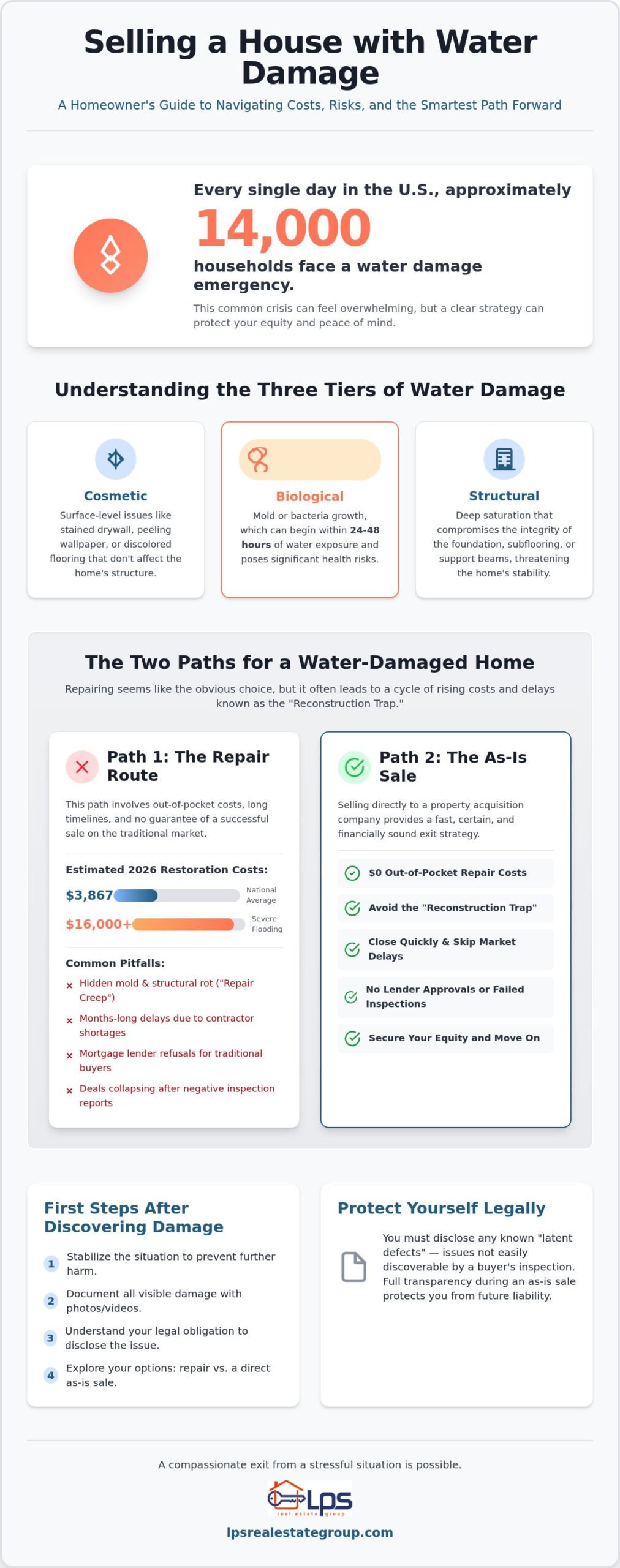
To make an informed decision, you need to understand What is Water Damage? and how it specifically impacts residential real estate. Most damage falls into three distinct categories:
- Cosmetic: Surface-level issues like stained drywall, peeling wallpaper, or discolored flooring that don’t affect the home’s structure.
- Biological: The growth of mold or bacteria, which can begin within 24 to 48 hours of water exposure and creates health concerns.
- Structural: Deep saturation that compromises the integrity of the foundation, subflooring, or support beams.
The Different Levels of Water Damage
Industry professionals categorize water intrusion into four distinct classes based on the rate of evaporation. Class 1 refers to minor moisture in a small area, while Class 4 involves deep saturation into low-porosity materials like concrete, stone, or hardwood. The most challenging issues are often the invisible ones. Mold spores can thrive inside wall cavities long after the surface feels dry, and trapped moisture can quietly rot the wooden framing of your home. While early detection helps maintain residual property value, even high-class damage doesn’t make selling a house with water damage an impossible task.
Why Traditional Buyers Often Walk Away
The traditional retail market is rarely a good fit for homes with moisture issues. Most families shopping on the MLS rely on mortgage lenders who often refuse to provide financing for properties with active mold or structural concerns. If a buyer’s inspector finds evidence of past flooding, it usually brings the deal to a sudden halt. There’s also a significant psychological barrier to overcome. Many families fear the potential health risks of damp environments and prefer the safety of a move-in-ready home rather than taking on a complex, expensive renovation project.
Validating your stress is the first step toward a solution. Selling your property as-is is a common and often the most financially sound choice. It provides a clean break, allowing you to avoid the “reconstruction trap” where one repair leads to discovering several more hidden problems.
The Real Cost of Remediation: Repairing vs. Selling As-Is
Deciding whether to repair your home or move on is a heavy choice. Many homeowners feel pressured to fix every leak and replace every piece of damp drywall before listing. However, the true cost of professional restoration often includes more than just the contractor’s bill. When you’re selling a house with water damage, you also have to consider the “reconstruction trap.” This occurs when a simple wall repair reveals hidden mold or structural rot that wasn’t in the original budget. Many people find that selling a house with water damage directly to an investor is the most logical way to avoid these rising construction costs and the “Opportunity Cost” of a six-month renovation.
Estimated Repair Timelines and Budgets
In 2026, the national average for water damage restoration is approximately $3,867, but severe flooding can quickly push that number over $16,000. The process is methodical and time-consuming. It starts with water extraction and drying, which typically costs between $3.00 and $7.50 per square foot. If the moisture isn’t addressed within 48 hours, mold treatment becomes a mandatory and expensive addition. Finally, reconstruction costs for drywall can range from $50 to $70 per square foot. Contractor shortages in 2026 mean these projects often face significant delays, turning a minor leak into a months-long renovation. This “Repair Creep” can easily consume your entire equity before the home even hits the market.
The Benefits of a Direct As-Is Sale
Choosing to move forward by selling your house as-is eliminates the need for any out-of-pocket repair costs. You don’t have to spend your savings on dehumidifiers or wait for insurance adjusters to approve your claim. Instead, direct home buyers assess the property’s potential and provide a fair value based on its “after-repair” state. This approach transfers the entire logistical burden of mold remediation and structural repairs to the buyer. It’s a transparent way to achieve a fast closing without the emotional toll of a construction zone. If you’re ready for a simpler solution, an as-is property acquisition provides the immediate relief you need to move forward with your life.
Disclosure and Legal Requirements: Protecting Yourself During the Sale
Transparency isn’t just about ethics; it’s about your legal protection. When selling a house with water damage, many homeowners worry that being honest will drive away every potential buyer. In reality, hiding a leak is a recipe for a post-closing lawsuit. Most jurisdictions classify water intrusion and mold as “latent defects.” These are problems that aren’t immediately obvious to a casual observer but significantly affect the home’s value or safety. Documenting these issues through photos or a professional inspection report creates a clear paper trail that protects you from future claims of failure to disclose.
Understanding the Disclosure Statement
You must legally reveal any history of flooding, pipe bursts, or moisture-related insurance claims. Even if you believe the issue is “fixed,” it’s always safer to provide the full history. Attempting to hide damage by simply painting over water stains can be viewed as active concealment or fraud in a court of law. Thorough disclosure is the seller’s primary legal shield in 2026. By being completely upfront, you effectively shift the risk to the buyer. Once they sign a contract acknowledging the damage, they cannot hold you responsible for those specific issues after the keys change hands.
Selling to Professionals vs. Families
Traditional families often look for a “perfect” home and are easily spooked by a history of dampness. Professional buyers, however, view selling a house with water damage as a routine transaction. They have the resources and experience to handle the complex remediation work we discussed in previous sections. Choosing a professional partner simplifies the process in several ways:
- Specific As-Is Clauses: Professional contracts use language that explicitly acknowledges existing damage and waives the buyer’s right to sue for it later.
- No-Contingency Offers: These remove the risk of a buyer backing out after an inspection report reveals what you already disclosed.
- Simplified Paperwork: Cash buyers often provide their own disclosure forms that are streamlined for as-is property acquisitions.
This approach provides the peace of mind that the price agreed upon is the amount you’ll actually see at the closing table. It removes the fear of a deal falling apart at the last minute because of a failed inspection or a nervous lender. For many, this legal and emotional certainty is more valuable than any minor price difference found in the retail market.
How to Sell Your Water-Damaged Home Fast in 2026
Efficiency is your greatest ally when moisture is actively compromising your home’s equity. While the emotional weight of property damage can feel paralyzing, following a methodical path helps you regain control. If you’re selling a house with water damage, your goal is to minimize further loss while maximizing your final walk-away amount. By stripping away the complexity of traditional real estate, you can move from discovery to closing in a matter of days rather than months.
To secure a fast, successful sale, follow these five logical steps:
- Stop the source: Ensure any active leaks are capped or the water supply is shut off. This prevents a Class 1 issue from becoming a Class 4 structural disaster.
- Document the condition: Keep copies of any professional inspection reports or remediation estimates. These provide a factual baseline for your sale.
- Choose your path: Decide if you have the time for the traditional market or if a cash buyer for your house is the more practical choice for your timeline.
- Request an offer: Reach out to a reputable investment group for a no-obligation assessment of the property as it sits today.
- Close and transition: Finalize the paperwork and receive your funds without ever picking up a hammer or hiring a contractor.
Setting a Realistic Price
Pricing a damaged property requires a shift in perspective. Many homeowners feel they are “giving the home away” if the offer is lower than the neighbors’ pristine houses. However, professional buyers use “Investor Math” to find a fair number. They start with the After-Repair Value (ARV) and subtract the estimated restoration costs, holding costs, and a small margin for the risk of hidden rot. When selling a house with water damage, a slightly lower price today is often worth more than a higher price a year from now. You save on twelve months of mortgage payments, utilities, and the immense stress of managing a construction site.
The Fast-Track Closing Process
The most significant advantage of an as-is sale is the speed of the transaction. Traditional deals often stall for 45 days or more while banks struggle with appraisals and underwriting for a damaged asset. Direct cash sales bypass these hurdles entirely. The walk-through is straightforward; professional buyers look past the stains and mold to see the underlying potential. This leads to a “keys-for-cash” transition where you simply take what you want from the home and leave the mess behind. If you’re ready to see how simple this process can be, you can get a fair cash offer today and leave the repairs to us.
A Compassionate Exit: Why LPS Real Estate Group is the Right Choice
Choosing the right path for your property is about more than just a financial transaction. It’s about finding a sense of relief after a period of intense stress. At LPS Real Estate Group, we approach every homeowner with a blend of professional authority and deep empathy. We understand that selling a house with water damage is often the result of an exhausting ordeal, whether it was a sudden pipe burst or a slow, undetected leak. Our goal is to serve as a trusted advisor, helping you transition to your next chapter with clarity and peace of mind.
We operate with a sense of quiet confidence. We don’t rely on high-pressure tactics or aggressive marketing because we believe our straightforward process speaks for itself. We’re here to listen to your specific circumstances and provide a solution that respects your time and your equity. By choosing an as-is property acquisition, you’re choosing to let a professional partner handle the messy, technical, and logistical parts of the sale so you don’t have to.
Our Commitment to Transparency
We believe that you should feel fully informed at every stage of the narrative. When we evaluate your property, we don’t just give you a number; we walk you through the logic behind our valuation. We consider the 2026 restoration costs and the property’s potential to ensure our offer is fair and transparent. There are no hidden fees, no surprise commissions, and no repair concessions requested at the last minute. Our “No-Pressure” promise means you’re always the one in control. You’ll have direct access to our decision-makers, ensuring your questions are answered quickly without having to navigate a complex corporate hierarchy.
Taking the Burden Off Your Shoulders
The most significant benefit of working with us is the immediate removal of the remediation burden. When selling a house with water damage to LPS Real Estate Group, you don’t need to spend a single dollar on mold removal, dehumidification, or structural repairs. We buy your home exactly as it is today. We also specialize in resolving complex real estate situations that often overlap with property damage, such as probate or foreclosure prevention. We handle the heavy lifting so you can walk away with a clean break and a fresh start. If you’re ready to explore a simpler way forward, we invite you to a low-pressure consultation to discuss your needs. Get your fair cash offer from LPS Real Estate Group today.
A Clean Break and a Fresh Start
The moisture in your home doesn’t have to define your financial future. The path of professional remediation is often paved with hidden costs and construction delays. By prioritizing your peace of mind, you can bypass the “reconstruction trap” and the stress of insurance complexities. Selling a house with water damage can be a straightforward, transparent process when you have the right partner. You’ve learned how to document your property’s condition and protect yourself through full disclosure, ensuring a smooth transition for everyone involved.
LPS Real Estate Group specializes in as-is property acquisitions, offering a national reach with a focus on fast, certain closings. Our empathy-led approach ensures your situation is handled with the integrity it deserves. We take on the burden of mold removal and structural repairs so you don’t have to. If you’re ready to move forward without the weight of costly renovations, Request your fair, as-is cash offer from LPS Real Estate Group today. You deserve a solution that brings stability back to your life.
Frequently Asked Questions
Can I sell a house with active mold growth?
Yes, you can sell a house with active mold growth, provided you disclose the condition to potential buyers. While traditional families often avoid these properties due to health concerns, professional investors specialize in as-is acquisitions. They have the resources to handle professional remediation after the sale is complete. This allows you to walk away from the property without the personal burden of cleaning or paying for expensive mold treatment.
Do I have to fix a leaking roof before selling my house?
No, you aren’t legally required to fix a leaking roof before selling, but you must disclose the leak to any prospective buyer. Replacing a roof in 2026 is a significant out-of-pocket expense that you may not fully recover in a traditional sale. Selling as-is allows you to pass the repair responsibility to the buyer. This is a common and effective strategy for homeowners who want to avoid construction stress.
Will insurance cover the repairs if I decide to sell the house as-is?
Insurance coverage depends on your specific policy and the cause of the damage, but selling as-is doesn’t automatically cancel a valid claim. Typically, insurance covers sudden and accidental damage like burst pipes. If you sell before the repairs are made, you may still be entitled to the payout for the loss incurred while you owned the property. It’s important to consult your adjuster before finalizing the sale to ensure your claim remains intact.
How much value does water damage actually take off a home?
The impact on value varies, but water damage can reduce a home’s market price by 10% to 30% depending on the severity. This reduction accounts for the direct cost of remediation, which averages $3,867 in 2026, plus a risk premium for hidden issues. When selling a house with water damage, professional buyers calculate offers based on the property’s potential value after all necessary repairs and mold treatments are completed.
Is it better to take an insurance payout and sell the house damaged?
For many homeowners, taking the payout and selling as-is is the most efficient path. Managing a 2026 restoration project involves navigating contractor shortages and rising material costs, which can take several months. By keeping the insurance funds and selling the property in its current state, you avoid the “reconstruction trap.” You can move on to a new home much faster than waiting for a complex renovation to be finished.
What happens if I don’t disclose water damage to a buyer?
Failing to disclose known water damage can lead to serious legal consequences, including lawsuits for fraud or breach of contract. In most states, moisture issues are considered “latent defects” that must be revealed even in “buyer beware” jurisdictions. Being transparent protects you from future liability. A documented disclosure statement serves as your primary legal shield, ensuring the buyer accepts the property’s condition as part of the final deal.
Can a bank deny a loan to a buyer because of water damage?
Yes, mortgage lenders frequently deny financing for properties with active water damage or mold growth. Banks view these issues as significant risks to the collateral’s value. This is a primary reason why selling a house with water damage on the traditional market is so difficult. Cash buyers are often the only viable option because they don’t rely on bank appraisals or underwriting to close the transaction.
How fast can LPS Real Estate Group close on a water-damaged property?
LPS Real Estate Group can often close in as little as a few days, depending on your specific needs. Because we provide direct cash offers and specialize in as-is acquisitions, we bypass the lengthy bank approval process and traditional inspections. We move at a pace that respects your need for immediate relief. This provides a certain closing date so you can stop worrying about ongoing maintenance and utility costs.