
Did you know that significant pet or wildlife issues can slash a home’s value by as much as $30,000? It’s a heavy burden to carry, especially when you’re already dealing with the embarrassment of lingering odors or the shock of a high quote for subfloor replacement. You might feel stuck between spending money you don’t have and accepting a low-ball offer that feels unfair. It’s a stressful position to be in, but you aren’t alone in facing these challenges.
Selling a house with animal damage doesn’t have to be a source of shame or financial ruin. We believe in providing clear paths forward when a property’s condition feels overwhelming. This 2026 guide will show you how to navigate the complexities of pet or wildlife damage by comparing traditional repair strategies against stress-free as-is sale options. We’ll walk through the realities of disclosure laws, the actual costs of restoration, and how to secure a fair value for your home without the need for a single repair. By the end, you’ll have a logical plan to exit your property quickly and move forward with peace of mind.
Key Takeaways
- Understand how persistent animal odors and visible wear can trigger immediate buyer rejection and complicate a traditional retail sale.
- Learn why selling a house with animal damage often involves navigating appraisal hurdles that can prevent buyers from securing necessary financing.
- Discover how to categorize damage from cosmetic scratches to deep structural issues to avoid the high costs of unexpected “scope creep” during repairs.
- Compare the financial and emotional trade-offs of managing complex renovations against the convenience of a direct as-is property acquisition.
- Follow a simple two-step audit process to determine the most logical and fair exit strategy for your specific property condition.
Why Animal Damage Complicates a Traditional Home Sale
Selling a house with animal damage presents unique hurdles that go beyond simple aesthetics. While a scratched door or a stained rug might seem like minor fixes, they often signal a larger story of neglect to potential buyers. In a traditional market, these issues can quickly derail a sale, turning a promising listing into a stagnant property that buyers avoid. Understanding why these complications arise is the first step in deciding whether to invest in repairs or seek a direct sale.
The Psychology of Scent and Sight
Scent is perhaps the most powerful and immediate trigger for a home buyer. When a family walks into a showing and smells persistent pet odors or wildlife musk, their perception of the entire property shifts instantly. They don’t just smell a mess; they worry about property damage they cannot see, such as urine that has soaked through the carpet and into the subflooring.
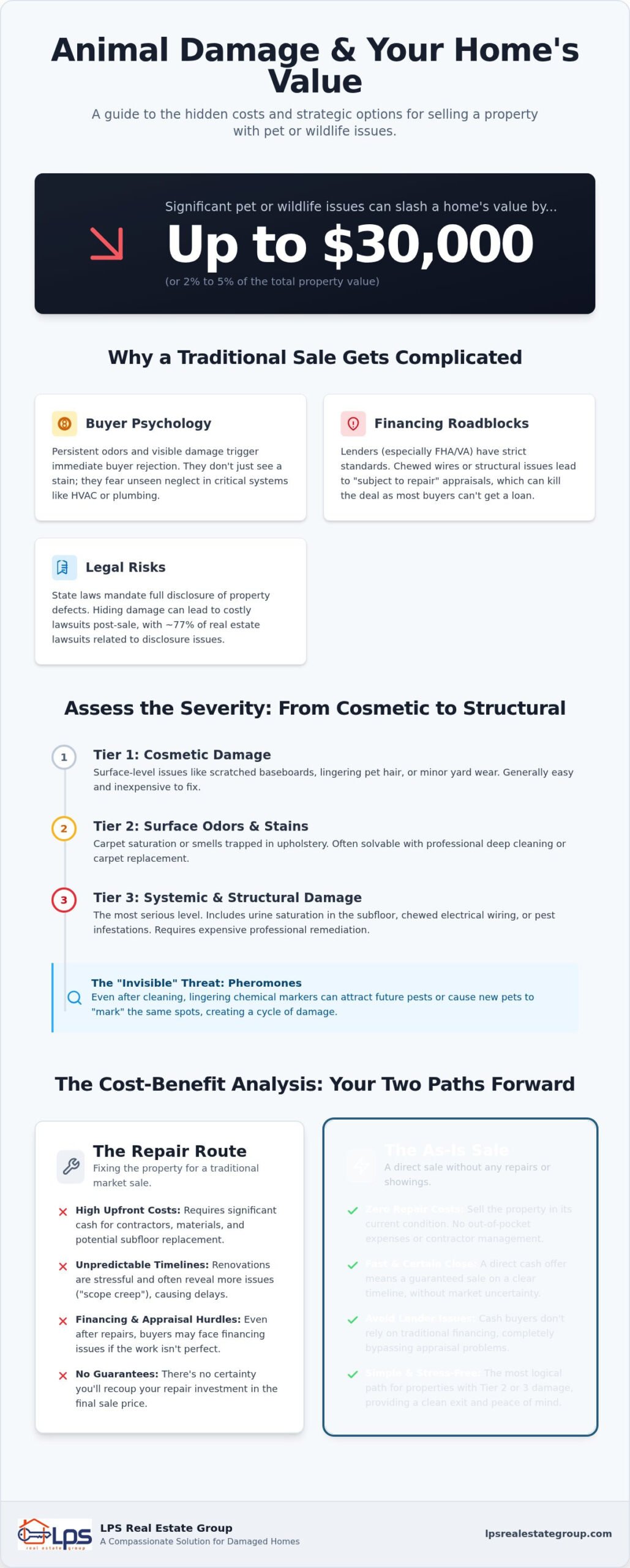
Retail buyers typically distinguish between “lived-in” pet wear, like a few stray hairs, and “neglect-level” damage. If the damage feels systemic, it creates a sense of unease. Buyers fear that if the visible areas were ignored, the hidden systems like HVAC or plumbing might also be failing. This psychological barrier is why significant pet-related issues can lower a home’s appraised value by 2% to 5%, sometimes resulting in a loss of up to $30,000 in the final sale price.
Financing and Appraisal Roadblocks
Even if you find a buyer willing to look past the damage, their lender might not be so forgiving. Traditional mortgage approvals, especially those backed by the FHA or VA, require the home to meet strict safety and soundness standards. If an appraiser discovers that rodents have chewed through electrical wiring or that wildlife has compromised the structural integrity of the attic, they will flag the property.
These “subject to repair” appraisals can kill a deal. The lender will refuse to fund the loan until the issues are professionally remediated. This often limits your pool of potential buyers to cash-only investors, as most families don’t have the liquid capital to fix a home they don’t yet own.
Legal obligations also play a massive role when selling a house with animal damage. Real estate disclosure laws vary by state, but the trend is clear: transparency is mandatory. Roughly 77% of real estate lawsuits are related to disclosure issues. Attempting to mask odors with heavy perfumes or hiding chewed drywall behind furniture can lead to expensive litigation long after you’ve handed over the keys. Being honest about the property’s history is essential for a clean exit.
Assessing the Severity: From Cosmetic to Structural
Before you decide on a sales strategy, you need an honest look at the property’s condition. Not all issues are created equal. Some are simple weekend projects, while others represent significant financial liabilities. When you’re selling a house with animal damage, it helps to categorize the issues into three distinct tiers. This clarity allows you to weigh the cost of repairs against the potential return on your investment.
- Tier 1: Cosmetic Damage. These are surface-level problems like scratched baseboards, lingering pet hair, or minor wear in the yard. These issues are generally easy to fix and don’t usually scare away traditional buyers.
- Tier 2: Surface Odors and Stains. This involves carpet saturation or smells trapped in upholstery and curtains. While more intense than cosmetic wear, deep cleaning or carpet replacement often solves the problem.
- Tier 3: Systemic and Structural Damage. This is the most serious level. It includes urine that has reached the subfloor, chewed electrical wiring, or pest infestations in the attic. These problems often require professional contractors and can be quite expensive to resolve.
There’s also an “invisible” threat to consider: pheromones. Even after a surface is cleaned, animals often leave behind chemical markers. These pheromones can linger in the subfloor or drywall, potentially attracting future pests or causing new pets to “mark” the same spots. If your audit reveals these deep-seated issues, considering an as-is property acquisition might save you from the cycle of endless repairs.
Identifying Subfloor Saturation
Standard cleaning often fails because the source of the odor is hidden beneath the floorboards. You can use a high-powered UV blacklight and a moisture meter to find these invisible spots. If the moisture has reached the wood, simply replacing the carpet won’t work; the smell will return as soon as the humidity rises. Subfloor saturation is a material defect requiring professional remediation. Ignoring this detail during the assessment phase often leads to “scope creep,” where a simple flooring update turns into a full-scale renovation.
Wildlife and Pest Damage
Wildlife issues bring a different set of risks. Raccoons, squirrels, or rodents in attics and crawlspaces can significantly lower your home’s resale value by damaging insulation and chewing through vital systems. Chewed electrical wiring is a major fire hazard that home inspectors will flag immediately. Because of the health risks associated with animal waste, these repairs often require specialized certifications. Successfully selling a house with animal damage caused by wildlife usually means providing proof that the animals are gone and the space is fully sanitized.
The Cost-Benefit Analysis: Repair vs. As-Is Sale
Deciding whether to fix a property or list it in its current state requires a clear look at the numbers. While many sellers assume that repairs always lead to a higher profit, the reality is often more complex. When you’re selling a house with animal damage, the “real” cost includes far more than just materials and labor. You must also account for the value of your own time and the emotional toll of managing a construction project.
One of the biggest risks in this process is “scope creep.” What starts as a simple plan to replace urine-stained floorboards can quickly escalate. Once the subfloor is removed, you might discover that the damage has reached the structural joists or that rodents have compromised the insulation. Suddenly, a $2,000 flooring project becomes a $10,000 structural repair. These surprises can drain your budget and extend your timeline by weeks or even months.
You must also consider the “holding costs” of the property. While the house sits vacant during renovations, you’re still responsible for:
- Property taxes and homeowners insurance.
- Utility bills to keep the HVAC running (essential for odor control).
- Lawn maintenance and security.
- Mortgage payments on a home you aren’t living in.
To find your true net proceeds, subtract these holding costs, the repair bills, and the standard 6% real estate commission from your expected retail sale price. Often, the amount you actually keep is lower than what you would receive from a direct, as-is sale today.
When Repairs Make Financial Sense
Fixing the property is usually the best path if the damage is strictly cosmetic. If the issues are limited to Tier 1 problems, such as scratched trim or pet hair, a few hundred dollars in paint and professional cleaning can provide a high return on investment. In these cases, a traditional listing remains the most profitable route. When addressing odors, always choose neutralizing enzymes over masking scents. Buyers are savvy; if a house smells too much like vanilla or bleach, they’ll immediately wonder what you’re trying to hide.
The Benefits of Selling As-Is
Choosing a direct sale allows you to skip the renovation nightmare entirely. You won’t have to vet contractors, wait for permits, or worry about the deal falling through because of a bad appraisal. This path provides certainty in an uncertain market. If the damage has reached the subfloor or involves wildlife infestations, selling your house as-is is often the most compassionate choice for your own well-being. It allows you to hand over the burden to an expert and walk away with a fair value, focusing on your future rather than the property’s past.
How to Sell a House with Animal Damage: Your Step-by-Step Options
Selling a house with animal damage requires a logical, step-by-step approach to ensure you don’t waste resources or time. First, conduct a thorough audit as we discussed in earlier sections. Once you understand the extent of the damage, you can decide on a selling strategy. If the issues are cosmetic, a retail sale might be your best path. However, if you’re dealing with structural damage or systemic odors, a direct sale is often more practical.
For those choosing the retail route, focus only on “Minimum Viable Repairs.” This means executing high-impact cosmetic fixes, like replacing a single chewed door frame or painting over minor stains, rather than gutting an entire room. If a repair doesn’t clearly increase the sale price by more than its cost, skip it. Next, disclose every known issue accurately. Transparency is your best defense against post-closing legal disputes. Finally, vet your buyers carefully. Many traditional buyers rely on financing that can fall through once a bank inspector sees significant damage.
Preparing for a Traditional Listing
If you choose the open market, deep cleaning is your top priority. Standard household cleaners aren’t enough for biological stains. You’ll need professional ozone treatments and enzymatic cleaners to break down odors at the molecular level. Staging also plays a vital role. Use fresh, neutral scents and bright lighting to create a clean atmosphere that de-emphasizes previous pet presence. During the showing window, you’ll need to manage pet logistics carefully by removing all animals, food bowls, and toys from the property. It’s a high-effort path, but it can be effective for homes with minor wear.
Preparing for a Direct Cash Sale
For properties with structural issues or severe odors, skipping the cleaning and repairs entirely is often the most sensible move. When you work with companies that buy houses for cash, you don’t need to scrub floors, replace insulation, or vet contractors. You simply gather basic information about the property’s condition so the buyer can provide an accurate offer. We specialize in these “as-is” acquisitions, offering a fair value without asking you to lift a finger or spend a dime on renovations. If you’re ready for a simple exit from a difficult property, request a fair cash offer today to see how we can help you move forward.
LPS Real Estate Group: A Compassionate Solution for Damaged Homes
At LPS Real Estate Group, we approach every property with a sense of quiet confidence and genuine care. We understand that selling a house with animal damage often comes with a side of embarrassment or exhaustion. You’ve likely spent weeks worrying about how a traditional buyer might react to the state of your subfloors or the scent in the air. Our philosophy is different. We don’t see a mess that needs to be judged; we see a property with potential that simply needs a professional touch to be restored.
By choosing to work with us, you’re eliminating the traditional middlemen that make distressed sales so difficult. There are no real estate agents to manage, no commissions to pay, and certainly no long lists of repairs you’re required to complete before closing. We handle the logistical heavy lifting so you can focus on your next chapter. Our team treats every homeowner with integrity, ensuring that even the most complex situations are resolved with transparency and respect.
Why Our Direct Purchase Model Works
Our model is built on efficiency and expertise. Because we leverage our own professional renovation teams, we’re equipped to handle severe damage that would scare away a typical family or a tech-heavy buyout firm with strict criteria. This allows us to close quickly, often putting liquidity in your hands in just a few days rather than the months it takes to renovate and list a home. LPS Real Estate Group remains committed to providing fair and transparent offers for every property, regardless of its current condition or the extent of the repairs needed.
Getting Your No-Obligation Offer
Starting the process is intentionally simple. You don’t need to spend a dime on professional cleaning or waste time trying to mask odors. When you reach out, we’ll schedule a brief, low-stress property walkthrough to understand the scope of the work. We aren’t there to critique your home; we’re there to listen to your needs and find a solution that fits your timeline. If you’re tired of the stress and ready for a fresh start, get a fair cash offer today and let us take the burden off your shoulders.
Moving Toward a Fresh Start
We’ve explored the complexities of selling a house with animal damage, from identifying hidden subfloor saturation to weighing the risks of “scope creep” during renovations. You now have the tools to decide whether a traditional listing or a direct sale aligns best with your goals. It’s important to remember that you aren’t stuck; there is always a logical path forward that respects both your financial needs and your peace of mind. By assessing the damage honestly and looking at the net proceeds of each option, you can make a choice with confidence.
LPS Real Estate Group specializes in as-is property acquisition, meaning you don’t have to lift a finger for cleaning or repairs. We offer a fast and certain closing process that bypasses the traditional market’s hurdles, providing a simplified exit strategy for even the most challenging properties. You deserve a partner who sees the potential in your home and treats your situation with the integrity it deserves. Our team is ready to listen and help you find the best way forward.
Get a fair, as-is cash offer for your house today. Your property’s past doesn’t have to define your future; we’re here to help you turn the page.
Frequently Asked Questions
Do I have to disclose pet urine damage if I replace the carpet?
Yes, you generally must disclose known pet urine damage even after replacing the carpet. Many state laws require the disclosure of material defects that could affect a property’s value. Replacing the surface doesn’t always fix the subfloor saturation beneath. If a buyer discovers the odor later, you could face legal action. Roughly 77% of real estate lawsuits involve disclosure issues, so transparency is the safest path for every seller.
Will animal damage significantly lower my home appraisal?
Significant animal damage can indeed lower your home’s appraised value by 2% to 5%. Appraisers focus on the safety, soundness, and security of the property. If they find chewed wiring or structural issues in the attic, they may flag the home as “subject to repairs.” This can prevent a buyer from securing a traditional mortgage. In severe cases, the property may sell for significantly less than a comparable home in good condition.
Can I sell a house that has a persistent “cat smell”?
You can sell a home with a persistent cat smell, but it often requires a specialized strategy. Retail buyers frequently reject homes with strong odors because they fear hidden damage behind the walls. You might try professional ozone treatments or enzymatic cleaners to neutralize the scent. If the odor is trapped in the subfloor, selling to an as-is property acquirer is often the most efficient way to exit without expensive renovations.
Is it better to fix animal damage or lower the asking price?
Deciding whether to fix the damage or lower the price depends on the severity of the issues. Minor cosmetic fixes like scratched trim usually offer a high return on investment. However, for systemic problems like subfloor saturation, lowering the price or selling as-is is often more logical. This approach helps you avoid the “scope creep” of renovations. It also prevents your home from sitting on the market while you manage contractors.
How much does it cost to remediate severe pet damage?
Remediation costs vary depending on the extent of the damage. Minor cleaning may only cost a few hundred dollars, but attic restoration or subfloor replacement can quickly reach several thousand. For example, removing wildlife and replacing insulation often costs between $500 and $3,500. When selling a house with animal damage, it’s vital to get professional quotes. This ensures you understand the financial trade-offs before committing to a lengthy repair project.
Can I sell my house if a wild animal is currently living in the attic?
You can sell a house with active wildlife, but it significantly limits your buyer pool. Traditional buyers and lenders usually require the animals to be professionally removed and the damage repaired before closing. This process can be both expensive and time-consuming. If you prefer to avoid the hassle of trapping and remediation, a direct as-is sale is a viable option. We specialize in buying homes exactly as they are, including those with current wildlife issues.
Do cash buyers really buy houses with structural animal damage?
Yes, professional cash buyers specialize in properties that traditional buyers avoid. We have the resources and renovation teams to handle structural issues, chewed wiring, and deep-seated odors. While a retail buyer’s mortgage might be rejected due to property condition, a cash buyer doesn’t rely on bank appraisals. This makes it a reliable option for homeowners who need a certain closing without the burden of performing costly, complex repairs themselves.
What is the fastest way to sell a house that smells like dogs?
The fastest way to sell a home with persistent odors is through a direct, as-is property acquisition. This method bypasses the need for deep cleaning, staging, and multiple showings. When selling a house with animal damage, you can often receive an offer within 24 hours and close in just a few days. It’s a low-stress alternative that allows you to walk away from the property’s condition and move forward with your life immediately.