
You don’t have to spend $100,000 gutting your home just to get it off your hands. While the discovery of defective materials can feel like a financial weight, learning how to sell a house with Chinese drywall doesn’t have to mean draining your savings account before you can move on. We understand the anxiety that comes with corroded wiring and that persistent “rotten egg” smell. It’s an exhausting situation that leaves many homeowners feeling trapped by potential legal liabilities and the overwhelming cost of traditional repairs.
You deserve a clear path forward that prioritizes your peace of mind over endless construction. This 2026 guide will help you discover the most effective strategies to sell a home affected by defective drywall without the stress of remediation. We’ll walk you through current disclosure laws, compare different selling methods, and explore how a direct, as-is sale can provide the fast, certain exit you need. By the end of this article, you’ll have a logical plan to turn a difficult property into a closed chapter.
Key Takeaways
- Learn to identify the clear signs of defective materials, such as the distinct “rotten egg” sulfur odor and blackened copper wiring or pipes.
- Understand the legal necessity of full disclosure to protect yourself from future lawsuits and ensure a transparent, valid real estate transaction.
- Compare the significant financial burden of a full gut-remediation against the speed and simplicity of selling your property in its current condition.
- Discover the most reliable methods for how to sell a house with Chinese drywall by following a clear, step-by-step path from inspection to closing.
- Explore how a direct as-is property acquisition can provide a certain exit strategy, allowing you to bypass costly repairs and the stigma of a traditional listing.
Identifying the Problem: Does Your Home Have Chinese Drywall?
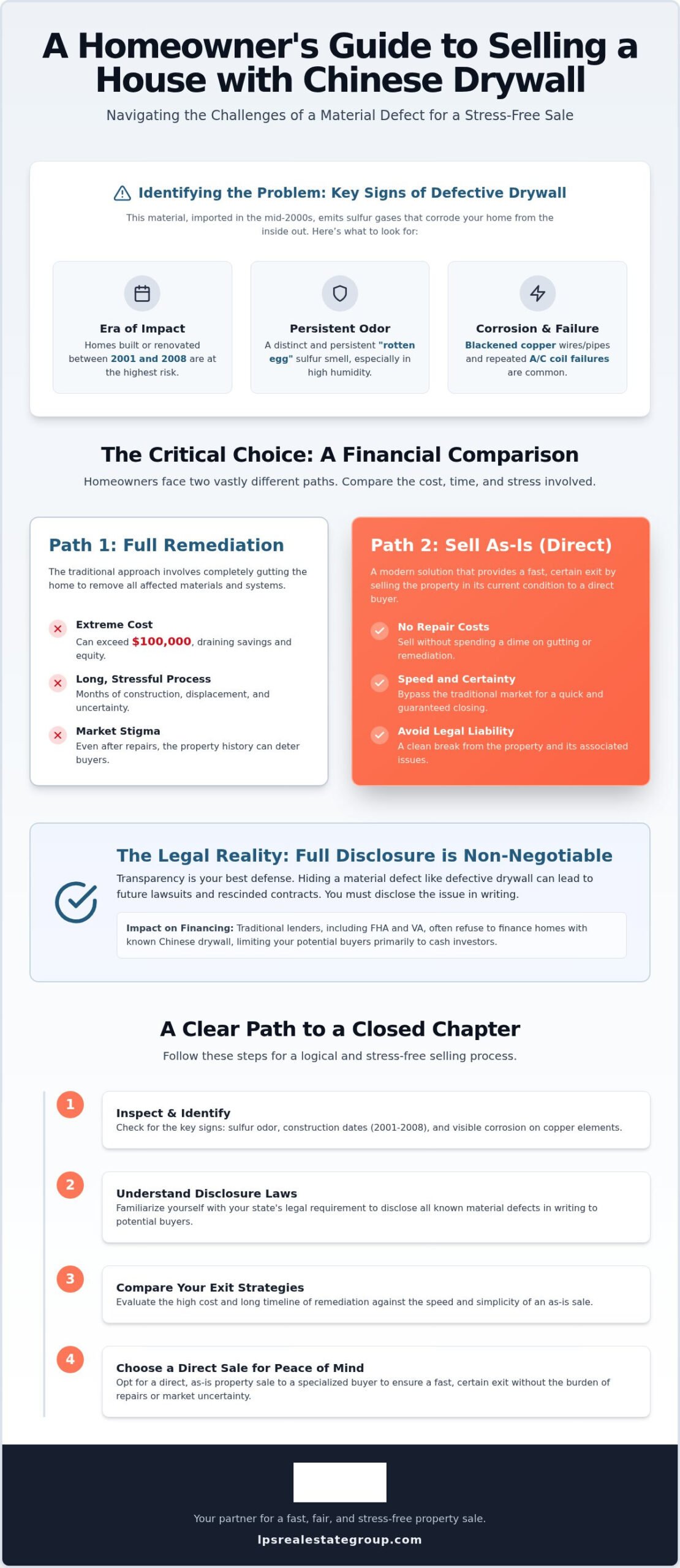
Discovering your property might be part of the Chinese drywall scandal is a heavy realization. This defective material, imported primarily in the mid-2000s, emits off-gas sulfur compounds that can corrode your home from the inside out. It isn’t just a cosmetic issue; it’s a structural and material defect that changes the entire math of your property value. Understanding the signs is the first step in deciding how to sell a house with Chinese drywall without unnecessary stress.
The most common indicator is a persistent “rotten egg” smell. It’s distinct and often becomes more noticeable when the home has been closed up or when the humidity rises. If you notice a sulfur-like odor that doesn’t go away with cleaning, it’s a major red flag. In 2026, buyers are more sensitive than ever to indoor air quality and environmental hazards, making this a critical hurdle to address early in your selling process.
The Era of Impact: 2001 to 2008
Between 2001 and 2008, a surge in construction led to the import of millions of pounds of defective drywall. If your home was built or underwent a major renovation during this specific window, your risk is significantly higher. You can verify these dates by checking your local property records or original permits. In 2026, Chinese drywall is legally classified as a material defect that requires specific legal handling and full transparency during any real estate transaction.
Technical Indicators and Inspection
You shouldn’t rely on your nose alone to confirm the problem. A specialized home inspector can look for technical indicators that the average person might miss. These include:
- Blackened Copper: Look at the wiring in your electrical panel or the copper pipes under your sinks. Sulfur gas causes these to turn black and brittle.
- A/C Coil Failure: Defective drywall often leads to repeated air conditioning failures as the gas eats through the copper coils.
- Tarnished Metals: Silver jewelry or chrome fixtures throughout the home may appear unusually tarnished or dull.
If you can access an attic or unfinished crawlspace, look at the back of the drywall sheets. You might find manufacturer stamps that identify the origin of the material. These sulfur gases don’t just smell; they actively destroy the delicate circuit boards in your household electronics and appliances. Modern families prioritize safety above all else, and knowing exactly what you’re dealing with allows you to approach the sale with honesty and a clear plan for a fast exit.
Disclosure Requirements: The Legal Reality of Selling
Transparency is your best defense when you’re dealing with a property defect of this scale. You might feel tempted to minimize the issue to attract more interest, but in the 2026 real estate market, hiding a material fact like defective drywall is a recipe for legal disaster. Understanding how to sell a house with Chinese drywall requires a commitment to honesty that protects you long after the closing papers are signed. If a buyer discovers the issue after the sale, they can sue for damages or even have the entire contract rescinded, leaving you with the house and a mountain of legal fees.
Standardized disclosure forms now include specific sections for hazardous materials or environmental concerns. You must document the presence of the drywall, any inspections you’ve had, and any known impacts on the home’s systems. This level of detail isn’t just about following the law; it’s about building a paper trail that proves you acted in good faith. An official attorney general guide on consumer protection provides a solid foundation for understanding the types of information that should be shared with potential buyers to ensure everyone is protected.
Federal and State Disclosure Standards
Current CPSC guidelines heavily influence how real estate laws are applied to these properties. Most states operate under the “material fact” rule, which means any condition that significantly affects the property’s value or the health of its occupants must be disclosed in writing. This is particularly important because traditional lenders, including those for FHA and VA loans, often refuse to finance homes with known Chinese drywall. This restriction narrows your pool of potential buyers significantly, often leaving you with only cash buyers or specialized investors. In such cases, Florida Commercial Investment Properties can provide the professional guidance needed to successfully sell specialized residential and commercial assets despite these hurdles.
Disclosing a major defect doesn’t have to mean scaring off every prospect. You can manage the narrative by providing existing inspection reports upfront. This shows you’re a trustworthy seller who isn’t hiding anything. When you address the psychological barrier of health and safety concerns directly, you reduce the fear of the unknown. If the thought of managing these complex disclosures and the resulting market pushback feels overwhelming, exploring an as-is property acquisition can simplify the process by removing the need for traditional buyer negotiations and financing hurdles.
Remediation vs. Selling As-Is: A Financial Comparison
Deciding how to sell a house with Chinese drywall often comes down to a single question: is the investment worth the return? For many, the answer is a sobering realization that the cost of fixing the problem may not be recouped at the closing table. Remediation isn’t a simple patch job. It’s a “gut-rehab” reality that requires stripping the home down to its studs. Because the sulfur gases permeate porous materials, you must remove all drywall, electrical wiring, insulation, and even the air conditioning system to truly clear the home’s history.
The financial math rarely works in the homeowner’s favor. While you might spend six figures on a total overhaul, the market doesn’t always reward that effort with an equivalent increase in value. Buyers in 2026 remain cautious of homes with a history of material defects, even after professional repair. You also have to account for hidden costs that aren’t on the initial contractor’s bid. These include the price of temporary housing for your family, the cost of city permits, and the inevitable delays that come with large-scale construction projects.
The High Cost of Remediation
In 2026, the average cost for a whole-house remodel ranges from $150,000 to $450,000 for extensive projects like drywall remediation. This is a massive jump from the baseline of $52,275 for standard renovations on smaller homes. Partial remediation is rarely a viable solution because most buyers and lenders won’t accept anything less than a full, certified clearance. Professional remediation often exceeds 30% of a home’s total value, making it a difficult pill to swallow for those who want to preserve their equity.
The Speed of an As-Is Sale
If you don’t have the stomach for a 6 to 12 month renovation timeline, an as-is sale is a logical alternative. Choosing the path of selling your house as-is allows you to sidestep these logistical nightmares and move on with your life immediately. When calculating your net proceeds, you should compare the market discount of an as-is sale against the combined cost of repairs, holding costs, and the emotional toll of a year-long construction project. Often, the certainty of a fast exit outweighs the slim possibility of a slightly higher sale price months down the road. This strategy is frequently the most effective way to manage how to sell a house with Chinese drywall while keeping your finances and sanity intact. Once you have moved on from a distressed property, you can explore Luxury Property Listing Services to find a high-quality, move-in ready home.
How to Sell a House with Chinese Drywall (Step-by-Step)
Taking the first step toward a sale can feel daunting, but a structured approach removes the guesswork. When you understand how to sell a house with Chinese drywall, you can move from a state of anxiety to one of action. This process isn’t about hiding the problem; it’s about managing it with professional precision. By following a clear sequence, you ensure that you don’t waste time on buyers who aren’t equipped to handle a distressed asset.
- Step 1: Professional Inspection. Confirm the extent of the impact. A specialized report provides the data you need to price the home accurately.
- Step 2: Equity Assessment. Determine your financial flexibility. Knowing your mortgage balance helps you understand if you can absorb a market discount.
- Step 3: Select a Selling Method. Decide between a traditional listing, which requires more patience, or a direct sale for maximum speed.
- Step 4: Document Everything. Create a comprehensive package that includes every report and repair record you have.
- Step 5: Vet Your Buyer. Ensure the person or company on the other side of the contract has the funds and experience to close on a home with material defects.
Preparing Your Documentation
Transparency is your most effective tool for a smooth closing. We recommend creating an “honesty folder” for every prospective buyer. This should include all previous repair records, air conditioning service history, and any inspection reports you’ve commissioned. By organizing your records now, you create a transparent environment that discourages future legal disputes. It shows you’re a responsible seller who respects the buyer’s right to know exactly what they’re acquiring.
Choosing the Right Buyer
Traditional retail buyers often have high expectations and low risk tolerance. They usually walk away as soon as an inspection reveals sulfur corrosion or blackened wiring. Most traditional mortgage lenders will also deny their loan applications once the defect is identified. Instead of fighting an uphill battle on the MLS, many homeowners find success with companies that buy houses for cash. These specialists understand the technical side of remediation and aren’t scared off by the “drywall nightmare.” Always ask for proof of funds to ensure the buyer has the liquidity to follow through without bank interference. If you’re looking for a certain exit without the stress of traditional negotiations, a direct as-is property acquisition might be the most logical path forward.
LPS Real Estate Group: A Stress-Free Exit Strategy
Discovering that your home was built with defective materials feels like a betrayal of your biggest investment. You have already seen the staggering costs of remediation and the legal complexities of disclosure. At LPS Real Estate Group, we provide a path that avoids the stress of traditional real estate transactions. We specialize in as-is property acquisitions, meaning we take on the burden of the “drywall nightmare” so you don’t have to. Our approach is built on transparency and fairness, ensuring you have a clear understanding of your options from the very first conversation.
We believe in a partnership that starts with active listening. Instead of pushing for a quick contract, we take the time to understand your specific financial goals and the extent of the damage to your property. Our team brings professional authority to the table, but we deliver it with the compassion of a trusted advisor. This methodical process ensures you feel fully informed and respected at every stage of the sale. Learning how to sell a house with Chinese drywall shouldn’t be a solitary struggle; it should be a collaborative effort to find the best possible outcome for your family.
Our As-Is Acquisition Process
Our process is designed for homeowners who need a fast, certain exit without the stigma of a traditional listing. We provide a fair cash offer for your house based on its current condition. You won’t need to spend a single dollar on cleaning, gutting, or replacing electrical systems. Our experience with structural and material defects allows us to value your property accurately without the fear that causes retail buyers to walk away.
- No Commissions: You keep more of your equity by avoiding agent fees.
- No Repairs: We buy the property exactly as it sits today.
- Rapid Timeline: We can often close in as little as 7 days to provide immediate relief.
Moving Forward with Certainty
The emotional toll of living with a sulfur odor or failing appliances is significant. We have helped many families resolve these complex situations through creative finance solutions. If you have low equity or owe more than the home is worth in its current state, we work with you to find a path that preserves your financial future. You aren’t stuck with this property, and you aren’t alone in this process. We invite you to a no-obligation consultation to discuss how to sell a house with Chinese drywall with a partner who truly understands the situation. Let us handle the technical and logistical challenges while you focus on your next chapter.
Taking the Next Step Toward Your Fresh Start
You’ve learned that full transparency and a clear understanding of your property’s condition are the foundations of a successful sale. While the financial burden of a gut-rehab can be overwhelming, you now know that costly remediation isn’t your only option. Understanding how to sell a house with Chinese drywall is about choosing the path that preserves your time and emotional well-being. By prioritizing honesty and exploring direct sales, you can avoid the months of construction and uncertainty that come with traditional market listings.
LPS Real Estate Group is here to act as your trusted partner. We are specialists in as-is property acquisitions and offer a transparent, no-pressure evaluation process. Even if you’re facing low-equity hurdles, our team uses creative financing to find a solution that works for your unique situation. We handle the technical complexities so you can move forward with confidence. It’s time to leave the stress of defective materials behind for good.
Get a Fair Cash Offer for Your House Today. You aren’t alone in this process, and a clean break from your property is well within reach.
Frequently Asked Questions
Do I have to disclose Chinese drywall if I think I fixed it?
Yes, you must disclose the history of the property. Even if you completed professional remediation, the presence of defective materials is considered a material fact that affects value. You should provide all repair records and clearance certificates to the potential buyer. This transparency protects you from future legal claims. In the 2026 market, buyers and their attorneys are very thorough. Being upfront is the best way to ensure the sale remains valid and final.
Can a buyer get a mortgage on a house with Chinese drywall?
Securing traditional financing for these properties is nearly impossible. Most major lenders, including those for FHA and VA loans, refuse to provide mortgages on homes with known defective drywall. Banks view the material as a significant safety risk and a threat to the property’s collateral value. This reality often forces sellers to look for cash buyers or specialized investors who don’t need to meet strict bank requirements to close the deal on a distressed asset.
How much does it cost to replace Chinese drywall in 2026?
Remediation costs are significant and vary based on home size. In 2026, a whole-house remodel for extensive damage can range from $150,000 to $450,000. This process involves stripping the home to the studs, replacing all electrical wiring, and installing new HVAC systems. Because the sulfur gases affect so many components, partial repairs are rarely sufficient. Most homeowners find that the total cost exceeds 30% of their property’s market value, making it a difficult investment to recoup at closing.
Is it illegal to sell a house with Chinese drywall?
It is perfectly legal to sell the home, provided you follow all disclosure requirements. You aren’t prohibited from transferring the property, but you are legally obligated to inform the buyer about the defect in writing. Hiding the issue is where sellers run into trouble. If you provide a clear disclosure and find a buyer willing to take on the project, you can successfully close the transaction without any legal repercussions from state or federal authorities.
Will homeowners insurance cover Chinese drywall remediation?
Most standard homeowners insurance policies do not cover the cost of remediation. Carriers typically categorize this issue as a “latent defect” or a result of “faulty materials,” both of which are standard exclusions in modern policies. While there were some settlements during the peak of the litigation years ago, those opportunities have largely passed. You should review your specific policy with a professional, but you shouldn’t rely on insurance to fund the repairs for your property.
How much of a price discount should I expect when selling with Chinese drywall?
Selling a home as-is usually results in a price 5% to 30% lower than a comparable, updated home. For properties with significant defects like these, you should expect a discount at the higher end of that range. Buyers factor in the massive cost of a gut-rehab and the emotional stress of managing a major construction project. This discount is a trade-off for the speed and certainty of a sale that doesn’t require you to perform the work yourself.
Can I sell my house to a cash buyer if it has defective drywall?
Yes, selling to a cash buyer is often the most effective strategy. These buyers specialize in as-is property acquisitions and have the resources to handle the remediation themselves. This is a common path in how to sell a house with Chinese drywall because it eliminates the need for bank appraisals and inspections that usually stop a traditional sale. It provides a fast, certain exit for homeowners who want to avoid the stress of a long renovation process.
What happens if I unknowingly sold a house with Chinese drywall?
You may still face legal liability even if you didn’t know the material was there. If a buyer discovers the defect after closing, they can sue you for damages or attempt to rescind the contract. Courts often look at whether you “should have known” based on the home’s build date or visible signs of corrosion. This is why a professional inspection is a vital step in how to sell a house with Chinese drywall, as it identifies hidden problems early.