

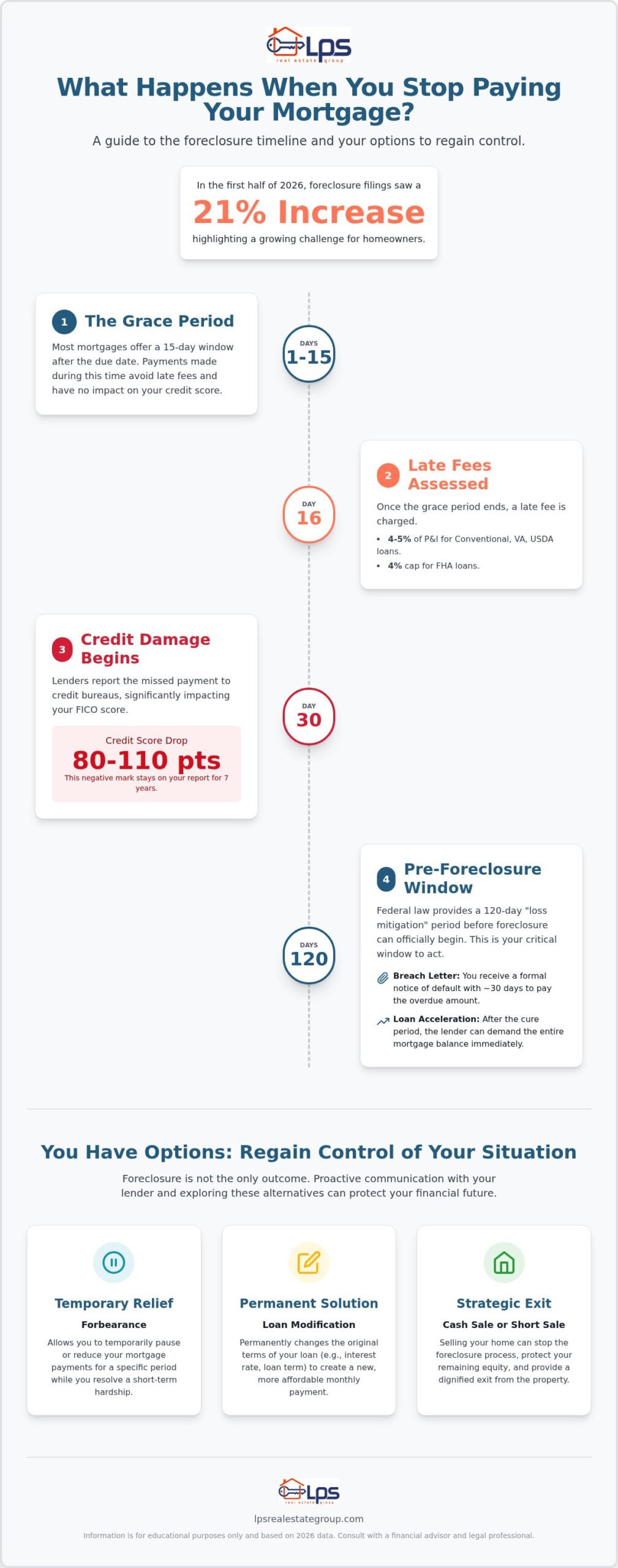
What if missing a mortgage payment wasn’t a sign of failure, but rather a signal that it’s time to choose a new path for your family’s future? You’re likely feeling a heavy weight of stress right now, perhaps even fearing the loss of your home or the destruction of your credit score. It’s completely normal to feel overwhelmed by legal jargon and the constant worry of what comes next. You aren’t alone; with foreclosure filings up 21 percent in the first half of 2026, many homeowners are facing these same difficult questions.
This guide provides a clear, compassionate look at exactly what happens if i stop paying my mortgage, including the 2026 timelines and the specific steps you can take to regain control. We’ll walk through the 120 day window before foreclosure begins, how to minimize damage to your FICO score, and how to secure a dignified exit that protects the equity you’ve worked hard to build. By understanding the process from the initial 15 day grace period to the final resolution, you can replace fear with a solid plan. You have more options than you might realize, and we’re here to help you find the one that fits your life best.
Key Takeaways
- Identify the critical deadlines in the mortgage timeline that provide a vital window for making informed decisions before foreclosure begins.
- Understand how long a foreclosure stays on your credit report and the specific waiting periods for when you can qualify for a new mortgage.
- Compare the differences between temporary relief like forbearance and permanent solutions like loan modifications to see which fits your hardship.
- Gain a clear understanding of what happens if i stop paying my mortgage so you can respond to lender notices with confidence instead of fear.
- Discover how proactive exit strategies, such as direct cash sales, can stop the foreclosure process in its tracks and protect your remaining equity.
The First 30 Days: Late Fees, Credit Impacts, and the Grace Period
The first thirty days after a missed payment are often the most stressful because of the uncertainty involved. You might be asking yourself what happens if i stop paying my mortgage and how quickly your life will change. It’s helpful to first understand that a missed payment is different from a default state. A missed payment is simply a transaction that didn’t happen by the due date, while default carries heavier legal weight.
Most mortgage contracts include a 15 day grace period. If you submit your payment within this window, you typically won’t face a late fee or any negative reporting to credit bureaus. It’s a safety net for life’s small delays.
Once you cross that 15 day mark, the situation shifts. The lender will assess a late fee to your account. For conventional, VA, and USDA loans, this is usually 4 to 5 percent of your overdue principal and interest payment. For FHA loans, the late fee is capped at 4 percent of the past due amount. These fees can add up quickly, making it harder to catch up the following month.
Mortgage default is the point where the contract is officially breached, moving the situation from a simple late payment into a serious legal matter.
When Does the Bank Report to Credit Bureaus?
Many homeowners worry about what happens if i stop paying my mortgage in terms of their long-term financial health. Lenders generally wait until you are a full 30 days past due before they notify credit bureaus. This month-long window is your most valuable opportunity to fix the situation before your credit score takes a hit.
The impact of a 30 day late payment is significant. According to 2026 FICO data, a single reported late payment can drop a high credit score by 80 to 110 points. This mark remains on your credit report for seven years, which can make future borrowing much more expensive.
The Importance of Opening Your Mail
Fear often leads to mail paralysis, where the sight of an envelope from your lender causes enough anxiety to keep it sealed. You must resist this urge because the letters contain vital information about your timeline and rights.
Ignoring these letters won’t stop the legal process of foreclosure; it only limits your ability to respond. Early letters often contain information about loss mitigation, which are programs designed to help you stay in your home or find a graceful way out.
Opening your mail allows you to identify a Notice of Default early. This document is a formal legal trigger. By engaging with your lender’s loss mitigation department now, you show that you’re a proactive partner looking for a solution rather than someone who has simply walked away.
The 120-Day Countdown: From Default to the Foreclosure Notice
While the first 30 days feel urgent, the following three months represent a critical legal window. Many homeowners worry about what happens if i stop paying my mortgage in terms of losing their home overnight, but federal law provides a specific shield. Under the Consumer Financial Protection Bureau rules, your mortgage servicer generally must wait until you are more than 120 days delinquent before they can officially start the foreclosure process. This 120 day countdown is designed to give you enough time to explore loss mitigation options and find a sustainable solution.
During this period, you’ll receive a formal Breach Letter, often called a Demand Letter. This document is a serious notice stating that your loan is in default. It typically gives you a 30 day window to “cure” the debt by paying the total amount past due, including late fees and interest. If this deadline passes without payment, the lender can “accelerate” the loan. Acceleration means the bank no longer wants monthly payments; they demand the entire remaining balance of the mortgage immediately. This shift is why acting early is so vital for protecting your equity.
As the clock ticks toward the 120 day mark, costs begin to pile up beyond your monthly principal. You’ll see an accumulation of interest on the unpaid balance, and the lender may begin charging for property inspections to ensure the home is still occupied and maintained. These fees are added to your total debt, slowly eroding the equity you’ve built over the years.
Phase 1: The First 60 Days of Non-Payment
During the second month of missed payments, the tone of communication changes. Friendly reminders from the bank are replaced by formal demand letters. This is when the lender starts assessing property inspection fees, which often appear on your statement without much explanation. The bank is essentially preparing their file for legal action, even though they can’t file the paperwork yet. If the stress of these letters feels heavy, a foreclosure prevention purchase can often provide a path to stop the clock and settle the debt before more fees accumulate.
Phase 2: The 90-120 Day Window
The 90 day mark is a major turning point. At this stage, your file is usually moved from the standard customer service department to a specialized foreclosure attorney or a law firm. This is often the last chance to qualify for traditional loan modifications. Once the lawyer takes over, the legal fees increase significantly. Understanding what happens if i stop paying my mortgage during this final phase is about recognizing that the window for simple negotiations is closing. By the time you hit day 121, the lender is legally cleared to file a Notice of Sale or a foreclosure lawsuit, depending on your state’s laws.
Beyond the Bank: The Lasting Impact on Your Credit and Future
While the immediate loss of a home is the primary concern for many, the financial ripples of a foreclosure extend far into the next decade of your life. When considering what happens if i stop paying my mortgage, it is vital to look past the current month and visualize your life five or seven years from now. A foreclosure isn’t just a single event; it’s a public record that remains on your credit report for seven years. This mark can lower a credit score by 85 to 160 points, which often pushes even those with excellent credit into a “subprime” category overnight.
The emotional toll of “walking away” can be just as taxing as the financial damage. There is a profound sense of loss and uncertainty that comes with an unplanned exit. Choosing a structured, proactive strategy allows you to maintain a sense of dignity and control. Depending on the type of loan you had, you may be barred from obtaining a new mortgage for anywhere from two to seven years. For example, Fannie Mae and Freddie Mac typically require a seven year waiting period after a foreclosure before you can buy again, though this may be shorter for certain FHA or VA scenarios.
Employment and Future Housing Hurdles
The impact reaches into areas of your life that might seem unrelated to your housing. Many employers, especially in the finance, legal, or high-level security sectors, conduct credit checks as part of their hiring process. A foreclosure can be seen as a sign of financial instability, potentially costing you career opportunities. Even finding a new place to live becomes a challenge. Private landlords often screen for recent foreclosures and may require significantly higher security deposits or a co-signer before they’ll agree to a lease.
Your daily cost of living will likely increase as well. With a damaged credit profile, the interest rates on car loans and credit cards will be much higher. You’ll end up paying thousands of dollars in extra interest over time, simply because of a mark on your record from years prior.
The Deficiency Judgment: A Hidden Danger
One of the most overlooked aspects of what happens if i stop paying my mortgage is the deficiency judgment. If your home is sold at a foreclosure auction for less than what you owe the bank, you may still be on the hook for the difference. For instance, if you owe $350,000 but the home only fetches $300,000 at auction, the bank can sue you for the remaining $50,000. In many states, this allows them to garnish your wages or place liens on other assets you own.
You can protect yourself from this outcome by taking control of the sale yourself. By selling your house as-is to a direct buyer, you can often negotiate a settlement with the lender that prevents a deficiency judgment entirely. This proactive step stops the bank from chasing you for years to come, allowing you to start your next chapter with a clean slate.
Exploring Your Options: Forbearance, Loan Modifications, and Short Sales
When you start researching what happens if i stop paying my mortgage, you’ll likely encounter several technical terms like forbearance and loan modification. These are the bank’s primary tools for helping you stay in your home, but they aren’t always a perfect fit for every financial situation. Forbearance is a temporary pause or reduction in your monthly payments. While this provides immediate relief, it’s not a permanent fix. Once the forbearance period ends, you’re responsible for the missed amount, which is often added to the back of the loan or repaid through a payment plan.
A loan modification is a more permanent change to your mortgage terms, such as extending the loan length or lowering the interest rate. However, the approval process is often frustrating and slow. Lenders require extensive documentation of your income and expenses. Many homeowners find themselves denied because their debt to income ratio doesn’t meet the bank’s strict 2026 requirements. If you’re looking for a way to leave the property without a foreclosure on your record, you might consider a short sale or a deed in lieu of foreclosure. In a short sale, the bank allows you to sell the home for less than the remaining balance, while a deed in lieu involves voluntarily handing over the keys to the lender to avoid a legal battle.
The Pros and Cons of Staying in the Home
Deciding whether to fight for a loan modification or plan an exit strategy depends on sustainability. You must honestly evaluate if a modified payment is something you can afford long term. Sometimes, the effort to “buy time” through multiple appeals only depletes your savings and adds more interest to your debt. If the financial burden is too high, a clean break might be the more compassionate choice for your family’s future. For those who feel stuck, consulting a HUD approved housing counselor can provide free, objective advice on your specific rights and options. Homeowners in other regions, such as Western Australia, often seek guidance from real estate agents Atwell WA to accurately assess their home’s value before choosing a path forward.
If you decide to sell, the traditional real estate market often presents a timing problem. A standard listing on the MLS typically takes 60 to 90 days to close, but the foreclosure clock doesn’t stop just because a “For Sale” sign is in the yard. Furthermore, traditional buyers often struggle to get financing for homes that need repairs or are sold “as-is.” This is where companies that buy houses for cash provide a vital alternative. They can close in a matter of days rather than months, which is often the only way to stop a scheduled auction. If you need a faster solution to protect your credit, you can request a foreclosure prevention purchase to settle your debt and move forward with peace of mind.
Taking Control: How a Strategic Sale Can Stop Foreclosure and Protect Your Equity
The advantage of an as-is property acquisition is that it removes the physical and financial burden of preparing a home for sale. You don’t need to worry about deep cleaning, expensive repairs, or the stress of multiple inspections. You can leave the property in its current condition and focus entirely on your next steps. Most importantly, a strategic sale often allows you to walk away with cash in hand. This provides a financial cushion that a foreclosure judgment simply doesn’t offer, giving you the resources to secure new housing and start over with dignity. For those considering high-quality rental options as part of their next chapter, Nicholson Lettings serves as an excellent example of luxury furnished apartments that provide comfort and style during a transition.
For homeowners who owe more than their property is worth, traditional selling isn’t always an option. This is where creative real estate exit strategies become invaluable. One common method is a ‘Subject-To’ offer. In this scenario, a buyer takes over your existing mortgage payments. This is a powerful tool because it catches up your arrears immediately and keeps the loan current in your name, which helps to heal your credit score over time. These creative solutions are typically much faster and more certain than waiting for a bank to approve a short sale, which can be denied even after months of waiting. When you are weighing what happens if i stop paying my mortgage, these alternatives provide a way to turn a potential loss into a manageable transition.
The LPS Real Estate Group Approach
At LPS Real Estate Group, we believe every homeowner deserves a partner who listens first. We bring a sense of quiet confidence to every consultation, ensuring you feel respected and heard during this stressful time. Our team handles the complex paperwork and coordinates directly with your lender’s loss mitigation department. This removes the burden of constant collector calls from your shoulders and ensures the process moves forward smoothly. We focus on finding the right fit for your specific needs, whether that’s a direct cash offer or a creative finance solution. Contact us today for a compassionate, no-obligation consultation to see how we can help you find a dignified path forward.
Choosing Your Path Forward with Confidence
You now have a clearer picture of exactly what happens if i stop paying my mortgage, from the initial late fees to the long-term credit impacts. While the 120 day federal window offers time to breathe, the most successful outcomes happen when homeowners take early, decisive action. You aren’t just a bystander in this process; you have the power to protect your credit and preserve the equity you’ve built over the years.
LPS Real Estate Group is here to act as your compassionate partner through this transition. We are specialized in foreclosure prevention and creative finance solutions that provide certainty even in low equity situations. Our no-fee, as-is cash purchases allow you to move forward without the burden of repairs, cleaning, or agent commissions. By choosing a structured exit, you can avoid the lasting damage of a foreclosure judgment and start your next chapter with a clean slate.
Get a Fair, No-Obligation Offer to Stop Foreclosure Today. You don’t have to face this uncertainty alone. Reach out to our team of experts to explore the options that best fit your family’s future.
Frequently Asked Questions
How many months of mortgage payments can I miss before foreclosure starts?
You generally have four months before a lender can officially begin the foreclosure process. Federal law requires mortgage servicers to wait until a borrower is more than 120 days delinquent. This window is designed to give you time to explore options like a loan modification or a strategic sale. If you reach the 121st day without a resolution, the lender is legally permitted to file the first legal notice of foreclosure.
Can I sell my house if I am already in foreclosure?
Yes, you can sell your home at any point up until the day of the foreclosure auction. Selling the property allows you to pay off the mortgage balance and stop the legal proceedings immediately. This is often a preferred route because it prevents a foreclosure from appearing on your credit report. Direct cash buyers can often close these transactions in a few days, which is vital if the auction date is approaching quickly.
What is the 120-day rule in mortgage servicing?
The 120 day rule is a federal regulation that prohibits mortgage servicers from making the first official foreclosure filing until you are more than 120 days past due. This period serves as a protective buffer for homeowners. It ensures you have a fair opportunity to apply for loss mitigation programs. During this time, the bank must provide you with information about available options to help you avoid losing your home.
Will stopping mortgage payments affect my ability to rent an apartment?
Yes, missing payments can make it much harder to rent a new home in the future. Landlords frequently check credit reports and public records during the screening process. A history of missed payments or a foreclosure filing suggests financial instability to a potential landlord. You might be required to pay a much higher security deposit or provide a co-signer to secure a lease. Taking a proactive approach to settle the debt can help minimize this long term damage.
What happens to my equity if the bank forecloses on my home?
If your home is sold at a foreclosure auction, any equity you have is at risk. While you are technically entitled to any funds that remain after the mortgage and all legal fees are paid, houses often sell for much less than market value at auctions. Legal costs and interest also accumulate quickly during the process, which eats into your potential return. A strategic sale before the auction is usually the best way to protect your remaining equity.
Can the bank sue me after they take my house?
Yes, in many states the bank can pursue a deficiency judgment if the auction price doesn’t cover your total debt. This legal action allows the lender to collect the remaining balance from you personally. They might garnish your wages or place liens on other assets you own. Understanding what happens if i stop paying my mortgage involves recognizing these long term legal risks. Choosing a settlement through a direct sale can often prevent this outcome.
Is it better to do a short sale or a direct cash sale?
A direct cash sale is often better because it provides more certainty and moves much faster than a short sale. Short sales require the lender’s approval, which can take several months and may be denied at the last minute. A cash purchase can often close within a week, stopping the foreclosure clock immediately. This speed is essential when you want to protect your credit score and avoid the uncertainty of a bank’s lengthy internal review process.
How does a ‘Subject-To’ offer help my credit after missed payments?
A ‘Subject-To’ offer helps your credit because the buyer takes over your existing mortgage payments while the loan stays in your name. This arrangement ensures that future payments are made on time and in full. Over time, these consistent, on-time payments help to heal the damage caused by your initial missed months. It’s a creative way to resolve the debt while slowly rebuilding your financial profile. This is often a key consideration when weighing what happens if i stop paying my mortgage.