

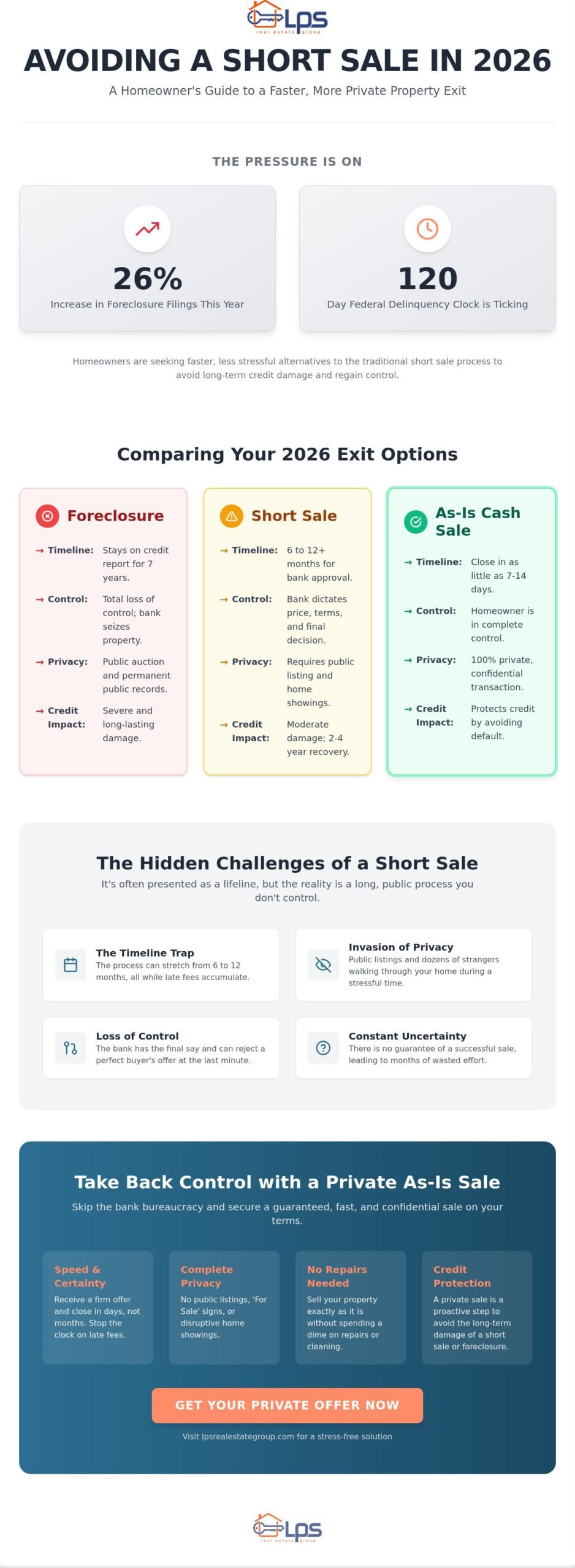
The traditional short sale is often presented as a helpful lifeline, but for many homeowners in 2026, it can feel more like a bureaucratic marathon. If you’re looking for a way to avoid short sale delays while foreclosure filings are up 26 percent this year, you aren’t alone. The pressure to find a solution before the federal 120-day delinquency mark is intense. It’s exhausting to deal with bank bureaucracy while worrying about long-term credit damage, especially when you just want a fresh start.
You deserve a path forward that respects your time and your privacy. In this guide, you’ll discover how to navigate these complexities and find a faster, less stressful alternative to the traditional process. We’ll compare your 2026 exit options, from bank-led programs to direct as-is property acquisitions. This overview will help you understand how to stop the clock on late fees and secure a private sale without the exhaustion of constant home showings or public listings. Let’s look at how you can move forward with clarity and confidence.
Key Takeaways
- Understand the timeline risks of bank-led sales that can often stretch from six to twelve months before approval.
- Discover how to avoid short sale uncertainty by comparing traditional routes with faster, direct purchase options.
- Learn which specific documents to request from your lender to gain a clear picture of your financial path forward.
- See how a private, as-is sale allows you to skip the stress of public showings and expensive home repairs.
- Explore practical methods to protect your credit and stop the clock on late fees before the foreclosure process advances.
What is a Short Sale and Why Do Homeowners Want to Avoid It?
A short sale occurs when you sell your home for less than the balance remaining on your mortgage. Because the proceeds won’t cover the full debt, your lender must agree to “short” the payoff. Many homeowners look for ways to avoid short sale proceedings because they involve a significant loss of control. You are essentially asking the bank for permission to sell your own property. They dictate the terms, the price, and the timeline. While it’s often viewed as a graceful exit, it remains a public and emotionally taxing process that can linger for months without a guaranteed result.
The core benefit of this path is the protection of your credit report. By completing a short sale, you prevent the “foreclosure” label from being attached to your financial history. This distinction is vital for your future, but it’s important to remember that this isn’t your only choice. You can find alternatives that offer more privacy and a much faster resolution than the traditional bank-led process.
The “Underwater” Reality in 2026
Even with general property appreciation, negative equity is still a reality for many in 2026. With 30-year fixed mortgage rates averaging 6.47 percent as of July 1, 2026, many buyers find their purchasing power limited. This can lead to localized price drops or stagnant values in areas hit by the “insurance squeeze,” where rising premiums make homes less affordable. This financial pressure can quickly leave a homeowner “underwater,” meaning they owe more than the home’s current market value.
A deficiency waiver is a legal agreement where the lender promises not to pursue the homeowner for the remaining balance of the loan after the sale is finalized. Securing this waiver is the most critical part of any negotiation. You might choose a voluntary sale to protect your future, or you might feel forced into one because of the federal 120-day rule. This law generally prohibits a mortgage servicer from starting foreclosure until you are more than 120 days delinquent, creating a narrow window to find a solution. Understanding how to stop foreclosure during this critical window can mean the difference between preserving your equity and losing it entirely at auction.
Short Sale vs. Foreclosure: The Standard Narrative
The primary reason people consider this route is to protect their long-term financial health. A foreclosure stays on your credit report for seven years and can make it difficult to buy another home or even secure a rental agreement. In contrast, a short sale typically allows you to apply for a new mortgage in just two to four years. For many, selling a house to stop foreclosure is the ultimate goal to preserve their future options.
Lenders often prefer this outcome because it saves them the legal costs and maintenance burdens of taking back a property. However, the bank’s preference doesn’t always align with your need for speed and privacy. While they weigh their options, your late fees continue to climb and your stress levels rise. Understanding this dynamic is the first step toward finding a solution that puts you back in the driver’s seat.
The Hidden Challenges: Why You Might Choose to Avoid a Short Sale
The decision to avoid short sale proceedings often comes down to the hidden costs that banks don’t highlight in their brochures. While a short sale is technically an alternative to foreclosure, it’s a process plagued by delays and public exposure. Many homeowners find themselves trapped in a “timeline trap” that can last anywhere from 6 to 12 months. During this period, you aren’t just waiting for a buyer; you’re waiting for a massive financial institution to review hundreds of pages of your personal financial history. This isn’t a quick fix, it’s a long-term commitment to a process you don’t control.
Privacy is another major hurdle. To satisfy a lender that a home is being sold for “Fair Market Value,” the property usually must be listed on the public market. This means dozens of strangers walking through your home during a time that’s already incredibly stressful. If you prefer a quiet, respectful exit, the public nature of a short sale can feel like an invasion. If you’re looking for a more discreet way to move on, you might consider reaching out to a professional cash home buyer who can offer a private solution.
The Uncertainty of Lender Approval
One of the most frustrating aspects of this process is that you aren’t the one making the final decision. Even if you find a perfect buyer who’s ready to move in, the bank can reject the offer at the very last minute for any reason. The “agreement” is primarily between the buyer and the lender; you are simply a third party waiting for permission to leave. This power dynamic can lead to months of wasted effort if the bank decides the offer isn’t high enough.
This uncertainty is compounded by the endless paperwork required by loan servicers. You’ll likely spend weeks completing Borrower Response Packages (BRP), only to be told a document is missing or outdated. If the bank ultimately denies the short sale after months of negotiation, the property often falls right back into the foreclosure process. This leaves you with even less time to find a solution than when you started.
Credit Impact During the Waiting Period
There’s a common misconception that starting a short sale “freezes” the foreclosure clock or stops credit damage. In reality, your credit score continues to drop every single month you miss a payment. If a negotiation takes nine months to complete, that’s nine months of “30-day late” marks hitting your report. This ongoing damage happens because the bank doesn’t stop reporting late payments just because you’re trying to sell.
Homeowners often feel stuck in limbo during this time. You can’t easily move because you don’t know when the sale will close, yet staying in the home feels like a constant reminder of financial hardship. This waiting period often does more damage to a person’s mental well-being and credit standing than the sale itself eventually repairs. Finding a way to avoid short sale delays is often the best way to stop the financial bleeding and begin your recovery sooner.
Comparing Your Options: Short Sale vs. Cash Offer vs. Creative Finance
Choosing the right exit strategy is about more than just numbers; it’s about reclaiming your peace of mind. While a short sale is one path, it often leaves you waiting for a lender’s permission to move forward. In contrast, a direct cash offer or a creative finance solution allows you to avoid short sale delays and take back control of your timeline. By understanding the differences in speed, equity handling, and certainty, you can choose the option that best fits your family’s needs. The differences are often found in the details of how the debt is handled and how quickly you can walk away. For a comprehensive breakdown of how these two outcomes compare, our guide on foreclosure vs selling for cash walks through the long-term financial impacts of each path.
- Speed: Direct sales can close in as little as 7 to 14 days, whereas short sales frequently stretch from 6 to 12 months.
- Commissions: A direct sale bypasses the standard 6 percent agent commission, a fee that a lender must approve and deduct from their payoff in a short sale.
- Certainty: Cash buyers don’t require bank financing, which eliminates the risk of a sale falling through because a buyer’s loan was rejected at the last minute.
Speed and Certainty: The Direct Sale Advantage
One of the biggest hurdles in a short sale is the “List Price Guidance Request.” This is where the bank decides what they think your home is worth before you even start marketing it. A direct sale removes this step entirely. You deal directly with the buyer, which simplifies the process and provides a guaranteed closing date. This level of predictability is essential if you need to relocate for work or want to stop the clock on late fees. For a deeper look at how timing affects your strategy, you can read our guide on how to sell a house in pre-foreclosure.
Creative Finance: A Solution for Low-Equity Situations
Many homeowners believe that if they have little to no equity, a short sale is their only choice. However, creative finance strategies like “Subject-To” or owner financing offer a powerful alternative. In a “Subject-To” transaction, a buyer takes over your existing mortgage payments. This can allow you to exit the home without needing the bank to agree to a “short” payoff, potentially protecting your credit from the deeper impact of a settled debt. Because the mortgage stays in place, you aren’t waiting for a bank negotiator to approve a loss.
These strategies are complex and require a partner who understands intricate title issues and mortgage legalities. At LPS Real Estate Group, we specialize in these creative solutions to help homeowners find a way out when traditional routes feel blocked. We work to find a path that pays off the debt and allows you to move forward without the “short sale” or “foreclosure” labels on your record. This approach prioritizes your long-term financial health while providing the immediate relief you need.
5 Practical Steps to Avoid a Short Sale and Protect Your Credit
Taking action early is the most effective way to maintain control over your financial future. When you feel the weight of a mortgage you can no longer afford, it’s easy to feel paralyzed by the options. However, following a methodical set of steps can help you avoid short sale complications and find a resolution that protects your long-term interests. These steps focus on gathering accurate data and exploring paths that bypass the bank’s lengthy approval process.
- Step 1: Request a Payoff Statement. Contact your lender for a “Mortgage Reinstatement” or “Payoff Statement” to see your exact balance. This number is often higher than you expect due to accumulated fees.
- Step 2: Explore a Loan Modification. If your goal is to stay in the home, ask your lender if they can lower your interest rate or extend your term to make the monthly payment manageable.
- Step 3: Consider a Deed-in-Lieu. This involves voluntarily handing the keys back to the bank. It still impacts your credit, but it’s often faster and more private than a public short sale.
- Step 4: Get a Direct Cash Offer. Determine the current market value of your home in its current condition. Comparing a cash home offer to your payoff statement helps you see if the gap is small enough to bridge without bank intervention.
- Step 5: Consult a Creative Finance Expert. Professionals can often structure a “Subject-To” deal where they take over your payments, allowing you to walk away without the “short” status on your credit.
Assessing Your Equity and Mortgage Balance
Before you can choose a path, you need to calculate your “net equity.” This is the amount left over after subtracting your total mortgage payoff and estimated closing costs from the home’s value. Your total payoff is different from your principal balance; it includes accrued interest, late fees, and potential legal costs if the bank has already started the foreclosure process. Relying on automated online estimates can be risky for distressed properties because they don’t account for needed repairs. A professional valuation provides a much more realistic starting point for your negotiations.
Negotiating with Your Lender
If you decide to work with your bank, bypass the general customer service line and ask for the “Loss Mitigation” department. These are the specialists authorized to discuss foreclosure alternatives. You’ll be required to write a “Hardship Letter” explaining why you can no longer make payments. Be honest and concise about your circumstances, whether it’s a job loss, medical emergency, or divorce. It’s vital to keep a detailed log of every person you speak with and the date of each call. Bank paperwork is frequently “lost” in large systems, so having your own record of every submission is your best defense against unnecessary delays. Our step-by-step guide to stop foreclosure covers how to use loss mitigation to your advantage and navigate these lender conversations effectively.
How LPS Real Estate Group Helps You Skip the Short Sale Headache
LPS Real Estate Group provides a clear path for homeowners who want to avoid short sale delays and the public exposure of a traditional bank-led listing. We understand that your situation is about more than just a property; it’s about your future and your peace of mind. Our approach is designed to be a partnership where we handle the heavy lifting, allowing you to focus on your next chapter without the weight of an uncertain sale hanging over you.
- As-Is Acquisition: We buy houses in their current condition. You don’t need to spend money on repairs, paint, or professional cleaning before you move out.
- Total Privacy: Our process is entirely confidential. You won’t have “For Sale” signs in your yard or strangers walking through your home during public open houses.
- Foreclosure Prevention: We specialize in fast closings. We can often complete the purchase before a scheduled auction date, providing a definitive resolution to a stressful timeline.
- Transparent Communication: We believe in honesty above all else. We explain every step of our offer, whether it’s a direct cash purchase or a creative finance solution.
Our Transparent As-Is Acquisition Process
We take pride in handling the complex parts of a real estate transaction so you don’t have to. In a traditional short sale, the homeowner is often responsible for managing the bank’s endless requests for documentation and property access. We simplify this by acting as the direct buyer. One of the biggest hurdles in low-equity situations is the cost of closing, which can range from 2 percent to 5 percent of the home’s price. We pay all closing costs, ensuring that the numbers we discuss are the numbers you can actually count on. When you choose to sell their house fast for cash, you’re choosing a path that prioritizes speed and certainty over bureaucratic red tape.
Creative Exit Strategies Tailored to Your Situation
Every home and every financial situation is a unique puzzle. We don’t believe in one-size-fits-all solutions. Our team has the expertise to work through difficult circumstances, including probate, inherited properties, or homes with complex title issues that might scare away traditional buyers. If you’re struggling with a mortgage that feels like a burden, we look at the entire picture to find a creative way out that respects your equity and your credit. This might involve a “Subject-To” arrangement where we take over your payments, or an as-is purchase that satisfies the debt quickly. You have more options than the bank is telling you, and we’re here to help you find the one that feels right for your family.
Take Control of Your Home Exit Today
Navigating financial distress is a heavy burden, but you have more paths forward than the bank might suggest. You don’t have to endure 12 months of uncertainty or invite strangers into your home for public showings. By choosing a direct property acquisition, you can avoid short sale bureaucracy and move forward with a guaranteed closing date. Whether it’s through a cash purchase or a creative finance solution, the goal is to stop the clock on late fees and protect your long-term credit.
LPS Real Estate Group specializes in foreclosure prevention and creative finance, offering as-is purchases that require no repairs or cleaning. We handle the complex title issues and pay all closing costs, so the process remains simple and transparent for you. There are no agent fees or hidden costs, just a straightforward way to settle your debt and start fresh.
If you’re ready to explore a private, stress-free alternative to the traditional market, we’re here to listen. Request a fair, no-obligation cash offer from LPS Real Estate Group today. You deserve a solution that respects your time and your family’s needs. A fresh start is well within your reach.
Frequently Asked Questions
Is a short sale better than a foreclosure for my credit?
Yes, a short sale is generally less damaging to your long-term financial standing than a foreclosure. While both will cause your credit score to drop, a foreclosure remains a major red flag on your report for seven years and can prevent you from securing any type of housing. A short sale is viewed by lenders as a more responsible way to handle a difficult situation, allowing your credit recovery to begin much sooner.
How long does a short sale stay on my credit report?
A short sale typically remains on your credit report for seven years from the date of the first missed payment. Although it stays on the record, the negative impact on your score diminishes as time passes. Most homeowners find that they can rebuild their credit enough to qualify for a new mortgage in just two to four years, which is a much faster recovery than the seven-year wait following a foreclosure.
Can I avoid a short sale if I have no equity?
You can avoid short sale proceedings even with zero equity by using creative finance strategies like a “Subject-To” transaction. In this scenario, a specialized buyer takes over your existing mortgage payments instead of asking the bank to accept a lower payoff. This allows you to walk away from the property and the debt without the “short” status ever appearing on your credit report, providing a cleaner exit from a difficult situation.
Do I have to pay taxes on the forgiven debt in a short sale?
You might be required to pay taxes because the IRS often views forgiven debt as taxable income. If the bank “forgives” $50,000 of your loan, they may issue a 1099-C form, which treats that amount as if you earned it. There are specific exclusions for insolvency or primary residences that may apply under 2026 tax regulations, so it’s vital to consult a tax professional to see if you qualify for relief.
Can a lender deny a short sale even if I have a buyer?
Yes, a lender has the absolute right to reject a short sale offer for any reason they choose. They might believe the offer price is too low compared to local market data or decide that you have enough personal assets to continue making payments. This inherent uncertainty is one of the biggest frustrations of the process, as months of negotiation can end in a denial that leaves you right back where you started.
What happens if I just walk away from my home instead of a short sale?
Walking away leads to a foreclosure, which is the most damaging outcome for your credit and future housing options. Beyond the seven-year mark on your credit report, the bank may pursue a deficiency judgment against you. This is a legal order that allows them to collect the remaining balance of the loan from your future wages or other assets, meaning the debt could follow you long after you leave the house.
How much does it cost to do a short sale?
Homeowners generally don’t pay out-of-pocket fees for a short sale because the lender usually covers the commissions and standard closing costs. However, the hidden cost is the time you spend in financial limbo, often lasting 6 to 12 months. During this period, your credit continues to suffer from missed payments. Direct buyers also pay all closing costs but can often close in under two weeks, saving you months of late fees and stress.
Can I buy another house after a short sale?
Yes, you can typically qualify for a new mortgage within two to four years after a short sale is finalized. The exact waiting period depends on the loan type; for example, FHA loans often have shorter waiting periods than conventional loans if you can prove a documented hardship. This timeline is significantly better than a foreclosure, which often forces a full seven-year wait before you can even be considered for a new home loan.