

A title defect doesn’t mean your house is unsellable. It means it’s un-listable on the MLS, and those are two very different things. If you’re trying to sell a house with title issues and a traditional buyer just walked away because their lender flagged a lien, a missing heir, or an old judgment on the property, take a breath. You’re not stuck.
That sinking feeling when a deal falls through over something buried in a title search is real, and it’s more common than most people realize. The instinct is to assume you’ll need to spend thousands on legal fees before you can do anything. For many homeowners, that cost alone feels like a wall with no door in it.
This guide is here to change that picture. You’ll learn exactly what title issues are, which ones can quietly derail a sale, and how homeowners in your situation are closing deals without first emptying their savings on a quiet title lawsuit. By the end, you’ll have a clear, honest path forward, including options that let you sell the problem rather than solve it yourself.
Key Takeaways
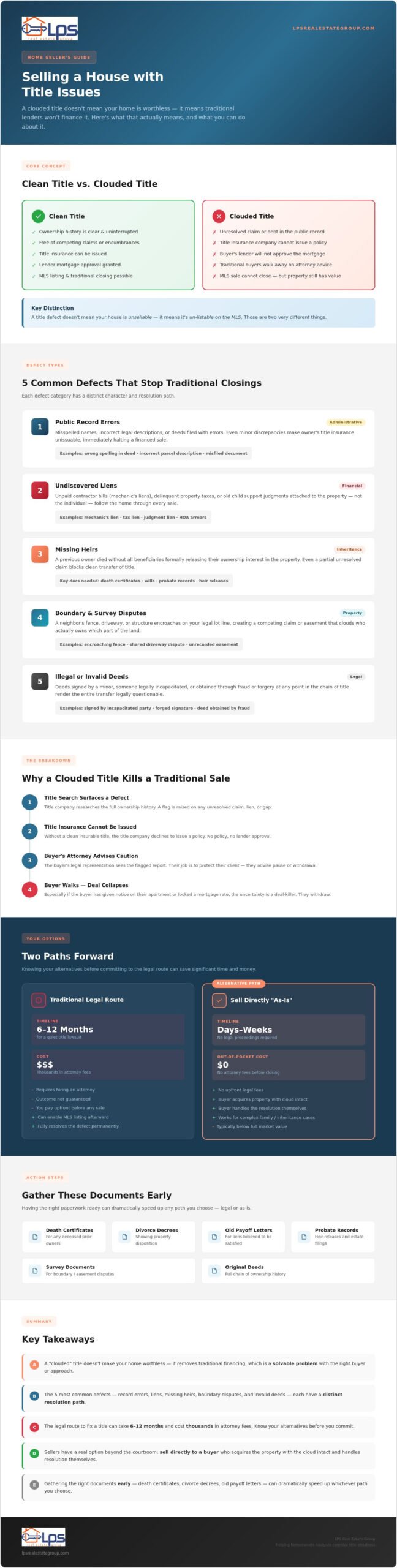
- A “clouded” title doesn’t mean your home is worthless — it means traditional lenders won’t finance it, which is a solvable problem with the right buyer or approach.
- Common defects like unpaid liens, clerical errors, and missing heir claims are the most frequent reasons deals collapse, and each one has a distinct resolution path.
- The legal route to fix a title can take 6–12 months and cost thousands in attorney fees — knowing your alternatives before you commit to that path can save you significant time and money.
- Homeowners who want to sell a house with title issues have a real option beyond the courtroom: selling directly to a buyer who acquires the property with the cloud intact and handles resolution themselves.
- Gathering the right documents early — death certificates, divorce decrees, old payoff letters — can dramatically speed up any path you choose, whether legal or as-is.
Understanding Title Issues and Why They “Cloud” Your Home Sale
Owning a home and having the legal right to sell it are not the same thing. That distinction trips up a lot of homeowners, and it’s worth understanding clearly before anything else. You can live in a property for decades, pay the mortgage faithfully, and still discover that the chain of ownership in the public record has a gap, a competing claim, or an unresolved debt attached to it. When that happens, your ability to transfer ownership cleanly to a new buyer becomes legally complicated, regardless of how long you’ve been there.
A clean title means the property’s ownership history is clear, uninterrupted, and free of competing claims. A clouded title means something in that history is unresolved. It could be a lien from an unpaid contractor, a boundary dispute from 30 years ago, or a clerical error in a deed from a previous sale. The size of the issue almost doesn’t matter at first; even a small discrepancy can create enough legal uncertainty to stop a sale cold.
What Is a “Cloud on Title”?
Any unresolved claim or encumbrance sitting on a property’s record creates what’s legally called a “cloud.” Title insurance companies, which act as the gatekeepers of virtually every traditional home sale, are required to research the full ownership history through the title search process before they’ll issue a policy. If they find something they can’t insure around, they flag it. No title insurance policy means no mortgage approval for your buyer. No mortgage approval means no closing.
When a buyer’s agent or attorney sees a flagged title report, the reaction is almost always the same: caution, then hesitation, then withdrawal. It’s not personal. Buyers who are financing a purchase are required by their lender to have insurable title. A cloud doesn’t just slow things down; it removes the legal foundation the entire transaction is built on.
Why Traditional Buyers Walk Away from Title Defects
The buyer’s attorney or real estate agent has one job in this moment: protect their client. If a title search surfaces a defect, they’ll typically advise the buyer to pause or walk away entirely, because the timeline to resolve a cloud can stretch from weeks to many months depending on the issue. That kind of uncertainty is a deal-killer for someone who’s already given notice on their apartment or locked in a mortgage rate.
Marketable title is the legal standard required for a standard MLS sale: the title must be free of defects that a reasonable buyer would object to. If you’re trying to sell a house with title issues through the traditional market, that standard is the wall you’re running into. Understanding it clearly is the first step toward finding a path around it.
Common Title Defects That Stop Traditional Closings
Not all title problems look the same, and that matters when you’re trying to figure out your next move. Some defects are administrative, buried in a filing error from years ago. Others are financial, tied to debts that followed the property through multiple owners. And some are deeply personal, rooted in family dynamics that nobody anticipated at the time of inheritance. Knowing which category your situation falls into is the first step toward understanding what it will actually take to resolve it, or to sell house with title issues without resolving it yourself.
The most common defects that derail traditional closings include:
- Public record errors: A misspelled name, incorrect legal description, or a deed that was filed incorrectly. These seem minor but are enough to make owner’s title insurance unissuable, which stops a financed sale immediately.
- Undiscovered liens: Unpaid contractor bills (mechanic’s liens), delinquent property taxes, or old child support judgments attached to the property rather than the individual.
- Missing heirs: A previous owner died without all beneficiaries formally releasing their interest in the property.
- Boundary and survey disputes: A neighbor’s fence, driveway, or structure encroaches on your legal lot, creating a competing claim.
- Illegal deeds: Deeds signed by a minor, someone legally incapacitated, or obtained through fraud or forgery at any point in the chain of title.
Liens and Encumbrances: The Financial Hurdles
Tax liens sit at the top of the priority stack. They take precedence over almost every other claim, including the mortgage, which means a buyer’s lender won’t touch the property until those obligations are cleared. Equally disruptive are “zombie mortgages,” old loans from decades ago that were paid off but never formally discharged in the public record. The original lender may no longer exist, making documentation nearly impossible to obtain. If the property has passed through an estate, the cost to sell a house in probate can compound quickly when estate liens layer on top of existing encumbrances.
The “Heir Problem” in Inherited Properties
This is the defect that competitors rarely explain well, and it’s one of the most common reasons inherited homes sit unsold for years. A will establishes intent, but it doesn’t transfer legal title. Without a completed probate process, the deceased owner’s interest hasn’t formally passed to anyone. If there are multiple heirs, including estranged relatives or family members who simply can’t be located, every one of them typically needs to sign off before clear title can be conveyed. One refusal or one missing signature can freeze the entire transaction. When siblings disagree on what to do with a property, understanding the full range of inherited home buyouts can help heirs find a resolution that feels fair without requiring everyone to agree on a traditional sale. A cash buyer for an inherited house often has the experience and resources to locate missing heirs and structure deals that account for competing interests, something a traditional buyer simply won’t attempt.
If any of these situations sound familiar, the path forward doesn’t have to start with a lawyer’s retainer. Understanding the specific defect you’re dealing with opens up options worth exploring before committing to a lengthy legal process.
The Cost of Waiting: Traditional Legal Remedies vs. Selling As-Is
Once a title defect surfaces, most homeowners face a version of the same choice: spend the time and money to fix it legally, or find a path that doesn’t require you to solve the problem before you sell. Neither option is wrong. But understanding what each one actually costs, in dollars, months, and stress, changes how you weigh them.
What Is a Quiet Title Action?
A quiet title action is a court proceeding that legally extinguishes all competing claims to a property, producing a court order that establishes your ownership as clear and undisputed. It’s the most thorough fix available, and for some defects, it’s the only fix a traditional buyer will accept. The problem is what it demands from you in the meantime.
The process typically runs six to twelve months, and in contested cases involving missing heirs or disputed boundaries, it can stretch longer. Attorney fees, court filing costs, and title search expenses add up quickly, and you’re carrying the property the entire time: mortgage payments if any remain, property taxes, insurance, and maintenance. Those holding costs don’t pause while the court calendar moves at its own pace.
For some sellers, that math works. If the property has significant equity and the defect is straightforward, absorbing those costs to unlock a full-market sale can make sense. But for many homeowners trying to sell house with title issues, especially those dealing with inherited properties or multiple competing claims, the legal route trades one kind of pressure for another.
The As-Is Advantage for Complex Titles
Professional investment groups that specialize in direct acquisitions operate on a different model entirely. They don’t need insurable title at closing because they’re not financing the purchase through a conventional lender. That single fact removes the wall that stops every traditional transaction.
When a direct buyer acquires a property with a clouded title, they’re absorbing the legal risk and the resolution costs as part of the deal. The seller receives a cash offer, transfers whatever interest they legally hold, and walks away. The buyer then handles the quiet title action, lien negotiations, or heir outreach on their own timeline and at their own expense. For sellers who need to sell a house fast after probate, this approach eliminates months of legal limbo and the unpredictable costs that come with it.
The honest trade-off looks like this:
- Legal route: Higher potential net proceeds, but only after attorney fees, holding costs, and a timeline measured in months or years.
- Direct sale: A lower gross offer that reflects the buyer’s risk and resolution costs, but no legal fees, no holding costs, and a closing timeline measured in weeks.
Neither path is universally better. What matters is which one fits your actual situation. If the carrying costs alone are eating into your equity every month, waiting for a court order may cost more than the discount a direct buyer is asking for. That’s the calculation most legal guides skip entirely, and it’s the one worth doing before you commit to anything.
Steps to Take When You Discover a Title Problem Before Listing
Discovery is actually the best moment to act. Once you know what you’re dealing with, you have options. The mistake most homeowners make is either freezing in place or immediately calling an attorney before they’ve done the basic organizational work that makes any professional consultation more productive and less expensive.
Start by reading your preliminary title report carefully, ideally with a trusted real estate advisor or escrow officer who can translate the legal language into plain terms. The report will identify specific exceptions, meaning the exact items the title company won’t insure. That list is your roadmap. Each exception points to a document, a filing, or a missing signature somewhere in the chain of ownership. Before you can decide how to move forward, you need to know precisely what’s broken.
Then gather your documents. This step costs nothing, but it changes everything. Depending on the defect, you may need:
- Death certificates for any previous owner who passed away
- Divorce decrees that transferred or released a spouse’s interest in the property
- Old mortgage payoff letters or discharge documents from lenders that may no longer exist
- Probate court orders that formally transferred title through an estate
- Recorded releases for any liens shown on the report
Having these in hand before your first professional consultation shortens that conversation considerably and often reveals that the fix is simpler than it initially appeared.
Researching the Chain of Title
Your county recorder’s office holds the public record of every deed, lien, and encumbrance ever filed against your property. Most counties now offer online deed search tools, but a visit in person can surface documents that haven’t been digitized. You’re looking for the unbroken sequence of ownership transfers from the earliest recorded deed to your name. A gap, an unsigned document, or a deed recorded out of order is where the cloud typically lives. A quitclaim deed, which transfers whatever interest a person holds without guaranteeing the extent of that interest, is a common tool for resolving minor heirship issues by formally releasing a relative’s potential claim.
Consulting with a Title Specialist
A real estate agent can tell you what a defect means for your listing. A title officer can tell you whether it’s actually fixable before you find a buyer. Those are different conversations. Ask a title company for a title commitment on the property before you list; it forces the issue into the open early and gives you a written list of conditions that must be met for them to insure the sale. In some cases, a letter of indemnity between two title companies can bridge a minor gap, with one insurer agreeing to hold the other harmless if a specific claim materializes later. It’s not available for every defect, but it’s worth asking about directly.
Once you’ve done this groundwork, you’re in a genuinely informed position. You know the defect, you know what resolution would require, and you can weigh the legal path honestly against alternatives. If the cost and timeline of a quiet title action don’t fit your situation, that’s not a failure. It’s useful information. Homeowners who want to sell house with title issues without absorbing those costs themselves have a real alternative in direct acquisition, where a buyer takes the property as-is and handles resolution on their end. If you’re at that fork in the road, connect with a direct acquisition specialist at LPS Real Estate Group to understand what that path looks like for your specific situation.
How LPS Real Estate Group Resolves Complex Title Situations for Sellers
Everything covered in this guide points toward one practical reality: the legal route to a clean title is real, but it’s not the only route. LPS Real Estate Group was built specifically for homeowners who need a different path. The core of what we do is straightforward. We buy the property with the cloud intact. You don’t fix the title first. You don’t pay an attorney to open a quiet title case. You don’t wait months for a court order before you can move on. We acquire whatever interest you legally hold, and we take on the resolution work ourselves.
That’s not a workaround. It’s a deliberate acquisition model designed for exactly the situations that stop traditional buyers cold: inherited properties with missing heir signatures, homes carrying undisclosed liens from previous owners, estates tangled in probate, and deeds with errors that no title insurer will touch. When you want to sell house with title issues without absorbing the cost and timeline of fixing them yourself, this is the structure that makes it possible.
Our creative finance solutions give us flexibility that conventional buyers simply don’t have. Because we’re not working through a traditional lender, we’re not bound by the insurability requirements that kill financed deals. We can structure acquisitions around partial interests, negotiate lien payoffs as part of the transaction, and coordinate with probate courts when estate assets are involved. The legal and administrative complexity that makes your property un-listable is exactly the kind of problem our team is set up to handle.
Our Compassionate Expert Approach
We listen before we make any recommendations. Every title situation has a human story behind it, and understanding yours shapes how we structure an exit that actually fits. There’s no pressure, no aggressive timeline, and no expectation that you’ll have all the answers before we talk. Our experience with probate and foreclosure-related title issues means we’ve worked through scenarios that most buyers would walk away from without a second look. That experience translates into a clearer, faster path for you.
Getting Your Fair Cash Offer Today
Starting the process costs you nothing. There are no upfront fees, no listing commissions, and no requirement to resolve the title defect before we can make an offer. You’ll know your closing date before you sign anything, which matters enormously when you’re carrying a property that’s costing you money every month it sits.
If you’re ready to stop waiting and start moving, get a fair cash offer for your house with title issues today. One conversation is all it takes to understand what your options actually look like.
Your Path Forward Starts with One Conversation
A clouded title doesn’t have to be the end of the road. Throughout this guide, you’ve seen that the defect type shapes your options, that the legal route carries real costs in both time and money, and that selling directly to a specialist buyer is a legitimate alternative worth considering before you commit to months of court proceedings.
The most important thing to take away is this: you don’t have to solve the problem before you can sell. When you sell a house with title issues to a direct buyer like LPS Real Estate Group, the resolution work transfers with the property. Their team specializes in probate and inherited property buyouts, absorbs the title resolution costs as part of the acquisition, and moves through the process with transparency at every step.
You’ve already done the hard work of understanding your situation. The next step is simple. Get your fair cash offer from LPS Real Estate Group today and find out exactly what your options look like. There’s no pressure and no obligation, just a clear, honest conversation about what’s possible.
Frequently Asked Questions About Selling a House with Title Issues
Can you sell a house if the title isn’t completely clear?
Yes, you can sell a house with title issues, but the buyer pool narrows significantly. Traditional buyers using mortgage financing can’t complete a purchase without insurable title, so a conventional MLS sale is off the table until the defect is resolved. However, direct buyers and investment groups that acquire properties with cash aren’t bound by lender insurability requirements, which means they can purchase the property with the cloud intact and handle resolution themselves.
How much does it cost to fix a title issue before selling?
The cost varies widely depending on the defect type. A simple clerical error corrected through an affidavit or corrective deed might involve only recording fees. A quiet title action, which is the full court process for extinguishing competing claims, typically involves attorney fees, court filing costs, and title search expenses that accumulate over months. On top of those direct costs, you’re also carrying the property the entire time, meaning mortgage payments, taxes, and insurance continue until the case resolves.
What happens if a title search finds a lien I didn’t know about?
First, don’t panic. Undiscovered liens are genuinely common, especially in properties that have changed hands multiple times or gone through estate transfers. The title company will list the lien as an exception on the commitment, meaning they won’t insure around it. From there, you have a few paths: negotiate a payoff directly with the lienholder, dispute the lien if it was improperly filed, or sell to a direct buyer who folds the lien negotiation into the acquisition process rather than requiring you to clear it first.
How long does it take to clear a title for a home sale?
Simple administrative fixes, like correcting a misspelled name on a recorded deed, can sometimes be resolved in a few weeks. Contested situations involving missing heirs, boundary disputes, or a full quiet title action typically run six to twelve months, and complex cases can stretch longer. That timeline is one of the most important factors to weigh honestly before committing to the legal route, because holding costs accumulate the entire time the property sits unresolved.
Can I sell an inherited house if the probate isn’t finished?
This depends on your state’s probate laws and the specific stage of the estate process. In many cases, a sale can be initiated during probate with court approval, but the closing can’t happen until the estate has legal authority to transfer title. Some direct acquisition specialists, including those with experience in probate buyouts, can structure a transaction that coordinates with the probate court timeline, allowing you to lock in terms now rather than waiting for the process to fully conclude before finding a buyer.
Who is responsible for paying to clear the title, the buyer or the seller?
In a traditional transaction, the seller is generally expected to deliver marketable title, which means the cost of resolving defects falls on the seller’s side. That’s the standard that makes title issues so disruptive: you’re responsible for a problem you may not have created. When you sell house with title issues to a direct buyer who acquires the property as-is, that dynamic flips. The buyer absorbs the resolution costs as part of their acquisition model, which is reflected in the offer price rather than charged back to you at closing.
What is a quiet title action and do I need one?
A quiet title action is a lawsuit filed in civil court that asks a judge to formally declare your ownership as clear and superior to any competing claims. The court order it produces is the strongest possible resolution for a clouded title because it’s legally binding on all parties. Not every defect requires one. Minor clerical errors, dischargeable liens, and some heirship issues can be resolved through corrective deeds, lien releases, or quitclaim deeds without going to court. Whether you need a quiet title action depends entirely on the specific defect and whether a title insurer will accept a simpler resolution.
Will a cash buyer purchase a house with a tax lien or judgment?
Many direct buyers and investment groups will, yes. Tax liens and judgments don’t automatically make a property unsellable to a cash buyer; they make it un-financeable for a conventional buyer. A cash buyer can structure the acquisition to account for the outstanding obligation, either by negotiating a discounted payoff with the lienholder, folding the lien amount into the deal terms, or assuming responsibility for resolution after closing. The offer will reflect those costs, but the transaction itself doesn’t have to stall the way it would with a financed buyer who needs a clean title certificate before their lender will fund.