

Could the family home you just inherited actually be a financial ticking clock? While many heirs hope to keep a property “in the family,” the most obvious path of an internal sibling transfer can often be the most expensive decision you make. You likely want to honor your parents’ legacy while keeping the peace, but the reality of inherited home buyouts in 2026 is frequently more complex than a simple handshake. Between 30-year mortgage rates averaging 6.64% and the rising costs of property maintenance, the pressure to find liquid cash can quickly turn a sentimental asset into a source of deep family friction.
We understand that you are looking for a resolution that feels fair, transparent, and final. It is completely normal to feel overwhelmed by probate court requirements or the prospect of significant legal fees that can exceed $56,000 for a typical California estate. This guide provides a clear, compassionate framework to help you navigate these hurdles without sacrificing your family relationships. We will walk you through the logistics of sibling agreements, explain how to leverage the current $15 million estate tax exemption, and help you decide if a professional exit strategy is the right move to ensure a fast, certain result for everyone involved.
Key Takeaways
- Distinguish between internal sibling transfers and external sales to choose the path that best preserves your family’s equity and peace of mind.
- Follow a structured process to establish fair market value and calculate equity, ensuring every heir receives a transparent and honest settlement.
- Identify common emotional and legal roadblocks, including how to avoid the “nuclear option” of a forced partition suit through collaborative planning.
- Explore how professional inherited home buyouts offer a certain, as-is exit that eliminates the need for costly repairs or months of waiting on the open market.
- Learn how a compassionate advisor can handle the logistical heavy lifting of probate, allowing you to focus on your family’s well-being rather than property taxes.
Understanding Inherited Home Buyouts: Internal vs. External Solutions
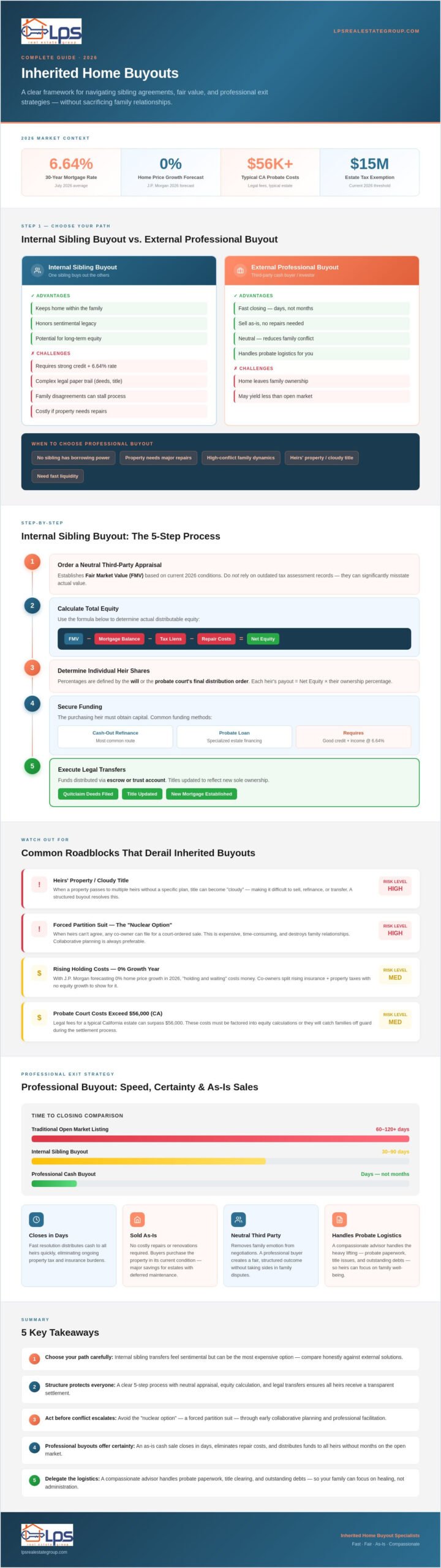
An inherited home buyout is the formal process where one or more heirs liquidate their financial interest in a property. It is a way to turn a shared physical asset into individual liquid cash. In 2026, many families are finding themselves at a difficult crossroads. With market forecasts from J.P. Morgan suggesting 0% growth in home prices this year, the old strategy of “holding and waiting” is losing its appeal. When property values stall, co-ownership often leads to splitting the bill for rising insurance premiums and property taxes without the benefit of equity growth. Inherited home buyouts offer a path to resolve these financial ties before they become a source of family conflict.
The executor of the estate typically acts as the primary facilitator for these transactions. Their job is to ensure that the distribution of assets is handled fairly and according to the law. When a property passes to multiple people without a specific plan, it is often classified as heirs’ property. This status can make the title “cloudy” and difficult to manage. A structured buyout provides a clean exit that respects the rights of every beneficiary while preventing the home from becoming a permanent financial drain on the estate.
What is an Internal Sibling Buyout?
This is the most common choice for families who want to keep a childhood home within the family circle. In this scenario, one sibling chooses to live in or keep the home and pays the others for their share of the equity. It requires a clear legal paper trail to be successful. You will need to file quitclaim deeds to transfer interest and update the title. Most importantly, the sibling staying in the home usually needs a new mortgage agreement. Since mortgage rates in July 2026 are averaging around 6.64%, the buying sibling must have the credit strength and income to qualify for a loan that covers the payout to all other heirs.
When Does an External Professional Buyout Make More Sense?
An internal transfer is not always the best or most realistic option. If no sibling has the liquid cash or the borrowing power to fund a buyout, the family must look elsewhere. This is frequently the case when a property requires significant repairs or renovations that the heirs simply cannot afford or manage. High-conflict family dynamics also make a third-party sale more attractive. A professional inherited home buyout provides a neutral solution. It allows the estate to close quickly, settles all outstanding debts, and distributes cash to heirs in a matter of days. This “clean break” approach preserves family relationships by removing the stress of a long, drawn-out listing process.
The Step-by-Step Process of an Internal Sibling Buyout
Executing inherited home buyouts requires a blend of financial precision and family diplomacy. It is a methodical path that ensures everyone walks away feeling respected. While the emotional weight of a family home is significant, the buyout itself must be treated as a professional transaction to protect all parties involved. By following a clear sequence of steps, you can minimize friction and move toward a fair resolution.
- Step 1: Order a neutral, third-party appraisal. This establishes the Fair Market Value (FMV) based on current 2026 market conditions. Do not rely on outdated tax records.
- Step 2: Calculate the total equity. Subtract any remaining mortgage balances, property tax liens, or documented repair costs from the FMV.
- Step 3: Determine individual shares. These percentages are typically defined by the will or the probate court’s final distribution order.
- Step 4: Secure funding. The purchasing heir must obtain the necessary capital, often through a cash-out refinance or a specialized probate loan.
- Step 5: Execute legal transfers. Funds are distributed through an escrow or trust account, and titles are updated to reflect the new ownership status.
Determining Fair Market Value and Equity Shares
Establishing an accurate value is the foundation of a successful buyout. You should avoid relying on tax assessments or automated online estimates. These tools often fail to account for the specific condition of the property or recent hyper-local sales data. An Equity Share is the market value minus liabilities, divided by the number of heirs. It’s also vital to account for the real cost to sell a house in probate during these calculations. If you don’t factor in statutory fees, which can reach approximately $56,000 for a $1.5 million estate in California, the purchasing sibling may end up overpaying for their share of the actual net value.
Funding the Buyout: Financing and Cash Options
Funding is often where the process stalls. With average 30-year fixed mortgage rates at 6.64% as of July 2026, the cost of borrowing is a significant factor for many heirs. Traditional lenders often hesitate to provide loans on properties that are still technically in the estate’s name or those in “as-is” condition. Portfolio loans or specialized probate lenders might offer more flexibility, though they often come with different terms. If the financing hurdles feel too high for your family, exploring direct acquisition options can provide a simpler, cash-based path forward. This approach removes the need for traditional bank approvals and allows for a faster closing for all siblings involved in inherited home buyouts.
Common Roadblocks: Why Inherited Property Buyouts Get Complicated
Even with the best intentions, inherited home buyouts often encounter friction. It’s rarely just about the money. Most siblings start with a shared goal of fairness, but individual financial needs and deep-seated emotional ties can quickly pull the group in different directions. If one sibling is ready to move on while another is paralyzed by nostalgia, the process can grind to a halt. This mismatch in timing and priorities is often the primary reason these transactions become stressful.
When negotiations break down completely, families sometimes face the “nuclear option” known as a Partition Suit. This is a legal action where a co-owner asks the court to force the sale of the property. It’s a costly, public, and emotionally draining path that usually results in a lower net payout for everyone because of legal fees and court-ordered auction pricing. Avoiding this outcome is almost always in everyone’s best interest, as court-mandated sales rarely reflect the true market potential of the home.
Beyond family dynamics, financial liabilities often complicate the math. Reverse mortgages are a frequent hurdle. These loans typically become due shortly after the owner passes away, often within six to twelve months. If the estate doesn’t have the cash to pay it off, the equity you hoped to split can vanish into interest and fees. Property taxes and insurance also continue to mount during the negotiation phase. In California, for example, failing to move into an inherited home within one year can trigger a massive property tax reassessment under Proposition 19, significantly increasing the monthly carrying costs and shrinking the available equity for inherited home buyouts.
Disagreements on Value and Emotional Attachment
Mediation is often the most effective tool for resolving value disputes. A neutral third party can help siblings separate the “sentimental premium,” which is the extra value someone places on a home due to memories, from the actual fair market value. One helpful strategy is including a “Right of First Refusal” clause in the initial agreement. This gives the sibling who wants to keep the home a specific window of time to match any outside offer. This ensures the process remains transparent and fair to everyone without making anyone feel “pushed out.”
Dealing with Title Issues and Existing Liens
Title defects are another common roadblock in estate sales. You might discover missing heirs from previous generations or improper transfers that were never recorded correctly. These issues can stop a traditional sale or an internal buyout in its tracks. If you find yourself in this situation, learning how to sell a house with title issues is a critical next step. Professional buyers who specialize in estate liquidations often have the experience and legal resources to clear these hurdles faster than a traditional buyer who relies on standard bank financing.
The Professional Buyout Advantage: Speed, Certainty, and As-Is Sales
While an internal transfer is often the first thought, many families quickly realize that no single heir has the liquid cash or borrowing power to complete the transaction. This is where professional inherited home buyouts provide a necessary alternative. Instead of waiting months for a sibling to secure a loan at 2026’s 6.64% interest rates, a professional acquisition offers a certain, cash-based exit. This approach provides the immediate liquidity needed to pay off estate debts, settle with probate attorneys, and distribute fair shares to every beneficiary without the risk of a deal falling through at the last minute.
A professional buyout acts as a “clean break” for the family. It removes the property from the estate’s books in a matter of days, effectively stopping the drain of property taxes and insurance premiums. For an executor, this speed is a significant relief. It fulfills their fiduciary duty to the heirs by securing a guaranteed, documented sale that avoids the volatility of the traditional retail market. This certainty is especially valuable in a year like 2026, where home price growth has stalled, making a fast exit more financially sound than a long-term hold.
Skipping Repairs and Traditional Listing Hassles
Most inherited properties haven’t been updated in decades. When you choose a professional path, you skip the expensive “market-ready” renovations that traditional buyers demand. Heirs often find that the cost of a six-month renovation project, including contractor fees and holding costs, far outweighs the potential increase in sale price. Professional buyers take on the risk of structural or code violations. This means you don’t have to worry about cleaning out years of belongings or fixing a leaky roof before you can move forward with your life.
Avoiding Probate Delays and Legal Friction
The legal weight of an estate can be exhausting. A direct sale can simplify the process by providing a clear, transparent valuation that the probate court can easily approve. By choosing a certain path, you reduce the potential for liability and the legal friction that often arises when a traditional buyer’s financing fails. If you’re looking for a way to streamline the final stages of the estate, reviewing a guide on how to sell a house fast after probate can help you understand the specific timelines involved. If your family is ready to move past the logistics and toward a fair settlement, a direct property acquisition might be the most compassionate choice for everyone involved in inherited home buyouts.
Navigating Your Inherited Home Buyout with LPS Real Estate Group
At LPS Real Estate Group, we understand that selling a family home is about more than just a real estate transaction. It’s often the final step in a long, emotional journey. We position ourselves as a compassionate partner, specializing in inherited home buyouts that respect both the financial needs of the heirs and the legacy of the property itself. Our approach is grounded in transparency and quiet confidence. We don’t use high-pressure tactics because we believe that the right solution should provide immediate relief, not added stress.
Our “As-Is” purchase model is designed specifically for estates that aren’t ready for the retail market. You won’t need to spend months coordinating repairs or cleaning out decades of memories. We buy the house exactly as it stands today. When we calculate an offer, we look at the verified 2026 market trends, including the current 6.64% mortgage rates and forecasted flat price growth, to ensure our proposal is grounded in reality and fairness for all siblings involved. We work collaboratively with executors and every heir to ensure the transition is smooth and every voice is heard.
Our Transparent Process for Heirs and Executors
We’ve streamlined our process to remove the uncertainty that typically haunts probate sales. It starts with a simple conversation where we listen to your specific needs and family situation. From there, we provide a firm cash offer within 24 to 48 hours. We recognize that sorting through a loved one’s belongings takes time, so we offer flexible closing dates that work on your schedule. You can take what is sentimental and leave the rest behind. There are no commissions, no hidden fees, and we cover all standard closing costs, ensuring the number you see on the offer is the amount the estate actually receives.
Creative Finance Solutions for Complex Estate Situations
Not every inheritance is straightforward. Some properties come with high debt-to-value ratios, complex liens, or title defects that make traditional bank financing impossible. While most buyers walk away from these hurdles, we specialize in creative finance solutions that can still provide a payout for heirs. We have the expertise to navigate these obstacles, clearing the path for the estate to close. Understanding your options is the first step toward protecting your family’s equity. For many, finding a reliable cash buyer for inherited house is the most secure way to protect your inheritance and ensure a fast, certain exit from property responsibilities. We are here to provide that stability when you need it most.
Moving Forward with Confidence and Clarity
Navigating the legacy of a loved one while managing a shared property doesn’t have to be a source of stress. Whether you decide on an internal sibling transfer or an external sale, the most important step is reaching a settlement that respects both the estate and your family bonds. We’ve seen how inherited home buyouts provide a clear framework for turning a physical asset into liquid equity, allowing every heir to move forward without the weight of ongoing maintenance, mounting property taxes, or probate delays.
LPS Real Estate Group brings specialized expertise in probate and estate sales to every consultation. We purchase properties in their current condition, which means no repairs or cleaning are ever required on your part. Even if you’re facing complex title or lien issues that have stalled your progress, we have the resources to resolve them quickly and professionally. If you’re ready for a certain, stress-free resolution, Get a Fair, No-Obligation Buyout Offer for Your Inherited Property Today. You deserve a partner who values your family’s peace of mind as much as the financial outcome. We’re here to help you find the best path forward.
Frequently Asked Questions
Can I force my siblings to sell the inherited house if I want a buyout?
Yes, you can legally compel a sale through a legal process known as a partition action. This is often considered a last resort because it involves court-ordered sales that can be expensive and emotionally taxing for the family. A more collaborative approach is to seek a professional buyout that provides the liquid cash needed to pay out your share without the high costs of a courtroom battle.
How is the buyout price calculated for an inherited property?
The buyout price is typically determined by taking the Fair Market Value (FMV) from a neutral appraisal and subtracting any outstanding liabilities like mortgages or tax liens. The remaining equity is then divided by the number of heirs according to the will. In 2026, it is vital to use a current appraisal rather than tax records to ensure the calculation reflects the most recent market data.
Do I have to pay taxes on a buyout of an inherited home?
Most heirs pay little to no federal capital gains tax due to the “stepped-up” cost basis, which resets the property’s value to its market price on the date of the owner’s death. If the buyout happens shortly after the inheritance, there is usually no “gain” to tax. However, you should be aware that for inherited home buyouts in California, specific reassessment rules under Proposition 19 may apply if the property isn’t used as a primary residence.
What happens if one heir wants to keep the house but cannot afford the buyout?
If an heir wants to keep the home but lacks the cash or credit to buy out the others, the family may need to explore creative finance solutions or an external sale. Traditional lenders can be strict with 2026 mortgage rates averaging 6.64%, making it difficult for some individuals to qualify. In these cases, selling the entire property to a professional buyer is often the most equitable way to ensure everyone receives their fair share.
How long does a professional inherited home buyout typically take?
A professional buyout can often be completed in as little as 7 to 14 days, depending on the status of the title. This is significantly faster than a traditional sale, which can take several months of listing, inspections, and buyer financing approvals. This speed is particularly helpful for estates facing mounting property taxes or those that need to be settled quickly to finalize probate.
Can we sell the house to a professional buyer before probate is finished?
Yes, an executor can often sell the property while probate is still open if they have “full authority” under the Independent Administration of Estates Act. If the executor has limited authority, they may need specific court permission to move forward. Inherited home buyouts during probate can provide the necessary liquidity to pay off estate debts and statutory fees, which can exceed $56,000 for a $1.5 million estate in California.
Who pays for the appraisal in a sibling buyout situation?
The cost of a neutral, third-party appraisal is usually paid for by the estate as a shared administrative expense. If the estate doesn’t have liquid funds, the siblings might agree to split the cost or have the buying sibling cover it as part of the transaction. It’s best to agree on a single, certified appraiser to avoid conflicting valuations and unnecessary family friction.
Is a professional buyout offer lower than a traditional market listing?
A professional offer is typically lower than a full retail listing price because it accounts for the convenience of an as-is sale. However, you save significantly on realtor commissions, closing costs, and expensive repairs. When you factor in the 0% home price growth forecasted for 2026, the certainty of a cash offer today often outweighs the risk of a property sitting on the market for months while carrying costs eat away at your equity.