

Imagine standing in a hallway where the floor is no longer visible, feeling the weight of years of accumulated items and the deep fear that a single open house would invite the whole neighborhood’s judgment. It’s a heavy burden, and the embarrassment of the property’s condition often feels like a barrier you can’t climb. You likely feel that before you can learn how to sell a hoarder house privately, you’ll need to spend thousands on professional biohazard cleaning or spend months sorting through everything yourself. It’s natural to feel stuck when the traditional real estate market seems to demand a level of perfection that feels impossible right now.
The good news is that you don’t have to face this alone or in public. In this guide, you’ll discover how to navigate the emotional and logistical hurdles of selling a hoarder property without public listings, open houses, or stressful clean-outs. We’ll walk through the steps of a quiet, as-is sale in 2026 that requires zero repairs or trash removal from your side. By focusing on a direct, transparent process, you can find a manageable path forward that prioritizes your privacy and peace of mind.
Key Takeaways
- Understand how to protect your privacy and dignity by bypassing public listings and the stress of judgmental open houses.
- Avoid the “clean-out trap” by learning why selling as-is often makes more financial sense than paying for expensive professional remediation.
- Discover how to sell a hoarder house privately through a confidential, step-by-step process that eliminates the need for cleaning or repairs.
- Learn how to accurately assess your property’s value based on its structural integrity rather than the presence of clutter.
- Explore a “leave the rest” approach that allows you to take only your sentimental items and walk away from the remaining mess with a fresh start.
The Reality of Selling a Hoarder House Privately in 2026
In the context of distressed real estate, a private sale is a confidential transaction where the property’s condition is never shared with the public. It’s a direct agreement between the owner and a specialized buyer, bypassing the standard marketing machine that thrives on bright photos and “For Sale” signs. When you’re exploring how to sell a hoarder house privately, you’re looking for a way to maintain control over your story. For many, the challenge isn’t just the physical clutter. It often involves Hoarding disorder, a recognized mental health condition that requires a sensitive, non-judgmental approach. By 2026, the real estate market has shifted toward these direct models because they offer a level of discretion that traditional methods simply can’t provide.
Traditional real estate agents often struggle with these properties because their entire business model relies on visibility. They need to host open houses and post high-resolution photos on the MLS to attract buyers. This “broadcast” approach is the opposite of what a seller in a sensitive situation needs. Direct buyers have become the standard for these sales in 2026 because they prioritize the human element over the listing’s “curb appeal.”
Why Privacy Matters in a Sensitive Sale
Privacy is the primary motivator for many sellers dealing with a hoarder property. A private sale ensures that a “For Sale” sign never touches your lawn, preventing curious neighbors from asking uncomfortable questions. It also protects the occupant’s dignity by ensuring that interior photos of the clutter never appear on public websites like Zillow or Redfin. This level of confidentiality allows families to handle the transition quietly, protecting their reputation and the privacy of their loved ones during a difficult time.
The Hidden Costs of a Traditional Listing
Choosing a traditional listing often leads to unexpected financial and logistical hurdles. Consider these common challenges:
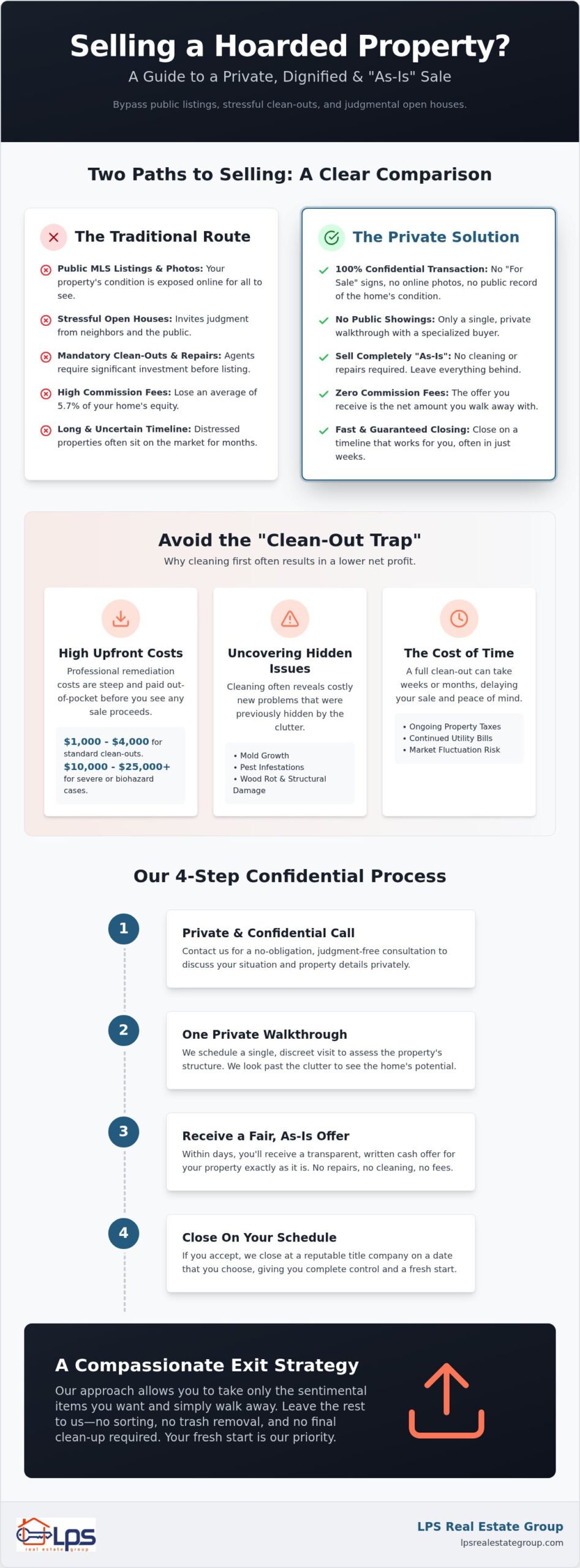
- Commission Rates: In 2026, the average national real estate commission is approximately 5.7%. On a distressed property, this is a significant amount of equity to lose.
- The “Clean-Out” Mandate: Most agents will insist on a professional clean-out before they’ll even list the home. This can cost anywhere from $3,000 to over $25,000 depending on the severity.
- Days on Market: Distressed homes often sit on the market longer, which can lead to “stigma” that drives the price down even further.
- Open House Logistics: Hosting a public viewing in a hoarder home is often impossible due to safety hazards and the extreme emotional stress it places on the seller.
By understanding how to sell a hoarder house privately, you can avoid these public-facing stressors. A private acquisition allows you to skip the cleaning, the commissions, and the judgment, moving straight to a fair closing that respects your circumstances.
The ‘Clean-Out Trap’: Why Cleaning Might Cost You More
Many people assume that cleaning a property is the only way to get a fair price. However, in 2026, the “clean-out trap” is a very real financial risk for those wondering how to sell a hoarder house privately. Professional hoarding cleanup costs now range from $1 to $2 per square foot for standard cases, which often totals $1,000 to $4,000 for an average home. In severe situations involving biohazards, costs can quickly escalate to between $10,000 and $25,000. Beyond the invoice, cleaning often uncovers hidden structural damage like mold, pest infestations, or wood rot that was previously invisible. When you add these repair costs to the initial cleaning bill, your “net walkaway” often ends up lower than if you had sold the house exactly as it is today.
The “Time Value of Money” is another critical factor. A thorough clean-out of a Level 3 or 4 hoarder home can take weeks or even months to coordinate and execute. During this time, the property’s market value may fluctuate, and you continue to sink money into a house you no longer want. Calculating your net walkaway means looking at the final check you’ll receive after all cleaning, repairs, and commissions are paid. Often, a direct offer for the property in its current condition provides more actual cash in your pocket because it eliminates these mounting expenses.
Professional Remediation vs. DIY
Attempting a DIY clean-out might seem like a way to save money, but it carries significant health risks. Disturbed dust, mold spores, and animal waste can cause serious respiratory issues. The American Psychiatric Association on Hoarding Disorder notes that the emotional toll on family members is equally intense, as sorting through a loved one’s possessions can be paralyzing. In some jurisdictions, professional biohazard remediation is legally required if certain contaminants are present, making the DIY route a potential legal liability.
The Holding Cost Factor
While the house sits empty during a months-long clean-out, you’re still responsible for property taxes, utilities, and insurance. Holding costs are the silent equity killer in real estate. A vacant hoarder property is also a magnet for vandalism or squatters, which can further decrease the property’s value and increase your liability. If you’re feeling overwhelmed by these potential expenses, exploring an as-is property acquisition can provide a much faster and more predictable exit strategy.
How to Assess Your Property’s Value As-Is
Traditional appraisals often fall short when dealing with a distressed property. Many appraisers won’t enter rooms that are blocked by clutter, which leads to incomplete reports and conservative estimates that don’t reflect the home’s true potential. When you’re looking into how to sell a hoarder house privately, it’s more effective to work with a buyer who looks at the “bones” of the structure. They focus on the foundation, the roof’s age, and the condition of major systems like the HVAC and electrical panels. These core elements determine the property’s baseline value far more than the items stored inside.
Professional direct buyers calculate an offer by first determining the After-Repair Value (ARV). This is the price the house would command on the open market if it were fully renovated and cleared. From that number, they subtract the estimated costs for remediation, junk removal, and structural repairs. The type of hoard significantly impacts these estimates. A “dry” hoard consisting mostly of paper or collectibles is generally easier to manage than an “organic” hoard involving food waste or animal issues. Organic material often leads to deep-seated odors and rot in the subflooring, which requires more intensive construction work to resolve.
Categorizing the Level of Hoarding
Understanding the severity of the situation helps you choose the right exit strategy. Levels 1 and 2 usually involve cosmetic clutter that doesn’t block exits or create immediate structural risks. However, Levels 3 through 5 involve biohazards, narrow “goat paths” through rooms, and potential fire code violations. Because hoarding is recognized as a mental disability, these higher-level cases require a buyer who understands the legal and emotional complexities involved. A private sale to a specialist ensures these hurdles are handled with the necessary expertise and compassion.
Identifying Value-Add Opportunities
Even if the house itself is in poor condition, the land and location still hold significant weight. In many desirable neighborhoods, the lot value alone can be substantial. If the property sits in an area with rising demand, a buyer may see it as a “scrape” or a total gut-renovation project, which can actually simplify the transaction. You don’t need to fix the roof or clear the rooms to unlock this value. For a deeper look at how condition affects your bottom line, you can read our Selling Your House As-Is: The Complete 2026 Homeowner’s Guide. Understanding these value-add factors helps you realize that you have options, regardless of the home’s current state.
The Step-by-Step Guide to a Private Hoarder House Sale
Following the decision to avoid a public listing, the next phase is executing a structured, discreet plan. Learning how to sell a hoarder house privately requires a shift in perspective. You aren’t looking for a buyer who wants a perfect home; you’re seeking a partner who specializes in as-is property acquisition. This process is designed to be low-stress, moving at your pace while maintaining total confidentiality. By following a methodical approach, you can transition from feeling overwhelmed to achieving a clean break.
The journey typically follows five clear stages:
- Step 1: Research direct buyers. Look for entities with a proven history of handling distressed properties and complex hoarding situations.
- Step 2: Request a confidential walkthrough. This is a simple, no-obligation visit to assess the structure and major systems.
- Step 3: Review the offer. A legitimate buyer will provide a written offer and share “Proof of Funds” to show they have the cash ready for closing.
- Step 4: Select your closing date. You should have the flexibility to close in as little as a week or take several months if you need more time.
- Step 5: Walk away. Take only what you want and leave everything else behind for the buyer to manage.
Vetting a Private Direct Buyer
Not every investor has the experience or the bedside manner required for a sensitive sale. When you vet a buyer, ask about their specific history with hoarder properties. A professional partner will cover all closing costs and fees, ensuring the offer you see is the amount you actually receive. Most importantly, ensure the contract includes a “no-cleaning” clause. This legal protection guarantees that you aren’t responsible for removing a single bag of trash or piece of furniture before the sale is finalized.
Preparing for the Walkthrough
The thought of a stranger entering the home often causes significant anxiety. It’s helpful to remember that a professional direct buyer has seen it all. You don’t need to “tidy up” or clear paths for their arrival. They’re looking past the clutter to see the foundation, plumbing, and electrical systems. Their goal is to find a solution that works for both parties, not to judge the living conditions. For more details on what to expect during this stage, see our article on Companies That Buy Houses for Cash: A Homeowner’s 2026 Guide. If you’re ready to see what’s possible for your property, you can request a confidential property assessment to get started without any pressure.
LPS Real Estate Group: A Compassionate Exit Strategy
At LPS Real Estate Group, we recognize that every property tells a story, and some chapters are more difficult to close than others. When you research how to sell a hoarder house privately, you aren’t just looking for a buyer. You’re looking for a partner who understands the deep embarrassment and logistical exhaustion that comes with a distressed property. We’ve built our business on the principle of “quiet confidence,” providing a professional, empathetic alternative to the high-pressure tactics found elsewhere in the industry. We prioritize your dignity and privacy from the first phone call to the final signature at closing, ensuring that your situation is handled with the utmost integrity.
Our “Take What You Want, Leave the Rest” policy is a cornerstone of this commitment. We believe you should only have to worry about the items that hold sentimental value. Whether it’s family heirlooms, old photographs, or personal records, you take what matters. We handle the rest of the contents and any necessary repairs. This as-is property acquisition ensures that your privacy remains intact, as no large cleaning crews or contractors will be seen entering the home by curious neighbors before the sale is finalized. You get a fast, quiet exit without the stress of a professional clean-out.
Beyond Cash: Creative Solutions for Heirs
A standard cash buyout isn’t always the perfect fit for every family. This is especially true in probate or situations involving high debt. We offer creative finance solutions that can help maximize the equity you receive from an estate. These options are useful when dealing with inherited property taxes or complex family dynamics where a fast, certain closing is needed to settle the estate fairly. We act as a listener first and a service provider second, finding the specific financial path that works for your goals. For a deeper look at these specific challenges, you can explore our How to Sell an Inherited Property: A Complete Guide.
Your Next Chapter Starts Here
Closing a difficult chapter shouldn’t be a source of more trauma. We’ve refined our process to be as streamlined and transparent as possible. Our process moves at a pace that allows you to absorb information without feeling rushed or overwhelmed. We provide high-level reassurance followed by a logical explanation of every step. This methodical approach ensures you feel fully informed at every stage of the narrative. It feels like a calm, one-on-one consultation rather than a broadcasted advertisement. If you’re ready to move forward with a partner who respects your situation, get your confidential as-is offer from LPS Real Estate Group today.
Your Path to a Stress-Free Fresh Start
Navigating a property with significant clutter doesn’t have to be a public or painful ordeal. By choosing a private sale, you protect your family’s dignity and avoid the high costs of professional remediation. Understanding how to sell a hoarder house privately allows you to skip the judgment of open houses and the “clean-out trap” that often drains equity. You deserve a transition that respects your history while focusing on your future. It’s possible to walk away from the mess and into a new chapter without ever picking up a broom.
LPS Real Estate Group is here to act as your trusted advisor during this transition. We are specialized in as-is acquisitions, meaning no cleaning or repairs are ever required from your side. We pride ourselves on A+ transparency and professional empathy, ensuring you feel heard and respected throughout the entire process. If you’re ready to leave the clutter behind and move forward, we invite you to Request Your Confidential As-Is Cash Offer Now. You’ve carried this burden long enough; it’s finally time to experience the relief of a quiet, fair, and simple closing.
Frequently Asked Questions
Do I have to clean out a hoarder house before selling it privately?
No, you aren’t required to clean or clear the property when you choose a private as-is sale. Specialists in this field expect to handle the heavy lifting themselves. You can simply take your sentimental items and leave everything else behind. This is a primary benefit for those learning how to sell a hoarder house privately because it removes the physical and emotional exhaustion of a clean-out.
Can I sell a hoarder house if it has been condemned or has code violations?
Yes, you can sell a property even if it has active code violations or a condemnation notice. Professional buyers are experienced in working with local municipalities to resolve these issues after the closing. They assume the legal and financial responsibility for bringing the structure back to code. This allows you to walk away from the liability without spending your own funds or dealing with city inspectors.
How long does a private cash sale of a hoarder house usually take?
A private cash sale typically closes within 7 to 21 days, though the timeline is flexible based on your needs. Because there are no bank inspections or traditional appraisals required, the process moves much faster than a standard listing. This speed is helpful if you’re trying to stop holding costs like taxes or insurance from eating into your equity during a long cleanup process.
What happens to the items left behind in a hoarder house after a private sale?
Any items left behind after you’ve taken what you want become the responsibility of the buyer. They coordinate with professional crews to sort, donate, or dispose of the remaining contents responsibly. This “leave it all behind” approach is designed to provide you with a clean break and a fresh start without the burden of sorting through years of accumulated belongings yourself.
Is a private sale better than an auction for a hoarder property?
A private sale is generally better for privacy, as auctions are public events that can attract neighborhood curiosity. Auctions also come with uncertain final prices and high seller fees. A private transaction provides a guaranteed price and total confidentiality. This ensures your family’s circumstances stay private while you secure a fair and predictable outcome for the property without public bidding wars.
Will a direct buyer purchase a hoarder house with mold or pest infestations?
Yes, direct buyers will purchase homes with severe mold, pest infestations, or biohazards. They factor the cost of professional remediation into their initial offer so you don’t have to pay for these services out of pocket. This is a key part of how to sell a hoarder house privately when the property’s condition has deteriorated beyond what a traditional buyer or bank would ever accept.
How do I ensure my privacy is protected during the sale process?
Your privacy is protected by bypassing the Multiple Listing Service (MLS) and avoiding “For Sale” signs on the lawn. Direct transactions are handled through confidential walkthroughs and private contracts. This ensures that interior photos of the property are never posted online and that neighbors remain unaware of the sale details until after you’ve successfully moved on to your next chapter with total peace of mind.