

What if the hardest part of losing a loved one wasn’t the final goodbye, but the stack of legal papers left on the kitchen table? Inheriting a home often feels like a second job you never applied for. You want to honor your family’s legacy, but you’re also facing potential disagreements with siblings and the daunting task of managing an older house. Learning how to sell an inherited property doesn’t have to be a source of constant anxiety. It is a legal process first and a real estate transaction second. Once you understand the sequence of steps, the path forward becomes much clearer.
We understand that you’re likely feeling the weight of this responsibility. It’s normal to worry about the cost of repairs or how the 2026 tax laws will impact your inheritance. This guide is designed to remove that burden. You’ll learn how to handle the legal, tax, and emotional complexities of selling inherited real estate with a straightforward, step-by-step plan. We will cover the $15 million federal estate tax exemption, the benefits of a stepped-up basis, and how to achieve a clean title transfer. Our goal is to help you reach a fast, stress-free liquidation of the asset so you can move forward with peace of mind.
Key Takeaways
- Master the legal foundation. Learn the difference between probate and non-probate assets to ensure a clean title transfer.
- Save on taxes. Use the “stepped-up basis” advantage to minimize capital gains liability when you sell.
- Simplify the cleanup. Use our “Keep, Sell, Donate, Toss” framework to manage personal belongings without the stress.
- Choose your strategy. Compare traditional listings with direct cash sales to decide how to sell an inherited property on your own timeline.
- Skip the repairs. Discover how to liquidate the asset as-is, avoiding the high costs of fixing up an older home.
Understanding the Legal Foundation: How Ownership Transfers
Selling a home you’ve inherited isn’t just about finding a buyer. It’s a legal transition that requires clear authority. Before you list the home or accept a cash offer, you must identify who actually owns the dirt. If the property was held in “Joint Tenancy with Right of Survivorship,” it usually bypasses the court. The title transfers straight to the surviving owner. However, if the deceased was the sole owner, the house is considered a probate asset. This means the court must oversee the transfer before any sale can be finalized.
The rules of inheritance depend heavily on whether a valid Will exists. A Will typically names an Executor to manage the estate’s affairs. If there is no Will, state “intestacy” laws decide the heirs. In either scenario, the court appoints a Personal Representative. This individual is the only person with the legal power to sign closing documents. Without this court-sanctioned authority, you cannot legally sell the home.
Before you dive into the details of how to sell an inherited property, you must secure the asset. Change the locks on day one. It’s not about a lack of trust; it’s about protecting the estate’s value and preventing unauthorized access. You should also notify the insurance company immediately. Most standard policies don’t cover homes that sit vacant for more than 30 to 60 days. You’ll likely need a “vacant property” rider to ensure the home remains protected against fire, theft, or water damage during the transition.
The Probate Process Simplified
Probate begins when you file a petition with the local court. You’ll eventually receive “Letters Testamentary” or “Letters of Administration.” These documents are your proof of authority. They tell title companies and buyers that you have the right to sell. You must also identify and notify creditors. In many jurisdictions, estates exceeding a certain value threshold are generally required to go through this formal process. These thresholds vary significantly by location and can change over time. While some sales can happen in a few weeks if the court grants “full authority,” others may take months if every step requires a judge’s specific approval.
Selling Through a Living Trust
If the property is held in a Living Trust, the path is much faster. A Successor Trustee can often bypass the court system entirely. Look for a “Power of Sale” clause in the trust documents. This clause gives the trustee the green light to liquidate assets without waiting for a judge. Some jurisdictions also utilize Transfer on Death (TOD) deeds. These allow the home to transfer to you the moment a death certificate is filed. It’s a streamlined way to handle how to sell an inherited property without the traditional probate delays. For further assistance with the sale process, contact LPS Real Estate Group.
Navigating Tax Obligations: The Stepped-Up Basis Advantage
Tax bills are often the most intimidating part of managing an estate. Many heirs worry they will lose a significant portion of their inheritance to the IRS. Thankfully, the tax code provides a major benefit for those learning how to sell an inherited property. This benefit is known as a stepped-up basis. It can effectively eliminate decades of accumulated capital gains taxes in a single stroke.
Imagine a scenario where your parents purchased a home in 1985 for $75,000. If they had sold that home for $600,000 while they were still alive, they would have faced taxes on a $525,000 profit. However, when you inherit the home, the “cost basis” resets to the current market value. Stepped-up basis is the resetting of a property’s value for tax purposes to its current market value on the date of the owner’s death. If the home is worth $600,000 on the day they pass, that becomes your new baseline. If you sell it for that same amount, your taxable gain is zero.
To secure this advantage, you must establish the Fair Market Value (FMV) as of the date of death. A professional appraisal is your best tool here. Don’t rely on automated online estimates or local tax assessments; the IRS requires a more formal valuation. If you want to avoid the hassle of appraisals and market prep, seeking inherited property buyouts can offer a faster path to liquidation while keeping your tax records simple.
Capital Gains vs. Inheritance Tax
State-Level Tax Considerations
While federal taxes are rarely an issue, state laws are more varied. As of 2026, twelve states and the District of Columbia maintain their own estate taxes with much lower thresholds than the federal government. Additionally, five states-Kentucky, Maryland, Nebraska, New Jersey, and Pennsylvania-impose an inheritance tax paid directly by the heir. You should also prepare for potential property tax reassessments. In many jurisdictions, the transfer of ownership triggers a new tax valuation that could increase monthly carrying costs. Consulting a CPA is a smart move to ensure every heir understands their specific tax responsibilities before the sale closes.
Preparing the Property: Dealing with Physical and Emotional Hurdles
Walking into a family home after a loss is heavy. It isn’t just about the real estate; it’s about the decades of belongings inside. Many heirs find themselves stuck in a cycle of indecision. Should you keep the vintage furniture? Is the house even sellable in its current state? Figuring out how to sell an inherited property starts with a clear plan for the “stuff.”
To Repair or Not to Repair?
Most inherited homes are older. They often come with “deferred maintenance.” This is a polite way of saying the roof is 25 years old and the HVAC is on its last legs. You might think a new kitchen will net you a higher price. Usually, it won’t. Major updates often offer a poor return on investment when you factor in the 6-month delay for contractors. With the U.S. median home sale price sitting at $366,667 as of April 2026, spending $50,000 on renovations rarely makes sense. Structural issues like foundation cracks or outdated wiring can also prevent traditional buyers from securing a mortgage. If the house won’t pass a standard inspection, a traditional listing is often a dead end. An as-is property acquisition bypasses these hurdles entirely.
Managing Multiple Heirs
Disagreements are common. One sibling might want to keep the house as a rental, while two others want the cash now. In many jurisdictions, you need unanimous consent to sell. This can lead to years of legal gridlock and rising property tax bills. Mediation is an option, but it’s often slow. A direct cash buyout provides a clean break for everyone involved. It turns a complex family dispute into a simple financial distribution. Everyone gets their share of the equity quickly. No one has to argue over which paint color to use or who is responsible for the lawn care. It is the most straightforward way to handle how to sell an inherited property when multiple stakeholders are involved.
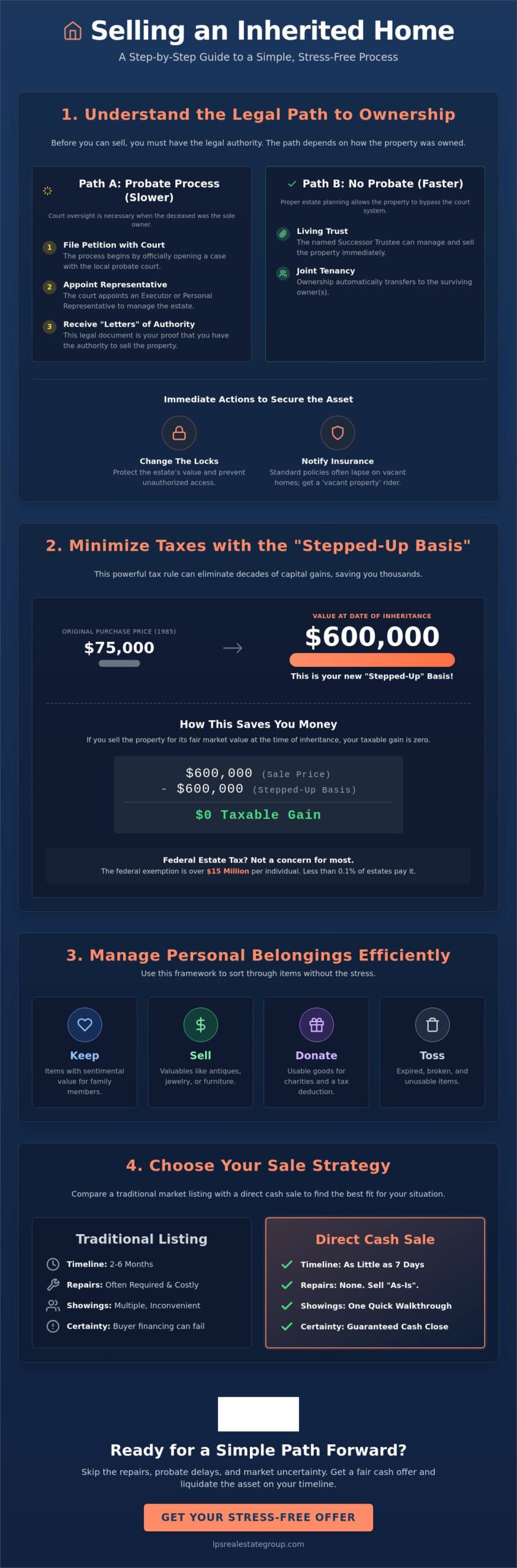
Comparing Sale Methods: Traditional Listing vs. Direct Cash Sale
You essentially have two paths forward when the legal hurdles are cleared. One path is public and often slow. The other is private and designed for speed. When deciding how to sell an inherited property, you must look past the initial “asking price” on a listing. You need to calculate your actual net profit. This is the amount of money that actually hits the estate’s bank account after every fee, repair, and holding cost is subtracted.
The traditional route involves hiring a realtor, staging the home, and hosting multiple showings. This method aims for the highest possible market price. However, it also comes with guaranteed deductions. You will typically pay 6% in real estate commissions and another 2% to 3% in closing costs. For a median-priced U.S. home of $366,667, those fees alone can exceed $30,000. If the estate needs liquidity to pay off existing debts or state inheritance taxes quickly, a long listing period can become a financial liability. In some cases, heirs also discover that the estate carries mortgage debt that has fallen behind, making it important to understand how to sell a house in pre-foreclosure before the lender takes action.
A direct sale offers a different math equation. You trade a portion of the market value for total certainty and speed. There are no commissions. There are no staging costs. You don’t even have to clean out the closets. If you’re ready to skip the stress, direct probate and inherited property buyouts provide a way to liquidate the asset in days rather than months.
The Hidden Costs of Traditional Selling
Holding costs are the silent killer of estate value. Property taxes, insurance premiums, and utility bills don’t stop just because the owner passed away. If a house sits on the market for six months in a cautious 2026 real estate climate, those carrying costs can eat thousands of dollars in equity. You also face the “Inspection Trap.” Traditional buyers use professional inspectors who will find every flaw in an older home. A buyer’s lender may refuse to fund the loan unless you pay for expensive repairs, like a new roof or updated electrical work, before the closing date. This puts the executor in the difficult position of spending estate cash just to keep a deal alive.
The Benefits of an As-Is Cash Buyout
An as-is property acquisition removes the “what-ifs.” You can sell a distressed property or a hoarder house without lifting a finger. You don’t have to worry about buyer financing falling through at the last minute because the buyer is using cash. This is a major advantage when the housing market is flat. You can choose your own closing date. Whether you need to close in 7 days to settle an urgent debt or 30 days to give family members more time to collect heirlooms, the timeline is yours. If you want to understand the full landscape of all-cash transactions in today’s market, our guide on how to sell my house fast for cash covers the process in detail. This flexibility is the most pragmatic way to handle how to sell an inherited property while protecting your peace of mind.
Closing the Chapter: A Simple Path Forward with LPS Real Estate Group
The administrative burden of an estate can feel like a weight that never lifts. Between court dates and family meetings, the physical house often becomes the biggest obstacle to moving forward. You don’t need another complex project. You need a resolution. LPS Real Estate Group specializes in probate and inherited property buyouts, providing a direct exit strategy that prioritizes your peace of mind. We understand that how to sell an inherited property should be about more than just a transaction; it should be about closing a chapter with dignity and ease.
Our approach is built on transparency. We assume all the liability that usually falls on the executor’s shoulders. You won’t need to worry about the leaking roof, the outdated electrical panel, or the decades of personal belongings left in the attic. We handle the junk removal and the repairs ourselves. This service-oriented model is designed specifically for grieving families who want a clean break without the typical industry hurdles. We strip away the noise so you can focus on what matters most.
Your Direct Solution for Inherited Property
Many heirs find that traditional MLS listings are a poor fit for their situation. Staging an older home and managing endless showings is exhausting. We offer a pragmatic alternative. There are no commissions to pay and no hidden fees to worry about. You don’t even have to pick up a broom. LPS Real Estate Group provides immediate liquidity for inherited assets regardless of their current condition. This “no-nonsense” path ensures you get the equity out of the home without the six-month wait associated with traditional buyers.
Get Your Fair Cash Offer Today
We’ve streamlined our process into three simple steps to keep your momentum high. First, you reach out for a brief consultation. Second, we perform a quick walkthrough of the property to assess its “as-is” value. Third, you receive a straightforward cash offer. We offer total flexibility with closing dates to accommodate the specific timelines of your probate court or family needs. If you’re ready to see how to sell an inherited property without the stress, contact LPS Real Estate Group for a straightforward, as-is cash offer.
Take the Next Step Toward Resolution
Managing an estate is a significant responsibility, but it doesn’t have to be a lifelong project. You now have the clarity needed to handle the legal requirements and leverage tax advantages like the stepped-up basis. By focusing on court authority and identifying the right sale method, you can protect the family’s equity while minimizing your own stress. Deciding how to sell an inherited property ultimately comes down to your priorities; whether you need a fast exit or a hands-off transition.
LPS Real Estate Group is here to simplify the final stage of this journey. We bring professional expertise to probate and inherited property buyouts, allowing you to bypass the traditional market entirely. There is no need for expensive repairs, cleaning, or staging. We can close in as little as 7 days, providing the immediate liquidity the estate needs to settle debts and distribute assets. You can finally step away from the administrative burden and focus on what truly matters.
Get a fair, all-cash offer for your inherited property today. You’ve navigated the complexities of the law and taxes with grace. Now, let us provide the straightforward solution that brings this chapter to a peaceful close.
Frequently Asked Questions
Can I sell an inherited property before probate is finished?
You generally cannot finalize the sale until the court grants you the legal authority to do so. This usually happens when you receive your Letters Testamentary or Letters of Administration. However, you can sign a purchase agreement “subject to probate court approval.” This allows you to secure a buyer early while the legal paperwork catches up. It’s a pragmatic way to keep the process moving without waiting for the final decree.
Do I have to pay capital gains tax on a house I inherited?
You likely won’t owe capital gains tax if you sell the property shortly after inheriting it. This is due to the “stepped-up basis” rule, which resets the home’s value to its market price on the date of the owner’s death. You only pay tax on the profit made above that new baseline. If you sell quickly, there is rarely any taxable gain to report to the IRS.
What happens if there are multiple heirs and we can’t agree to sell?
If heirs cannot agree, the situation often requires legal mediation or a “partition action” lawsuit. A partition action is a court process that forces the sale of the property so the proceeds can be divided fairly. It is often expensive and time-consuming. Seeking a direct buyout is usually a better alternative. It provides a clean financial split that satisfies everyone’s need for liquidity without a long courtroom battle.
Do I need to clean out the house before selling to a cash buyer?
No, you don’t need to clean out the house when selling to an as-is property acquisition specialist. You can take the items you want and leave the rest behind. We handle the junk removal, deep cleaning, and any necessary repairs ourselves. This is a significant relief for families dealing with hoarder situations or decades of accumulated belongings. It lets you focus on your family instead of physical labor.
How do I determine the fair market value of an inherited home?
The most accurate way to determine fair market value is through a professional date-of-death appraisal. An appraiser looks at comparable sales from the exact time your loved one passed away. This number is critical for establishing your tax basis. Avoid relying on tax assessments or automated online tools. Those sources often miss the specific condition of the home or local market nuances that a human appraiser will catch.
Can the executor sell the house without all the beneficiaries’ consent?
Yes, an executor can often sell a house without unanimous consent if they have “Full Authority” under the Independent Administration of Estates Act. However, the executor must still notify all beneficiaries through a “Notice of Proposed Action.” If a beneficiary objects, the court may need to intervene. Understanding how to sell an inherited property under these rules requires following specific legal timelines to ensure the sale remains valid.
What are the most common hidden costs when selling an inherited home?
Common hidden costs include vacant property insurance, ongoing utilities, and title clearing fees. Standard insurance policies often stop coverage if a home sits empty for more than 30 days. You’ll need a specific rider to stay protected. You might also discover old liens or property tax discrepancies during the title search. These costs can add up quickly, eating into the inheritance if the property sits on the market for too long.
How long does it typically take to sell an inherited property for cash?
A cash sale typically closes in as little as 7 to 14 days once the legal authority is established. Since there are no bank inspections or mortgage approvals required, the process is incredibly fast. This speed is helpful when the estate needs to pay off debts or funeral expenses immediately. Knowing how to sell an inherited property quickly allows the heirs to move forward with their lives without months of uncertainty.
9 Responses