

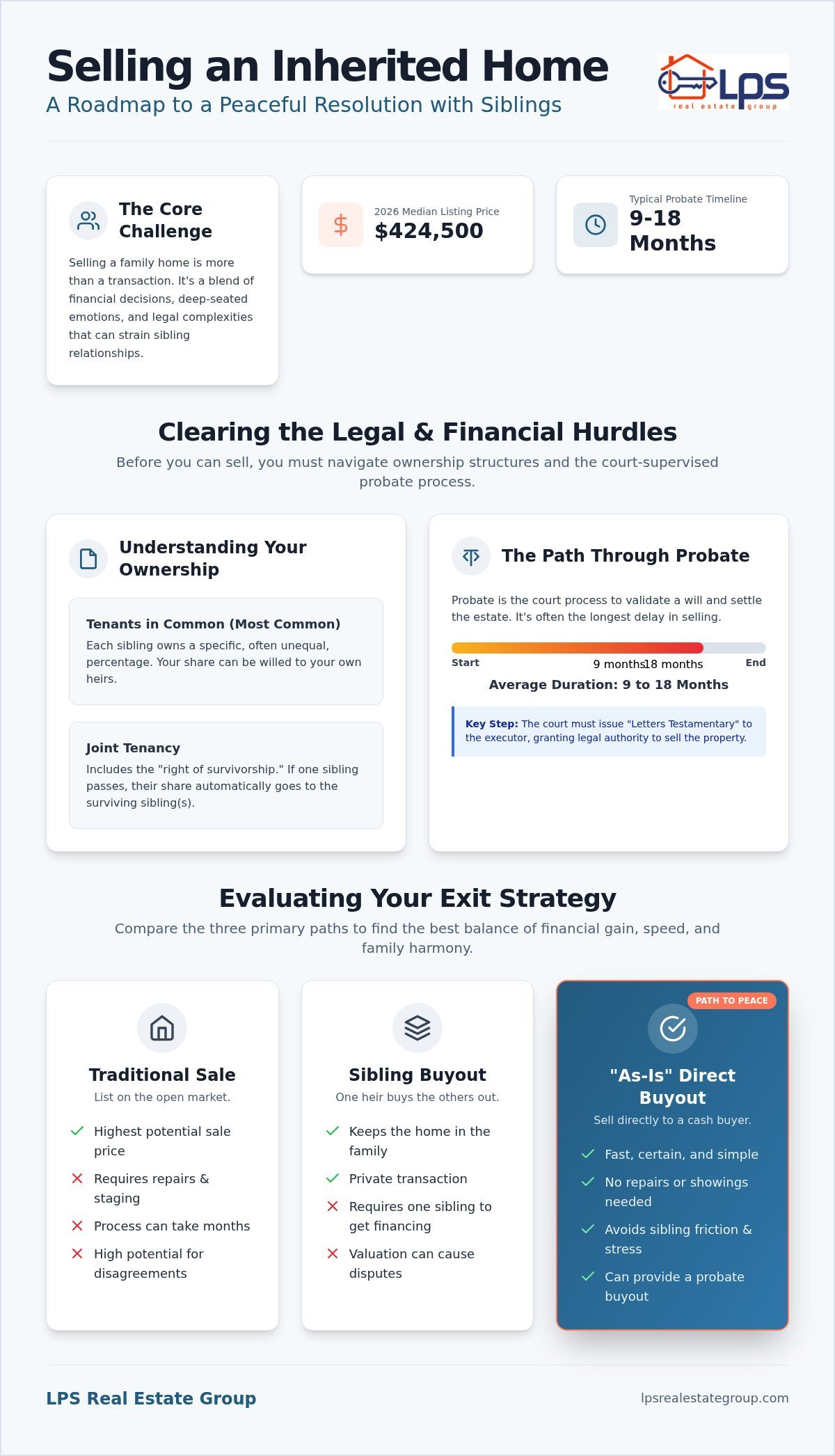
The hardest part of selling a family home isn’t finding a buyer; it’s finding common ground with the people you grew up with. When you’re selling inherited property with siblings, the house is rarely just a piece of real estate. It’s a collection of memories, a source of potential financial relief, and, occasionally, a catalyst for old childhood rivalries. You might be facing a cooling 2026 market where the median listing price sits around $424,500, yet the pressure to settle the estate feels more urgent than ever.
It’s completely normal to feel overwhelmed by the friction of repair costs or the legal maze of probate. You want a fair financial outcome, but you also want to be able to sit across from your brother or sister at Thanksgiving without talking about title deeds. This guide provides a clear path through the complexities of shared ownership in today’s economy. We will explore how to manage disagreements over listing prices, handle the 2026 tax landscape, and evaluate “as-is” solutions that remove the stress of renovations. By the end, you’ll have a roadmap to close this chapter with your finances and your family bonds intact.
Key Takeaways
- Understand the legal differences between joint tenancy and tenants in common to ensure every sibling’s rights and responsibilities are clearly defined.
- Learn how to navigate the probate process and clear potential title issues that could otherwise delay your ability to sell the home.
- Discover strategies for managing disagreements when selling inherited property with siblings, including how to handle an heir who refuses to cooperate.
- Evaluate the benefits of an as-is buyout as a neutral way to avoid out-of-pocket repair costs and eliminate friction over home maintenance.
- Compare your exit options to find the path that balances financial gain with the need for a fast, certain resolution that preserves family relationships.
Understanding the Dynamics of Co-Inherited Property
Inheriting a property often feels like receiving a gift that comes with a heavy manual. When you are selling inherited property with siblings, you aren’t just dealing with a real estate transaction. You are managing a group of people with different financial needs, varying levels of grief, and deep-seated emotional ties. The first 30 days are critical for maintaining family peace. During this period, everyone should agree on a clear communication plan. Transparency prevents the suspicions of “secret deals” or unfair advantages that often tear families apart before the process even begins.
The legal structure of your ownership dictates your next moves. Most siblings inherit as “Tenants in Common.” This means each of you owns a specific percentage of the home. Unlike “Joint Tenancy,” where ownership passes automatically to the survivors, Tenants in Common can leave their share to whoever they choose in their own estate. The specific rules of inheritance vary depending on whether your parent left a clear will or died “intestate.” If there’s no will, state law decides the distribution, which often adds a layer of legal confusion to an already stressful time.
Common Legal Structures for Heirs
Your deed is the ultimate authority on how the sale proceeds will eventually be split. In a Tenants in Common arrangement, the split doesn’t necessarily have to be equal. One sibling might own 60 percent while another owns 40 percent, perhaps reflecting previous financial contributions or caregiving roles. Understanding this split early prevents bitter arguments when the final check arrives. It’s also vital to distinguish between the Executor and the beneficiaries. While the Executor manages the estate’s logistics, they have a fiduciary duty to act in the best interest of all beneficiaries, not just themselves. To ensure this responsibility is met with transparency and market expertise, many families partner with a dedicated agency like AW Homes of Bellabay Realty to manage the residential sale and achieve a fair outcome for everyone involved.
The Emotional Weight of the Family Home
A house is often an emotional liability as much as a financial asset. While one sibling sees a $424,500 asset that can pay off their mortgage, another might see the only place they ever felt truly at home. This “sentimental value” gap is where most conflicts start. Beyond the memories, there are real-world costs to consider. Property taxes and insurance continue to accrue even while the house sits empty. In 2026, with home price growth projected at a modest 2 to 3 percent, holding onto a vacant house rarely makes financial sense. Setting a neutral, business-like tone early helps everyone transition from “grieving children” to “collaborative partners” focused on a fair resolution for everyone involved.
Clearing Legal and Financial Hurdles Before the Sale
The process of selling inherited property with siblings often hits a wall when the legal paperwork begins. You might feel ready to move forward, but the law requires a specific sequence of events before a deed can transfer. Most houses must pass through probate, which is the court-supervised process of authenticating a will and settling an estate. In 2026, a typical probate case can last between 9 and 18 months. This timeline often surprises families who need immediate liquidity to cover funeral costs or ongoing property taxes.
Title issues are another common hurdle. Over decades, “clouds” can form on a title. These might include old tax liens, unreleased mortgages from decades ago, or even claims from long-lost relatives. Finding these early is vital. If your parents had a reverse mortgage, the clock is ticking even faster. Most reverse mortgage companies require the balance to be paid in full shortly after the owner passes away, which can force a quick sale before the family is emotionally ready.
Navigating the Probate Timeline
To start the sale, the court must issue “Letters Testamentary” to the executor or “Letters of Administration” if there’s no will. These documents give one person the legal authority to sign closing papers. While you wait for the full probate process to conclude, you can sometimes pursue a probate buyout to access cash faster. This path bypasses the lengthy court delays and provides a certain exit for siblings who don’t want to manage a vacant property for over a year.
Managing Property Debt and Liens
Existing mortgages don’t disappear when a parent passes. The estate is responsible for these payments during the transition. If the estate lacks cash, siblings often have to chip in, which can lead to resentment if one person is doing all the financial heavy lifting. All outstanding debts, including mortgages and tax liens, are paid directly from the house proceeds at closing before the remaining funds are divided among the siblings. This ensures a clean break for everyone involved.
One bright spot in the 2026 tax landscape is the “step-up in basis.” When you inherit a home, its value for tax purposes is reset to the fair market value on the date of the previous owner’s death. This means if the house was bought for a small fraction of today’s value, you only pay capital gains tax on the growth that happens after you inherited it. With the median listing price in 2026 hovering around $424,500, this rule significantly reduces the tax burden for heirs, making the financial split much fairer for the whole family.
Evaluating Your Options: Sell, Buyout, or Keep?
Once you’ve cleared the legal hurdles, you must decide what to do with the home. This is where individual financial goals often collide. When selling inherited property with siblings, it’s vital to weigh the pros and cons of four primary paths. Every family has different needs, so the “right” choice depends on your collective tolerance for risk, work, and time.
When a Traditional Listing Makes Sense
Listing on the open market often aims for the highest price, but it requires significant upfront effort. In the 2026 housing market, buyers have more leverage due to increased inventory. They expect homes to be move-in ready. This means your family might need to fund renovations, staging, and professional cleaning before the first open house. These projects frequently spark arguments. One sibling might want high-end finishes to maximize the price, while another wants the cheapest fix possible to save cash. Since home prices are only growing at 2% to 3% annually, spending $50,000 on a kitchen update might not actually return that investment at the closing table. If the house sits on the market for months, you’re also stuck paying for ongoing insurance and taxes as a group.
The Sibling Buyout
If one person wants to stay in the home, they can buy out the others. This sounds simple but is often difficult in practice. The buying sibling needs either enough cash or the credit strength to secure a new mortgage in a mid-5% interest rate environment. If they can’t qualify for a loan, the family remains stuck in a stalemate. Engaging a professional agency like Integrity Estates Realty can help you explore mortgage options or establish a fair market value for the buyout. It’s also hard to agree on a price without a neutral third party involved, as siblings often have different opinions on what the “family discount” should be.
For many families, the best path is an as-is property acquisition. This removes the “money friction” entirely. You don’t have to argue about which contractor to hire or who will pay for a new roof. A direct buyer acts as a neutral third party, purchasing the home in its current condition. This provides immediate liquidity for siblings who may need cash for their own debts or retirement. If you’re unsure of the steps, learning how to sell an inherited property through a direct buyout can save months of stress and thousands in out-of-pocket costs.
Converting to a Rental
You could keep the house and split the monthly income. However, this turns siblings into business partners for the long term. You’ll have to manage tenants, emergency repairs, and complex accounting together. If one sibling is doing the “landlord work” while the others just collect checks, resentment builds quickly. Most heirs find that a clean break is better for the family bond than a shared management responsibility that could last for years.
Managing Sibling Conflict and the Uncooperative Heir
When selling inherited property with siblings, the process often slows down because of one person. Conflict usually isn’t about the house itself; it’s about different financial needs or unresolved family history. One sibling might be living in the home and refusing to move, while another might insist on a listing price that the 2026 market simply won’t support. If you’re facing a stalemate, the first step is to remove the emotion from the valuation. Hiring a neutral, third-party appraiser provides a professional figure that everyone can respect, moving the conversation away from “what I think it’s worth” to “what the data shows.”
Mediation is often more effective than arguing. Try to understand the “why” behind a sibling’s resistance. Are they afraid of the tax implications, or are they simply overwhelmed by the emotional burden of cleaning out a childhood home? Listening first can often reveal a path forward that doesn’t involve lawyers. However, when conversations fail, you may need to look at more formal structures to protect your interest in the estate.
Avoiding the Partition Lawsuit
Many people think the only way to handle an uncooperative heir is to sue them. A partition suit is a court-mandated legal process that forces the sale of a property when co-owners cannot agree, typically resulting in high legal costs and a lower final payout for every heir. This is truly the nuclear option. Legal fees eat into the inheritance quickly, and court-ordered sales often happen at public auctions where the price is significantly lower than a private sale. To avoid this, consider offering the “stuck” sibling a slightly larger share of the proceeds or a longer move-out window. It’s often cheaper to give up a small percentage of equity than to pay a law firm to fight a battle that leaves everyone with less.
The ‘As-Is’ Compromise
A major roadblock in shared sales is the cost of repairs. If the house needs a new roof or updated wiring to pass a traditional inspection, one sibling might refuse to chip in, effectively halting the sale. Selling to a direct buyer removes this friction entirely. Since the property is purchased in its current condition, there are no out-of-pocket costs to argue over. This allows the family to close the chapter collectively without the stress of managing contractors or funding renovations. If you’re ready to bypass the conflict and find a fair way out, you can request a cash offer from LPS Real Estate Group to see how a direct buyout could work for your family. This neutral path ensures that every sibling receives their fair share without the delays of the retail market.
The Path to Family Peace: Choosing a Direct Buyout
For many families, the goal of selling inherited property with siblings isn’t just to maximize every possible cent. It’s to find a resolution that allows everyone to move forward without resentment. While a traditional sale might target the median listing price of $424,500 seen in August 2026, the reality of the current cooling market means homes often sit longer and require more concessions. In this environment, the certainty of a direct sale often outweighs the theoretical “top dollar” of a retail listing. A fast, predictable exit prevents the monthly drain of property taxes and insurance from eating into the estate’s value.
Choosing a direct path simplifies the final probate accounting. When a house is sold quickly, the executor can settle outstanding debts and distribute the proceeds sooner. This reduces the time the estate remains open, which is particularly helpful given that 2026 probate timelines can stretch up to 18 months. By removing the house from the equation early, siblings can focus on the personal aspects of the estate rather than the logistics of a real estate transaction.
The LPS Real Estate Group Approach
We specialize in handling the “heavy lifting” that often causes friction between heirs. Our process is designed to be a neutral solution for families who want to avoid the stress of the retail market. We offer specialized probate buyouts that can address complex title issues or “clouds” left behind by the previous generation. One of the biggest points of relief for our clients is our as-is property acquisition. You don’t need to spend weeks cleaning out a childhood home or arguing over which repairs are necessary. You can simply take the items with sentimental value and leave the furniture, old appliances, and “junk” behind. We take on the burden of the cleanup and the renovations so you don’t have to. If you are researching companies that buy houses for cash, you’ll find that our focus on inherited situations provides a level of empathy and expertise that traditional buyers often lack.
Final Steps for Siblings
Once the sale is finalized, the path to closing the estate becomes much clearer. To ensure a smooth finish, follow these steps:
- Settle Final Bills: Use the sale proceeds to pay off any remaining utility balances, property taxes, or estate-related debts.
- Use the Estate Account: Ensure all funds are funneled through the official estate bank account to maintain a clear paper trail for the court.
- Divide the Balance: Distribute the remaining funds according to the percentages defined in the will or by the rules of inheritance.
By choosing a straightforward exit, you remove the “money friction” that often damages family bonds. Selling inherited property with siblings doesn’t have to be a source of conflict. With a clear plan and a neutral partner, you can honor your parents’ legacy while keeping your relationships with your brothers and sisters intact.
Moving Forward with Confidence and Clarity
Real estate is a temporary asset, but your family relationships are meant to last a lifetime. Selling inherited property with siblings doesn’t have to be a source of long-term conflict if you prioritize transparency and explore neutral exit strategies. By understanding your legal standing and evaluating as-is options, you can bypass the repair disputes and market delays that often strain sibling bonds. You have the power to choose a path that balances financial fairness with emotional peace of mind.
At LPS Real Estate Group, we provide the specialized expertise needed for complex probate buyouts and estate situations. We buy properties in their current condition, which means your family won’t have to worry about out-of-pocket repair costs or the burden of cleaning out decades of belongings. Our closing process is fast and transparent, designed to provide immediate relief and a clean break for everyone involved. If you’re ready to resolve your estate situation without the stress of the retail market, we are here to help.
Get a Fair Cash Offer for Your Inherited Property Today
You’ve done the hard work of honoring your loved one’s legacy. Now, it’s time to find the simple, certain resolution your family deserves so you can focus on the memories that truly matter.
Frequently Asked Questions
Can siblings force the sale of inherited property?
Yes, a sibling can legally force a sale through a court process called a partition suit. This often happens when co-owners cannot agree on the best path for selling inherited property with siblings. While it guarantees a sale, it’s the most expensive path because legal fees and court costs are deducted from the final proceeds. Most families find it much more beneficial to reach a private agreement before the court intervenes.
What happens if one sibling wants to keep the house but can’t afford a buyout?
If a sibling wants to keep the home but lacks the funds for a buyout, the property typically must be sold to satisfy the other heirs’ equity. In the 2026 market, securing a mortgage with rates in the mid-5% to low-6% range can be difficult for many individuals. A direct buyout can provide a clean break for everyone, allowing each sibling to receive their fair share of the cash value immediately.
How is the sale of an inherited house taxed in 2026?
In 2026, you’ll likely benefit from a “step-up in basis,” which resets the home’s value to its fair market value on the date of the original owner’s death. You only pay capital gains tax on any appreciation that occurs after that date. Depending on your income, your federal long-term capital gains rate will be 0%, 15%, or 20%. This rule significantly reduces the financial burden of selling inherited property with siblings.
Who is responsible for the mortgage if the house is in probate?
The estate is legally responsible for making mortgage payments while the home is in probate. If the estate doesn’t have enough liquid cash to cover these costs, the siblings or heirs may need to pay out of pocket to prevent foreclosure. Keeping the mortgage current is vital for protecting the home’s equity until a final sale or transfer can be completed by the executor. This prevents the loss of value during the transition.
Do all siblings have to sign the deed to sell the house?
Yes, every person listed on the title or deed must typically sign the closing documents to sell the house. If the property is still in probate, the court-appointed Executor or Administrator may have the authority to sign on behalf of the estate once they receive their “Letters Testamentary.” Clear communication early on ensures that no one is surprised when it’s time to finalize the legal paperwork and distribute the final proceeds.
How do we determine a fair price if we aren’t using a Realtor?
Hiring an independent, state-certified appraiser is the most reliable way to find a fair price without a Realtor. An appraiser acts as a neutral third party and provides a detailed report based on current market data and comparable sales. This removes personal bias from the equation and gives every sibling confidence that the valuation is based on facts rather than opinions or sentimental feelings. It’s a transparent way to ensure everyone is treated fairly.
Can I sell my share of an inherited house to a third party?
You can legally sell your individual interest in a property if you hold it as “Tenants in Common,” but finding a buyer for a partial share is very difficult. Most traditional buyers and lenders require the entire property to be sold at once. If you’re looking for a way out of the investment, it’s usually more effective to coordinate a full-property sale to a direct acquisition firm that handles complex inherited situations.
What if the inherited house has major code violations?
You can still sell a house with major code violations by choosing an as-is acquisition. Traditional buyers often can’t get financing for homes with structural issues or safety violations, which can lead to failed sales in a cooling market. A direct cash buyer handles these problems after the closing, which means your family won’t have to argue over who is responsible for paying for expensive repairs or navigating difficult city inspections.