

Waiting for interest rates to drop before selling your home might actually be the riskiest move you can make in 2026. Many homeowners currently feel trapped because traditional mortgage rates are holding near 6.5%, making it difficult to find qualified buyers who can actually afford a mortgage. If you are weighing the benefits of seller financing vs subject to, you have likely realized that the old ways of selling aren’t always the best fit for your current equity or timeline.
It’s stressful to feel stuck with a property, especially when you’re worried about high commissions or the dreaded “due on sale” clause. You deserve a clear, honest path forward that doesn’t require you to bring cash to the closing table. This article will help you discover the critical differences between these two creative strategies so you can choose the right one to sell your property with certainty.
We will break down how each method works under the latest 2026 FinCEN regulations and how they provide either debt relief or passive monthly income. You’ll get a transparent look at the risks and rewards of both options. Our goal is to provide the information you need to move forward with confidence and settle your housing situation for good.
Key Takeaways
- Discover why 2026 homeowners are choosing creative finance strategies over traditional listings to achieve faster certainty and avoid high commissions.
- Learn how seller financing allows you to earn passive monthly income by acting as the bank when you have significant equity in your property.
- Understand the mechanics of a subject-to offer, which provides debt relief even if you have little equity or a high interest rate mortgage.
- Identify the right strategy for your specific situation by weighing the pros and cons of seller financing vs subject to regarding title and debt.
- Gain a clear, step-by-step process for safely closing your sale with professional guidance to ensure every legal detail is handled correctly.
Understanding Creative Finance in the 2026 Housing Market
Creative finance describes a set of strategies used to buy and sell real estate without relying on traditional bank loans. In 2026, these methods have moved from the fringes of the market into the mainstream. Creative finance is a tool for homeowner liquidity. With the national average 30-year fixed mortgage rate sitting near 6.5%, many potential buyers are priced out of conventional financing. This leaves sellers in a difficult position. If you want to move quickly, you need a strategy that doesn’t depend on a bank’s slow approval process.
To understand these deals, you should be familiar with three key terms. A Promissory Note is the legal document where a buyer promises to pay back a specific amount. The Deed of Trust is the security instrument that links that promise to the property itself. Finally, the Due on Sale clause is a common feature in most modern mortgages. It gives a lender the right to demand full payment if the property is sold, though many investors navigate this by ensuring payments stay current and the bank remains satisfied.
Why Traditional Sales Aren’t Always the Answer
Listing your home on the MLS can be a long, expensive journey. If your equity is low, you might find that agent commissions and closing costs actually require you to bring money to the table just to walk away. That is a painful reality for many. Additionally, traditional buyers often demand expensive repairs or modern updates before they’ll commit. When LPS Real Estate Group makes a creative offer, we acquire the property as-is. This removes the stress of renovations and allows you to close in days instead of months. Speed and certainty are the primary reasons homeowners are moving away from traditional listings in the current market.
The Core Difference: Debt Creation vs. Debt Assumption
The choice between seller financing vs subject to usually comes down to whether you want to create new debt or leverage existing debt. When you choose Seller Financing, you are essentially acting as the bank. You create a new private loan for the buyer, which is ideal if you own your home free and clear. You get to collect monthly interest, often at rates between 7.5% and 12%, which provides a steady stream of passive income.
In a Subject To deal, the buyer takes over your existing mortgage payments without a formal loan assumption. The original loan stays in your name, but the buyer becomes responsible for the debt. This is a powerful tool for homeowners who have a low interest rate from years ago but need immediate debt relief. Understanding the nuances of seller financing vs subject to helps you decide which path leads to the financial freedom you need.
What is Seller Financing? Becoming the Bank
Seller financing occurs when you, the homeowner, take on the role of the lender. Instead of a buyer going to a traditional bank for a mortgage, you provide the credit to cover the purchase price. This strategy is ideal for homeowners who own their property free and clear or have a substantial amount of equity. When comparing seller financing vs subject to, the main difference is that seller financing creates a completely new debt rather than working with an old one. You receive a down payment at closing and then collect monthly payments over a set period, just like a bank would.
The transaction is secured by two primary documents: the Promissory Note and the Deed of Trust. The Promissory Note is a legal agreement that outlines the specific terms of the loan. In the 2026 market, interest rates for these private notes typically range between 7.5% and 12%. This note dictates the monthly payment, the interest rate, and the duration of the loan. The Deed of Trust ensures you retain a security interest in the property. If the buyer fails to make payments, you have the legal right to foreclose and take the property back, protecting your investment.
Benefits of Seller Financing for Homeowners
One of the most attractive parts of this strategy is the creation of a long-term passive income stream. Instead of receiving a single lump sum that might sit in a low-interest savings account, you earn a higher rate of return through monthly interest. There are also significant tax advantages. By using an installment sale, you can spread out your capital gains tax liability over several years instead of paying it all at once. This approach also opens your home to a wider pool of buyers. While some sellers prefer this method for high-equity homes, others look into Subject To In Real Estate when they need to address an existing mortgage with a lower interest rate.
Risks and How to Mitigate Them
The primary risk is the possibility of a buyer defaulting on their payments. To protect yourself, it’s vital to require a substantial down payment. This “skin in the game” ensures the buyer is financially committed to the property and provides you with a cushion if you ever need to take the house back. We also recommend using a third-party loan servicer to handle the collections. These companies manage the math, send out statements, and ensure that property taxes and insurance are paid on time. This adds a layer of transparency and professionalism to the deal. If you’re looking for a way to exit your property without the stress of traditional listings, our team at LPS Real Estate Group can help you explore creative finance solutions tailored to your needs.
What is a Subject-To Real Estate Offer?
A subject-to transaction is a method where a buyer takes ownership of your property while your existing mortgage remains in place. Unlike a traditional sale where the loan is paid off at closing, the buyer receives the deed and begins making your monthly payments. The title transfers to the new owner, but the loan stays in your name. While the debate of seller financing vs subject to often centers on who holds the note, subject-to is uniquely suited for those who need to walk away from a debt quickly without the hurdles of a bank approval process.
This method differs significantly from a formal loan assumption. In an assumption, the bank must vet the new buyer and officially transfer the liability. In a subject-to deal, the bank is not typically notified of a transfer of debt. The buyer simply becomes responsible for the PITI, which stands for Principal, Interest, Taxes, and Insurance. While the National Association of REALTORS® on seller financing regulations provides a framework for private lending, subject-to functions as a specialized strategy for managing existing institutional liens.
Solving the Low Equity Dilemma
If you have little to no equity in your home, a traditional sale can be nearly impossible. Between agent commissions and closing costs, you might find yourself in a position where you have to pay the bank just to sell your house. Subject-to removes this burden. It allows you to sell without bringing cash to the table because the buyer takes over the existing balance as it stands. This provides immediate debt relief by stopping the clock on your monthly obligations. It’s often a primary solution for selling a house in pre-foreclosure, as it can catch up on arrears and protect your credit from a foreclosure filing.
The Due on Sale Clause Explained
Most modern mortgages contain a “due on sale” clause, often found in Paragraph 17 or 18 of a standard contract. This clause gives the lender the right to demand full payment of the loan if the title is transferred. Many homeowners fear this, but the reality in 2026 is that banks rarely exercise this right on a performing loan. With the federal funds rate holding between 3.50% and 3.75%, banks are generally satisfied as long as they receive their payments on time. Professional buyers use several strategies to minimize this risk, such as using third-party loan servicers and maintaining proper insurance coverage. This ensures the lender stays happy while you get the relief you need.
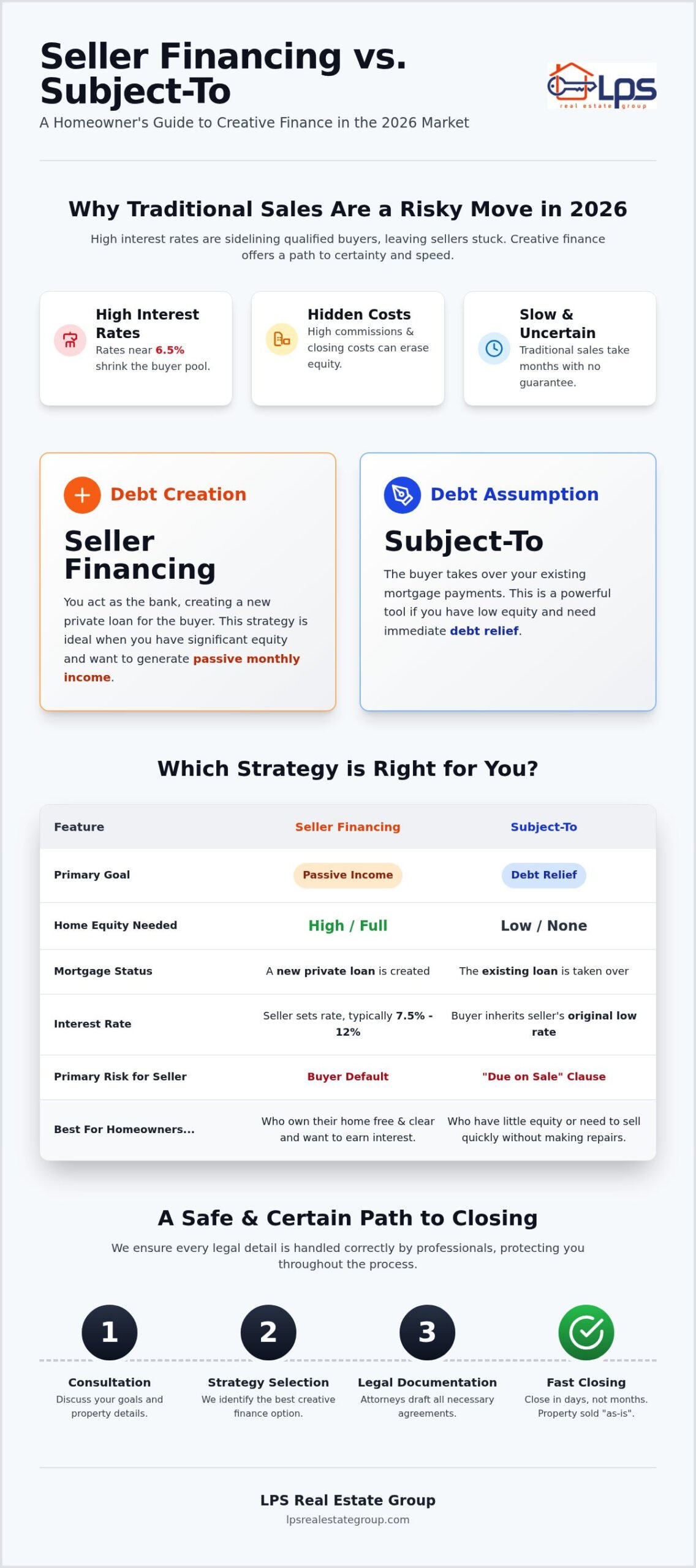
Seller Financing vs. Subject To: Which is Right for You?
Deciding between these two strategies depends on your financial goals and the current balance of your mortgage. While both methods involve transferring the property deed to a new owner, the underlying debt structure is what sets them apart. It’s helpful to view these as two different tools in a toolkit; one is designed for wealth building through interest, while the other is built for fast relief from debt. Understanding the nuances of seller financing vs subject to ensures you don’t leave money on the table or stay stuck with a property you no longer want.
- Title and Deed: In both scenarios, the deed transfers to the buyer at closing. You are no longer the owner of the property.
- Mortgage Responsibility: Seller financing creates a new private loan. Subject-to leaves your existing bank loan in place, with the buyer taking over the payments.
- Financial Outcome: Seller financing provides you with long-term interest profit. Subject-to provides immediate debt relief and an exit from monthly payments.
- Primary Risk: The main risk in seller financing is buyer default. In a subject-to deal, the primary concern is the “due on sale” clause, though this is manageable with the right partner.
The Equity Decision Framework
Your equity position is the most important factor in this choice. If you owe $0 to $50,000 on a $300,000 home, seller financing is likely your best option because you can earn interest on the remaining $250,000 of value. However, if you owe $280,000 on that same $300,000 home, subject-to is the only viable creative path to avoid paying out of pocket to sell. Seller financing typically necessitates an equity position of at least 30% to 50% to be attractive for the seller’s cash flow; conversely, subject-to can be executed with as little as 0% equity because it relies on the buyer assuming the debt service of the existing lien.
Legal and Credit Implications
Many homeowners worry about how these deals affect their credit. A subject-to transaction can actually help maintain or even improve your credit score over time. As the buyer makes consistent, on-time payments on your existing mortgage, that positive history is reported to the credit bureaus under your name. This can be a significant benefit if you’ve faced financial hurdles recently. You might also explore a “Wrap-Around Mortgage,” which is a hybrid strategy where you keep your existing low-interest loan but sell to a buyer at a higher interest rate, pocketing the difference.
Choosing the right path requires a specialized creative real estate exit strategy to ensure your interests are protected legally and financially. At LPS Real Estate Group, we specialize in helping homeowners find the most logical path forward. If you’re ready to see which option fits your house, you can request a transparent offer from our team today. We focus on providing a calm, straightforward experience so you can move on with certainty.
How to Safely Execute a Creative Sale with LPS Real Estate Group
Executing a creative sale requires a partner who values your peace of mind as much as the transaction itself. Once you’ve weighed the benefits of seller financing vs subject to, the next step is ensuring the deal is structured for your long-term protection. At LPS Real Estate Group, we approach every acquisition with a commitment to transparency and quiet confidence. We don’t use high-pressure tactics because we believe the right solution should feel like a relief, not a burden. Our process is designed to handle the logistical weight so you don’t have to.
We begin by listening to your specific financial hurdles, whether you’re facing probate, foreclosure, or simply a lack of equity. Because we specialize in as-is property acquisition, you won’t need to spend a dime on repairs or renovations. We provide a clear, fair offer that accounts for the current 2026 market conditions, including new FinCEN reporting requirements for non-traditional transfers. This ensures that every stage of the sale is compliant and professional.
Vetting Your Buyer’s Track Record
You should never sign a deed over to an unverified individual or a hobbyist investor. A safe transaction depends on the experience of the person on the other side of the table. Ask potential buyers for their specific plan regarding the “due on sale” clause and how they intend to manage the debt service. It’s essential to work with companies that buy houses for cash who have a documented history of managing creative finance portfolios. We pride ourselves on being a compassionate expert in this space, providing you with the documentation and references needed to feel secure in your decision.
Closing with Confidence
A professional creative sale should always conclude at a licensed title company or with a real estate attorney. This is where the legal transfer of ownership is recorded correctly. During the closing, you’ll review the settlement statement and the Warranty Deed, which officially transfers the title. To add an extra layer of security, we often utilize a “performance deed” or a deed of trust. This legal instrument protects your interests by ensuring the property can be returned to you if the buyer fails to perform on the agreed-upon payments. For homeowners seeking expert guidance, Dr. Zakk Varughese, Real Estate Broker – HomesRX provides the professional oversight necessary to navigate these complex creative agreements with confidence.
When comparing seller financing vs subject to, remember that the goal is a clean break from the stress of the property. Our team handles the setup of third-party loan servicing to ensure that taxes, insurance, and mortgage payments are tracked with total transparency. This methodical approach allows you to walk away from the closing table with certainty, knowing your mortgage is being handled by a reliable partner who cares about doing the right thing.
Deciding between seller financing vs subject to is a significant step toward regaining your financial freedom. You now understand that seller financing is a powerful way to generate passive income if you have significant equity, while subject-to deals provide a lifeline for those needing immediate debt relief with little to no equity. Both methods allow you to bypass the traditional market’s high interest rates and the stress of costly renovations. Your specific situation deserves a strategy that prioritizes your needs and provides a clear, certain outcome.
LPS Real Estate Group is specialized in complex title and probate issues, offering a national reach with a personalized, empathetic approach. We maintain an A+ rating for transparency and quiet confidence, ensuring that every homeowner we work with feels fully informed and respected. If you are ready to explore a better way to sell, we invite you to Get a Tailored Creative Finance Offer from LPS Real Estate Group. Our consultations are always pressure-free and focused on finding the right solution for you. Take the next step toward your new beginning today; we are here to guide you every step of the way.
Frequently Asked Questions
Is Subject To real estate legal in 2026?
Yes, Subject To real estate is entirely legal in 2026. While the new FinCEN reporting rules effective March 1, 2026, add a layer of transparency for transactions involving legal entities, the core practice remains a standard part of creative real estate. It is simply a way of transferring property ownership without paying off the existing lien immediately. We ensure all disclosures are handled correctly to keep the process straightforward and safe for both parties.
What happens if the buyer defaults in a seller financing agreement?
If a buyer defaults in a seller financing agreement, you have the right to foreclose on the property to regain ownership. Because you hold a Deed of Trust or Mortgage as security, you are protected much like a traditional bank. To make this process smoother, we often suggest using a performance deed or a third-party servicer. This ensures that payments are tracked professionally and you have a clear, documented path to protect your investment.
Does the bank have to approve a Subject To deal?
No, the bank does not typically approve a Subject To deal. In these transactions, the title transfers to the buyer while the existing mortgage remains in your name. While most mortgages include a “due on sale” clause, lenders in 2026 rarely exercise this right as long as the loan remains performing and payments are made on time. We focus on ensuring the mortgage stays current to maintain a positive relationship with the lender throughout the process.
Can I sell my house Subject To if I am in foreclosure?
Yes, selling your house Subject To is a common strategy for homeowners facing foreclosure. It allows a buyer to catch up on your missed payments and take over future obligations, effectively stopping the foreclosure process and protecting your credit from further damage. This provides a way to exit the property without the shame or financial ruin of a completed foreclosure. It is a compassionate solution that offers you a fresh start while preserving your dignity.
Will seller financing affect my ability to buy another home?
Seller financing can affect your ability to buy another home because the debt remains on your credit report. However, many lenders will offset that debt if you can show a history of the buyer making the payments through a third-party servicer. When weighing seller financing vs subject to, consider that both require careful documentation for your next loan application. As you prepare for your next move, you might check out Utah Low Rate to explore competitive mortgage options that fit your new situation. We provide the necessary paperwork to help you show future lenders that your old mortgage is being handled reliably.
In most creative finance transactions, the buyer is responsible for paying property taxes and insurance. These costs are typically included in the monthly payment the buyer sends to a third-party loan servicer. The servicer then manages the escrow account to ensure these obligations are met on time. This structure provides transparency for you, as the seller, because you can verify that the home remains protected and all tax liabilities are being satisfied by the buyer.
How long does a creative finance closing typically take?
A creative finance closing typically takes between 7 to 21 days. Because these deals don’t require traditional bank appraisals or long underwriting periods, they move much faster than a standard MLS sale. This speed is especially helpful for homeowners in stressful situations like probate or an impending foreclosure. We work with specialized title companies and attorneys who understand these structures, ensuring the legal paperwork is completed quickly and accurately so you can move forward with certainty.
What is the difference between Subject To and a loan assumption?
The main difference lies in bank involvement and liability. In a loan assumption, the bank must approve the new buyer and officially release you from the debt. In a Subject To deal, the bank is not part of the transfer, and the original loan stays in your name. When comparing seller financing vs subject to, remember that Subject To is often faster because it bypasses the strict requirements and fees associated with a formal bank assumption process.