
A “condemned” notice posted on your front door isn’t a legal dead end; it’s a signal that it’s time to change your strategy. You’re likely feeling the heavy weight of daily municipal fines and the constant worry of code enforcement letters piling up in your mailbox. It’s incredibly stressful to face structural repairs that cost more than the home is worth, especially when the city is threatening demolition. You might feel trapped by a property that feels like a liability, but you still have options to sell condemned house as is for cash before the situation escalates further.
We understand the anxiety that comes with the “unfit for habitation” label, and we’re here to help you find a path toward relief. In this guide, you’ll discover how to navigate the legal complexities of a condemned property and secure a fair cash offer without making a single repair. We’ll walk you through the 2026 landscape of municipal regulations, explain how to stop the accumulation of fines, and show you the steps to a fast closing that bypasses traditional inspections. You don’t have to face the city alone, and you certainly don’t have to spend your life savings on a building that’s currently beyond your reach.
Key Takeaways
- Learn how a condemned declaration works and why it doesn’t have to mean you’re stuck with a total financial loss.
- Discover the steps to stop municipal fines from growing and how to prevent the city from moving forward with a costly demolition at your expense.
- Understand why traditional bank financing fails for these properties and how to sell condemned house as is for cash to a buyer who doesn’t require inspections.
- Find out which documents you’ll need to gather, such as code violation letters and lien notices, to move from a stressful situation to a successful closing.
- Explore how a professional as-is acquisition allows you to walk away from structural issues with total transparency and zero repair costs.
What Does it Mean to Have a Condemned House?
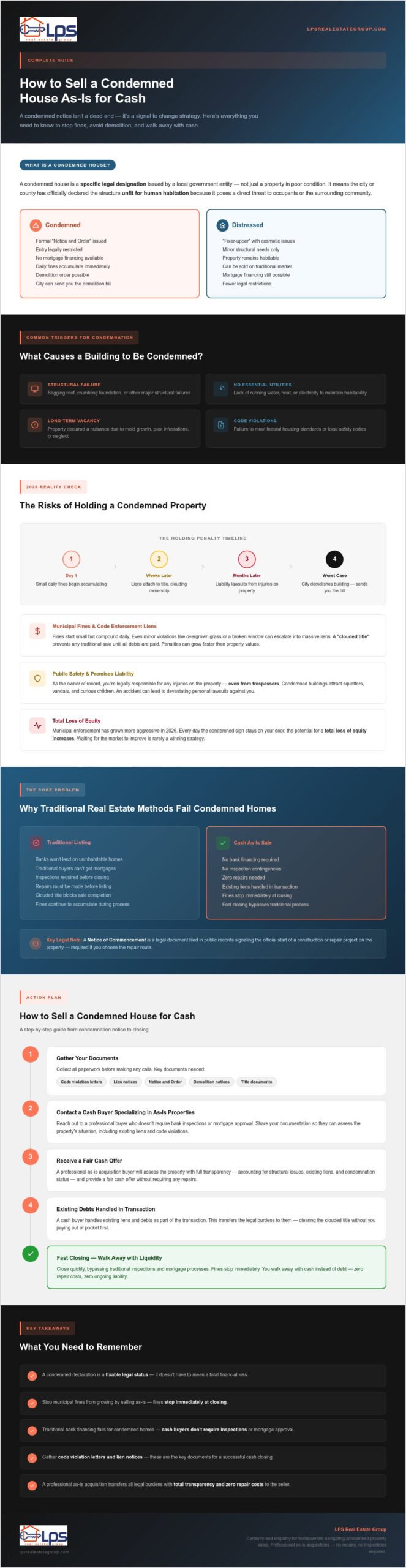
A condemned house is more than just a property in poor condition; it’s a specific legal designation issued by a local government entity. When a building is condemned, the city or county has officially declared the structure unfit for human habitation. This status usually means the property poses a direct threat to the safety of its occupants or the surrounding community. While the label sounds final, it’s actually a fixable legal status that requires a clear plan of action to resolve.
Several common triggers can lead a building inspector to issue this declaration. Structural failures, such as a sagging roof or a crumbling foundation, are frequent culprits. Other times, it’s the lack of essential utilities like running water, heat, or electricity. Long-term vacancy can also result in condemnation if the property becomes a “nuisance” due to mold growth, pest infestations, or neglect. If you’re facing this situation, you’re likely feeling a mix of frustration and fear. It’s important to realize that you aren’t stuck. Choosing to sell your house as-is is often the most effective way to transfer these legal burdens to someone else and move forward with your life.
Condemned vs. Distressed: Knowing the Difference
It’s easy to confuse these two terms, but the legal distinction is massive. A distressed property is typically a “fixer-upper” with cosmetic issues or minor structural needs. These homes can often still be sold on the traditional market because they remain habitable. A condemned property, however, comes with a formal “Notice and Order” that legally restricts entry. This label creates a significant hurdle because traditional buyers cannot obtain a mortgage for a home that isn’t habitable. Since banks won’t lend on these properties, your best option is to sell condemned house as is for cash to a professional buyer who doesn’t rely on bank inspections.
The Legal Implications of a Condemned Status
Municipalities use condemnation as a tool to enforce safety codes and encourage urban renewal. For the homeowner, this means the clock is ticking. Once a property is condemned, the city may begin assessing daily fines that can quickly drain your remaining equity. These penalties are designed to force you to either repair the home or tear it down. A Notice of Commencement is a legal document filed in public records that signals the official start of a construction or repair project on the property. If you lack the funds for these repairs, the “condemned” status can lead to a demolition order, where the city destroys the building and sends you the bill. Finding a way to sell condemned house as is for cash allows you to stop these fines immediately and walk away with liquidity instead of debt.
The Risks of Holding a Condemned Property in 2026
Holding a condemned property is often compared to a ticking financial clock. While you might hope for a market shift or a windfall to cover repairs, the reality in 2026 is that municipal enforcement has become more aggressive. Delaying action doesn’t just stall your progress; it actively erodes your home’s remaining equity through a variety of legal and financial pressures. Every day the “condemned” sign stays on your door, the potential for a total loss of equity increases.
Municipal Fines and Code Enforcement Liens
Local governments don’t simply ignore vacant or unsafe structures. They use code enforcement to ensure properties meet basic safety requirements. When a home falls below accepted federal housing standards, the resulting fines start small but compound daily. A simple violation like overgrown grass or a broken window can escalate into massive liens that attach to your title. These liens create a “clouded title,” meaning you cannot sell the property to a traditional buyer without paying off the debt first. Waiting for the market to improve is rarely a winning strategy because these penalties often grow faster than property values. If you find yourself in this cycle, the most effective way to stop the bleeding is to sell condemned house as is for cash to a buyer who handles these existing debts as part of the transaction.
Public Safety and Liability Concerns
Beyond the financial penalties, you face significant legal risks regarding premises liability. As the owner of record, you’re responsible for any injuries that occur on the property, even if the person was trespassing. Condemned buildings often attract squatters, vandals, or curious children, and an accident can lead to devastating personal lawsuits. Neighborhood blight lawsuits are also becoming more common as surrounding homeowners seek damages for decreased property values caused by your structure.
If the city determines the building is too far gone, they may issue a Demolition Order. In this scenario, the city hires a crew to tear down the house and sends you the bill. If you don’t pay, they can seize the land through a tax deed sale or eminent domain, leaving you with nothing. Choosing to sell condemned house as is for cash allows you to transfer these safety and legal risks to a professional acquisition group immediately. This path provides a clean break and protects you from future litigation while putting liquidity back in your pocket.
Why Traditional Real Estate Methods Fail Condemned Homes
Many homeowners first turn to a real estate agent, hoping for a high market price. However, the traditional Multiple Listing Service (MLS) is designed for homes that meet basic federal housing standards. When a property is condemned, it essentially becomes invisible to the vast majority of the buying market because it fails the most critical test: bankability. Traditional buyers rely on mortgages, and banks simply won’t lend on a property that isn’t habitable.
This creates a “Financing Gap” where the only people eligible to buy are those with immediate access to liquid funds. If you try to sell a condemned home through a standard listing, you’ll likely face the “Inspection Trap.” A condemned home won’t pass a standard 4-point inspection, which evaluates the roof, electrical, plumbing, and HVAC systems. Without these systems in working order, a conventional buyer’s loan will be denied every time. To even get the home ready for a traditional listing, you’d have to spend months and thousands of dollars bringing it up to code. This timeline contrast is stark; a traditional “fix and flip” can take 6 to 12 months, whereas choosing to sell condemned house as is for cash can be completed in as little as 7 to 14 days.
The Mortgage Problem: Why Cash is King
Lenders for FHA, VA, and conventional loans have strict requirements for safety and functionality. Even if you list a property as “As-Is” on the MLS, the buyer’s bank will still require the home to be functional before they release any funds. This means the buyer can’t close until the major issues are fixed, which usually falls back on you. This is why companies that buy houses for cash are often the only realistic path forward. They bypass the banking system entirely, using their own capital to acquire properties that traditional buyers can’t touch.
The Hidden Costs of Traditional Listing
Listing a condemned home involves several financial and emotional burdens that many owners overlook. Beyond the massive repair bill, you have to consider:
- Standard real estate agent commissions and closing costs.
- Property taxes and insurance that continue to accrue while the home sits vacant.
- The psychological toll of “failed” showings and hearing negative feedback from buyers who don’t understand the property’s potential.
Direct buyers provide the “certainty of closing” that a traditional listing lacks. When you sell condemned house as is for cash, you don’t have to worry about a deal falling through at the last minute because a bank inspector found a code violation. You get a firm offer, a clear timeline, and the ability to move on without another day of stress.
How to Sell a Condemned House for Cash: A Step-by-Step Guide
Selling a property that the city has red-flagged feels like managing a mountain of legal paperwork. It’s an overwhelming process, but it becomes manageable when you break it down into clear, logical steps. Moving from a “notice of condemnation” to a successful closing is about shifting the burden of repairs and municipal negotiations to a professional buyer who has the resources to handle them.
- Gather all municipal notices: Collect every code violation letter, lien notice, and utility shut-off order. Having a complete paper trail allows for a faster valuation.
- Request an as-is cash offer: Contact a reputable investment firm like LPS Real Estate Group. They specialize in properties that traditional buyers cannot touch.
- Review the offer details: Ensure the offer accounts for all outstanding liens. A transparent buyer will show you exactly how they calculated the final number.
- Close with a specialized title company: Standard title companies may struggle with municipal “clouds” on a title. Use a team that understands how to clear code enforcement debt during the sale.
- Hand over the keys: Once the sale is finalized, you walk away with cash in hand. The buyer takes over the legal responsibility for all future repairs and city requirements.
Preparing Your Documentation
Transparency is your greatest asset when you want to sell condemned house as is for cash. Being upfront about the specific reasons for the condemnation prevents surprises that could stall a closing later. If you find that the property has high debt-to-value ratios or complex legal hurdles, there are still options. In these cases, we often explore creative real estate exit strategies to ensure you can still walk away with a clean slate and financial relief.
Evaluating the Cash Offer
When you receive an offer, focus on your “Net Proceeds.” This is the actual amount you keep after all property taxes, municipal liens, and back utilities are paid off. A reputable buyer should not charge you for inspections, appraisals, or traditional agent commissions. A fair offer typically reflects the current land value minus the projected costs for demolition or major structural restoration. If you are ready to stop the cycle of fines and stress, you can request a no-pressure property assessment to see what your options look like today.
The LPS Real Estate Group Approach: Certainty and Empathy
At LPS Real Estate Group, we don’t look at a condemned notice and see a dead end. We see a homeowner who needs a reliable partner to help them resolve a complex and often overwhelming situation. Many real estate agents won’t touch these “impossible” properties because they don’t fit the traditional sales model, but we specialize in exactly these scenarios. Our goal is to provide you with immediate relief by taking the property off your hands exactly as it stands today. We believe in total transparency, which is why we take the time to explain the math behind every offer we make. You’ll see exactly how we factor in the land value, the cost of clearing municipal liens, and the necessary safety restorations.
When you work with us, you’re benefiting from our “Quiet Confidence” promise. We provide a calm, no-pressure environment where your needs come first. We understand that you’re likely facing a crisis, and the last thing you need is a high-pressure sales pitch. Instead, we act as a trusted advisor, handling all the heavy lifting regarding municipal paperwork and code enforcement negotiations. You don’t have to spend hours on the phone with the city or worry about filing legal documents; our team manages those details so you can focus on your future.
Why We Buy Condemned Houses
Our vision goes beyond simple property acquisition; we’re deeply invested in neighborhood revitalization and community safety. A condemned house is often a source of immense stress for the owner and can become a safety concern for the surrounding community. By acquiring these structures, we bring our own construction crews, legal experts, and immediate capital to the table. This allows us to resolve long-standing safety issues and restore the property’s potential without you having to lift a finger. We prioritize the human side of the transaction, recognizing that every house has a story and every owner deserves to be treated with respect and integrity.
Your Path to a Fresh Start
Choosing to sell condemned house as is for cash is the most direct way to stop the cycle of municipal fines and offload a “money pit” that’s draining your resources. The relief of walking away from a property that has caused years of anxiety is often the greatest benefit our clients experience. Homeowners we’ve partnered with frequently express how a single phone call changed their trajectory, moving them from the fear of a lawsuit to the certainty of cash in hand. We’ve helped many people navigate these exact hurdles, proving that even the most distressed property can lead to a positive outcome. If you’re ready to leave the stress of a condemned property behind, contact LPS Real Estate Group today for a compassionate, no-obligation consultation on your property.
Your Path to a Clean Slate and Financial Relief
A condemned label doesn’t have to define your financial future or cause endless sleepless nights. By understanding the risks of mounting municipal fines and the inherent limitations of traditional bank financing, you can make an informed choice to protect your remaining equity. You have the power to stop the accumulation of penalties today and walk away from the structural burdens that are currently weighing you down. It’s about choosing a solution that prioritizes your peace of mind over a building’s physical state.
Choosing to sell condemned house as is for cash allows you to bypass the inspection trap and focus entirely on your next chapter. At LPS Real Estate Group, we maintain an A+ Rating for Transparency and handle all the complex municipal paperwork on your behalf. You won’t have to worry about repairs, cleaning, or paying out traditional agent commissions. We’re here to listen to your story and provide a fair, straightforward path forward that respects your circumstances and your timeline.
Get Your Fair Cash Offer and Leave the Stress Behind. You deserve a fresh start, and our team is ready to help you secure it with quiet confidence and total integrity.
Frequently Asked Questions
Can you sell a house that has a demolition order from the city?
Yes, you can sell a property even after a demolition order is issued. However, you must act quickly before the city’s scheduled date. A professional buyer has the resources to negotiate with the city and present a restoration plan that can potentially stay the demolition. This process transfers the legal headache to the buyer while you walk away with cash instead of a bill for the teardown.
Do I have to pay off my code enforcement liens before I sell for cash?
You don’t need to pay these off out of your own pocket before the sale. When you sell condemned house as is for cash, any outstanding code enforcement liens are paid directly from the sale proceeds at closing. This ensures the title is cleared for the new owner while you receive the remaining balance. It’s a simple way to resolve debt without needing immediate liquid savings to satisfy the city.
Will a cash buyer buy a house with squatters or bad tenants?
Yes, most cash buyers will take on the burden of unauthorized occupants. Dealing with squatters in a condemned building is dangerous and legally complex. A specialized firm handles the legal eviction process or relocation assistance after the closing. This means you don’t have to step foot on the property or engage in stressful confrontations. You simply sign the paperwork and let the professionals manage the site security and occupant issues.
How long does it take to get a cash offer for a condemned home?
In most cases, you can receive a firm cash offer within 24 to 48 hours of contacting a buyer. Because these transactions bypass the traditional mortgage underwriting process, there’s no need for weeks of bank appraisals. This rapid timeline is especially helpful when you’re facing a “Notice and Order” with a tight deadline. A fast closing can happen in as little as seven days, stopping municipal fines from growing any further.
What happens to my mortgage if the house is condemned?
Your mortgage remains your responsibility even if the city declares the home unfit for habitation. In fact, condemnation can lead to a technical default on your loan because you’re failing to maintain the lender’s collateral. Selling the property for cash is often the most effective way to pay off the mortgage balance and avoid a foreclosure on your credit report. It provides a dignified exit from a difficult financial situation.
Is it better to fix a condemned house or sell it as-is?
Fixing a condemned property requires significant capital and a team of licensed contractors to meet modern building codes. For many, the cost of these repairs exceeds the home’s eventual market value. Selling as-is is the preferred path for homeowners who want to avoid the risks of a “money pit.” It allows you to trade a liability for immediate cash without the stress of managing a high-stakes renovation project.
Who pays the closing costs when selling a condemned house for cash?
When you sell to a direct property acquisition firm, the buyer usually pays for all standard closing costs. This includes title searches, recording fees, and settlement charges. Unlike a traditional sale where you might lose a significant percentage to agent commissions, a cash sale is designed to be transparent. You’ll know exactly what your net proceeds are upfront, with no hidden fees or surprise deductions at the final signing.
Can I sell a house that has been red-taped by the fire department?
Yes, a red tape notice from the fire department doesn’t prevent a sale. It simply indicates that the structure is currently unsafe for entry. Cash buyers are accustomed to evaluating fire-damaged properties and can assess the value of the land and any salvageable parts of the building. This provides a way to liquidate a property that would be impossible to sell to a family or a traditional buyer needing a mortgage.