
You’ve scrubbed the baseboards, replaced the rugs, and lit every candle in the house, yet that sharp, unmistakable scent remains. It’s a frustrating reality that leaves many homeowners wondering how to sell a home that smells like cat urine when every cleaning product seems to fail. Cat urine isn’t just a simple mess; it’s a structural liability that can derail a traditional sale before the first showing even begins.
We understand the heavy weight of this situation. It isn’t just about the odor. It’s the social embarrassment of hosting an open house and the anxiety that a failed cleaning attempt will waste thousands of dollars. You want to move forward, but the thought of judgmental buyers or expensive repairs feels overwhelming. This guide will show you the professional remediation steps required to eliminate pet odors while exploring a more cost-effective way to sell without the stress of renovations. We’ll cover the true costs of fixing deep-seated issues, from subfloor sealing to HVAC cleaning, and introduce a transparent path to an as-is sale that respects your time and your budget.
Key Takeaways
- Understand why cat urine is considered a material defect that requires legal disclosure and why standard cleaning often fails to remove uric acid crystals.
- Learn the professional two-stage remediation process, which involves removing all soft surfaces and sealing the subfloor to prevent the scent from returning.
- Compare the total cost of professional odor removal against the price reductions traditional buyers typically demand during negotiations.
- Discover how to sell a home that smells like cat urine without the stress of showings or the high cost of repairs by opting for an as-is cash sale.
- Recognize the emotional and financial relief of a judgment-free process where the buyer handles all necessary cleaning and repairs after you move out.
Why Cat Urine is a Significant Real Estate Hurdle
Selling a home is stressful enough without the added burden of a persistent odor. For many sellers, the challenge isn’t just the smell itself, but the way it transforms a buyer’s perception of the entire property. When you’re researching how to sell a home that smells like cat urine, it’s helpful to understand that this isn’t a minor cosmetic flaw; it’s a structural liability that affects your bottom line and your timeline.
The Reality of Uric Acid Crystals
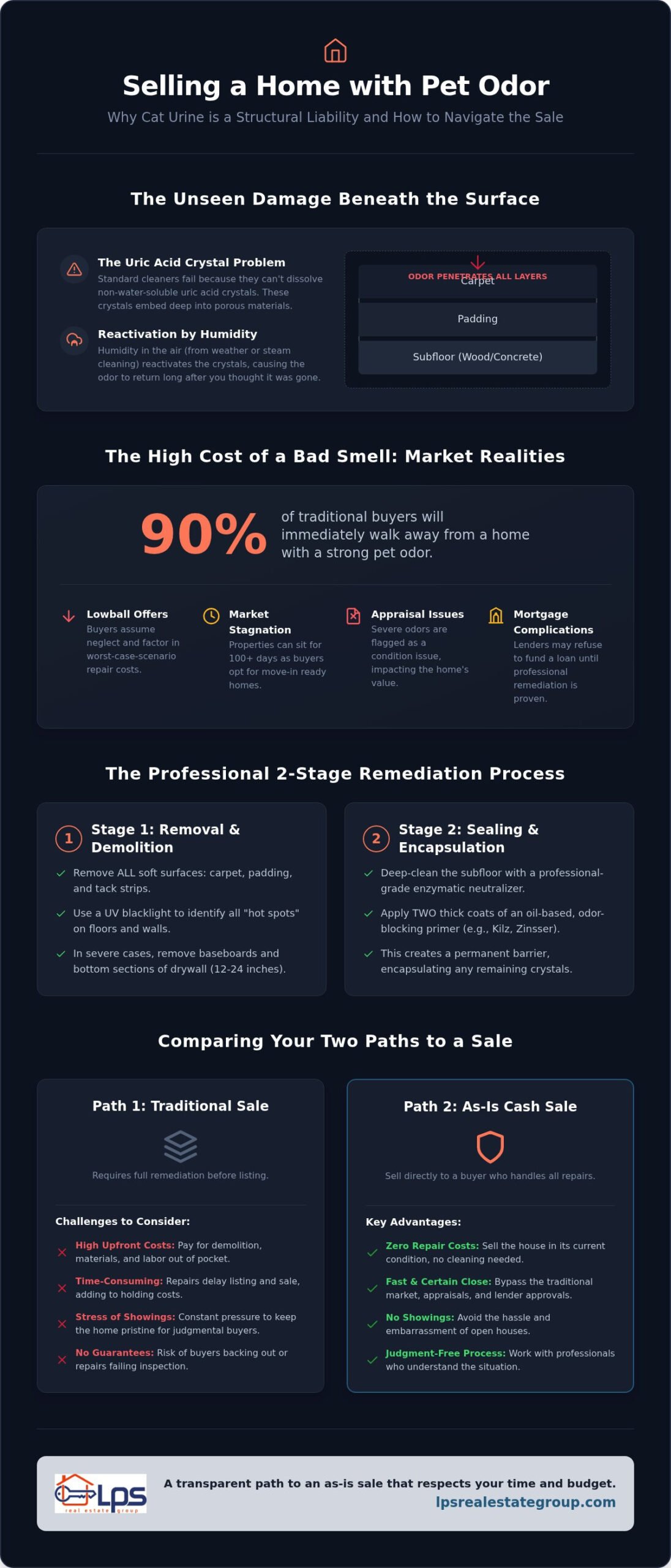
The primary reason cat urine is so difficult to eliminate is the presence of uric acid crystals. These crystals are not water-soluble, which means that standard household cleaners or steam treatments often leave them behind. When urine hits porous materials like unfinished wood subfloors, concrete, or drywall, it seeps deep into the fibers. As the liquid evaporates, the crystals remain trapped inside the material.
These crystals are highly sensitive to humidity. On a rainy day or during a humid summer, the moisture in the air reactivates the crystals, causing the smell to return with full force. This is why many homeowners believe they’ve solved the problem, only to find the odor resurfacing months later. Without professional-grade enzymatic cleaners or physical removal of the material, the scent remains dormant but permanent.
Market Perception and Property Value
In a traditional real estate market, odor is a massive deterrent. Industry observations suggest that roughly 90% of traditional buyers will walk away from a home immediately if they detect a strong pet scent. They don’t just see a cleaning bill; they see a psychological red flag. Buyers often assume that if a homeowner hasn’t addressed a noticeable smell, they’ve likely neglected other critical maintenance tasks, such as roof repairs or HVAC servicing.
This perception leads to several tangible hurdles when determining how to sell a home that smells like cat urine through traditional channels:
- Lowball offers that account for the perceived risk of hidden damage.
- Market stagnation, with properties often sitting for 100 days or more as buyers choose move-in ready alternatives.
- Appraisal issues, as severe odors can be flagged as a condition issue that impacts the home’s official value.
- Mortgage complications, where lenders may refuse to fund a loan until professional remediation is documented.
Real estate agents typically insist on full remediation before listing because they know that “masking” the scent with candles or perfumes rarely works. Buyers see through these attempts, often feeling more suspicious than they would have otherwise. Fixing the problem correctly is the only way to satisfy a traditional buyer, but as we’ll explore, that process is often expensive and invasive.
Step-by-Step Remediation: The Professional Approach
If you’re trying to figure out how to sell a home that smells like cat urine, you’ve likely realized that a standard carpet cleaning won’t solve the problem. Because uric acid crystals bond to porous materials, the remediation process must be thorough and invasive. It’s a multi-stage project that requires moving beyond surface-level fixes to address the structural elements of the home.
Demolition and Surface Removal
The first stage of professional remediation is the total removal of all soft surfaces. This means pulling up the carpet, but more importantly, the padding underneath. The padding acts like a sponge, trapping liquid and holding it against the subfloor for years. You must also remove the wooden tack strips, as they are often saturated and will continue to emit odors if left behind.
To ensure you don’t miss any affected areas, we recommend using a UV blacklight in a dark room. This tool reveals “hot spots” where urine has dried, allowing you to map out exactly where the damage is most severe. If a cat has sprayed vertically, the odor has likely penetrated the baseboards and the bottom of the drywall. In severe cases, you may need to cut out and replace the bottom 12 to 24 inches of drywall to fully eliminate the source.
Sealing and Encapsulation Techniques
After the materials are removed, the subfloor requires deep-cleaning with a high-quality enzymatic neutralizer. Once the floor is completely dry, the next step is encapsulation. This involves sealing the subfloor with a specialized, oil-based primer such as Kilz or Zinsser. These products are specifically designed to lock in odors that have soaked into the wood or concrete.
Applying a single coat is rarely enough for a permanent fix. We suggest two thick coats to ensure the uric acid crystals are fully encapsulated. It’s a common mistake to rely on air scrubbers or ozone machines early in the process. While these tools can help clear the air, they are only temporary fixes if the physical source of the odor hasn’t been removed or sealed. If this level of demolition and chemical treatment feels like more than you want to take on, you can sell your property exactly as it is and let a professional team handle the heavy lifting after you’ve moved on.
By following these steps, you create a clean slate for new flooring. This systematic approach is the only way to provide a traditional buyer with the peace of mind that the scent won’t return on the first humid day of summer.
Traditional Listing vs. Cash Sale: Comparing the Math
Deciding how to sell a home that smells like cat urine often comes down to a simple mathematical equation. You have to weigh the potential profit of a retail sale against the immediate, guaranteed costs of remediation and the risk of a deal falling through. While a traditional listing might promise a higher top-line number, the net proceeds after repairs and fees often tell a different story.
The Hidden Costs of Repairing to List
Preparing a house with severe odors for the traditional market involves more than just a few cans of paint. Based on 2026 market data, professional pet odor removal for a whole home can cost up to $2,000, while sealing or replacing damaged subfloors adds another $300 to $1,000. These are upfront expenses you must pay before even putting a sign in the yard. While you’re waiting for contractors to finish, you’re still responsible for the mortgage, taxes, and utilities, which are known as holding costs.
Once the home is listed, you’ll likely face the “Odor Discount.” Traditional buyers who detect even a faint scent will often deduct the perceived cost of a total renovation from their offer. Many real estate agents suggest offering a “repair credit” to satisfy buyers, but this approach has a major flaw. If the odor is severe enough to be classified as a material defect, some lenders may refuse to approve a mortgage until the remediation is complete. This can leave you stuck with a house that nobody can buy. When you add the standard 6% realtor commission to your repair bill, the return on investment for these fixes often disappears.
The Benefits of an As-Is Cash Offer
An alternative path is to bypass the traditional market entirely. Selling to a cash buyer allows you to walk away from the property without lifting a finger to clean or repair it. This approach eliminates the social embarrassment of showings and the anxiety of wondering if the smell will return during a buyer’s inspection. It’s a strategic choice for those who value certainty and speed over the unpredictable nature of the MLS.
Choosing this route means you don’t have to worry about contractor delays or whether your subfloor seal will hold up. You can find more details on this process in our Selling Your House As-Is: The Complete 2026 Homeowner’s Guide. By selling directly, you avoid commissions and closing costs, often netting a similar amount to a traditional sale but without the months of stress. We handle the remediation after the sale, taking the burden off your shoulders and letting you start fresh in a clean, scent-free environment.
Practical Guidance if You Choose to List Traditionally
If you decide to take your property to the open market, your strategy must shift from structural remediation to presentation and management. Navigating the traditional real estate process with a pet-impacted home requires a delicate balance of transparency and preparation. While previous sections focused on the deep fixes, managing the daily reality of showings is a different challenge. You’ll need a plan that addresses the immediate sensory experience of potential buyers without triggering their suspicions.
Odor Neutralization vs. Masking
One of the biggest mistakes sellers make is trying to cover up pet scents with heavy perfumes, scented candles, or multiple plug-in air fresheners. To an experienced buyer or a diligent home inspector, these are immediate red flags. They suggest that the seller is hiding a deeper issue rather than solving it. Instead of masking, focus on genuine neutralization and air quality.
High-quality air exchange is your best friend. Keep windows open whenever possible and use high-efficiency air purifiers with HEPA and charcoal filters. For minor cases, placing activated charcoal bags or natural volcanic rock neutralizers in closets and corners can help absorb lingering scents without adding artificial fragrances. These methods create a neutral environment that feels clean rather than “covered up.” Professional staging can also help by drawing the buyer’s eye toward the home’s best features, though it cannot replace the need for a scent-free environment.
Disclosure and Transparency
When you’re figuring out how to sell a home that smells like cat urine, honesty is your most effective tool. In most states, severe cat urine odor that has saturated the subfloors is considered a material defect. This means you have a legal obligation to disclose it to potential buyers. While there are no federal laws requiring you to state a pet lived in the home, you must disclose conditions that significantly affect the property’s value or habitability.
Being upfront about the history of the home and the steps you’ve taken to fix it actually builds trust. Provide a list of the remediation work you’ve completed, such as subfloor sealing or professional duct cleaning. This shows buyers that you are proactive and ethical. If the thought of managing these disclosures and the potential for a failed inspection feels like too much, you can always request a direct cash offer and skip the traditional market entirely.
Knowing when to admit the problem is too large for a DIY fix is crucial. If you’ve tried multiple enzymatic treatments and the scent still returns on humid days, the damage is likely structural. At this point, continuing to list traditionally may lead to your home sitting on the market for months, resulting in repeated price drops that cost more than the original repair would have. Professional guidance can help you determine if the investment in further repairs will truly yield a higher sale price.
Selling As-Is to LPS Real Estate Group: The Stress-Free Path
After reviewing the structural challenges and the significant financial investment required for professional remediation, it’s clear that the traditional path isn’t the right fit for everyone. If you’re looking for a way how to sell a home that smells like cat urine without the burden of expensive repairs or the social anxiety of open houses, a direct sale offers a reliable alternative. At LPS Real Estate Group, we specialize in taking on the properties that traditional buyers often avoid.
The LPS Real Estate Group Difference
Our approach is rooted in empathy and transparency. We understand that life happens; sometimes a property reaches a state where a standard listing is no longer practical. We specialize in complex situations, including homes with severe pet odors, structural neglect, or hoarder environments. You’ll never face judgment from our team. We see the potential in every property and focus on finding a fair solution that allows you to move forward with peace of mind.
One of the greatest benefits of working with us is our flexible closing process. You don’t need to worry about moving out before you’re truly ready. We work on your timeline, allowing you to transition to your next home without the pressure of a rigid deadline. To learn more about how this compares to other options, you can read our article on Companies That Buy Houses for Cash: A Homeowner’s 2026 Guide to Selling Fast. We handle all the remediation, cleaning, and structural repairs after the sale is complete, so you can leave the odor and the stress behind.
How to Get Started Today
We’ve designed our process to be as simple and straightforward as possible. There are no complicated hurdles or hidden requirements. It typically follows three clear steps:
- Initial Contact: Reach out to us with a few details about your property. We’ll listen to your situation and answer any questions you have about our as-is acquisition process.
- Property Assessment: We’ll conduct a brief, judgment-free walk-through of the home. You don’t need to clean, paint, or hide anything; we’re there to understand the property’s current state.
- Fair Cash Offer: We provide a direct cash offer based on the current condition of the home. There are no realtor commissions, no hidden fees, and we cover all the closing costs.
Our commitment is to provide a transparent and fair experience that prioritizes your needs over a quick transaction. By choosing a direct sale, you gain the certainty of a guaranteed closing and the relief of knowing the property’s challenges are no longer your responsibility.
Moving Toward a Fresh Start
Deciding how to sell a home that smells like cat urine is a significant choice that impacts your finances and your emotional well-being. While professional remediation can solve the problem, it often involves invasive demolition and high costs that may not be recovered in a traditional sale. If the prospect of managing contractors, disclosing defects, and hosting judgmental buyers feels overwhelming, there’s a simpler path forward.
LPS Real Estate Group specializes in as-is property acquisition, providing a judgment-free solution for even the most challenging situations. We offer transparent, creative finance solutions and a fast, reliable closing process that puts you back in control of your timeline. You don’t have to carry the burden of repairs or the stress of a property that feels stuck in the past. Get a fair, as-is cash offer for your home today; no cleaning or repairs required. You deserve a fresh start in a home that feels like yours again, and we’re here to help you get there.
Frequently Asked Questions
Can I sell a house that smells like cat urine on the MLS?
Yes, you can list a property with odors on the MLS, but you should prepare for a challenging process. Traditional buyers often associate pet smells with broader property neglect, which can lead to your home sitting on the market for 100 days or more. If you choose this route, you’ll likely need to invest in deep cleaning or offer a significant price reduction to attract interest from those willing to take on a renovation project.
Will an ozone generator permanently remove cat pee smell?
Ozone generators are effective at neutralizing airborne molecules, but they won’t provide a permanent solution for deep-seated stains. The primary cause of the scent is uric acid crystals trapped in porous materials like wood or concrete. While the machine makes the air smell fresh for a few days, the odor will eventually return when humidity levels rise. Permanent removal requires physically removing saturated materials or using enzymatic cleaners to break down the crystals.
How much does it cost to professionally remove cat urine odor from a house?
The average cost for professional pet odor removal is $350, though whole-home treatments for severe cases can reach $2,000. If the urine has permeated the subfloor, sealing or replacing those materials typically costs between $300 and $1,000. You should also account for HVAC and air duct cleaning, which ranges from $300 to $700. These upfront costs are necessary if you want to know how to sell a home that smells like cat urine to a traditional buyer.
Do I have to disclose pet urine smells to potential buyers?
Yes, most states require you to disclose known material defects that affect a property’s value or habitability. Severe cat urine odor that has saturated subfloors or drywall generally qualifies as such a defect. Even if you’re selling as-is, you’re legally and ethically obligated to be transparent about the issue. Failing to disclose this can lead to legal complications or a buyer backing out of the contract after a professional home inspection reveals the damage.
Will Kilz primer really stop the smell of cat urine?
Oil-based Kilz primer is a highly effective tool for encapsulating odors, but it must be used correctly. You can’t simply paint over a fresh mess. You first need to clean the area with an enzymatic neutralizer and allow it to dry completely. Applying two thick coats of the primer to the subfloor creates a barrier that locks in the uric acid crystals. This prevents the scent from reactivating when the weather becomes humid or damp.
Is it better to offer a repair credit or fix the odor myself?
Offering a repair credit might seem easier, but it often leads to lower offers than the actual cost of the repair. Traditional buyers often perceive the problem as bigger than it is, leading them to demand a much larger odor discount during negotiations. Additionally, some mortgage lenders won’t approve a loan for a home with significant structural damage from pets. Fixing the issue yourself provides more certainty, though it requires a significant upfront financial investment.
Can I sell my house for cash if it has severe pet damage?
Selling for cash is often the most practical way how to sell a home that smells like cat urine without the stress of repairs. Cash home buyers specialize in purchasing properties in their current condition, regardless of how severe the pet damage might be. This path allows you to avoid the social embarrassment of showings and the high costs of professional remediation. You receive a fair offer and can close on a timeline that works for you.
How do cash buyers like LPS Real Estate Group handle odor remediation?
LPS Real Estate Group takes a partnership-focused approach to every property we acquire. We handle the entire remediation process after the sale is finalized, which means you don’t have to lift a finger or spend a dime on cleaning. Our professional teams are experienced in tearing out saturated flooring and properly sealing subfloors. This allows you to walk away from the property with your equity in hand while we take on the structural challenges and renovations.