

Imagine you’re finally starting to process the loss of a loved one, only to realize you’re now responsible for a property that feels more like a burden than a gift. Between the rising utility bills and a confusing stack of court papers, the weight can feel overwhelming. Learning how to sell house in probate shouldn’t add to your grief. It’s a unique process that requires a steady hand, but it doesn’t have to be a source of constant anxiety.
You probably feel like you’re stuck in a legal maze where every turn leads to another fee or a longer delay. We understand that you want to honor your loved one’s legacy without the financial pressure of holding costs or the fear of a legal misstep. This guide provides a clear path through the 2026 regulations to help you move forward with certainty. We’ll break down the essential steps, from obtaining your Letters of Administration to choosing a selling method that bypasses the need for expensive repairs. By the end, you’ll have a logical plan to liquidate the estate while ensuring every detail is legally compliant.
Key Takeaways
- Learn why you must be formally appointed as a Personal Representative by the court before you have the legal authority to sign a deed or transfer property ownership.
- Discover how to sell house in probate using a step-by-step 2026 guide that covers everything from initial court petitions to establishing fair market value.
- Compare the long timelines and high commissions of a traditional sale against the speed of a direct buyout, which can provide a closing in as little as 7 to 21 days.
- Find out how to resolve complex estate hurdles like “clouded titles” or major property repairs without having to spend your own inheritance on renovations or clean-outs.
- Understand how a compassionate, as-is acquisition can simplify the liquidation process, allowing you to focus on your family while the heavy lifting is handled for you.
Understanding the Legal Landscape of Selling a House in Probate
Probate is more than just a legal hurdle. It’s a court-supervised path designed to ensure a person’s final wishes are honored and their debts are settled. The legal process of probate involves validating the deceased person’s will, identifying assets, and eventually distributing what remains to the rightful heirs. While this sounds straightforward, it often feels like a standstill for family members. You might be eager to move forward, but you can’t officially list or sell the property until the court gives someone the legal authority to do so. This authority is the foundation of how to sell house in probate correctly.
In 2026, the law generally categorizes probate into independent and dependent administration. Independent administration is the preferred route for many families because it allows the executor to act with minimal court supervision. This usually leads to a faster, more efficient sale. Dependent administration requires the court to sign off on nearly every decision, including the final sale price and the choice of buyer. This extra layer of oversight is often required if there are disputes among heirs or if the estate’s affairs are particularly complex. Knowing which path you’re on will dictate how much control you have over the timeline.
The Role of the Personal Representative
The court appoints a Personal Representative, often called an executor if there’s a will or an administrator if there isn’t. This person carries a fiduciary duty. This is a high legal standard that requires them to act solely in the best interest of the estate and its beneficiaries. Many families assume that simply being named in a will provides the power to sell. This isn’t true. You must first obtain “Letters of Administration” or “Letters Testamentary.” These documents are the official proof that title companies and buyers need to see before they’ll accept your signature on a deed.
When Probate is Required (and When It’s Not)
Not every inherited home has to go through the full court cycle. If the property was held in “Joint Tenancy with Right of Survivorship,” the title typically passes directly to the surviving owner. Similarly, “Transfer on Death” (TOD) deeds allow for a transition without court involvement. As of 2026, many states have updated their simplified process thresholds to reflect rising property values. For example, Florida House Bill 1337 recently doubled the limit for summary administration to $150,000. In California, estates with real property valued under $750,000 may qualify for simplified procedures. If a loved one dies intestate, which means passing away without a valid will, state laws will determine how the house is distributed among heirs.
The Step-by-Step Path to Selling a Probate Property in 2026
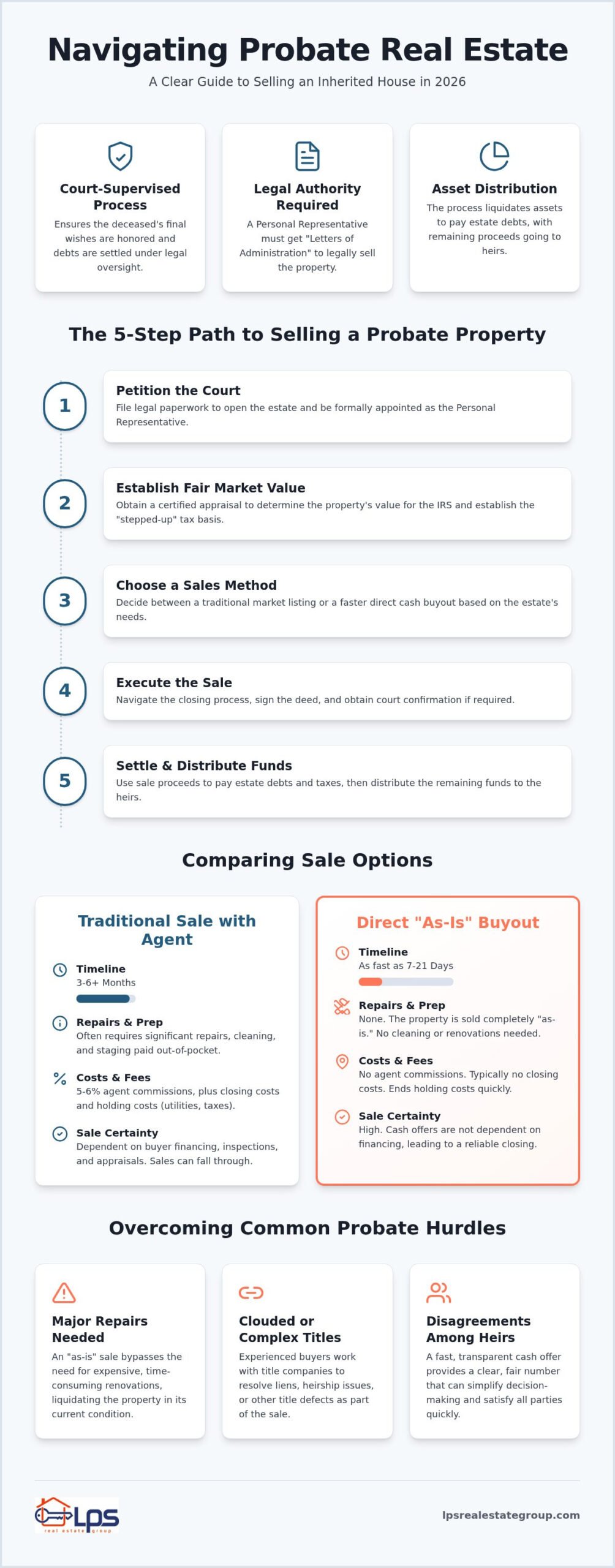
Selling a home while mourning is a heavy task, but following a methodical sequence can help you manage the burden. Once the court validates the will and appoints you as the Personal Representative, the logistics of the sale begin. This Forbes guide to probate offers a deeper look at the financial implications of these early legal filings. Understanding how to sell house in probate starts with these five core steps:
- Petition the court: File the necessary paperwork to open the estate and receive your official “Letters.”
- Establish value: Obtain a professional appraisal to determine the property’s worth at the time of the owner’s passing.
- Choose a sales method: Decide if a traditional market listing or a direct cash buyout fits the estate’s needs.
- Execute the sale: Navigate the closing process and obtain court confirmation if your specific state or authority level requires it.
- Settle and distribute: Use the proceeds to pay off estate debts and taxes before distributing the remaining funds to the heirs.
Establishing Fair Market Value
In 2026, getting a certified appraisal is more than a suggestion; it’s a legal shield. While a real estate agent’s comparative market analysis is helpful for pricing, a formal appraisal establishes the fair market value (FMV) for the IRS. This is crucial because of the “stepped-up basis” rule. When you inherit a home, its tax basis is “stepped up” to its value on the date of the owner’s death. This means heirs only pay capital gains tax on the appreciation that occurs after that date. A certified value also protects you as the representative if a beneficiary ever questions whether the property was sold for a fair price.
Petitioning for the Power to Sell
Being appointed as the representative is just the beginning. You must confirm whether you have “Full Authority” or “Limited Authority” under the law. If you’re working with independent administration, you can often proceed by sending a “Notice of Proposed Action” to all beneficiaries. This document informs them of your intent to sell and the terms of the deal. They typically have a short window to object. If no one raises a concern, you can move forward to the closing table. If you’re looking for a way to bypass the complexities of repairs and multiple showings, probate and inherited property buyouts can provide a streamlined path to liquidity for the estate.
Listing with an Agent vs. Selling to a Direct Cash Buyer
Deciding between a traditional market listing and a direct cash offer is often a choice between a theoretical high price and a certain, immediate outcome. When you’re managing an estate, the clock works differently than a standard move. A traditional sale through an agent typically takes between 6 and 12 months to finalize. In some states, like California, the process frequently stretches to 18 months. Conversely, a direct cash buyout can often be completed in 7 to 21 days. This speed is a significant factor when you consider how to sell house in probate without letting the property sit vacant for a year.
Financial transparency is vital during this transition. Listing with an agent involves a 6% commission, plus various closing costs that can quickly diminish the final inheritance. You should also consider the cost to sell a house in probate, which includes the 3% to 8% of total estate value typically spent on legal and administrative fees. While a “market offer” might look higher on paper, an “as-is” cash offer often results in more actual money in your pocket because it removes the need for expensive repairs, cleaning, and professional staging.
The Hidden Costs of Holding Probate Property
Every month a house sits in probate, the estate’s cash reserves are depleted by recurring expenses. These holding costs are often higher than people expect. You’ll need to manage several ongoing financial obligations:
- Property Taxes: These continue to accrue regardless of the owner’s passing.
- Vacant Home Insurance: Standard policies often don’t cover homes that are empty for more than 30 days, requiring specialized, more expensive coverage.
- Utility Maintenance: Keeping the electricity and water on is essential to prevent pipe bursts or mold growth.
- Security Risks: Vacant estate homes are frequent targets for vandalism or squatters, which can lead to costly legal battles and property damage.
Speed and Certainty: Why Heirs Choose Direct Sales
As of July 2026, mortgage rates are averaging around 6.63%, making traditional buyers more sensitive to a home’s condition and price. Many retail buyers won’t even consider a home that needs major work, or their lenders will deny the loan based on the appraisal. A direct sale skips the appraisal-contingency hurdle entirely. It also simplifies the legal side, as many jurisdictions allow executors with full authority to bypass the lengthy court confirmation process when accepting a cash offer. If you’re looking for a reliable exit, researching companies that buy houses for cash can help you find a partner who understands the unique pressures of estate liquidation.
Overcoming Common Probate Hurdles: Repairs, Title, and Disagreements
Inheriting a home often comes with a physical burden you didn’t expect. Whether it’s a “hoarder house” filled with decades of belongings or a property that hasn’t seen a renovation in thirty years, the task of cleaning it out can be emotionally and physically draining. When you’re figuring out how to sell house in probate, these physical obstacles often collide with emotional ones, such as disagreements among siblings. One heir might want to keep the family home for sentimental reasons, while another needs the liquidity to settle their own debts. Resolving these conflicts requires patience and, often, a neutral third party who can provide a clear financial exit that satisfies everyone involved.
If the property is in major disrepair, the prospect of managing contractors or spending the estate’s limited cash on a new roof is daunting. This is where a strategic approach to liquidation becomes essential. You don’t have to be the one to fix the foundation or clear out the attic. Instead of sinking money into a house you don’t intend to keep, you can choose to sell house as is, shifting those responsibilities to a buyer who specializes in restoration.
Selling the Property ‘As-Is’
In the context of an estate, selling “as-is” means the Personal Representative makes no repairs, performs no cleaning, and offers no warranties regarding the home’s condition. This is a significant relief for executors. Legally, executors are often granted more protection than traditional sellers because they may have never lived in the property and cannot be expected to know every hidden defect. Choosing this route allows you to leave unwanted furniture, old appliances, and even trash behind. The buyer takes on the “clean-out,” saving the estate thousands in hauling fees and labor.
Dealing with Title Issues and Liens
Title searches often reveal “clouds” that the deceased owner may have forgotten or never knew about. Common issues include unpaid property taxes, secondary mortgages, or old mechanic’s liens from a repair done years ago. In some cases, unknown heirs or long-lost relatives might even appear on the title. The estate must pay off all valid liens before heirs receive funds. A specialized buyer can work directly with title companies to resolve these issues during the escrow process. If you are facing complex title hurdles, our team at LPS Real Estate Group provides expert guidance on probate and inherited property buyouts to help you clear the way for a clean sale.
How LPS Real Estate Group Streamlines Inherited Property Buyouts
Managing the sale of a loved one’s home is a journey that requires both professional expertise and a gentle touch. At LPS Real Estate Group, we’ve built our process around the understanding that you aren’t just selling a building; you’re closing a chapter. We step in as a compassionate partner to handle the logistical burdens that often lead to emotional exhaustion. Our goal is to simplify how to sell house in probate by removing the obstacles of traditional real estate, such as the need for cleaning, repairs, and expensive agent fees. We take on the heavy lifting so you can focus on your family and your own well-being.
Every estate is different, and we treat every consultation as a unique opportunity to find the best possible outcome. Whether the house is in pristine condition or has been neglected for years, our approach remains transparent and low-stress. We’ve helped many families navigate the nuances of how to sell an inherited property, ensuring that the transition is handled with integrity and care. By choosing a direct buyout, you eliminate the uncertainty of a market that can be sensitive to price and condition in 2026.
Our Probate-Specialized Buyout Process
We’ve refined our buyout process into three manageable steps designed to provide clarity from the very first day. It starts with a simple, one-on-one conversation about the property and the specific goals of the estate. We listen first, seeking to understand the family’s timeline and any potential hurdles. Following this, we provide a transparent cash offer based on current market conditions. There’s no pressure to accept; we want you to feel confident in your decision. Once you’re ready, we work directly with your probate attorney to coordinate the closing. This collaboration ensures that all court filings and legal requirements are met, providing a smooth path to the final distribution of funds.
Creative Real Estate Exit Strategies for Estates
Sometimes, a standard cash offer isn’t the most effective solution for an estate. This is particularly true if the property has a high mortgage balance or complex liens that exceed a typical cash buyout price. In these situations, we utilize creative real estate exit strategies to find a way forward. We can explore options like “Subject-To” or “Seller Financing,” which allow us to take over existing payments or structure a payout that nets the heirs more money over time. These methods can turn a seemingly “underwater” property into a successful liquidation, providing the estate with a viable exit where others might only see a dead end. We take pride in finding these “win-win” scenarios that prioritize the financial health of the beneficiaries.
Moving Forward with Confidence and Clarity
Navigating an estate is often a marathon, not a sprint. By understanding the legal landscape and securing your Letters of Administration, you’ve already cleared the most significant hurdle. Choosing a sales method that prioritizes your family’s needs, whether through a traditional listing or a direct buyout, ensures that the estate remains solvent and protected. Mastering the details of how to sell house in probate allows you to transform a complex legal obligation into a manageable step toward closure.
At LPS Real Estate Group, we bring over 8 years of experience to every complex estate buyout. Our team maintains an A+ focus on transparency and ethical property acquisitions, providing you with a reliable path forward during a difficult time. We buy properties exactly as they are; you’ll never have to worry about cleaning out personal belongings or funding expensive repairs. If you’re ready to simplify this process and find certainty, Get a Fair, Stress-Free Cash Offer for Your Probate Property Today. You’ve handled the hard part of honoring your loved one’s legacy. Let us handle the logistical burden of the sale so you can focus on what truly matters.
Frequently Asked Questions
Can I sell a house before the probate process is finished?
Yes, you can sell the house before the probate case is fully closed, but you must first be formally appointed by the court. Once you receive your Letters of Administration or Letters Testamentary, you have the legal authority to sign a deed. Understanding how to sell house in probate means knowing that while the estate stays open, the property itself can be liquidated early to pay debts or heirs.
How long does it typically take to sell a house in probate?
A typical probate sale takes between six months and a year, though timelines vary by location. In California, the process frequently lasts 9 to 18 months because of court scheduling and mandatory waiting periods for creditors. If you’re facing financial pressure from holding costs, a direct cash buyout can often be finalized in 7 to 21 days once the court grants you the legal authority to act.
Who is responsible for the mortgage payments while the house is in probate?
The estate is responsible for making mortgage payments using its liquid assets until the property is sold. If the estate lacks the necessary cash, the Personal Representative or the heirs may choose to pay the mortgage themselves to protect the equity. Lenders must be notified of the owner’s passing. Most lenders cannot trigger an immediate “due on sale” clause for inherited homes because of federal consumer protections.
Do all heirs have to agree to sell the property in probate?
No, the Personal Representative generally has the legal authority to sell the property without unanimous consent from all heirs. This power is usually exercised to pay off estate debts or to ensure a fair distribution of assets. However, acting against the wishes of heirs can lead to court objections. These disputes often delay the process and increase legal fees; so seeking a consensus is always the best path forward.
What happens if the house is worth less than the mortgage (underwater) during probate?
When a house is underwater, the estate may need to negotiate a short sale with the lender. Heirs are not personally responsible for the mortgage deficiency; the debt belongs to the estate alone. In these complex situations, a direct buyer can often offer creative solutions that satisfy the lender’s requirements. This prevents a foreclosure from damaging the estate’s value and allows the Personal Representative to move forward with the liquidation.
Can I sell the house to myself or a family member during probate?
Yes, you can purchase the home yourself, but the transaction must be conducted at fair market value. The court and other beneficiaries will closely monitor the sale to ensure you aren’t violating your fiduciary duty. You’ll need a formal, certified appraisal to justify the purchase price. This transparency protects you from future legal claims that you took advantage of your position as the estate’s representative.
What is court confirmation and do I need it to sell the house?
Court confirmation is a public hearing where a judge reviews and approves the final sale of the property. Whether you need this depends on if the court granted you “full authority” or “limited authority” during your appointment. If you have limited authority, the judge must confirm the price and terms. During this hearing, other buyers may submit “overbids,” which could potentially change who ends up purchasing the home from the estate.
Is a cash offer better than a traditional listing for a probate sale?
A cash offer is often the most reliable choice when you want to avoid the stress of repairs and long market delays. While a traditional listing might show a higher price, it involves 5% to 6% commissions and the risk of a buyer’s financing failing. For those learning how to sell house in probate, a cash buyout provides a certain closing date and allows you to walk away without cleaning or staging.