
That major kitchen renovation you’re considering might actually cost you more than it’s worth. With high-end remodels returning as low as 38% in the current 2026 market, pouring money into an old property is often a losing game. You’re likely worried about “picky” buyers walking away or losing a fortune on contractors you don’t have the time to manage. It’s a stressful spot to be in, and it’s natural to feel stuck between a costly renovation and a low-ball offer.
This guide explains how to sell a house that is not updated while protecting your equity and your sanity. You don’t need a construction crew to get a fair price. We’ll show you how to navigate a balanced market where inventory is up 8.9%, helping you decide if you should tackle small fixes or sell exactly as the house stands today. We’ll break down the true ROI of 2026 updates, from high-impact garage doors to low-value major overhauls, so you can choose the fastest, most profitable path forward.
Key Takeaways
- Learn to distinguish between simple cosmetic “datedness” and major structural issues to avoid overspending on unnecessary repairs.
- Identify high-impact “lipstick” fixes that improve curb appeal and interior feel without the high cost of a full renovation.
- Understand the 2026 ROI reality where minor updates like garage door replacements often outperform major kitchen or bath remodels.
- Discover how to sell a house that is not updated through a direct cash sale to skip the stress of showings, cleaning, and contractor management.
- Use a simple framework to decide between a traditional listing and an as-is sale based on your specific budget and moving timeline.
What Does it Mean to Sell an Un-updated House?
Selling a home that hasn’t been touched in decades is more than a real estate transaction. It’s often an emotional journey. You might feel “stuck in time” as you look at the wood paneling or the linoleum floors. It’s natural to worry that your home won’t measure up to the shiny, staged houses on the market. But understanding how to sell a house that is not updated starts with knowing exactly what you’re selling.
There is a massive difference between a house that is “old” and one that is “broken.” Most buyers can handle a dated bathroom. They struggle much more with a failing foundation or a leaking roof. When you prepare your home, you must still follow all seller disclosure requirements to ensure a smooth legal transfer. Being honest about what’s cosmetic and what’s structural builds trust with the right buyer. It also helps you avoid legal headaches after the sale.
In the 2026 market, there are three main types of buyers for these properties:
- The Retail Buyer: Usually a family looking for a home. They often lack the cash for renovations and want something “move-in ready.”
- The Fix-and-Flipper: Professional investors who want to buy low, renovate fast, and sell high. They will negotiate aggressively to protect their margins.
- The Direct Cash Buyer: Companies like LPS Real Estate Group that buy as-is. They prioritize speed and equity over aesthetics, offering a streamlined path for the seller.
The Definition of an Outdated Home
Cosmetic issues are the most common signs of an un-updated property. We’re talking about heavy wallpaper, stained carpets, and 90s-style oak cabinetry. Then there is functional obsolescence. This occurs when a house lacks modern conveniences like smart home integration or an open-concept layout. An un-updated home is one that lacks modern finishes but remains structurally sound.
Why Traditional Buyers Are Hesitant
Today’s buyers are more sensitive to aesthetics than ever. Why? It comes down to the math. With 30-year fixed mortgage rates sitting around 6.5%, buyers are already stretching their budgets just to cover the monthly payment. They don’t have the spare $50,000 or $100,000 needed for a major kitchen remodel. They want to move their furniture in on day one without picking up a hammer or managing a contractor.
Technology also plays a role. Most buyers start their search on listing apps. They use filters to find “renovated” or “modern” properties. If your home hasn’t been updated, it might get filtered out before a buyer even sees the price. This makes it harder to reach the general public. Learning how to sell a house that is not updated requires a strategy that bypasses these digital roadblocks and speaks directly to the right audience.
Renovate vs. Sell As-Is: The ROI Reality Check
Most homeowners believe a brand-new kitchen is the secret to a high sale price. In 2026, that belief is often a costly mistake. If you’re wondering how to sell a house that is not updated, the first step is looking at the hard data. The “100% Rule” in real estate is simple: very few renovations actually return every dollar you spend. Most major projects lose money the moment the contractor leaves your driveway. You’re essentially paying for the next owner’s personal taste.
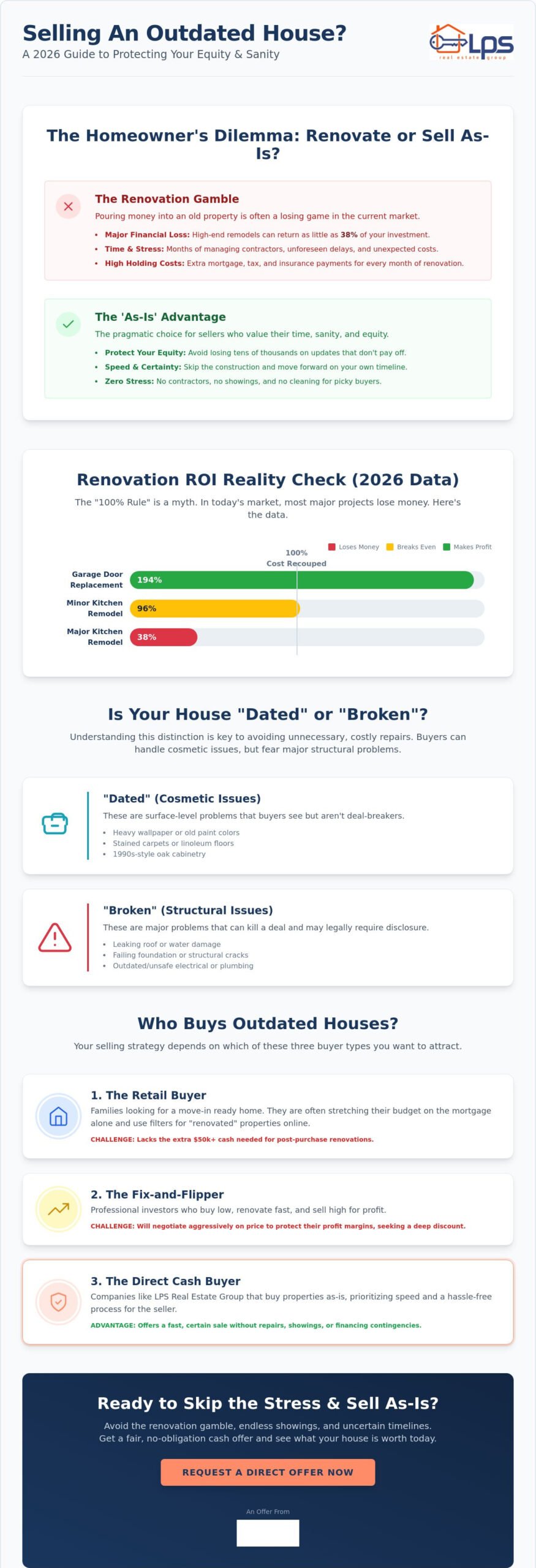
Evaluating home selling strategies for 2026 requires a cold look at current ROI trends. For example, while a garage door replacement can offer a staggering 194% return, major kitchen remodels are currently returning as little as 38% to 59%. If you spend $50,000 on a luxury kitchen, you might only see a $20,000 bump in your sale price. That’s a $30,000 loss you can’t get back. You also have to consider holding costs. With the average house taking 47 to 49 days to go under contract, adding three months of renovation time means three extra months of taxes, insurance, and mortgage interest.
The High Cost of Mid-Range Updates
Mid-range updates are a gamble. A minor kitchen remodel might net you a 96% return, but that still isn’t a profit. It’s just a smaller loss. There’s also the danger of “over-improving.” If your neighborhood features modest homes, a marble-clad master bath won’t raise your value; it will just make your house the most expensive one on the block. That is a notoriously difficult sell. If you want to avoid these financial traps, you can request a direct property assessment to see how your home stacks up without any changes.
The Advantages of Selling As-Is
Selling as-is removes the guesswork. It’s the most pragmatic choice for sellers who value their time and peace of mind. When you skip the renovation, you gain several key advantages:
- Speed: You can close in a matter of days rather than waiting months for permits and construction.
- Certainty: You won’t find expensive surprises like mold or faulty wiring hidden behind the walls mid-project.
- Simplicity: You don’t have to manage contractors, visit showrooms, or agonize over paint swatches.
- Liquidity: You keep your cash in your pocket instead of tying it up in a property you’re leaving.
The “renovation gap” is the real enemy. Every week spent fixing up an old house is a week you aren’t moving into your new one. Choosing how to sell a house that is not updated often comes down to protecting your equity from being swallowed by high labor costs and diminishing returns. Why take the risk when you can walk away with your equity intact?
How to Prepare an Outdated House for a Traditional Sale
Selling a house doesn’t always require a sledgehammer. If you’ve decided to list on the open market, you need a strategy that highlights value without draining your bank account. The goal is to maximize appeal while spending the absolute minimum. We call these “lipstick” fixes. They are high-impact, low-cost changes that help a buyer see past the 1980s wallpaper and focus on the structure.
Start with the basics. Deep cleaning and professional decluttering are non-negotiable. A spotless home feels well-maintained, even if the finishes are old. Remove the personality from the space. Pack away the family photos and the eccentric decor. You want the buyer to imagine their own life in these rooms. When considering how to sell a house that is not updated, remember that cleanliness is the cheapest and most effective form of staging.
Pricing is your most powerful tool. You cannot price your home against the fully renovated property down the street. Buyers are savvy. They will do the math on what it costs to update your kitchen and bathrooms. If you decide on selling a house as-is on the traditional market, your price must reflect the “sweat equity” a buyer will need to invest. Aim to be the best value in your price bracket, not the most expensive house in a lower one.
Low-Cost Updates That Actually Matter
Focus your energy where it counts. Fresh paint is your best friend. It’s the highest ROI project you can tackle. Stick to neutral tones like warm whites or soft greys to make the space feel larger. Lighting upgrades also make a massive difference. Swap out dated brass fixtures for modern black or brushed nickel LEDs. Finally, don’t ignore curb appeal. First impressions start at the sidewalk. Mow the lawn, trim the hedges, and consider a fresh coat of paint for the front door to welcome potential buyers.
Marketing the “Potential”
You aren’t just selling a house; you’re selling a vision. Use virtual staging in your online listing to show what the living room could look like with modern furniture and flooring. Your listing description should focus on “good bones,” “solid construction,” and “spacious layouts.” This specifically attracts first-time flippers and DIY enthusiasts who are looking for a project. Knowing how to sell a house that is not updated means finding the buyer who sees the diamond in the rough rather than just the rough itself.
The Direct Sale Alternative: Selling for Cash
Not every homeowner wants to deal with “lipstick” fixes or the circus of open houses. If you’re looking for how to sell a house that is not updated without the retail stress, a direct sale is the most streamlined option. Professional buyers don’t care about your 1970s shag carpet or the avocado-green appliances. In fact, they often prefer them. They see your “dated” property as a professional opportunity rather than a liability. While a traditional buyer sees work, an investor sees potential.
The traditional market is built for families who want turnkey homes. Direct sales are built for sellers who want speed and certainty. You skip the “Retail” headaches entirely. There are no weekend showings, no stressful inspections, and zero cleaning required. You don’t even have to take the trash out if you don’t want to. It’s a “take what you want and leave the rest” scenario. This eliminates the anxiety of wondering if a picky buyer will back out because of an old HVAC system or an un-modernized floor plan.
Why Direct Buyers Love Un-updated Homes
Investors look for “equity opportunities.” They have the crews and the capital to renovate at scale, which means they don’t need you to lift a finger. Your dated kitchen is a clean slate for them. They aren’t judging your taste; they’re calculating the potential of the square footage. LPS Real Estate Group specializes in this exact process. We evaluate the home’s bones and offer a price based on its current condition, stripping away the typical industry hurdles that slow down a traditional sale.
The Financial Benefits of a Direct Sale
Many sellers focus only on the gross sale price. That’s a mistake. You need to look at the net proceeds. In a traditional sale, you’ll likely lose 5.44% to 5.70% to realtor commissions. Then come the closing costs, repair credits, and the “holding costs” of taxes and utilities while the house sits for an average of 47 to 49 days. A direct sale eliminates these leaks. You pay zero commissions and no closing fees. The price we agree on is what you actually walk away with at the end of the transaction.
If you want to see the difference for yourself, you can get a fair cash offer today. It’s a no-pressure way to compare your options. You might find that the speed and simplicity of an as-is sale far outweigh the stress of trying to please a picky retail buyer. Knowing how to sell a house that is not updated means understanding that convenience has a very real financial value.
Making the Final Decision: Which Path Wins?
Deciding how to sell a house that is not updated shouldn’t feel like a gamble. It is a logical choice based on your current resources. You must weigh your available time against your financial goals. Are you looking to squeeze every possible dollar out of the sale, even if it takes six months of stress? Or do you value a fast, certain exit that lets you move on with your life? There is no single “right” answer, only the one that fits your specific needs.
Listing traditionally is often a mistake if you lack the budget or the patience for repairs. In a balanced market, buyers are less forgiving. They use “dated” features as leverage to demand deep discounts or expensive repair credits during the inspection period. You often end up doing the work anyway just to keep the deal alive. If you want to avoid the “retail” circus of strangers walking through your hallways and judging your kitchen, a direct sale offers the most peace of mind.
Your Decision Matrix
Use this simple framework to determine your next move. Your path depends on your liquidity and your moving timeline. Be honest about your tolerance for construction dust and contractor delays.
- The Cash Sale: Best if you have $0 for repairs and need to move within 2 to 3 weeks. It provides the highest level of certainty.
- The Traditional Sale: Only recommended if you have at least $20,000 in liquid cash and 6 months to wait for the right buyer.
- The Hybrid Approach: Tackling “lipstick” fixes if you have a few thousand dollars and 2 months, though this still carries the risk of buyer financing falling through.
Get Your Fair Cash Offer Today
If you’ve decided that the traditional route is too slow or too expensive, LPS Real Estate Group is here to help. We provide a transparent, straightforward alternative to the standard listing process. Our goal is to reduce the complexity of your move. We don’t ask for repairs, and we don’t require you to clean. You can expect a brief, no-pressure walkthrough followed by a fair offer based on the current condition of your home.
The best part? You choose the closing date. Whether you need to move in ten days or two months, we work around your schedule. We handle the paperwork and the logistics so you can focus on your next chapter. Get a fair cash offer for your un-updated home today and see how simple selling a house can actually be. You don’t have to navigate this market alone; we’re ready to provide the direct path you need.
Ready to Move Forward Without the Stress?
Selling an older property in 2026 doesn’t have to be a financial burden. You’ve seen that major renovations often fail to return your investment. You’ve also learned that the traditional market’s “move-in ready” trend can leave un-updated homes sitting for weeks. Understanding how to sell a house that is not updated is about choosing the path that protects your equity and your time. Why risk your savings on a renovation when you can walk away with a certain price today?
If you’re ready to skip the contractors and the constant cleaning, we’re here to help. LPS Real Estate Group offers a direct, pragmatic solution. You won’t pay any commissions or fees. We buy your property exactly as it stands; no repairs are ever needed. We can even close in as little as 7 days, allowing you to move on your own schedule. Take the first step toward a simpler sale right now.
Get a Fair, All-Cash Offer on Your House Today. You deserve a straightforward path that honors your home’s value without the typical industry hurdles.
Frequently Asked Questions
Can I sell a house that needs a lot of work without fixing it?
Yes, you can absolutely sell a house in its current condition without performing any repairs. Selling as-is is a common strategy for homeowners who want to avoid the stress and cost of renovations. Direct buyers, such as LPS Real Estate Group, specialize in purchasing properties regardless of their condition. This path allows you to bypass the traditional market’s demand for turnkey homes and move on quickly.
Is it better to lower the price or do the updates myself?
Lowering the price is often the more pragmatic choice. Major renovations in 2026 rarely return the full cost of the project; some upscale kitchen remodels return as little as 38%. By pricing the home competitively for its current state, you attract buyers looking for a project. This saves you from the financial risk of over-improving a property in a balanced market where buyers are highly sensitive to price.
What are the most important updates to do before selling?
Focus on high-impact, low-cost “lipstick” fixes if you choose to update. Fresh neutral paint and updated light fixtures provide the best return on your effort. Statistics show that a garage door replacement can offer a return of 194% or more. Avoid major structural or layout changes. These cosmetic improvements help a buyer see potential without requiring you to manage a massive construction budget.
Will a bank finance a buyer for a house that is not updated?
Banks will typically finance a buyer for an outdated house as long as it’s structurally sound and safe. Lenders care about habitability more than aesthetic trends. However, if the property has major issues like a failing roof or foundation, it might not qualify for traditional FHA or VA loans. In these cases, the pool of retail buyers shrinks significantly, making a cash sale a much more reliable option.
How much do investors usually pay for outdated houses?
Investors calculate their offer based on the property’s potential value after it’s fully renovated. They subtract the estimated cost of repairs and a margin for their risk and overhead. While the gross offer might be lower than a retail price, you must consider the net proceeds. You’ll save roughly 5.44% to 5.70% on commissions and avoid all closing costs, often resulting in a similar net gain.
Do I need to clean out my house before selling to a cash buyer?
No, you don’t need to clean or declutter when selling to a direct cash buyer. One of the biggest perks of an as-is acquisition is the “take what you want, leave the rest” policy. Whether you have old furniture, trash, or decades of accumulated items, the buyer handles the removal after closing. This is a massive time-saver for families managing inherited properties or those who simply need a fast exit.
How long does it take to sell an un-updated house for cash?
A direct cash sale typically closes in 7 to 14 days. Because there are no bank appraisals, mortgage approvals, or lengthy inspection negotiations, the timeline is significantly compressed. This is much faster than the 2026 market average of 47 to 49 days for traditional contracts. You get to choose the closing date that works for your schedule, providing a level of control that the open market can’t match.
What if my house has old wiring or plumbing along with the dated decor?
You can still sell a house with outdated systems, but you must be transparent about these issues. Learning how to sell a house that is not updated involves understanding your disclosure obligations. Many retail buyers will walk away from old wiring or plumbing, but professional investors view these as standard components of a renovation. Selling as-is ensures you aren’t forced to pay for expensive system overhauls just to reach the closing table.