

What if the biggest obstacle to moving on with your life isn’t a slow market or a dated kitchen, but a stranger living in your property who refuses to leave? It’s a situation that brings a unique kind of anxiety, leaving many owners feeling trapped by complex adverse possession laws and the fear of skyrocketing legal fees. You’ve worked hard for your home, and seeing it occupied by unauthorized guests can feel like a violation of everything you’ve built. If you’re wondering how to sell a house with squatters without the exhaustion of a multi-year eviction battle, you’re not alone, and you do have options.
We understand that you want a fast exit and a fair outcome without the burden of cleaning up someone else’s mess. This guide provides a compassionate path forward, showing you how to legally and safely transition your property into someone else’s hands. We’ll walk through the significant legal shifts of 2026, such as the new removal protocols in Texas and Illinois, while explaining how an “as-is” cash sale can transfer the entire legal burden away from you. You don’t have to wait for the courts to catch up to find the relief and compensation you deserve.
Key Takeaways
- Identify the critical legal differences between trespassers and squatters to determine the most efficient removal path under 2026 state laws.
- Evaluate the financial impact of adverse possession and property damage to decide if a traditional eviction or a direct sale is your best exit strategy.
- Learn the risks of “Cash for Keys” agreements and why these informal arrangements often lead to more stress than solutions for homeowners.
- Discover how to sell a house with squatters by opting for an “as-is” cash sale that transfers all legal and physical responsibilities to the buyer.
- Gather the essential documentation needed to facilitate a fast closing, allowing you to walk away with fair compensation without performing any repairs or cleanups.
Understanding the Challenge: What Is a Squatter in 2026?
Discovering that someone is living in your property without permission is a deeply unsettling experience. It often feels like a violation of your privacy and a threat to your financial security. While the legal definition of What Is a Squatter in 2026? remains focused on unauthorized occupation, the emotional reality for homeowners is far more complex. You might feel trapped by laws that seem to protect the occupant more than the owner, leading to constant anxiety over property damage or mounting legal fees. This psychological weight is exactly why many people look for a way out that doesn’t involve a years-long courtroom battle.
The legal landscape has shifted significantly this year. While adverse possession laws still exist, many states have introduced expedited removal processes to help owners regain control. In states like California, the timeline for a squatter to claim ownership is as short as five years, while in others like New Jersey, it can take thirty. Understanding these nuances is the first step in learning how to sell a house with squatters effectively. Knowing where you stand legally helps replace fear with a clear, actionable plan.
Squatters vs. Holdover Tenants
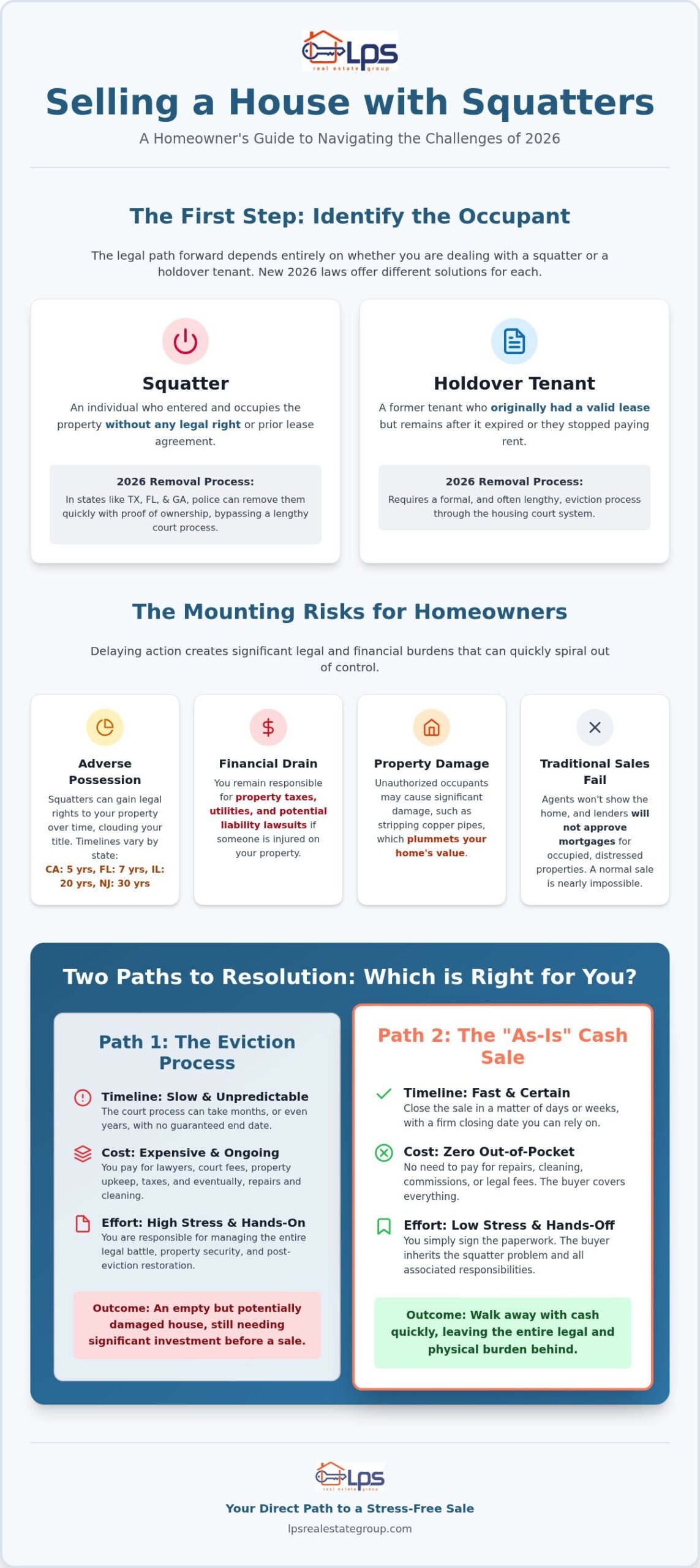
It’s vital to distinguish between a squatter and a holdover tenant because the path to resolution is different for each. A squatter is someone who entered the property without any prior legal right or lease agreement. In contrast, a holdover tenant is someone who originally had a valid lease but stayed after it expired or stopped paying rent. Recent 2026 reforms in states like Texas, Florida, and Georgia now allow police to remove true squatters quickly if you provide proof of ownership. However, holdover tenants usually require a formal eviction through the housing court system. Hostile possession refers to an individual occupying a property without the owner’s permission and in direct opposition to the owner’s legal rights.
Why Traditional Sales Fail with Squatters
If you’ve tried calling a local real estate agent, you might have been met with hesitation. Traditional sales rely on professional photography, open houses, and walkthroughs, all of which are impossible when an unauthorized person is living on the premises. Most agents don’t want the liability of bringing families into a potentially volatile situation. Additionally, traditional mortgage lenders almost always reject buyers looking at occupied, distressed properties because they can’t verify the home’s condition. This makes how to sell a house with squatters through the “normal” market nearly impossible. Retail buyers want a move-in-ready home, not a legal project, which is why a direct, as-is sale is often the most reliable path to a fast exit.
The Legal and Financial Risks of Selling a Squatter-Occupied Home
Selling a home with unauthorized occupants involves more than just finding a buyer. It requires managing several legal and financial risks that can complicate the transaction and your personal peace of mind. One of the most significant concerns is adverse possession. While timelines vary by state, such as 7 years in Florida or 20 years in Illinois, a long-term occupant can eventually cloud your title. This makes it difficult to prove clear ownership during a sale and can stop a traditional closing in its tracks. Understanding how to sell a house with squatters safely means acknowledging these potential title defects early in the process.
Financial strain adds another layer of difficulty for homeowners. Even though you aren’t receiving rent, you remain responsible for property taxes and often the utility bills if the services aren’t in the occupant’s name. If a squatter is injured on your property, you could face expensive liability lawsuits as the legal owner. There’s also the risk of physical damage. It isn’t uncommon for squatters to strip copper piping or damage expensive fixtures, which significantly lowers the home’s value before you can even list it. These mounting costs can quickly exceed the potential profit from a traditional sale.
Disclosure Requirements for Sellers
When you’re figuring out how to sell a house with squatters, honesty is your best legal defense. You must disclose the presence of unauthorized occupants to any potential buyer. Failing to do so can lead to lawsuits for misrepresentation after the closing, which is a headache no seller wants. “As-Is” contracts are particularly helpful in these scenarios. They ensure the buyer accepts the property exactly as it stands, including the occupants and any damage they’ve caused. This approach protects you from future claims regarding the home’s condition and ensures a transparent transition of ownership.
The Cost of the Eviction Alternative
Many owners consider evicting the squatters before selling, but the costs are often prohibitive. You’ll likely face thousands in attorney fees and court costs. In many jurisdictions, the process takes between 6 to 12 months for a sheriff-assisted removal. During this long wait, you’re still paying the mortgage and taxes on a property you can’t use. It’s a drain on both your bank account and your emotional energy.
Because of these hurdles, many homeowners find that a fair cash offer for house is the most logical path forward. It provides immediate liquidity and removes the legal headache from your shoulders entirely. If you’re feeling overwhelmed by these risks, reaching out for a transparent property assessment can help you see a way out that doesn’t involve months of litigation or further property damage.
Eviction vs. Direct Sale: Which Strategy Is Right for You?
Deciding how to move forward requires a careful look at your financial goals and your emotional bandwidth. You’re essentially choosing between two paths: spending time and money to regain control yourself, or selling the property as it stands to someone else who will handle the cleanup. For those who wish to explore professional management as an alternative to a direct sale, you can discover TBM Property Management for expert guidance on handling unauthorized occupants. While evicting the occupants might eventually lead to a higher retail sale price, the hidden costs of the legal process often eat away at those potential gains. When you’re weighing how to sell a house with squatters, it’s helpful to look at the return on investment for your time as much as your money.
Professional investors value properties with “tenants in place” by calculating the anticipated cost of eviction, legal fees, and repairs into their offer. This allows you to receive your equity immediately rather than gambling on a future sale date that might be six months or a year away. For many homeowners, the certainty of a closed deal today is worth more than the stress of a prolonged courtroom battle.
The DIY Eviction Path
If you choose to handle the eviction yourself, the process is strictly methodical. You must serve a formal notice to vacate, file an unlawful detainer lawsuit, and eventually obtain a writ of possession for a sheriff-assisted removal. This path carries a significant risk of “retaliatory damage.” Once squatters realize they’re being legally forced out, they may intentionally damage the home’s structure or systems out of spite. It’s also vital that you never attempt a “self-help” eviction. Changing the locks, removing doors, or shutting off utilities is illegal in every state and can result in you being sued by the squatter for thousands of dollars in damages.
The Direct Sale Path (The “Problem Transfer”)
The alternative is to treat the situation as a problem transfer. By working with companies that buy houses for cash, you effectively sell the legal headache along with the deed. These buyers are comfortable with the risk because they have the resources and legal teams to manage the removal process after the closing. You don’t have to wait for the house to be empty or spend a single dollar on repairs. This strategy allows you to maintain your equity and walk away with cash in hand, leaving the courtroom drama and the physical cleanup to the new owner. It’s a clean break that prioritizes your peace of mind and financial liquidity.
Step-by-Step: How to Prepare for a Sale with Squatters
Start by securing a preliminary title report through a local title company. This document confirms you have a clear right to sell and identifies any liens or claims that might have been filed against the property. Since you likely cannot allow an appraiser inside, use your most recent tax assessments and local “comps” of similar distressed properties to establish a baseline value. It is also helpful to explore Legal fees for real estate transactions and estate planning or consult with a professional about creative real estate exit strategies that prioritize speed and legal protection over traditional marketing methods.
A detailed history of the situation is one of your most valuable assets. Keep a chronological log of every interaction you have had with the occupants, including dates of any notices served and any police report numbers. If you need to assess the exterior condition of the home, do so safely from the sidewalk or with a witness present. You should avoid entering the home or stepping onto the porch without law enforcement or a professional partner. This boundary prevents potential physical altercations and protects you from false accusations of harassment or illegal “self-help” eviction attempts.
Evaluating Your Offers
When you receive interest in your property, it is important to distinguish between a fair offer and a predatory one. A fair, market-adjusted offer will account for the cost of future legal proceedings and repairs while still respecting your equity. Always request a “Proof of Funds” to ensure the buyer has the liquidity to close without waiting for traditional bank approval, which rarely happens for occupied distressed homes. Most importantly, ensure the purchase contract explicitly states that the buyer assumes all responsibility for the occupants and any legal actions required after the closing. This clause is what finally releases you from the stress of the situation.
If you are ready to stop managing the paperwork and start moving forward, you can request a straightforward property assessment to see how a direct sale could work for your specific circumstances.
How LPS Real Estate Group Solves the Squatter Problem
LPS Real Estate Group provides a specialized path for owners who are tired of the legal and emotional drain caused by unauthorized occupants. While most industry advice focuses on the long, expensive road of litigation, we offer a shortcut that prioritizes your relief. Our approach is built on a simple foundation: we take on the risk and the responsibility so you don’t have to. If you’re looking for how to sell a house with squatters without the stress of being an unwilling landlord or a legal clerk, our “As-Is” promise ensures you can close this chapter with confidence.
We believe in doing the right thing for every homeowner. Every individual’s circumstances are unique, and we listen first to ensure we’re providing the best possible outcome for your specific needs. By removing the need for real estate agents or traditional bank approvals, we offer a direct solution that puts you back in control of your financial future. Our commitment to empathy and transparency means you’ll always know exactly where you stand throughout the entire process.
A Stress-Free Handover
Choosing selling your house as-is with us means you never have to step foot in the property again. You don’t need to clean up after the occupants, perform repairs to meet retail buyer expectations, or engage in potentially dangerous interactions. We buy the property exactly as it stands today. Once the sale is finalized, we handle the entire legal eviction process using our own resources and experience. You walk away with cash and immediate liquidity, while the legal headache becomes our responsibility to solve. This transfer of burden is the ultimate exit strategy for those who value their time and safety.
Getting Your Fair Cash Offer
We’ve streamlined our acquisition process to be as transparent and low-stress as possible. You can receive a fair valuation and reach a closing in as little as 7 days. Our three-step process is designed for clarity:
- Initial Consultation: You share the details of your situation with us through a calm, one-on-one conversation where we listen to your goals.
- Property Valuation: We perform a comprehensive assessment using exterior views and current market data. We don’t need an interior inspection to make an initial offer, which protects you from unnecessary conflict with the squatters.
- Secure Closing: We close through a reputable, independent title company to ensure every legal detail is handled with absolute integrity.
This methodical approach mirrors our commitment to transparency, ensuring you feel fully informed at every stage of the narrative. You don’t have to wait for the courts to find the relief you deserve.
Reclaim Your Peace of Mind and Your Financial Future
Reclaiming your property from unauthorized occupants doesn’t have to be a lifelong battle. While the legislative updates of 2026 have introduced criminal penalties for squatting in several states, the reality of a traditional sale remains fraught with delays and liability. By choosing an “as-is” acquisition, you bypass the courtroom and the physical cleanup entirely. You’ve learned that documenting the situation and securing your title are vital first steps, but the ultimate solution is often a direct transfer of the problem to a professional buyer.
Knowing how to sell a house with squatters gives you the power to choose a path that prioritizes your mental health and financial stability. At LPS Real Estate Group, we’re specialists in these complex situations. We provide fast, transparent closings with no hidden fees and handle the entire legal eviction process after the sale is complete. Our team has deep expertise in resolving complex title and occupancy issues, ensuring you receive a fair outcome without the usual stress. You deserve a partner who listens and acts with integrity.
Get a Fair Cash Offer and Leave the Squatter Problem Behind
It’s time to stop worrying about what’s happening behind your property’s closed doors. You have the tools and the support to move forward today.
Frequently Asked Questions
Can I legally sell a house with squatters still inside?
You can legally sell your property even if unauthorized occupants are currently living there. As the owner of record, you have the right to transfer the deed to a new party at any time. When you choose a direct sale to an investor, you are essentially selling the property along with the legal challenge of removing the occupants. This is a common solution for those wondering how to sell a house with squatters without the stress of a long court battle.
Will a bank give a mortgage to someone buying a house with squatters?
Traditional mortgage lenders almost always refuse to finance a home that is occupied by squatters. Banks require an interior appraisal and a clear possession status to ensure their investment is protected. Since a retail buyer cannot safely inspect or move into the home, these properties are typically ineligible for standard loans. This is why most sales involving squatters are handled through cash acquisitions or creative finance solutions rather than the traditional market.
How much value does a squatter take off a home’s sale price?
The impact on your home’s value is determined by the estimated cost of the legal eviction and the physical repairs needed afterward. Buyers who take on this risk calculate the time cost of a 6 to 12 month legal process and the potential for retaliatory damage to the property’s systems. While the reduction in price can be significant, it often mirrors the out-of-pocket expenses you would have faced if you attempted to resolve the situation yourself before selling.
What is the fastest way to get squatters out so I can sell?
In states like Texas and Illinois, new 2026 laws allow for immediate law enforcement removal if you provide proof of ownership. However, if your state still requires a civil process, the fastest way to move on is to sell the property as-is to a cash buyer. This allows you to receive your equity in as little as 7 days, while the new owner takes over the responsibility of the legal removal process through the courts.
Do I need to hire a lawyer before selling to a cash buyer?
You aren’t legally required to hire a personal attorney to sell your home to a cash buyer. Professional investment firms like LPS Real Estate Group use reputable, independent title companies to ensure the deed transfer is handled with absolute integrity. While you should always feel free to seek legal advice, a direct sale is designed to be a streamlined process that removes the need for you to manage complex litigation or ongoing courtroom appearances yourself.
What happens if the squatters damage the house after I sign the contract?
If you sign an as-is purchase agreement, the buyer typically assumes the risk of the property’s condition from that point forward. At LPS Real Estate Group, our promise is to buy the house exactly as it stands, regardless of what the occupants do to the interior. We understand the volatility of these situations and ensure our contracts protect you from being held responsible for damage that occurs during the transition period or the final closing.
Can squatters claim ownership of my house if I try to sell it?
Squatters can only claim legal ownership through adverse possession if they have occupied the property openly and continuously for a specific number of years. In 2026, these timelines range from 5 years in California to 30 years in New Jersey. Simply trying to sell your house does not give them a claim to the title. However, their presence can cloud the title, making it essential to work with a buyer who understands how to sell a house with squatters safely.