

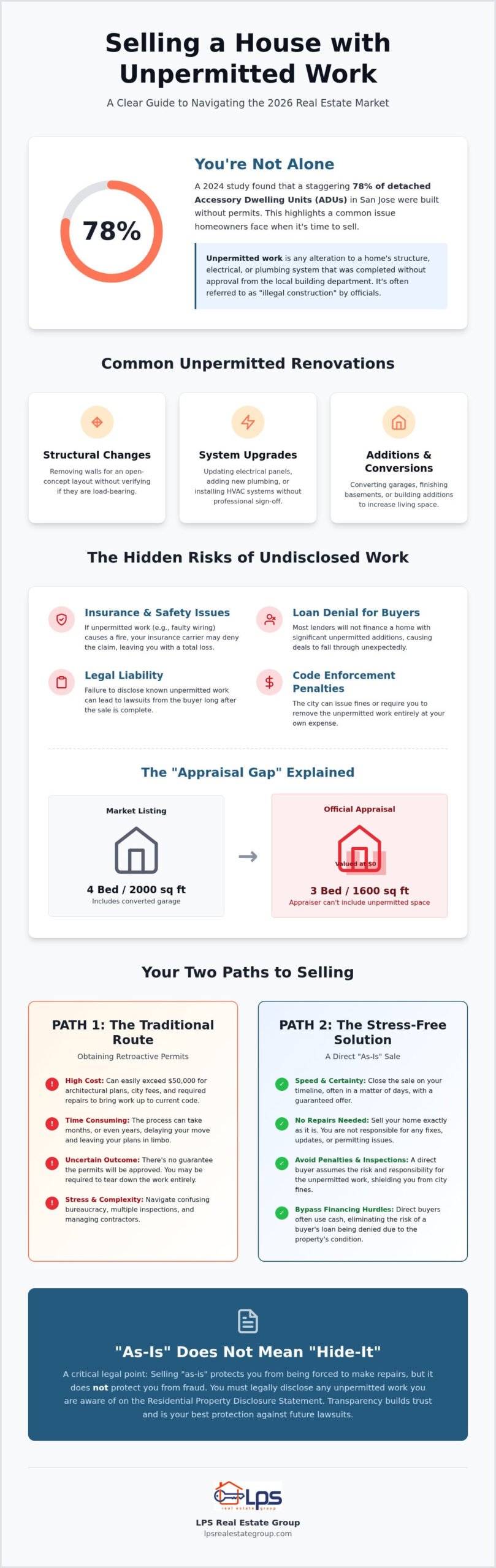
A 2024 study in the Journal of the American Planning Association revealed that 78% of detached Accessory Dwelling Units built in San Jose were unpermitted. If you’re currently wondering how to sell a house with unpermitted work, you’re certainly not alone. It’s completely understandable to feel a sense of anxiety about buyers backing out after an inspection or the fear of being sued long after the papers are signed. You might even feel stuck, caught between the confusion of local building department penalties and the rising costs of retroactive permits that can easily exceed $50,000 for major additions.
We believe that a past renovation shouldn’t stand in the way of your next chapter. This guide will help you understand the latest 2026 disclosure requirements and provide a clear path to selling your home with confidence and certainty. You’ll discover how to navigate legal hurdles without spending thousands on repairs you didn’t plan for. We’ll look at the current trends in buyer transparency and explain how an as-is sale can help you avoid the stress of a traditional listing falling through.
Key Takeaways
- Identify which renovations, from finished basements to electrical updates, qualify as unpermitted and how they impact your home’s marketability in today’s transparent real estate environment.
- Master the legal essentials of how to sell a house with unpermitted work by using clear disclosures that build trust with buyers without inviting unnecessary liability.
- Learn why traditional financing often fails for homes with unpermitted additions and how to navigate the “appraisal gap” that leaves many sellers frustrated.
- Compare the time-consuming process of obtaining retroactive permits against the speed of an as-is sale to see which path fits your timeline and budget best.
- See how a direct as-is acquisition can remove the stress of code enforcement penalties and inspections, providing a simple way to move forward without the burden of repairs.
What Is Unpermitted Work and Why Does It Matter in 2026?
Any change to a home’s structure, electrical system, or plumbing that didn’t receive the green light from the local building department falls into this category. In professional circles, this is often labeled as Illegal construction. While that sounds like a harsh term for a DIY deck or a finished basement, it’s the reality city inspectors and lenders use to evaluate your property. If the work was done without a permit, it hasn’t been verified for safety or compliance with local codes.
By 2026, the days of “buyer beware” have largely shifted toward extreme digital transparency. Many cities have launched free, map-based online tools, such as the “Permit View” system, which allow anyone to search for building, planning, and code enforcement activity by address. Buyers and their agents check these records before they even step inside. If the square footage on the listing doesn’t match the city records, red flags go up immediately. This makes learning how to sell a house with unpermitted work more vital than ever.
A standard real estate transaction usually requires a valid Certificate of Occupancy (CO). This document proves the home is safe to live in. If unpermitted work is discovered during an inspection, the city might revoke the CO. This makes the home legally uninhabitable and virtually impossible to finance through traditional banks, as lenders won’t risk their capital on a property that doesn’t meet basic safety standards.
Common Types of Unpermitted Renovations
Most homeowners don’t set out to break the rules. You might have inherited a previous owner’s projects or simply didn’t realize a permit was needed for a specific upgrade. These are the most frequent issues we see:
- Structural changes: Removing a wall to create an “open concept” floor plan without verifying if it’s load-bearing.
- Systems: Upgrading an electrical panel, adding a bathroom, or installing a new HVAC system without a licensed professional’s sign-off.
- Additions: Converting a garage into a bedroom or finishing a basement to increase living space.
These changes affect both safety and value. This is where the question of how to sell a house with unpermitted work starts to get complicated, as these modifications can lead to significant appraisal gaps.
The Legal Reality of “As-Is” Sales
There’s a common myth that selling “as-is” means you don’t have to talk about the unpermitted patio. That’s simply not true. State laws in places like Texas and California require you to complete a Residential Property Disclosure Statement. You must be honest about any modifications you know were made without permits.
There is a legal difference between “not knowing” about work done by a owner decades ago and “intentional concealment” of a project you finished recently. If you’re aware of the work, you must disclose it. An “as-is” clause protects you from being forced to make repairs, but it doesn’t protect you from fraud claims if you hide known issues. Being transparent is the only way to protect yourself from future litigation.
The Hidden Risks of Selling a House with Unpermitted Additions
This brings us to the “appraisal gap.” A professional appraiser is often prohibited from including unpermitted square footage in their valuation. If you listed your home as a four-bedroom but the city only recognizes three, the appraiser will value that fourth room at zero. This forces the buyer to either come up with more cash or walk away from the deal. Even in international hubs where property standards are strictly enforced, professional valuation experts such as Winfields Surveyors London provide the detailed assessments necessary to understand a property’s true market standing when modifications are present. Insurance companies are also using permit data to assess risk. If an unpermitted electrical panel causes a fire, your carrier may refuse to pay the claim, leaving you or the new owner with a total loss.
Traditional buyers often feel a deep sense of anxiety when they discover unpermitted work during an inspection. They worry about “unknown” costs or the possibility of the building department issuing an order to demolish the addition. In 2026, buyers are more likely to demand massive price credits to cover the potential cost of retroactive permitting. Disclosure is legally required, and failing to be upfront can lead to the deal falling through at the eleventh hour. If the stress of these negotiations feels overwhelming, an as-is property acquisition might be a more reliable path forward.
Municipal and Tax Implications
Inviting an inspector to your property to fix a small issue can sometimes open a “can of worms.” Once the building department is on-site, they may flag other non-compliant work, leading to municipal fines. The permit trail is the primary tool used by 2026 title companies to flag issues. Additionally, some cities now charge penalties equal to the standard permit fee for construction discovered without a permit, effectively doubling your costs. You may also face retroactive property tax assessments for the years the unpermitted square footage went untaxed.
Fixing vs. Disclosing: Evaluating Your Selling Options
When you realize your home has non-compliant modifications, you face a crossroads. Deciding how to sell a house with unpermitted work involves balancing your need for a high sale price against your need for a guaranteed closing. Most homeowners find themselves choosing between three distinct paths. Each has a different impact on your wallet and your stress levels.
The first path is obtaining retroactive permits. While this is often called the “right” way, it’s rarely the easiest. The second path involves listing the home on the open market and disclosing everything. This is often the “risky” way because it depends on finding a buyer and a lender willing to overlook the paperwork gaps. The third path is selling to a direct cash buyer. This is the “fast” way, designed for those who want to move on without the burden of repairs or legal red tape.
The True Cost of Retroactive Permitting
Many people assume getting a permit after the fact just requires paying a fine. In 2026, the process is far more involved. You’ll likely need to hire professionals for architectural drawings and engineering reports to prove the work meets current safety standards. These professional fees add up quickly before you even pay the city’s penalties.
The most stressful part is often the “destructive testing” requirement. Inspectors may demand that you open up finished walls or ceilings to verify the wiring and plumbing behind them. This can turn a simple paperwork fix into a secondary renovation project. Combined with municipal backlogs, the timeline for this process often stretches between 3 and 6 months. If you’re in a hurry to move, this delay can be a deal-breaker.
Market Comparison: MLS vs. Direct Sale
Comparing selling your house as-is to a traditional listing reveals a significant “certainty factor.” On the MLS, you’re at the mercy of appraisals and bank approvals. If the unpermitted work is structural, most traditional buyers won’t be able to get a mortgage. This leads to a smaller pool of potential buyers and a higher chance of the sale collapsing after weeks of waiting.
Direct cash offers from professional investment groups are often the only viable path for homes with major unpermitted additions. These buyers don’t require bank appraisals or municipal sign-offs before closing. This path eliminates the risk of a deal falling through at the last minute, providing a clean break from the property. There are several options for selling a house with unpermitted work, but for many, the direct sale offers the most peace of mind. You trade a bit of potential market value for the absolute certainty that the house is sold today.
How to Disclose Unpermitted Work to Protect Yourself Legally
Transparency is your best defense against future litigation. When you’re figuring out how to sell a house with unpermitted work, the Residential Property Disclosure Statement is the most important document you’ll sign. This form is a standard requirement in most states. It’s designed to give buyers a clear picture of the home’s condition before they commit. You must list every known modification that lacks a permit. Relying on a verbal mention during a walkthrough is never enough. If it’s not in writing, it simply doesn’t exist in the eyes of a legal professional.
To make this process smoother, gather any documentation you still have. Even if the work was done by a previous owner, you should disclose what you know. Having this history shows you’re acting in good faith and builds a bridge of trust with the buyer. Try to collect:
- Names of contractors or tradespeople who performed the work.
- Approximate dates or seasons when the projects were completed.
- Invoices or receipts for materials used during the renovation.
- Any previous inspection reports that might mention the work.
Drafting the Disclosure
When you’re writing your disclosure, stick strictly to the facts. Be specific about what was done and when. For example, instead of saying “the basement was finished,” write “the basement was converted into living space in 2018 without a municipal building permit.” Avoid making claims about the “quality” or “safety” of the work. Using subjective terms like “up to code” or “professional grade” can actually increase your liability if a problem arises later. Your job is to report the lack of a permit, not to certify the engineering.
Consulting Professional Help
If you’re feeling overwhelmed by the legal language, involving a real estate attorney is a wise move. They can review your disclosure to ensure it meets state-specific requirements. This step is about protecting your equity by avoiding post-sale lawsuits that could cost you thousands. Another reliable path is accepting a fair cash offer for your house. Professional buyers specialize in these situations. They accept the property’s history as part of the transaction, which significantly reduces your long-term risk.
If you want to skip the stress of drafting complex legal disclosures and dealing with traditional buyer demands, we can help. You can request a straightforward cash offer that accounts for any unpermitted work on your property today.
The Stress-Free Solution: Sell Directly to LPS Real Estate Group
Finding a path forward when you have non-compliant modifications can feel like an uphill battle. We understand that life happens, and sometimes renovations get finished without every box being checked at the city office. At LPS Real Estate Group, we specialize in as-is property acquisitions. We specifically focus on homes with unpermitted work, code violations, or complex structural issues. Our goal is to provide a sense of relief to homeowners who feel stuck in the “permit trap” described earlier in this guide.
When you work with us, the traditional roadblocks simply disappear. Because we use direct cash purchases, we eliminate the need for bank appraisals. This means the “appraisal gap,” where an inspector values your unpermitted room at zero, is no longer a concern. You won’t have to worry about lenders rejecting a mortgage or the deal falling through at the eleventh hour. We provide the liquidity you need to move on, regardless of the property’s permit history or current condition.
Our “As-Is” Commitment
We believe you shouldn’t have to spend thousands of dollars on retroactive permits or destructive testing just to sell your home. When we buy your property, we take on the full burden of permitting and bringing the work up to code after the sale is complete. You walk away with cash and the peace of mind that the legal and structural responsibilities are now in our hands. This is a transparent process designed specifically for certainty in 2026.
Our commitment to doing the right thing means we handle the “can of worms” that often scares away traditional buyers. You won’t need to hire architects for retroactive drawings or deal with municipal fines. We listen to your circumstances and handle every detail with integrity, ensuring you feel respected at every stage of the narrative.
Getting Started with Your Offer
If you’re still weighing how to sell a house with unpermitted work, we invite you to request a no-obligation evaluation of your property. Our team will listen to your specific situation and provide a clear, manageable path forward. We move at your pace. If you’re in a hurry, we can often close and put cash in your hands in as little as 7 days. You don’t have to deal with the stress of a traditional listing or the fear of a buyer backing out after a difficult inspection.
Get your fair cash offer today and leave the permit stress behind. We’re here to be your partner in finding the best outcome for your unique circumstances, allowing you to sell with quiet confidence.
Moving Forward with Confidence and Clarity
You’ve explored the legal realities and financial risks that come with non-compliant home improvements. Whether it’s a finished basement or a structural change, the key to a successful transaction is transparency and choosing the right path for your timeline. You now understand that while retroactive permits are an option, they often involve significant time and expense that may not fit your goals. Learning how to sell a house with unpermitted work doesn’t have to be a source of constant anxiety.
By following the disclosure steps we’ve discussed, you protect yourself from future liability and ensure a fairer transition. We’re here to help you bypass the traditional hurdles of bank appraisals and public permit searches. As specialists in as-is property acquisition with a national reach, we focus on homeowner transparency and simple solutions. We’re ready to take on the burden of code issues so you don’t have to spend another day worrying about the “permit trap.”
Request a fair cash offer for your house today and let us handle the complexities of your property’s history. You deserve a clear path forward and a fresh start without the weight of past renovations holding you back.
Frequently Asked Questions
Can a buyer sue me after the sale for unpermitted work?
A buyer can pursue legal action if they prove you intentionally concealed the work. Most real estate contracts require a full disclosure of known issues. If you fail to mention a finished attic or a moved wall, it’s considered misrepresentation. This is why being honest on your disclosure forms is vital. It creates a clear record of the home’s state. When you disclose everything, the buyer accepts the property with full knowledge, which protects you from future liability.
Will unpermitted work show up on a title search?
Standard title searches usually focus on ownership and liens rather than building permits. However, if the city has filed a formal code violation against the property, it will show up as a cloud on the title. In 2026, many title companies have started cross-referencing permit databases to flag inconsistencies. This extra layer of scrutiny helps buyers avoid inheriting safety issues. If a violation is found, it must be cleared before the title can transfer. If you are struggling with a clouded title or a municipal lien, you can discover Property Lien Group for specialized assistance in resolving these property issues.
The most reliable way is to contact your local building department. Most cities now offer digital portals where you can search the permit history of any address. You can compare these records to the physical features of your home. If the records show a two-bedroom house but you’re living in a three-bedroom, that extra room is likely unpermitted. Professional home inspectors can also help identify work that looks like it bypassed the standard permit process.
Can I get a retroactive permit after the work is already finished?
You can apply for a “permit after the fact,” but the process is often more expensive than the original permit. The city will charge penalties, and an inspector will need to verify the work. This often requires opening up walls to check wiring or plumbing, which is known as destructive testing. If the work doesn’t meet current 2026 codes, you’ll have to pay for repairs before the permit is granted. It’s a thorough but costly solution.
What happens if I sell a house and dont disclose unpermitted work?
Failing to disclose is a significant risk that often leads to litigation. If the buyer discovers the issue before closing, the deal will likely collapse or require a massive price credit. If they find out after moving in, they could sue you for the cost of bringing the home up to code. Honesty is the best policy. It’s better to accept a lower offer now than to pay for expensive legal defense fees later.
Is it illegal to sell a house with unpermitted work?
It’s perfectly legal to sell a home with unpermitted modifications as long as you’re transparent about it. The illegality arises when you hide the information to trick a buyer. Some traditional lenders might refuse to provide a mortgage for these properties because they represent a higher risk. This is why many people look for how to sell a house with unpermitted work through cash buyers. We accept the property in its current state, paperwork and all.
Will an appraiser count an unpermitted bedroom in the square footage?
Appraisers generally exclude unpermitted square footage from their final valuation. They rely on municipal records to verify the home’s layout. If your finished basement doesn’t have a permit, the appraiser will likely give it zero value in the report. This can cause the buyer’s loan to be denied if the appraisal comes in lower than the purchase price. It’s one of the most common reasons why traditional sales fall through when unpermitted work is involved.
Can I sell my house to a cash buyer if I have active code violations?
Yes, you absolutely can. We specialize in resolving complex real estate situations, including active code violations and unpermitted additions. When you sell to us, we handle the city inspectors and the permit paperwork after the closing. This allows you to skip the stress and move on with your life. It’s a streamlined alternative for anyone wondering how to sell a house with unpermitted work without the burden of costly repairs or municipal fines.