

What if the auction date on your calendar wasn’t an inevitable deadline, but a final window to secure a better exit? It’s common to feel paralyzed by the fear of losing your home or the anxiety of seeing your credit destroyed. You might feel overwhelmed by aggressive debt collectors and legal jargon that seems designed to confuse you. However, even when time is short, learning how to stop a foreclosure auction is possible through decisive action and the right strategy.
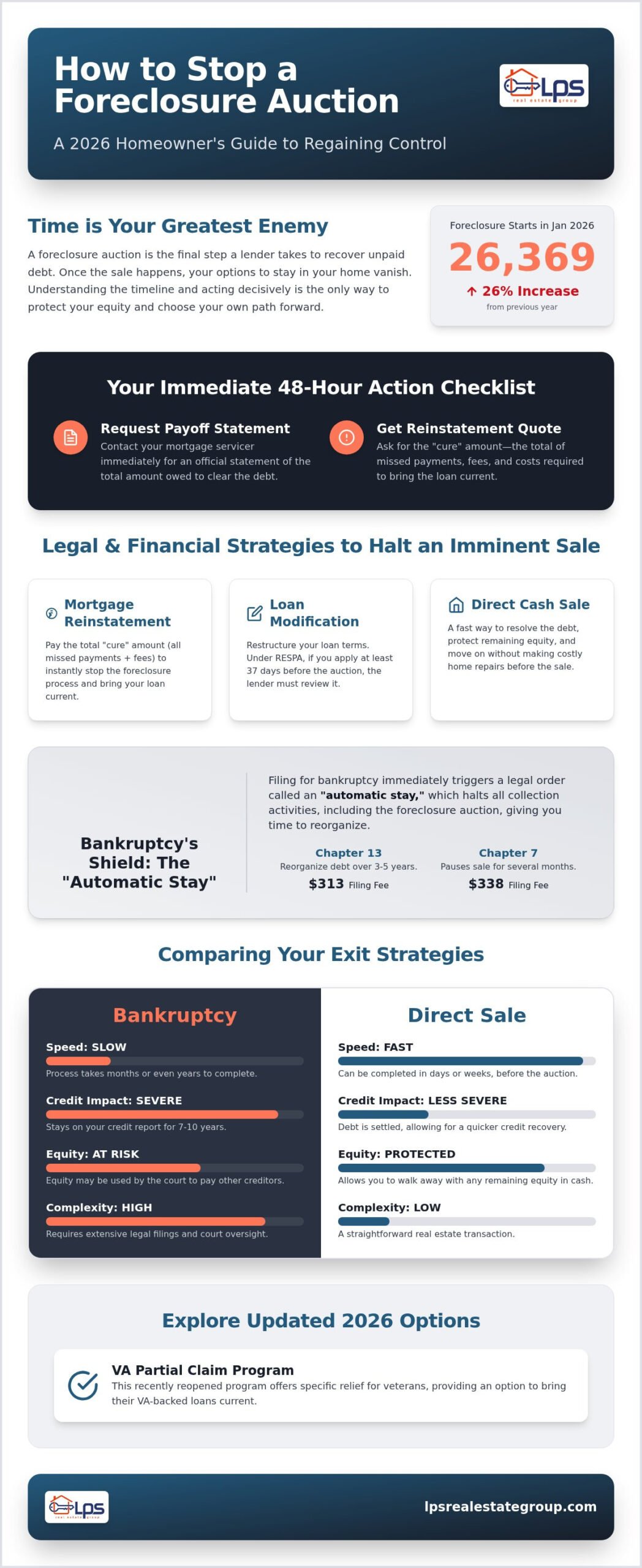
We know you want to protect your equity and find a dignified way to move forward. This 2026 guide cuts through the noise to show you exactly how to regain control of your situation. We’ll outline the legal protections available to you, including the 37-day RESPA loss mitigation rule and the recently reopened VA Partial Claim Program. By the end of this article, you’ll see the options available to discuss with professionals so you can halt the sale and choose the path that fits your life best.
Key Takeaways
- Act immediately within the first 48 hours to request an official payoff statement and reinstatement quote from your mortgage servicer.
- Discover the specific legal and financial steps for how to stop a foreclosure auction, including the 37-day RESPA loss mitigation rule and the automatic stay.
- Compare the long-term impact of bankruptcy versus a direct foreclosure prevention purchase to determine which path best protects your credit and remaining equity.
- Explore updated 2026 options such as the VA Partial Claim Program, which offers specific relief for veterans to bring their loans current.
- Learn how a direct cash sale allows you to resolve the debt quickly and move forward without the burden of making costly home repairs.
What is a Foreclosure Auction and Why is Time the Enemy?
A foreclosure auction is more than a legal formality; it’s the final step a lender takes to recover unpaid debt. In January 2026 alone, lenders started foreclosure on 26,369 properties across the country, marking a 26% increase from the previous year. To understand What is Foreclosure? at its most basic level, you must view it as the point where the property title transfers from you to the highest bidder. Time is your greatest enemy because once that gavel falls, your options to stay in the home vanish. Depending on where you live, the process might be judicial, requiring a court order, or non-judicial, which moves much faster. Knowing the specific timeline of your state is the first step in learning how to stop a foreclosure auction before it’s too late.
The “Point of No Return” isn’t the same for everyone. In some states, you have until the moment the auction begins to pay your arrears. In others, you might have a short window after the sale to reclaim the property. Waiting until the final hour is a high-stakes gamble. The emotional toll of this uncertainty can be paralyzing. You’re dealing with aggressive debt collectors and the constant fear of homelessness, which makes clear decision-making difficult. You should always discuss these timelines with a legal professional to ensure you don’t miss a critical filing date.
The Mechanics of the Auction Gavel
While some sales still occur on courthouse steps, many have moved to online portals in 2026. Platforms like auctionproperty.co.uk demonstrate how residential and commercial properties are now presented to bidders in these digital environments. The lender sets an opening bid. This amount usually covers the total loan balance plus any legal fees and interest. If no one outbids the lender, they take back the property as Real Estate Owned (REO). Some homeowners bank on the Right of Redemption to save them after the sale. This is risky. It often requires paying the entire loan balance in cash, which is difficult for anyone already in financial distress.
Many people believe the myth that the bank doesn’t want their house. While it’s true banks prefer cash to real estate, they will take the house to clear the debt. In 2026, with 30-year mortgage rates averaging 6.71%, lenders are moving more aggressively to resolve non-performing loans. Another danger is ostrich syndrome. Ignoring the stacks of mail won’t stop the clock. It only ensures you miss the deadlines for loss mitigation. Understanding how to stop a foreclosure auction requires you to face the situation head-on with transparency and speed. An as-is purchase or a direct cash offer can often be a faster way to resolve the debt before the auction date arrives.
Legal and Financial Strategies to Halt an Imminent Sale
When you’re facing a deadline, generic advice like “call your bank” can feel frustratingly vague. You need specific tools that carry legal weight. One of the most direct methods for how to stop a foreclosure auction is mortgage reinstatement. This involves paying the “cure” amount, which is the total of all missed payments plus late fees and lender legal costs. While difficult for many, finding these funds through a bridge loan or government programs and housing counselors can stop the process instantly. If staying in the home isn’t feasible, a “Deed in Lieu of Foreclosure” allows you to voluntarily hand over the property to the lender. This avoids the public auction and often results in less damage to your credit than a forced sale.
Loan modifications are another common path, but they require a proactive approach. Under federal RESPA guidelines, if you submit a complete loss mitigation application at least 37 days before the auction, the lender must review it before proceeding. If you’re closer to the date than that, a foreclosure prevention purchase might be a more realistic way to settle the debt quickly and protect your remaining equity. This strategy focuses on speed and transparency to ensure the lender is paid before the gavel falls.
The Automatic Stay: Bankruptcy as a Shield
Filing for bankruptcy is a serious decision that immediately triggers an “automatic stay.” This legal order halts all collection activities, including the auction, the moment you file. Chapter 13 bankruptcy allows you to reorganize your debt and catch up on payments over three to five years. In 2026, the court filing fee for Chapter 13 is $313. Alternatively, Chapter 7 bankruptcy, which has a $338 filing fee, can pause the sale for several months. While these filings are effective for how to stop a foreclosure auction, they have long-term credit implications that you should discuss with a legal professional before proceeding.
Stopping “Dual Tracking” Violations
A common but illegal practice is “dual tracking.” This happens when a mortgage servicer continues with the foreclosure process while simultaneously reviewing your application for a loan modification. Federal rules are clear; lenders cannot move toward an auction if a complete loss mitigation application is pending. If you suspect this is happening, you must flag the violation to your lender’s legal department immediately. Providing proof that your application was submitted more than 37 days before the sale can be a powerful way to secure a stay of the auction. This level of early intervention is your best defense against an aggressive lender.
Comparing Your Exit Strategies: Bankruptcy vs. Direct Sale
Many homeowners are told that filing for bankruptcy is the only way to halt a sale at the eleventh hour. While it’s a powerful legal tool, it’s essentially a court battle that can last months or years. In contrast, a direct sale focuses on an immediate exit. Speed is your primary weapon when you’re learning how to stop a foreclosure auction. A direct sale can often close in just a few days, whereas bankruptcy requires ongoing legal oversight and strict adherence to a court-mandated payment plan. The stress of a private, transparent sale is often much lower than the public nature of a court proceeding.
Choosing your path also involves looking at your long-term financial health. A foreclosure on your credit report is a significant blow. Selling the home to a direct buyer allows the debt to be marked as “Paid in Full” or “Settled.” This preserves your ability to qualify for new housing much sooner. Additionally, because you avoid the mounting interest of a long legal battle and the fees associated with a public auction, you’re more likely to walk away with whatever equity is left in the property. It’s about securing the most dignified exit possible under pressure.
Why a Direct Foreclosure Prevention Purchase Works
Traditional home sales through an MLS listing are often too slow to beat an auction date. A foreclosure prevention purchase removes these delays entirely. You won’t need to worry about finding an agent or making expensive repairs that you likely can’t afford right now. Direct buyers specialize in as-is property acquisition. They work directly with your lender to verify payoff amounts and ensure the auction is canceled because the debt is being satisfied through a certain, fast-closing transaction.
Creative Finance: A Modern Alternative
If you have little to no equity, a standard sale might not cover the loan balance. This is where creative finance solutions become valuable. Strategies such as “Subject-To” allow a buyer to take over your mortgage payments directly. This stops the foreclosure, saves your credit from the “Foreclosure” status, and provides a path forward when traditional options fail. Transparency is the most important part of these transactions. Every individual’s circumstances are respected, and the goal is always a collaborative effort to find the best outcome for your specific situation.
Immediate Action Steps: Your 48-Hour Auction Checklist
When you’re only 48 hours away from a sale, the luxury of waiting for a backlogged housing counselor is gone. You need a clear, hour-by-hour plan to protect your interests. This window is often the most stressful period for any homeowner, but it’s also a time where decisive action can still change the outcome. Following a structured checklist helps replace panic with a logical path forward. If you’re wondering how to stop a foreclosure auction at the last minute, these five steps are your primary defense.
- Verify the exact time and location: Don’t assume the details from your first notice are still accurate. Auctions in 2026 are frequently moved to online portals or different courthouse rooms. Confirming these details ensures you or your representative are looking at the right clock.
- Request an “Official Payoff Statement” and “Reinstatement Quote”: You can’t resolve a debt if you don’t have the exact “cure” amount in writing. Call your mortgage servicer’s loss mitigation department and demand these documents via email immediately.
- Consult with a direct home buyer: Getting an immediate valuation on your property gives you a baseline for your equity. A cash offer for your home can often be used as proof of a pending sale to convince a lender to pause the auction.
- Decide between legal intervention or a strategic sale: At this stage, you must choose your lane. You’re either filing for bankruptcy to trigger an automatic stay or executing a fast-closing sale to pay off the debt in full.
- Notify the lender’s attorney: Once you have a plan, call the law firm representing the lender. Provide them with your bankruptcy case number or your signed purchase agreement to show that a resolution is active.
Gathering Your Essential Documentation
Having your paperwork ready is vital for any last-minute negotiation. You’ll need your most recent mortgage statement and the last two years of tax returns to prove your financial standing. If you’re working with a professional buyer, you’ll also need a signed “Letter of Authorization.” This document allows them to speak with your lender on your behalf. Finally, prepare a concise “Hardship Letter” that explains your situation with honesty. This humanizes your case when a lender is deciding whether to grant a final extension.
Communicating with the Trustee
It’s important to distinguish between your bank and the party actually selling the house. The Trustee is the legal entity conducting the sale for the lender. While the bank owns the debt, the Trustee or Sheriff manages the auction logistics. You must contact their office to confirm if a sale has been “Postponed” or “Cancelled” after you’ve reached an agreement with the lender. A postponement simply moves the date, while a cancellation removes the auction from the schedule entirely, giving you more breathing room to finalize your exit.
Finding Certainty with LPS Real Estate Group
LPS Real Estate Group operates on a foundation of professional authority and deep empathy. We understand that the pressure of a looming auction date creates a unique type of stress that most people aren’t prepared to handle. Our goal isn’t to push you into a quick decision, but to listen first and provide a sense of relief through transparent, reliable information. We’ve seen how the right strategy for how to stop a foreclosure auction can change a person’s future, and we aim to be the partner that helps you find that path.
Providing immediate liquidity through cash home buying is one of our primary tools for helping homeowners. When you’re looking for how to stop a foreclosure auction, speed is often the most important factor. A direct foreclosure prevention purchase allows us to work with your lender to satisfy the debt before the sale occurs. This isn’t a high-pressure tactic; it’s a straightforward solution designed to give you a clean break and protect whatever equity you’ve built in your property. We focus on a collaborative effort to find the best outcome for your specific financial situation.
Moving Forward with Dignity
We specialize in as-is property acquisition, which means you don’t have to worry about the cost or stress of major repairs before selling. Many homeowners feel trapped because their property isn’t “market ready,” but we see the value in every home regardless of its condition. By choosing a private sale, you avoid the public spectacle of the courthouse steps and maintain your privacy. Our process is methodical and patient, ensuring you feel fully informed at every stage of the narrative. Getting a fair offer is the first step toward stopping the clock and regaining your peace of mind.
A Partner in Complex Situations
Our experience extends beyond standard foreclosures into complex areas like probate and inherited property buyouts. We focus on doing the right thing for the homeowner, even if that means suggesting creative finance solutions for low-equity situations. Every individual’s circumstances are respected and handled with integrity. We’re here to provide a calm, one-on-one consultation that demystifies the process and offers a clear way forward. You deserve a partner who carries the weight of professional experience but delivers it with the bedside manner of a helpful guide.
Request a transparent consultation and cash offer from LPS Real Estate Group today
Take the First Step Toward a Clear Path Forward
Navigating the final days before a sale is incredibly stressful, but you don’t have to face it alone. We’ve explored how time acts as the enemy and why immediate action is your best defense. Whether you utilize the legal protection of the 37-day RESPA rule or choose a strategic exit through a private sale, the goal remains the same: preserving your dignity and whatever equity you’ve built. Learning how to stop a foreclosure auction isn’t just about saving a building; it’s about securing your financial future and finding peace of mind.
At LPS Real Estate Group, we specialize in foreclosure prevention purchases and transparent, as-is property acquisition. We provide compassionate, expert guidance to help you move forward without the pressure of traditional listings or expensive repairs. Our team is here to listen and find the straightforward solution that fits your unique situation. You still have time to change the outcome of your story.
Get a fair cash offer and stop your foreclosure auction today
Common Questions About Halting a Foreclosure Sale
Can I stop a foreclosure auction the day before it happens?
Yes, you can stop a sale with only 24 hours remaining, but your options are limited to high-speed actions. Filing for bankruptcy is a common last-minute tactic because it triggers an automatic stay, which is a legal order that halts the sale immediately. Alternatively, you can pay the full reinstatement amount if you have the funds available. A direct cash buyer might also be able to provide the proof of funds needed to convince a lender to postpone the auction for a few days.
Will selling my house for cash stop the foreclosure process?
Selling your house for cash is an effective way to resolve the debt and halt the legal process. Because cash sales bypass the lengthy mortgage approval steps required by traditional buyers, they can close in just a few days. This speed is essential for how to stop a foreclosure auction. Once the lender receives the full payoff amount, the foreclosure is cancelled. This allows you to walk away with your credit intact and avoids the stress of a forced eviction.
How does filing for bankruptcy stop a foreclosure sale?
Filing for bankruptcy stops a sale through a legal mechanism called the automatic stay. This order prohibits creditors from continuing collection actions, including auctions, the moment you file. In 2026, the court filing fee is $313 for Chapter 13 and $338 for Chapter 7. While this provides an immediate halt, it’s a serious legal move with long-term impacts. You should discuss these consequences with a professional to ensure it’s the right path for your specific financial situation.
What is a reinstatement quote and how do I get one?
A reinstatement quote is a document from your lender that lists the exact amount needed to bring your loan current. This includes all missed payments, late fees, and the lender’s legal costs. To get one, you must call your mortgage servicer’s loss mitigation department and request the quote in writing. Ask for it to be sent via email to ensure you receive it immediately. These quotes usually have an expiration date, so you must act quickly to secure the funds.
Can the bank still sell my house if I have an active offer?
Legally, a bank can proceed with an auction even if you have an active offer on the property. However, most lenders prefer a paid-in-full sale over the uncertainty of a public auction. If you provide a signed purchase agreement and proof of funds from a buyer, many lenders will grant a short postponement. It’s vital to communicate this to the lender’s attorney as early as possible. This transparency shows you’re working toward a resolution that satisfies the debt.
Does a foreclosure auction always result in an eviction?
An auction doesn’t result in an immediate eviction on the same day, but it starts the legal process to remove you from the home. Once the property is sold, the new owner must follow state laws to gain possession. This usually involves serving a notice to quit followed by a formal eviction lawsuit. To avoid this stressful public process, many homeowners choose a strategic exit, such as an as-is property acquisition, to maintain their privacy and move on their own terms.
What happens if my house sells for more than I owe at the auction?
If your home sells for more than the total debt at auction, you’re entitled to the remaining money, which is known as surplus funds. These funds are held by the court or the trustee after the lender and other lienholders are paid. You must often file a formal claim to collect this money. While this sounds positive, auctions often result in lower sale prices than a private sale. A direct sale typically preserves more of your equity for your future.
How long does a foreclosure stay on my credit report compared to a sale?
A foreclosure typically stays on your credit report for seven years and can lower your score by over 100 points. In contrast, selling your home before the auction allows the account to be reported as “Paid” or “Settled.” This is much less damaging to your financial reputation. By learning how to stop a foreclosure auction through a proactive sale, you’re able to begin rebuilding your credit and qualifying for new housing much sooner than if you allowed the auction to proceed.