

One co-owner’s objection does not necessarily stop a property from being divided or sold. What is a partition lawsuit for real estate? It is a court case asking a judge to decide how jointly owned property should be divided or, when division is impractical, sold. Sale proceeds are generally distributed according to the owners’ interests.
When co-owners inherit a home or land, disagreement about its future can strain family relationships and finances. Before deciding what to do, it helps to understand what a court process may involve and which outcomes are possible.
This article explains how partition actions work in Texas, how heirs’ property may be treated, and how sale proceeds are allocated. It also covers how a court may weigh physical division against a sale, helping you understand the possible outcomes.
Key Takeaways
- A partition action gives co-owners a court process for resolving disputes over dividing or selling shared property.
- For heirs’ property, a physical division or buyout may offer an alternative to selling family land to an outside buyer.
- When a court orders a sale, each co-owner’s share of the proceeds generally reflects their ownership interest.
- If co-owners are considering a sale outside court, an as-is purchase or cash offer may be a practical option to explore.
How Does the Partition of Heirs’ Property Work?
Inherited property can leave relatives sharing ownership without agreeing on what should happen next. In Texas, partition of heirs’ property follows rules that differ from those for other co-owned property.
Partitioning Inherited Property
Partitioning inherited property means asking a court to divide or sell a home or land owned jointly by heirs. This may become necessary when relatives disagree, an owner cannot be located, or the property cannot be managed by consensus. A real estate attorney can review ownership records and explain how heirs’ property rules apply. In Texas, partition actions are typically filed in the district court of the county where the property is located.
Court-Ordered Division or Sale
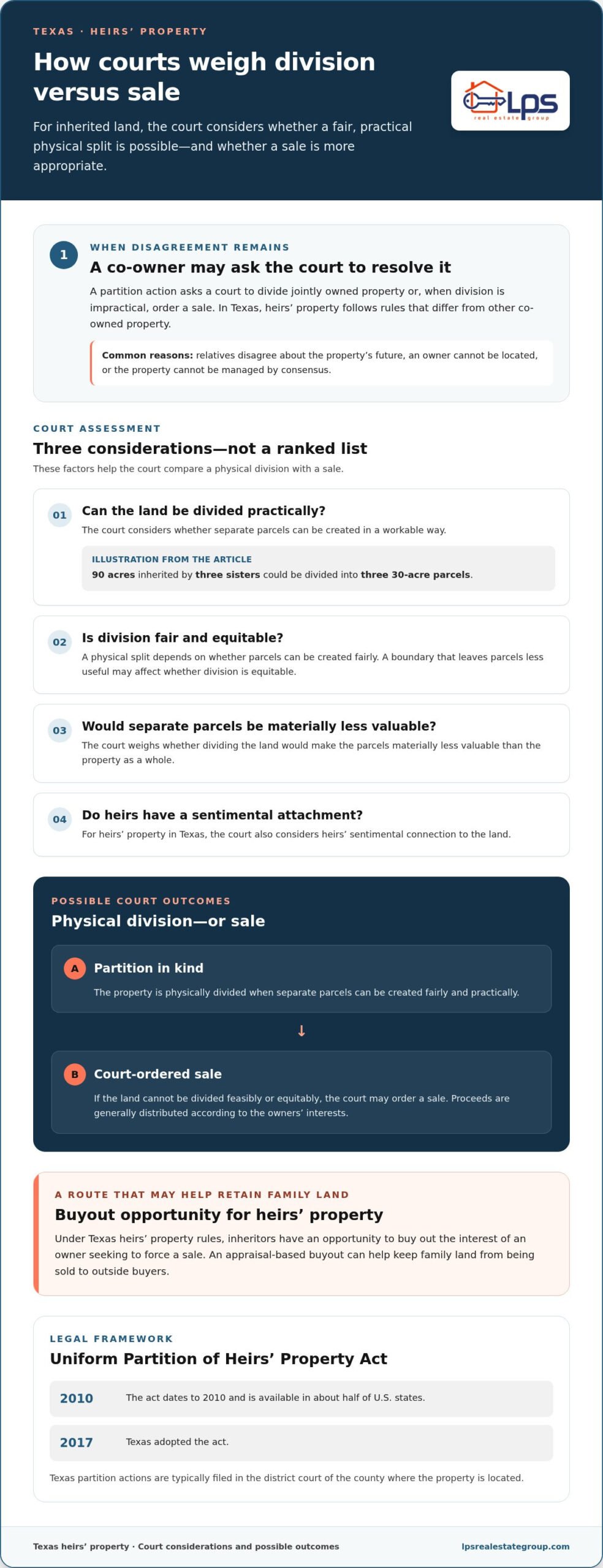
A court may order partition in kind, which physically divides the property, or a sale with proceeds split among the owners. For example, 90 acres inherited by three sisters could be divided into three 30-acre parcels. A physical division depends on whether separate parcels can be created fairly and practically. If the land cannot be divided feasibly or equitably, the court may order a sale instead.
Factors Courts Consider
For heirs’ property in Texas, a court considers whether the land can be divided practically, whether heirs have a sentimental attachment to it, and whether separate parcels would be materially less valuable than the property as a whole. These factors help the court compare physical division with a sale. For example, a boundary that leaves parcels less useful or less valuable may affect whether dividing the land is fair.
The Uniform Partition of Heirs’ Property Act
The Uniform Partition of Heirs’ Property Act provides protections and procedures for certain inherited-property disputes. The act dates to 2010 and is available in about half of U.S. states. Texas adopted it in 2017. Under Texas’s heirs’ property rules, inheritors have an opportunity to buy out the interest of an owner seeking to force a sale. An appraisal-based buyout can help keep family land from being sold to outside buyers.
What is a partition action?
A partition action asks a court to resolve a dispute over jointly owned real estate. In Texas, the case may result in physical division or a court-ordered sale.
Purpose of a Partition Action
A partition action is a legal process for deciding how co-owned property should be divided or sold. It becomes relevant when owners cannot agree on using, keeping, or selling real estate. The court makes the final decision, which may differ from what a co-owner wants. A court-supervised case can resolve the ownership dispute, but may also involve legal and appraisal expenses.
Who Can File and Which Co-Ownerships Qualify
In Texas, any co-owner of jointly owned real estate may file, regardless of their ownership percentage. Partition can be sought when two or more people share ownership and cannot agree on the property’s use or sale. Ownership may come through purchase or inheritance, although Texas has separate rules for heirs’ property. Co-owners may waive or contract away the right to partition if all parties agree.
Time and Costs of an Action
A Texas partition action can take months to years, depending on case complexity and conflict. Costs may include attorney, filing, court, and appraisal fees. One risk is that an owner who opposes division or sale may still face a court-ordered outcome. Co-owners can explore an agreed buyout or sale instead; if everyone agrees, they may also waive or contract away the partition right. For a possible sale outside court, review options for resolving shared-property disputes.
Responsibility for Partition Costs
Partition expenses may arise at several stages, including legal representation, filing, court proceedings, and property appraisal. Keep records of costs paid and property expenses covered by each owner. Texas courts may consider reimbursement for property taxes, insurance, or improvements paid by one owner on the property’s behalf. An attorney can explain how those payments may be weighed alongside ownership interests and court orders.
Distribution of sale proceeds by ownership percentage
When property is sold through a partition case, proceeds are generally distributed according to each co-owner’s interest. Partition laws and procedures vary by state, so Texas rules may differ from those that apply elsewhere.
How Ownership Shares Shape Distribution
Each owner’s documented interest provides the basis for allocating sale proceeds. When co-owners hold unequal shares, distributions reflect those percentages rather than an automatic equal split. Establishing each person’s legal interest is a practical step before proceeds are divided. Disagreement over ownership shares can complicate distribution, even if everyone agrees to sell. A partition action gives the court a way to resolve the dispute and allocate proceeds according to the owners’ interests.
Why Co-Owners Seek Partition
Co-owners may seek partition when they cannot agree on how to use or sell shared real estate. One person may want to keep the property while another wants to end the shared ownership, leaving decisions unresolved. A court action can determine whether the property should be divided or sold and guide the distribution of proceeds. Before litigation, co-owners can try to agree on a sale or buyout. If all parties agree, Texas co-owners may also waive or contract away the right to partition.
Texas Rights and State Procedures
Texas law allows a joint owner with an equal right to possess the property to compel partition. A co-owner may initiate an action regardless of their ownership percentage. This provides a legal route when discussions fail, but the court’s decision may not match every owner’s preference. In Texas, partition actions are typically filed in the district court of the county where the property is located. The court decides whether the property will be divided or sold, and sale proceeds are distributed in proportion to ownership interests. Heirs’ property is subject to different Texas rules from other jointly owned property.
Partition by sale
Partition by sale means the court orders jointly owned property to be sold rather than physically divided. In Texas, this may be appropriate when division is not feasible or equitable. A sale ends the shared ownership and converts the property into proceeds distributed according to each co-owner’s interest.
The type of property can affect the decision. For a single-family home or small lot, creating separate parcels may not be practical. Local zoning rules can also prevent a proposed division. If zoning or the property’s layout makes a fair physical split unworkable, a sale may be the more practical option.
The court considers whether the property can be divided fairly without significantly reducing its value. A parcel that cannot be separated into useful portions may not be suitable for partition in kind. In Texas, courts may appoint special commissioners or professionals, such as surveyors and appraisers, to evaluate the property. Their assessments can help the court decide whether division is practical and fair.
A court-ordered sale can resolve a disagreement even when one co-owner would rather keep the home or land. Because the court makes the final decision, the outcome may not match every owner’s preference. After the sale, proceeds are distributed according to ownership interests. Each person’s share, not simply who requested the sale, shapes their allocation.
Before a court resolves the dispute, co-owners can consider whether they can agree on a voluntary sale or another arrangement. That conversation may help clarify whether everyone wants to sell, whether one owner hopes to keep the property, and what each person’s ownership share means. If you’re weighing a sale outside court, explore an as-is property sale option as a possible alternative.
LPS Real Estate Group: Cash Home Buying
LPS Real Estate Group offers cash home buying and as-is property acquisition for owners considering a sale outside a partition case. If co-owners agree that selling is the right outcome, a direct purchase may provide an alternative to continuing shared ownership or pursuing a court-ordered sale. For inherited property, probate and inherited property buyouts may also help address a family’s ownership situation. These options don’t replace legal guidance about ownership rights or an active court case, but they can be relevant when considering a sale or buyout. Foreclosure prevention purchase and creative finance solutions are available for other property circumstances. To discuss a property sale or inherited-property buyout, contact LPS Real Estate Group.
Choose a Path That Fits Your Property
Understanding what a partition lawsuit for real estate may involve is a useful starting point, but your next step should reflect your priorities. Consider whether you want to keep the property, reach an agreement with co-owners, or explore a sale. Clarifying your goal can help focus conversations about what happens next.
If a direct sale or inherited-property resolution suits your circumstances, LPS Real Estate Group offers cash home buying, foreclosure prevention purchase, and as-is property acquisition. These options may be relevant when you’re weighing alternatives to continued co-ownership or a court-ordered sale. The right route depends on the property and the owners’ situation.
Contact LPS Real Estate Group to discuss a possible property sale. A clear next step can help you move forward with greater confidence.
Frequently Asked Questions
What Are the Types of Partition?
The two main court-ordered forms are partition in kind and partition by sale. Partition in kind divides land into separate parcels, such as splitting a ten-acre property between two owners into two five-acre parcels. A sale converts the property into proceeds for distribution. The right method depends on whether a fair, practical division is possible.
What is a partition lawsuit for real estate?
A partition lawsuit for real estate asks a court to decide what should happen to jointly owned property. The court may determine whether it can be divided or should be sold. This can resolve a deadlock when co-owners cannot agree on what to do, though the outcome may differ from what one or more owners wanted.
Who can file a partition action against a co-owner?
A co-owner of jointly owned real estate can file a partition action. In Texas, an owner may initiate one regardless of their ownership percentage, so a smaller share does not by itself prevent someone from seeking partition. Heirs’ property is subject to different Texas rules from other joint ownership, so inherited land may require the applicable heirs’ property procedures.
What are the steps in a real estate partition lawsuit?
A typical Texas case begins when a co-owner files a petition in the district court for the county where the property is located. The court considers how the property can be divided or whether a sale is appropriate. Commissioners or professionals, including surveyors and appraisers, may help assess the property. The court issues its decision, followed by division or sale as ordered.
When will a court order partition in kind versus a sale?
A court may choose partition in kind when the property can be divided fairly and practically without materially reducing its value. It may consider a sale when physical division is infeasible or inequitable, including when zoning limits the creation of separate parcels. For heirs’ property in Texas, courts also weigh heirs’ sentimental attachment and whether divided portions would be materially less valuable than the property as a whole.
How are sale proceeds divided in a partition action?
Sale proceeds are generally distributed in proportion to each co-owner’s interest. The deed, inheritance records, or other ownership documents can help establish those interests. If owners disagree about their shares, the dispute may need to be resolved as part of the case. Texas courts may also consider certain property expenses paid by one owner, such as taxes or insurance.