
The buyer’s payment plan may matter less than the role you’ll have after agreeing to sell. In a rent to own vs seller financing for seller comparison, the key difference is when ownership changes: with rent-to-own, you generally keep the property during the lease period; with seller financing, ownership commonly transfers as part of the sale, and you receive payments under a promissory note. That difference affects more than timing. It can shape your responsibilities, control, and exposure to risk.
It’s understandable to want flexibility without ending up with unclear terms or an uncertain payment arrangement. Neither option is automatically better for every seller. The right fit depends on when you need proceeds, how long you’re comfortable staying involved, and what the agreement says will happen if the buyer misses payments or doesn’t complete the purchase.
This article compares the seller-side trade-offs, payment structures, ownership timing, and risks of both options, and outlines questions to resolve before signing. It also covers a direct as-is sale: LPS buys homes without requiring repairs or cleaning, charges no fees, commissions, or hidden costs, and covers typical closing costs. You choose a closing date, with closings as little as 7 days or on your schedule.
Key Takeaways
- In a rent to own vs seller financing for seller comparison, focus on how each arrangement affects ownership, control, payment timing, and your ongoing role.
- Separate rent from purchase payments, and put any rent credits, option fees, and other payment terms in writing.
- Compare when you’ll receive proceeds and what happens if the buyer doesn’t complete the purchase before choosing a structure.
- Review responsibilities, contingencies, and exit terms with a qualified real estate attorney before signing.
- If you prefer a direct sale, LPS buys homes as-is with no repairs or cleaning required, no fees or commissions, and no hidden costs. LPS covers typical closing costs. Share property details, receive a no-obligation cash or creative offer, and choose a closing date.
Rent-to-Own vs. Seller Financing: What Does Each Mean for a Seller?
Rent-to-own and seller financing can sound similar because both may involve a buyer making payments over time. The key difference is the seller’s role: one arrangement may begin with occupancy and a possible later purchase, while the other is structured around a sale with payments made under agreed terms. For sellers comparing rent to own vs seller financing for seller priorities, that distinction affects when ownership may transfer, when you receive proceeds, and what responsibilities continue in the meantime.
In a rent-to-own arrangement, a person occupies the property as a tenant and may have the opportunity, or in some agreements an obligation, to buy later. The contract defines the arrangement; the label alone doesn’t determine the buyer’s rights or the seller’s responsibilities. Rent-to-own agreements can use different transaction structures, so the specific written terms matter more than a general description.
How rent-to-own works from the seller’s side
During the rental period, the seller may remain the property owner, depending on the agreement and applicable law. The occupant pays rent, while a separate purchase option or commitment may set out how a future sale could proceed. That possibility isn’t the same as a completed transfer of ownership. Until a sale closes or ownership otherwise transfers under the agreement, the seller’s role may continue.
Put every payment term in writing. Specify the rent amount and due dates, whether any portion can be credited toward a purchase, how an option fee is treated, and what happens if the buyer doesn’t proceed. Don’t assume rent will count toward the purchase price. The agreement should explain whether credits apply, how they’re calculated, what conditions govern them, and how the purchase price and timeline are determined.
How seller financing changes the seller’s role
With seller financing, the seller agrees to receive purchase payments over time under defined terms rather than receiving all proceeds at once. In a common structure, the sale closes and the seller receives payments under a promissory note. Other arrangements may handle title and security differently. The documents and local law determine how the transaction is structured, so the phrase “seller financing” alone doesn’t establish when ownership transfers.
The seller’s involvement may continue through payment collection, recordkeeping, and addressing questions about the agreed terms. The contract should clearly address the payment schedule, interest, late or missed payments, and what happens if the buyer fails to meet obligations. The seller isn’t simply collecting rent: payments are tied to a purchase arrangement, and the seller’s rights depend on the documents.
Both paths can involve ongoing responsibilities, but not necessarily the same ones. Before deciding, identify what you’ll receive, when you’ll receive it, who holds ownership at each stage, and what happens if the planned purchase or payments don’t proceed. Because agreement forms and legal treatment vary, have a qualified real estate attorney review the proposed documents and applicable rules before signing.
How Rent-to-Own and Seller Financing Affect Ownership, Payments, and Control
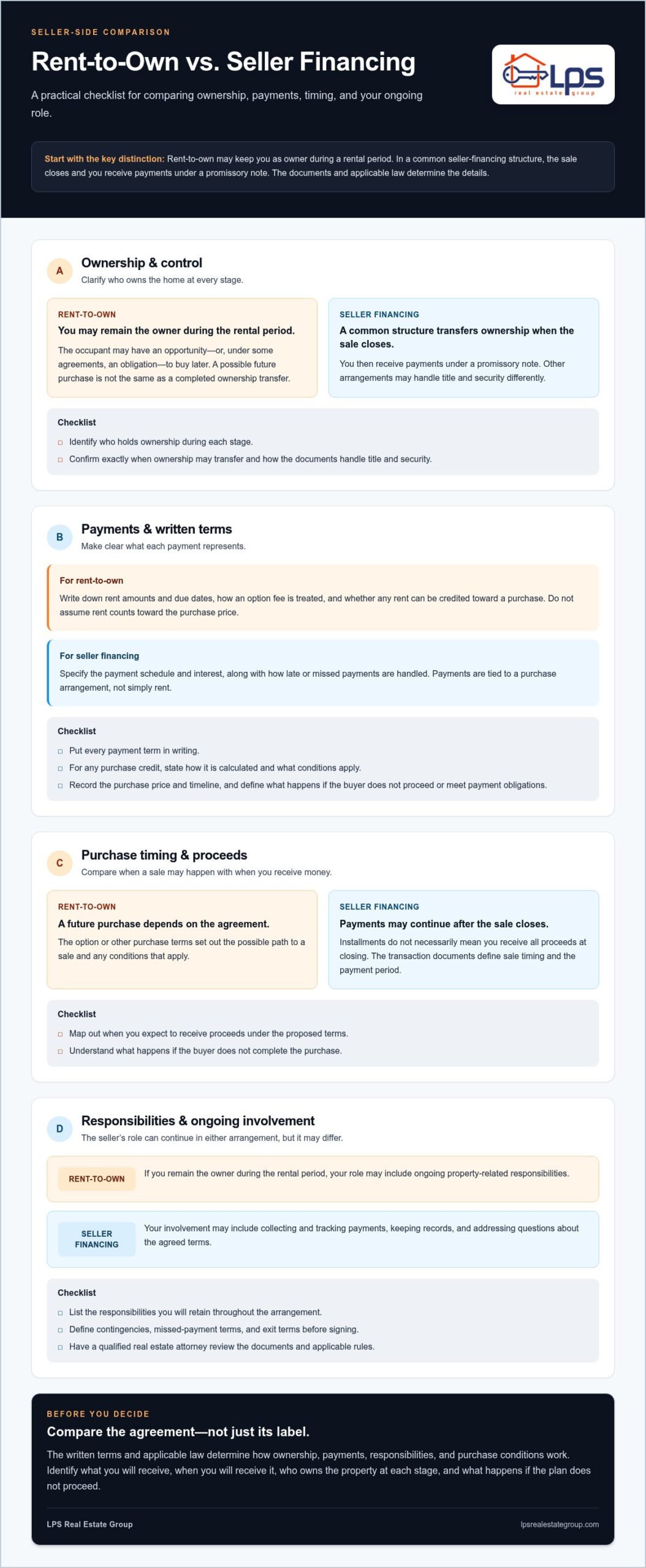
The practical differences show up in four areas: who owns the home, what each payment represents, when a purchase may happen, and how involved you remain. The comparison below describes common arrangements, not rules that apply to every contract. The written terms and applicable law determine the details.
| Topic | Rent-to-own | Seller financing |
|---|---|---|
| Ownership during the term | The seller may retain ownership while the buyer occupies the home as a tenant. | In a common structure, ownership transfers as part of the sale and the seller receives payments under a note. Other structures may handle ownership and security differently. |
| Payment flow | The occupant pays rent. A separate option fee or purchase credit applies only if the agreement says so. | The buyer makes payments under the purchase agreement, such as scheduled principal and interest, as defined by its terms. |
| Purchase timing | A possible future purchase depends on the option or other purchase terms and their conditions. | The sale timing and payment period depend on the transaction documents; installments do not necessarily mean the seller receives all proceeds at closing. |
| Seller involvement | The seller may remain the owner during the rental period and have ongoing property-related responsibilities. | The seller may need to track payments and follow the agreement’s terms for the duration of the payment arrangement. |
Who owns the property, and when can that change?
In rent-to-own, ownership may stay with the seller through an agreed rental period, even as the occupant has a potential path to purchase. With seller financing, a common approach is to transfer ownership when the sale closes, while the seller receives payments afterward. Transaction documents can structure ownership and security differently, so don’t assume two agreements with the same label work alike. Check the documents for the specific event that transfers title and the rights each party has before and after it.
What happens to payments and the purchase timeline?
Rent compensates the seller for occupancy; it isn’t automatically a payment toward the purchase price. Seller-financed installments relate to the purchase under the signed agreement, but arrive over time. In either arrangement, a future purchase depends on the agreement and its conditions.
Before comparing offers, look for the purchase price, payment schedule, length of the arrangement, and any rent credits or other amounts applied toward the sale. For example, if a proposed lease mentions rent credits, the contract should say how they’re calculated and what conditions must be met. Clear terms help you understand what each payment means and what happens if the buyer doesn’t proceed or misses payments.
If ongoing ownership or payment tracking doesn’t fit your plans, consider whether a direct sale better matches your priorities. LPS Real Estate Group buys homes as-is, with no repairs or cleaning required, no fees or commissions, and no hidden costs. LPS covers typical closing costs. You can explore a direct home offer as a separate route, rather than treating it as either of these payment arrangements.
Which Option Is Better for a Seller? Compare the Trade-Offs
There isn’t one arrangement that suits every seller. Your decision depends on whether you’re comfortable staying involved while the buyer occupies or pays for the home, and whether receiving proceeds over time fits your plans. Both rent-to-own and seller financing can defer some or all proceeds compared with a direct sale. Neither guarantees that payments will continue as planned or that a buyer will complete a future purchase. In a rent to own vs seller financing for seller comparison, weigh your ongoing role as carefully as the payment terms.
| Arrangement | Potential seller benefit | Responsibility or uncertainty | Question for legal review |
|---|---|---|---|
| Rent-to-own | May allow an interim occupancy period alongside a possible future purchase. | The seller may retain ownership and have continuing responsibilities. The occupant may not exercise the purchase option. | Are occupancy, maintenance, option terms, credits, and outcomes if the buyer doesn’t purchase clearly addressed? |
| Seller financing | May make a sale possible with payments received under agreed terms over time. | The seller may need to manage payment records and address missed payments. Future installments aren’t the same as proceeds received upfront. | Are payment duties, default procedures, security, and enforcement terms clear and appropriate? |
| Direct sale | May suit a seller who prefers not to manage an ongoing occupancy or payment arrangement. | The transaction follows its own offer and closing terms rather than a continuing buyer-payment plan. | Do the written offer and closing documents reflect the agreed terms? |
When rent-to-own may fit a seller’s priorities
Rent-to-own may be worth considering if you’re open to someone occupying the property before a potential sale and are prepared to remain involved during that period. Before agreeing, clarify who handles property responsibilities and what happens if the occupant doesn’t buy. A purchase option creates a possible path, not certainty that the tenant will complete the purchase.
When seller financing may fit a seller’s priorities
Seller financing may suit you if you’re willing to receive purchase payments over agreed terms rather than rely on receiving all proceeds at once. That choice also means planning for payment administration and possible missed payments. Have the agreement explain what happens after a missed installment and how each party’s responsibilities are handled. A payment stream is not risk-free or guaranteed.
If you prefer a direct route without ongoing payment management, LPS Real Estate Group buys homes as-is, with no repairs or cleaning required, no fees or commissions, and no hidden costs. LPS covers typical closing costs. Share property details, receive a no-obligation cash or creative offer, then choose a closing date. You can explore a direct home offer as another option while weighing what level of involvement works for you.
What Sellers Should Clarify Before Signing Either Agreement
A clear agreement makes it easier to understand your role before payments or occupancy begin. Use this review sequence to identify missing terms and unresolved questions. The details matter in any rent to own vs seller financing for seller decision, because a general label doesn’t explain exactly what you’ve agreed to.
- Confirm ownership and possession. Identify who owns the property at each stage, when possession begins, and what event or document changes ownership. Don’t rely on a verbal summary if the written agreement says something different.
- Write out every payment term. Record the purchase price, payment amount and due dates, agreement term, and how payments are applied. For rent-to-own, distinguish rent from any option fee or purchase credit. State whether credits apply, how they’re calculated, and what conditions affect them.
- Assign property responsibilities. Spell out who handles taxes, insurance, maintenance, repairs, utilities, and other property-related tasks during occupancy or the payment period. Avoid broad wording that leaves either party unsure who must act or pay.
- Set out contingencies and missed-payment steps. Clarify what happens if a payment is late or missed, the buyer doesn’t exercise an option, or a planned purchase doesn’t close. The agreement should describe the process and each party’s responsibilities rather than leaving next steps to assumption.
- Review the exit scenarios. Consider how the arrangement ends if the buyer can’t or chooses not to proceed, and what happens to payments, credits, possession, and the property. Make sure the process is written down and understandable before signing.
Resolve legal questions before signing
Ask a qualified real estate attorney to review the proposed agreement and the rules that apply to your specific transaction. Discuss how the structure may affect title, possession, your continuing obligations, and the steps available if the other party doesn’t follow the agreement. Ask which federal and state requirements may apply rather than assuming a rule from another transaction applies to yours. The right answers can depend on the documents and circumstances. This article offers general information, not legal advice.
It may also help to consider how these terms fit into your broader plans for the property. For more context on possible sale paths, review creative real estate exit strategies. If you’d rather compare a direct route, LPS Real Estate Group buys homes as-is, with no repairs or cleaning required, no fees or commissions, and no hidden costs. LPS covers typical closing costs. Share your property details for a no-obligation offer, then choose a closing date that works for you.
A Direct Offer Is Another Route When You Want a Clearer Sale
Rent-to-own and seller financing can keep you involved after an agreement begins. If you’d rather not manage occupancy, track ongoing buyer payments, or wait for a possible future purchase, a direct offer may be another path to consider. It won’t be the right fit for every seller, but it offers a different decision: review the offer and closing terms, then decide whether they work for your plans.
Unlike rent-to-own, a direct sale isn’t built around a rental period and a possible later purchase. Unlike a seller-financed sale, it doesn’t necessarily mean receiving purchase payments over time. The terms depend on the offer you accept, so review them carefully. For a broader look at the process, see this guide to selling a house for cash.
Compare a direct offer with ongoing-payment arrangements
In a rent-to-own agreement, the seller may remain the owner while the occupant rents the property and considers a future purchase. With seller financing, the seller may receive payments over time under the sale agreement. A direct purchase is a separate route with its own offer and closing terms. Not every direct offer or creative offer follows the same payment structure, so focus on the specific terms rather than assuming it matches either arrangement.
That distinction can help clarify your priorities. If you value a defined closing process over an ongoing relationship with the buyer, review the written offer and what happens at closing. If you’re comparing cash-purchase options, this overview of companies that buy houses for cash provides additional context.
How the LPS offer process works
LPS Real Estate Group keeps its process straightforward. First, share the property details. Then review a no-obligation cash or creative offer. If you decide to move forward, choose a closing date. A closing can be as little as 7 days or arranged on your schedule.
The home is purchased as-is, so repairs or cleaning aren’t required. LPS charges $0 in fees, commissions, or hidden costs and covers typical closing costs. These terms may suit sellers who want to avoid preparing the property or managing ongoing buyer payments. Still, review the offer and closing documents so you understand the agreed terms before deciding.
The best route depends on how much ongoing involvement you’re comfortable with and when you want the sale to move forward. If a direct sale better matches your priorities, request a no-obligation offer by sharing your property details. Review the offer and decide whether it fits, without treating it as rent-to-own or seller financing.
Choose the Sale Structure That Fits Your Next Step
Before you commit, decide how much responsibility you’re comfortable carrying after an agreement begins and how predictable you need the sale process to feel. The right choice in a rent to own vs seller financing for seller decision is the one that fits your timing, plans, and comfort with ongoing involvement. If neither arrangement feels like a good fit, you can consider a direct offer instead.
LPS Real Estate Group presents a no-obligation cash or creative offer after you share your property details. Homes are purchased as-is, with no repairs or cleaning required, no fees or commissions, and no hidden costs. LPS covers typical closing costs. You choose a closing date, with closings as little as 7 days or on your schedule.
You don’t need to decide before you understand your options. Share your property details and request a no-obligation offer to explore whether a direct sale fits your plans. Take the next step at a pace that feels right for you.
Frequently Asked Questions
Is rent-to-own or seller financing better for a home seller?
Neither option is automatically better; the right fit depends on your priorities and comfort with staying involved. A rent-to-own arrangement may suit a seller willing to have someone occupy the home before a possible purchase. Seller financing may fit a seller prepared to receive payments over time. For a rent to own vs seller financing for seller decision, compare your need for proceeds, tolerance for ongoing responsibilities, and plans if the buyer doesn’t follow through.
Can a seller keep ownership of a home in a rent-to-own agreement?
Yes, a seller may retain ownership during the rental period, depending on the agreement and applicable law. For example, a contract may let the occupant live in the home while holding an option to purchase later. That option doesn’t itself mean ownership has transferred. Review the documents to understand when possession begins, what rights the occupant receives, and what event, if any, transfers title.
What happens if a rent-to-own tenant does not buy the house?
The outcome depends on the written agreement and applicable law. The tenant may have an option rather than an obligation to purchase, so the seller shouldn’t assume the sale will happen. Check the contract for what happens to any option fee or rent credits, when occupancy ends, and how possession is handled if the tenant doesn’t buy. Ask a qualified real estate attorney to review the specific terms before signing.
Can a seller change the purchase price during a rent-to-own agreement?
Usually, the agreed price is set by the contract, and a seller shouldn’t assume they can change it unilaterally after signing. The agreement may specify a price upfront or describe how it will be determined later. If both parties want a change, document it in a properly prepared written amendment. Have a qualified real estate attorney review whether the proposed change is allowed under the contract and applicable law.
How does a seller get paid in a seller-financed home sale?
The seller receives payments according to the signed sale documents, which may set out an initial payment, scheduled installments, interest, and the payment term. The exact structure varies, so don’t treat the full sale amount as money available at closing unless the contract says it will be paid then. Before agreeing, review how payments will be made and recorded, and ask a tax professional how the arrangement may affect your tax reporting.
What happens if a buyer misses payments in a seller-financed sale?
The agreement and applicable law govern the next steps; a missed payment doesn’t give the seller a free hand to act outside the required process. Check the documents for notice requirements, any time allowed to address a missed payment, and the remedies available if the issue continues. The seller’s options can depend on how the transaction is structured. Ask a qualified real estate attorney to explain the procedures before signing.
Can a seller choose a direct cash offer instead of rent-to-own or seller financing?
Yes. A direct sale is a separate route for sellers who prefer not to manage an occupancy period or ongoing buyer payments. LPS Real Estate Group buys homes as-is, with no repairs or cleaning required, charges $0 in fees or commissions, and has no hidden costs. LPS covers typical closing costs. Share property details to receive a no-obligation cash or creative offer, then choose a closing date, with closings as little as 7 days or on your schedule.