

A failed septic system can change how you sell a house, but it doesn’t automatically end the sale. If you’re selling a house with a failed septic system, you may be wondering whether you need to repair or replace it first, and what an inspection report means for your next move.
Your options depend partly on the system’s condition and the rules where the property is located. A sale may still be possible, but local transfer requirements and disclosure duties matter. Selling as-is doesn’t mean withholding a known problem from the buyer. To compare a repair with an as-is sale, start by separating confirmed inspection findings from symptoms and questions that still need answers.
This guide explains how to understand common septic findings, what to clarify about inspections and disclosures, and how repair, replacement, and as-is sale paths compare. You’ll also learn how a direct purchase can help if you’d rather not take on repairs. LPS Real Estate Group makes no-obligation cash or creative offers for as-is homes. No repairs or cleaning are required, and there are $0 fees, commissions, or hidden costs. You can choose a closing date that works for you and consider your next step without pressure.
Key Takeaways
- A failed septic system raises questions to resolve, but it doesn’t automatically mean a sale is impossible.
- Review what the inspection says about the tank, drainfield, and other components to understand what was assessed.
- Separate technical findings from local inspection, disclosure, transfer, and repair requirements, which vary by jurisdiction.
- Compare repair, replacement, and as-is paths based on the findings, applicable rules, timing, and your priorities.
- For selling a house with a failed septic system, an as-is sale to LPS is one option. No repairs or cleaning are required, and there are $0 fees, commissions, or hidden costs.
Selling a House With a Failed Septic System: What the Problem Means
A septic problem can raise serious questions, but it doesn’t automatically make a home impossible to sell. If you’re considering selling a house with a failed septic system, first identify what has actually been observed and what an inspection has confirmed.
A septic system handles household wastewater where a property isn’t connected to a municipal sewer. The tank holds wastewater so solids can settle, while liquid flows onward to the drainfield, where it disperses into the soil. The tank and drainfield work as parts of one system, but a concern in one area doesn’t by itself explain the condition of every component.
What does a failed septic system mean?
A septic system is considered failed when a component or the system as a whole isn’t functioning as intended, based on the findings and applicable standards for that property. This is a practical description, not a single universal threshold. The meaning of “failure” can depend on what was examined, what the findings show, and the rules that apply locally.
A problem may involve the tank, drainfield, pipes, or another component. Keep a reported symptom separate from a documented finding. For example, an odor is something a homeowner may notice, while an inspection report may identify a specific concern or recommend further evaluation. Those are different levels of information. Review the report’s wording, note which parts were inspected, and distinguish confirmed observations from possibilities or recommended next steps.
Which warning signs should a seller take seriously?
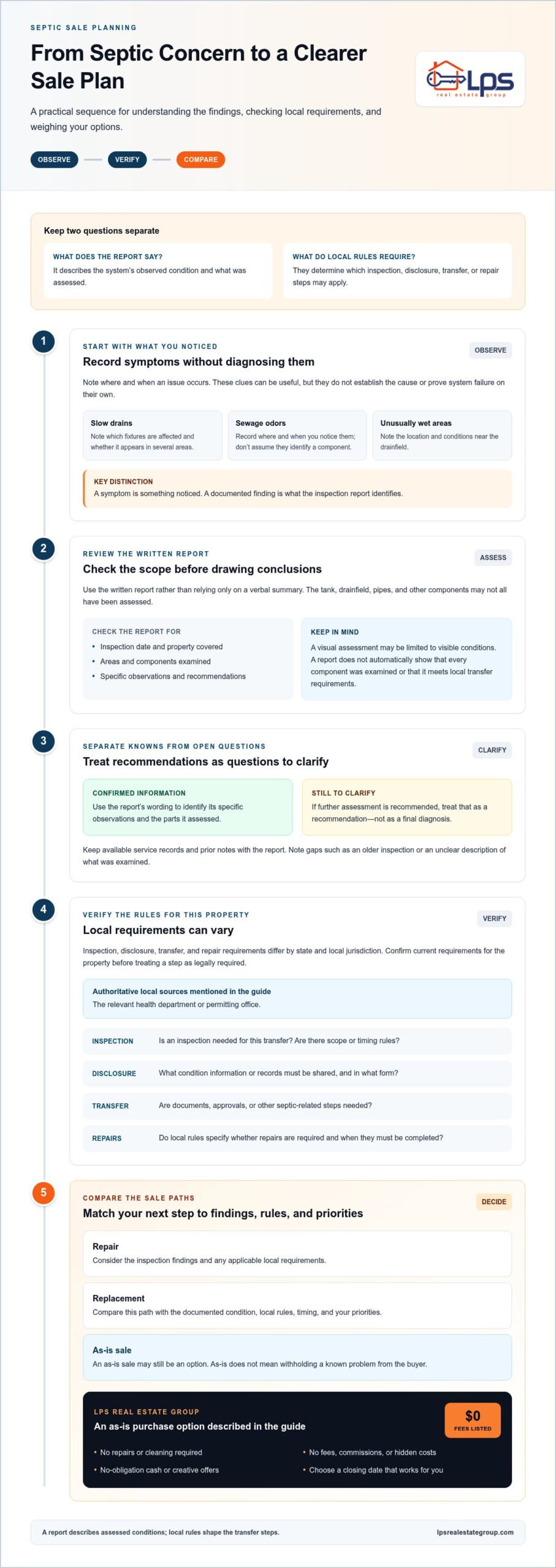
Some visible or noticeable changes may warrant attention, but they don’t establish a diagnosis on their own. Slow drains, sewage odors, or unusually wet areas near the drainfield are clues to record and include when describing the property’s condition. They don’t prove that the septic system is the cause, show how extensive a problem may be, or determine what work is needed.
- Slow drains: Note where they occur and whether the issue is limited to one fixture or appears in several areas.
- Sewage odors: Record where and when you notice them, without assuming the odor identifies a particular failed component.
- Unusually wet drainfield areas: Note the location and conditions, but don’t treat damp ground alone as proof of system failure.
Specific details make it easier to understand the issue and compare sale options. Gather any inspection reports, service records, or prior notes you have. When describing the property, don’t state an unconfirmed cause as fact. Separating what you’ve noticed from what an inspection documented gives you a more reliable starting point.
Septic Inspections, Records, and Sale Rules: What to Clarify
A septic report and local sale rules answer different questions. The report describes the system’s observed condition, while local rules determine what steps may apply to a property transfer. Keep these questions separate so you can understand what’s known about the system without assuming that an inspection alone settles the sale requirements.
Rules aren’t uniform across the country. Inspection, disclosure, transfer, and repair requirements can vary by state and local jurisdiction. Before treating any step as legally required, verify the current rules for the property’s location through an authoritative local source, such as the relevant health department or permitting office. This is an important part of planning for selling a house with a failed septic system.
What can an inspection or report tell you?
Start with the written report, not just a verbal summary. Check the inspection date, the property it covers, the areas and components examined, and the specific observations or recommendations. A visual assessment may be limited to conditions that can be seen, while a more comprehensive inspection may involve additional evaluation. The scope matters: a report describes what was assessed, but it doesn’t automatically establish that every component was examined or that the report meets local transfer requirements.
If the report recommends further assessment, treat that as a recommendation to clarify rather than a final diagnosis. Keep the report with available service records and note any gaps, such as an older inspection or an unclear description of what was inspected. This gives you a more useful record to consider alongside local rules.
How do septic sale requirements vary by location?
Local requirements may address whether an inspection is needed, what information a seller must disclose, what documentation is needed for transfer, or whether repairs must happen before or after a sale. Details differ, so don’t rely on a rule described for another town or state. Confirm the requirements that apply to this property and transaction before choosing a sale route.
For clarity, organize the questions separately:
- Inspection: Is an inspection required for this transfer, and are there rules about its scope or timing?
- Disclosure: What condition information or records must be shared, and in what form?
- Transfer: Does the transfer process require documents, approvals, or other steps related to the septic system?
- Repairs: Do local rules specify whether repairs are required, and when they must be completed?
Write down the source and date of the information you find. If guidance is unclear, seek clarification from the appropriate local authority or a qualified legal professional. Once you understand both the documented condition and the rules that apply, you can compare sale paths on firmer ground.
If an as-is sale is one path you’re weighing, LPS Real Estate Group’s direct home-buying option lets you consider a no-obligation cash or creative offer without required repairs or cleaning. There are $0 fees, commissions, or hidden costs.
Repair, Replacement, or As-Is Sale: Compare Your Septic Options
A failed septic system doesn’t automatically mean you must repair it before selling. The right route depends on what the findings show, what local rules require, how much time you have, and what matters most to you. If you’re selling a house with a failed septic system, comparing the paths side by side can make the decision more manageable.
When might repair or replacement be worth considering?
Repair may be worth exploring when the documented issue is limited to a component and the proposed work addresses that finding. Replacement is a broader option when the system or a major part of it needs to be renewed. These aren’t interchangeable terms. Review the written findings and applicable requirements before deciding which scope, if either, makes sense. Avoid relying on a general estimate or assumed outcome for a property-specific decision.
| Option | Potential advantages | Trade-offs and questions to resolve |
|---|---|---|
| Repair | May address a defined problem without replacing the entire system. | What work does the documented finding support? Would the repair satisfy any requirements that apply to the sale? |
| Replacement | May be appropriate if findings point to a broader system issue or local rules call for replacement. | What scope is needed, and how would the work affect your plans and timing? Don’t assume a replacement is required based only on a symptom. |
| As-is sale | Lets you consider selling without completing septic repairs first. A direct buyer may assess the property in its current condition. | What must you disclose, and do local transfer rules require specific steps? Review the offer terms and how the buyer plans to handle the property. |
What does selling the property as-is involve?
“As-is” describes the condition in which the property is offered and generally means the seller isn’t agreeing to make repairs as part of the sale. It doesn’t erase disclosure duties for known issues or override local requirements. A buyer’s intended next steps may shape how they assess the property, but they don’t replace the need to be clear about known findings.
An as-is route can be compared with repairing or replacing the system first. For example, a seller who wants to avoid arranging work may prefer to consider an offer based on the property’s present condition. LPS Real Estate Group buys homes as-is, with no required repairs or cleaning, no commissions, and no hidden costs. Sellers can review a no-obligation cash or creative offer and choose a closing date that works for them.
Before choosing, line up the inspection findings, verified local requirements, and your own priorities. The goal isn’t to pick the path that sounds simplest in general, but the one that fits the property and your circumstances.
How to Prepare for a Sale With a Failed Septic System
Getting organized can make sale discussions clearer, even if you haven’t decided whether to repair the system. When selling a house with a failed septic system, focus first on collecting accurate information, checking which rules apply, and understanding the terms of each sale route. Preparing doesn’t mean committing to a particular repair or sale plan.
Gather septic records and property information
Bring the available paperwork together in one place. A simple digital or printed folder can help you share consistent information and spot unanswered questions before reviewing offers.
- Inspection reports: Keep the full report, including its date, scope, findings, and recommendations.
- Service records: Collect available pumping, maintenance, or repair records, along with receipts or related notes.
- Permits and system details: Include documents that identify the system’s location, components, or prior work, if you have them.
- Your observations: Record issues you’ve noticed separately from professional findings. Note when and where they occurred without assuming the cause.
If a record is missing, label it as unavailable rather than trying to fill the gap from memory. You might write, “No permit record found in the documents on hand,” rather than guessing when the system was installed. This distinction helps keep known facts, reported symptoms, and open questions separate.
Check requirements, then compare sale routes
Use the property’s location to verify current inspection, disclosure, transfer, and repair requirements with the appropriate local authority. Note where you found the guidance and when you checked it. Then compare your options against both the documented condition and any requirements that apply.
- Gather the records. Make an inventory of what you have and flag missing or unclear documents.
- Summarize the findings. Use the report’s wording. Separate confirmed observations from symptoms or recommendations for further assessment.
- Verify local requirements. Identify what applies to this property and transaction before settling on a sale route.
- Compare your paths. Consider addressing the system, selling in its current condition, or another suitable route based on your priorities and the applicable rules.
- Review the terms. Read the offer and sale documents carefully so you understand what’s included, what you’re expected to do, and how the known septic condition is addressed.
Compare offers and sale terms carefully
Look beyond the offer structure. Compare what each route requires from you, how the closing date is handled, and whether the written terms reflect the property’s known condition. If a term is unclear, get it explained before you agree. A guide to selling a house as-is can provide broader context, while information about selling a house for cash can help you understand another sale route.
If you’re considering a direct as-is sale, request a no-obligation cash or creative offer from LPS Real Estate Group. LPS buys homes without required repairs or cleaning, with $0 fees, commissions, or hidden costs. You can review the offer and choose a closing date that works for you.
How an As-Is Sale With LPS Real Estate Group Works
A septic concern doesn’t prevent you from exploring a direct sale. LPS Real Estate Group buys residential properties directly from homeowners, including homes with problems, in as-is condition. You can consider an offer without first completing repairs or cleaning the property. You’re still responsible for sharing known information and understanding any local sale requirements that apply.
The process is straightforward:
- Share the property details. Provide information about the home and its current condition, including what you know about the septic system. Available reports and records can make the discussion more specific, but you don’t need to present an unverified concern as a confirmed finding.
- Receive a no-obligation offer. LPS presents a cash or creative offer for you to review. There’s no obligation to accept, so you can consider the terms and decide whether they fit your situation.
- Choose a closing date. If you decide to proceed, you select a date that works for you. A closing can take place in as little as 7 days or on your schedule.
What happens after you share the property details?
You can review the offer before making a decision, and you choose whether to move forward. If you do, you select a closing date that works for you. There are no required repairs or cleaning, and the offer has $0 fees, commissions, or hidden costs.
An as-is sale doesn’t remove disclosure responsibilities or local requirements. It means LPS doesn’t require you to repair or clean the home before the sale. Review the offer and its terms carefully so you understand how the transaction addresses the property in its current condition.
How can a seller take the next step?
If you’re selling a house with a failed septic system, share the facts you have, such as an inspection report, service records, or a clear description of what you’ve observed. You don’t need to decide in advance whether repair or replacement is the right answer to explore an as-is offer. Keep confirmed findings distinct from open questions, and review any offer at your own pace.
LPS requires no repairs or cleaning, and charges $0 in fees, commissions, or hidden costs. If a direct sale feels like a useful option, share your property details with LPS to receive a no-obligation cash or creative offer. Consider it without pressure, then decide whether to proceed and choose a closing date that suits you.
Choose the Next Step That Fits Your Situation
Selling a house with a failed septic system can feel like a decision you need to make all at once. You don’t. Start with the clearest information you have, identify what still needs an answer, and consider which sale path best fits your priorities. A practical next step can be comparing an as-is offer with the time and effort involved in addressing the system before a sale.
If you’d like to explore a direct sale, LPS Real Estate Group can consider the property in its current condition. There’s no obligation to accept an offer, and you choose whether to move forward. An LPS as-is purchase requires no repairs or cleaning, has $0 fees, commissions, or hidden costs, and can close in as little as 7 days or on your schedule.
Share your property details for a no-obligation offer, then take the time you need to decide whether it’s the right fit. You can move forward one informed step at a time.
Frequently Asked Questions
Can I sell a house with a failed septic system without replacing it?
Yes, a sale may be possible without replacement, but the answer depends on the property and transaction. First identify whether the report documents a specific failure or recommends further assessment, then verify local transfer requirements. A rule may affect when work must be addressed, even if it doesn’t require replacement before every sale. Compare the available routes using those facts rather than assuming replacement is always required or never required.
Does a failed septic inspection automatically make a house unsellable?
No, an inspection finding alone doesn’t establish that every sale is prohibited. Read the report closely: a noted concern, a confirmed defect, and a recommendation for further evaluation can have different meanings. Then check current requirements for the property’s jurisdiction. The transaction terms also matter, so don’t treat one inspection result as a universal decision about whether the property can be sold.
Do I have to disclose a failed septic system when selling my house?
Disclosure duties depend on applicable law and the facts of the transaction, so confirm what applies to your property. Don’t conceal or misstate a known issue. If a report confirms a failure, describe it as a documented finding. If you’ve only noticed an odor or slow drain, don’t present that symptom as a confirmed diagnosis. Keeping the report and related records available can help you communicate the condition accurately and consistently.
What should I do if I have no septic inspection records?
Make a short inventory of what you do have, such as service receipts, permits, or notes from prior work, and mark inspection records as unavailable if you can’t locate them. Don’t guess at installation dates or past findings. Next, identify whether the planned transfer has documentation or inspection requirements. Missing paperwork doesn’t prove the system has failed, but knowing what’s absent can help you decide whether more information would clarify your choices.
Can an as-is sale still involve septic disclosures or local requirements?
Yes. An as-is sale doesn’t automatically cancel disclosure duties or take precedence over local rules. It describes the property’s condition for the transaction, not an exemption from applicable requirements. For example, a seller may agree not to complete repairs while still accurately sharing a known inspection finding. Make sure the written terms address the property’s condition clearly, and establish which disclosure and transfer rules apply before relying on an as-is agreement.
Is a septic system considered failed if it has a bad smell or slow drains?
Not based on those signs alone. Odors or slow drains are reasons to gather more reliable information, but they don’t confirm a septic failure, identify the component involved, or establish what work is needed. Note where and when the symptom occurs, and keep that observation separate from inspection conclusions. For example, one slow fixture is an observation, not proof that the tank or drainfield has failed.