
What if the biggest obstacle to your home sale isn’t a leaky roof or an outdated kitchen, but a neighbor’s signature on a single piece of paper? It’s a common fear for many rural homeowners. You might feel a knot in your stomach wondering if a “handshake deal” with the folks next door will pass a 2026 mortgage inspection. Selling a house with a shared well agreement often brings up valid concerns about uncooperative neighbors or the fear of a sudden VA loan rejection. We understand how stressful it is when your water source feels like a ticking clock on your closing date.
This guide will help you navigate the legal and financial complexities of shared water sources without losing your buyer. You’ll learn the specific flow rate requirements for modern lenders and how to fix unrecorded easements that threaten your title. We’ll also provide a clear strategy for managing neighbor disputes and explain how an as-is cash sale can serve as a reliable backup plan if traditional financing stalls. By the time you finish reading, you’ll have a logical path forward to turn that shared well from a liability into a manageable part of your successful sale.
Key Takeaways
- Understand that a valid shared well agreement is a recorded easement that legally binds future owners, ensuring your property’s water access remains protected.
- Learn the specific 2026 flow rate and distance standards required by FHA and VA lenders to prevent financing rejections during the appraisal process.
- Discover how to build a “Well Binder” with maintenance records and water quality tests to reassure buyers and reduce the perceived risk of a shared utility.
- Successfully navigate the process of selling a house with a shared well agreement by identifying and resolving neighbor disputes or unrecorded “handshake deals” before you list.
- Explore how an as-is property acquisition offers a reliable backup plan if aging infrastructure or complex legal issues make traditional mortgage financing impossible.
What is a Shared Well Agreement and Why Does it Matter for Your Sale?
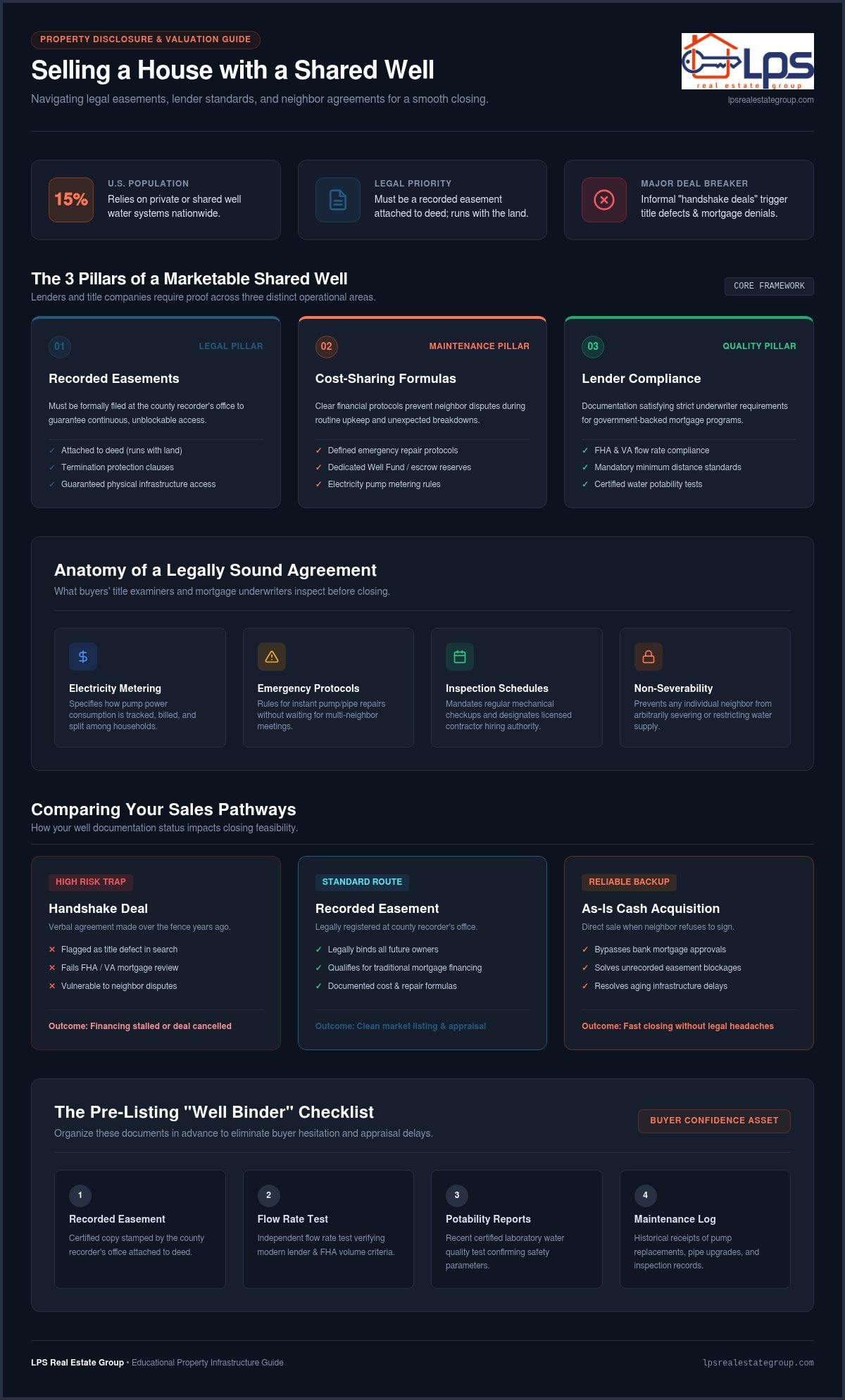
A shared well agreement is a legally binding contract between two or more property owners that governs the use, maintenance, and protection of a private water source. When you are selling a house with a shared well agreement, this document acts as the blueprint for how your property functions on a daily basis. The agreement is a recorded easement that runs with the land, meaning it remains attached to the property deed regardless of who owns the home. It dictates how neighbors split the costs for electricity to run the pump, routine maintenance, and unexpected repairs. Without a clear, written agreement in place, most traditional buyers won’t be able to secure a mortgage, as lenders view an undocumented water source as a high-risk liability.
The Legal Anatomy of a Shared Well
The legal foundation of any shared water system relies on real property easements. This ensures that every home connected to the well has a permanent, legal right to access the water and the physical infrastructure, even if the wellhead sits on a neighbor’s land. A “handshake deal” might have worked for years between friendly neighbors, but it won’t pass a modern title search. If the agreement isn’t formally recorded with the county, the property lacks a guaranteed water supply in the eyes of a bank.
A robust agreement typically includes several critical components to prevent future friction:
- Maintenance Schedules: Clear rules on how often the system is inspected and who hires the contractors.
- Emergency Repair Clauses: Procedures for handling sudden pump failures or pipe bursts without waiting for a neighborhood meeting.
- Electricity Metering: Specific details on how the power bill for the pump is calculated and paid.
Why Buyers Are Often Cautious
Buyers often feel a sense of vulnerability when they realize their water supply is shared. Their primary concern usually centers on water volume and pressure. They worry that if three households are doing laundry and watering lawns at the same time, their own shower might slow to a trickle. This “tethered” feeling can be a psychological hurdle, as many people move to rural areas specifically for independence.
If you are selling a house with a shared well agreement, the buyer’s lender will also look for potential red flags. There is a fear of future litigation or high costs if the well becomes contaminated or if the aquifer runs dry. Because roughly 15% of the U.S. population relies on private or shared wells, these concerns are common. Providing a clear history of the well’s performance can help settle these nerves and keep the transaction moving forward.
The 3 Pillars of a Marketable Shared Well: Legal, Maintenance, and Quality
Marketability depends on more than just the water being “clear” or “tasting good.” When you’re selling a house with a shared well agreement, documentation becomes your primary currency. Title companies and lenders don’t care how the water tastes; they care about the specific language that protects the property’s value and ensures future access. Proactive disclosure is your best tool to prevent a deal from falling through during the high-stress inspection period.
The Legal Pillar: Recorded Easements
You can find your current agreement at the county recorder’s office. If you discover you’re in the “Handshake Trap”—where a deal was made over a fence years ago but never filed—you’ll need to act quickly. A buyer’s title company will flag an unrecorded agreement as a defect. You must ensure the document includes termination clauses that prevent a neighbor from arbitrarily cutting off your supply. If a neighbor refuses to sign a formal version of an old verbal deal, an as-is property acquisition can provide a way out without the legal headache.
The Maintenance Pillar: Cost-Sharing Formulas
Documenting past repairs proves the system is reliable. Buyers feel much safer when they see a clear history of pump replacements or pipe upgrades. It’s also helpful to show if you’ve established a “Well Fund” or an escrow account for future major expenses. Defining exactly what constitutes an “emergency repair” in writing prevents delays when a pump dies on a holiday weekend and you can’t reach the neighbor for permission to fix it. This level of organization signals to the buyer that they won’t be left in the dark during a crisis.
The Quality Pillar: Testing and Flow Rates
Standard tests for bacteria and nitrates are no longer enough for many modern buyers. 2026 standards often require more rigorous testing than in previous decades, specifically looking for emerging contaminants like PFAS. You should consult the EPA private drinking water well guidelines to understand what your local health authority requires. Additionally, you’ll need to prove the well meets flow rate requirements. For FHA-insured loans, this typically means a continuous supply of at least 3 gallons per minute over a 4-hour window. Having these results ready before listing builds immediate trust with potential buyers and keeps the mortgage process moving smoothly.
Common Hurdles: When Buyers and Lenders Get Cold Feet
Even if a buyer falls in love with your property, the lender often acts as the final gatekeeper. When you are selling a house with a shared well agreement, you’re essentially asking a bank to approve a mortgage on a home with a utility they cannot fully control. This perceived risk leads to strict underwriting standards that can catch sellers off guard. If the well doesn’t meet specific 2026 benchmarks for distance, flow, or documentation, the loan may be denied regardless of how pristine the water quality appears.
FHA and VA Loan Requirements
Government-backed loans come with some of the most rigorous “Shared Well Minimum Standards.” For instance, the VA typically requires a 100-foot setback distance between the well and any potential contamination sources, such as septic tanks or drain fields. If your property’s layout doesn’t meet these sanitary codes, the appraiser will flag it as a safety issue. Lenders also look for a “Continuous Supply” certification. Under FHA guidelines, the well must provide at least 3 gallons per minute (GPM) for each connected dwelling over a 4-hour period. If the yield is lower, you may be required to install expensive pressurized storage tanks to meet the 720-gallon threshold per residence.
Lenders also demand specific wording in the recorded agreement. They want to see:
- A maximum of four properties connected to a single well.
- A legally binding cost-sharing formula for all repairs and electricity.
- Individual shut-off valves for each service line to ensure one home can be serviced without cutting water to the others.
To ensure your system is ready for this level of scrutiny, it is helpful to review pre-sale well inspection guidelines before you list the home.
The “Uncooperative Neighbor” Scenario
The human element is often the most unpredictable hurdle. If a buyer’s lender requires an updated or recorded agreement, you are at the mercy of your neighbors’ cooperation. A single neighbor who refuses to sign a new easement can effectively “veto” your home sale. They might be worried about future costs or simply dislike the idea of new owners. While you could pursue mediation or legal action to force a signature, these paths are often slow and expensive. Real estate attorneys typically charge between $500 and $1,500 just to draft a formal agreement, and that doesn’t include the time lost while your buyer waits. When neighbor disputes become a roadblock, many sellers find that an as-is property acquisition is the only way to bypass the need for a neighbor’s permission and close the deal on their own terms.
Preparing Your Property for the Market: A Pre-Sale Checklist
When you’re selling a house with a shared well agreement, you’re competing with homes on municipal water or private individual wells. To a buyer, “shared” can sometimes sound like “complicated.” This perception often leads to a “risk premium,” where buyers offer less to compensate for the perceived hassle. Preparation is the only way to eliminate this discount. By being transparent from day one, you build a level of trust that keeps the deal together during the inspection period and prevents aggressive price re-negotiations later on.
The Essential Documentation Binder
A complete “Well Binder” is one of the most effective tools you can give your real estate agent. It transforms a vague utility into a well-managed asset. This binder should be sitting on the kitchen counter during every showing. It provides immediate answers to a buyer’s silent questions and proves that the system is handled with care. This proactive approach shows that you aren’t hiding any mechanical or legal flaws.
- The Agreement: Include a clean copy of the recorded Shared Well Agreement. If there have been any amendments or updated cost-sharing notes, include those too.
- Water Quality Tests: Provide results dated within the last 6 months. In 2026, buyers look for more than just a passing grade; they want to see current data on bacteria, nitrates, and local contaminants.
- Maintenance History: List every repair, pump replacement, or service call. Include the contact information for your trusted well service provider so the buyer knows who to call if a problem arises.
Physical Inspections and Upgrades
Small mechanical issues can become major red flags during a buyer’s formal inspection. Addressing these items before you list the home ensures the inspector’s report is as clean as possible. Start by testing the pressure tank and pressure switch. If the pump is “short cycling,” which means it’s turning on and off too frequently, it often indicates a failing tank. Replacing a pressure tank now is much better than having a buyer demand a large credit during the closing process.
Check the wellhead itself to ensure the cap is sanitary, properly sealed, and elevated above the ground. This prevents surface water runoff from entering the system. If your area is known for specific minerals or aesthetic issues, consider installing a secondary filtration system. While it might not be strictly necessary for safety, it acts as a powerful confidence booster for buyers who are nervous about well water quality.
If the thought of compiling binders and managing mechanical repairs feels overwhelming, there are other paths available. You can choose to skip the prep work and sell your property as-is to a direct buyer who handles the well complexities for you.
The Fast Track: Selling a Shared Well Property “As-Is” to a Cash Buyer
Sometimes the legal or mechanical issues with a shared water source are simply too complex for the open market. Even with a perfect “well binder” and a history of maintenance, a single unrecorded easement or a failed pressure test can bring a traditional transaction to a grinding halt. When you’re selling a house with a shared well agreement, you might find that the hurdles we’ve discussed—like uncooperative neighbors or strict lender standards—are insurmountable in your specific timeline. In these cases, a direct buyer offers a reliable path forward when traditional financing becomes impossible.
When Traditional Sales Fail
Traditional buyers almost always rely on mortgage financing, and lenders are rarely flexible. If your well fails a flow test, you could be looking at the necessity of drilling a new well. Depending on the depth and bedrock, this is a massive out-of-pocket expense to manage before you even reach the closing table. If the system is aging, the financial burden of a replacement can wipe out a significant portion of your home’s equity.
Other times, the issue is purely administrative. You might be selling a house where the shared well agreement is entirely missing from county records, and the neighbor who needs to sign a new one is unresponsive or “MIA.” Instead of entering a six-month legal battle over water rights or easements, many homeowners choose to bypass the traditional market entirely. This prevents the stress of a deal falling through at the last minute because of a neighbor’s refusal to participate or sign the necessary paperwork for a buyer’s title insurance.
The Benefits of a Direct Offer
LPS Real Estate Group specializes in these high-complexity situations, acting as a relief valve for sellers who feel stuck. A direct cash offer provides a level of certainty that the open market cannot match. Because we focus on as-is property acquisition, we take on the burden of the well’s condition and the legal status of the agreement so you don’t have to.
- No repair requirements: We buy the property exactly as it sits today. You don’t need to shock the well, replace the pump, or fix the pressure tank.
- Certainty of closing: Cash offers aren’t dependent on FHA or VA well inspections, distance waivers, or continuous flow rate certifications.
- Privacy and speed: You can skip the public showings and the “well stigma” that sometimes scares off traditional families. We handle the title and easement issues after the sale is complete.
If your shared well is complicating your sale, you don’t have to navigate it alone. You can get a fair cash offer from LPS Real Estate Group today and move forward without the weight of neighbor disputes or mechanical failures holding you back. Selling a house with a shared well agreement can be a straightforward process when you have a partner who understands how to resolve these complexities through direct purchase.
Taking the Next Step Toward a Successful Closing
Selling a house with a shared well agreement doesn’t have to be a source of constant anxiety. By focusing on the legal pillars of recorded easements and preparing a transparent documentation binder, you can navigate most traditional buyer concerns. It’s about turning a complex utility into a well-managed asset that lenders can trust. However, we know that uncooperative neighbors or aging infrastructure can sometimes create roadblocks that even the best preparation can’t fix.
If you’re facing a failed flow test or a neighbor who refuses to sign an updated easement, you have a reliable alternative. You can skip the well inspections and sell your house as-is for cash. At LPS Real Estate Group, we specialize in resolving complex easement issues and can close in as little as 7 days. There’s no need for costly water testing or mechanical repairs before we buy. You deserve a path forward that values your time and peace of mind. Whatever choice you make, you’re now equipped with the knowledge to handle your water source with confidence.
Frequently Asked Questions
Do I have to disclose a shared well agreement when selling my house?
Disclosure is mandatory in nearly every jurisdiction because a shared utility is a material fact. When you are selling a house with a shared well agreement, you must inform potential buyers about the water source and provide the recorded easement. Hiding this information often leads to a deal collapsing during the title search or home inspection. Transparency early in the process builds trust and prevents future legal disputes over water rights or maintenance costs.
Can a buyer get an FHA loan on a house with a shared well?
Buyers can secure an FHA loan, but the property must meet specific 2026 HUD standards. The well cannot serve more than four living units and must provide a sustained flow of 3 gallons per minute for each home. Additionally, each service line needs an individual shut-off valve. If the well doesn’t meet these capacity or infrastructure benchmarks, the lender will likely deny the mortgage until the system is upgraded or supplemented with storage tanks.
What happens if there is no written agreement for our shared well?
Selling a house with a shared well agreement that hasn’t been recorded is nearly impossible through traditional channels. Lenders require a legally binding document that “runs with the land” to protect the buyer’s access to water. You’ll need to work with your neighbors to draft, sign, and record a formal easement with the county. If neighbors refuse to cooperate, you might need to consider an as-is sale to a direct buyer who can handle the title defect.
Who is responsible for repairs in a shared well agreement?
Repair responsibilities are dictated by the specific language in your recorded agreement. Most contracts require all parties to split maintenance and electricity costs equally or based on the number of connected households. A well-drafted agreement also defines “emergency repairs,” allowing one owner to fix a broken pump immediately and seek reimbursement later. Without this written structure, disputes over expensive repairs can stall a sale or lead to neighborhood tension.
Can my neighbor cut off my water if we have a shared well?
A neighbor cannot legally cut off your water if you have a recorded easement granting you access to the well. This legal right is attached to your property deed, meaning it remains valid even if the neighbor’s property changes hands. If a neighbor threatens your water supply, it’s usually a breach of the shared agreement. However, resolving these disputes through the court system is often slow and expensive, making a clear, friendly partnership essential for a smooth sale.
How much does a shared well inspection cost in 2026?
A standard well system inspection in 2026 typically costs between $250 and $550. This covers a visual check of equipment, mechanical testing of the pump, and a flow rate test. Basic laboratory water quality tests for bacteria and nitrates add another $100 to $250 to the total. If your buyer requires a comprehensive panel for heavy metals or VOCs, you should expect to pay between $300 and $500 for the laboratory results.
Is a shared well a deal-breaker for most home buyers?
A shared well isn’t a deal-breaker, but it does require more education for the buyer. Many people are comfortable with shared utilities if they see proof of a reliable system and a clear legal agreement. You can overcome buyer hesitation by providing a complete maintenance history and current water quality reports. While some buyers may prefer municipal water, others appreciate the lower monthly costs associated with a private, shared system when it’s managed correctly.
Can I sell my house if the shared well has failed a bacteria test?
You can sell a house that has failed a bacteria test, but traditional buyers will usually require remediation before closing. Most lenders won’t fund a loan if the water isn’t potable. Shock chlorination is a common fix that costs relatively little. However, if the contamination is a recurring issue, you might need to sell to a cash buyer like LPS Real Estate Group. We specialize in as-is acquisitions and handle the remediation after the sale is complete.