

You’re just days away from closing when a call from the title company brings everything to a halt: a kitchen remodel from years ago still has an open file at the building department. Suddenly, the excitement of your move is replaced by a heavy knot of anxiety about local government fines or a buyer’s mortgage being rejected. If you’re currently facing this, you aren’t alone. Selling a house with an expired building permit is a common hurdle that can feel like a mountain when you’re already managing the stress of a move.
We believe you deserve a transparent and straightforward path to the closing table. It’s frustrating to deal with technical “code cycle gaps” and confusing paperwork, but there is always a way through it. This guide will show you exactly how to navigate these complexities so you can protect your sale and avoid legal delays. We’ll explore the latest 2026 rules on permit renewals, explain how mortgage holdbacks work for unfinished work, and provide a clear sequence for either fixing the permit yourself or selling the property as-is to a buyer who can assume the liability for you.
Key Takeaways
- Understand the critical difference between open and expired permits and why these “title clouds” are flagged during a buyer’s due diligence.
- Identify why government-backed loans like FHA and VA are often rejected when permits remain unfinalized, potentially collapsing your sale at the last minute.
- Learn the essential steps for researching your property’s permit history and assessing if old projects must be brought up to current 2026 building standards.
- Determine whether the time and expense of fixing old permits align with your goals or if selling a house with an expired building permit as-is is the better path for your timeline.
- Discover how an as-is property acquisition can remove the burden of permit liability, allowing you to close quickly without the stress of repairs or engineering reports.
Understanding the Impact of an Expired Building Permit on Your Sale
Many homeowners assume that once the contractor packs up their tools, the job is legally finished. However, a permit remains “open” in the eyes of the city until a final inspector signs off on the work. If that final visit never happens within the allowed timeframe, which is typically 180 days of inactivity under standard building codes, the permit expires. This status creates a significant hurdle when selling a house with an expired building permit. It leaves a permanent record of incomplete regulatory oversight on your property file that any savvy buyer or professional search will uncover.
The Lifecycle of a Building Permit
The process begins when a contractor or owner applies for permission to renovate. Once issued, the permit is a legal “active” green light. The most critical step is the final inspection. This is the moment the municipal building department verifies the work meets safety standards. If this step is skipped, the permit eventually lapses into “expired” status. It doesn’t necessarily mean the work was done poorly. It simply means the city hasn’t officially confirmed that the project is safe for the public or future occupants.
Why 2026 Title Searches are Catching More Expired Permits
Historically, these issues often stayed hidden in dusty paper files at the town hall. By 2026, the widespread digitization of municipal records has changed the game. Title companies now perform deep municipal lien searches as a standard part of due diligence. They look for any unresolved issues that could prevent the issuance of a certificate_of_occupancy. If a “zombie permit” from a previous owner is flagged, it can stop a closing immediately, even if the work was completed decades ago.
An expired permit acts as a “cloud on title,” meaning you don’t have a perfectly clean history to hand over to a buyer. Title insurance underwriters see this as a liability. They fear the municipality might eventually force a new owner to tear out drywall for a “rough-in” inspection or pay retroactive penalties. Because of this risk, lenders often refuse to fund the loan until the permit is closed. Selling a house with an expired building permit requires you to deal with these bureaucratic ghosts before they haunt your final deal. It’s a technical problem, but it has very real financial consequences for your closing day.
The Risks and Hurdles of Selling with Unresolved Permits
Discovering an unresolved permit during a sale is more than just a paperwork glitch. It represents a significant financial and legal risk that can derail a closing in hours. When you’re selling a house with an expired building permit, you’re essentially asking a buyer to take on your unfinished business with the local government. This uncertainty often leads to two outcomes: the deal collapses because the buyer’s bank refuses to fund it, or the buyer demands a steep “safety discount” to compensate for the risk they’re inheriting.
Financing Roadblocks for Traditional Buyers
Most buyers rely on traditional financing, and lenders have become incredibly cautious. Appraisers are trained to look for signs of major renovations, such as a finished basement or a new deck. If they find work that doesn’t match the city’s records, they’ll flag it. For those using FHA loans, the hurdles are even higher. FHA guidelines strictly cap repair escrow holdbacks at $5,000. If the cost of reactivating an expired permit through local building departments and completing the required inspections exceeds that amount, the loan will be denied. It’s common for lenders to pull funding just 48 hours before closing once the final title search reveals these “zombie permits.”
Legal and Insurance Liabilities
Beyond the closing table, expired permits create long-term legal exposure. Most states require sellers to disclose “material defects,” and an unresolved permit certainly fits that description. If you fail to mention it, a buyer could sue you for misrepresentation years later. Insurance companies are also tightening their rules. If a house fire occurs due to electrical work that never received a final inspection, the provider may deny the claim entirely. This “successor liability” makes many retail buyers walk away, as they don’t want to be responsible for work they didn’t oversee.
Because of these risks, properties with permit clouds typically sell at a discount of 10% to 25% below their full market value. Buyers factor in the potential for daily municipal fines or the possibility that a building inspector might require them to tear open walls to verify plumbing or wiring. If these risks feel overwhelming, you might consider an as-is property acquisition, which allows you to transfer the property and all its permit liabilities to a professional buyer who specializes in these complex issues.
The municipal building department has the power to issue “orders to vacate” if they deem unpermitted work a safety hazard. While this is a worst-case scenario, the threat of daily fines is a reality in many jurisdictions. Dealing with these hurdles requires a clear strategy: either invest the time to close the permit or find a buyer equipped to handle the burden for you.
How to Resolve an Expired Permit Before Listing Your House
If you decide to fix the issue yourself, the road to a clean title begins at the municipal building department. It’s a methodical process that requires patience, but taking these steps can restore your home’s market value. Resolving the paperwork before listing helps you avoid the common pitfalls of selling a house with an expired building permit, such as losing a buyer during the final title search. Here is the logical sequence you should follow to close out those old files.
- Perform a Permit History Search: Visit your local building department’s digital portal or office to pull a full history of your property. You need to know exactly which permits are “open,” “expired,” or “void.”
- Consult with a Licensed Contractor: Before talking to an inspector, have a professional assess the work. They can tell you if the previous construction meets current safety standards or if it requires hidden corrections.
- Apply for a Permit Renewal or As-Built Permit: Depending on how long the permit has been inactive, you may need to pay a reactivation fee. If the permit is very old, the city might require a completely new application.
- Schedule Inspections and Complete Corrections: The city will send an inspector to sign off on the work. Be prepared for the possibility that they may require you to uncover plumbing or electrical lines for a proper “rough-in” inspection.
The ‘As-Built’ Permit Process Explained
When work was finished years ago but never inspected, the city often requires an “As-Built” permit. This process essentially asks the city to approve construction that is already complete. Because the framing and wiring are hidden behind drywall, you’ll likely need to hire a third-party structural engineer or master tradesperson. They must provide a certified affidavit attesting that the work is safe. Expect to pay significant administrative penalties; many municipalities charge double or triple the standard permit fee for retroactive approvals.
Dealing with Outdated Building Codes
The biggest financial risk in 2026 is the “code cycle gap.” If your permit expired years ago, the building department won’t let you pass based on the rules from 2010. You must bring the work up to current 2026 safety standards. This might mean upgrading your electrical panel or adding modern hurricane strapping that wasn’t required when the project started. Before you start these expensive retrofits, it’s vital to understand your disclosure obligations for unpermitted work when selling as-is. Sometimes, the cost of “ripping out and replacing” work to meet new codes exceeds the value it adds to the sale, making an as-is sale a more logical financial choice.
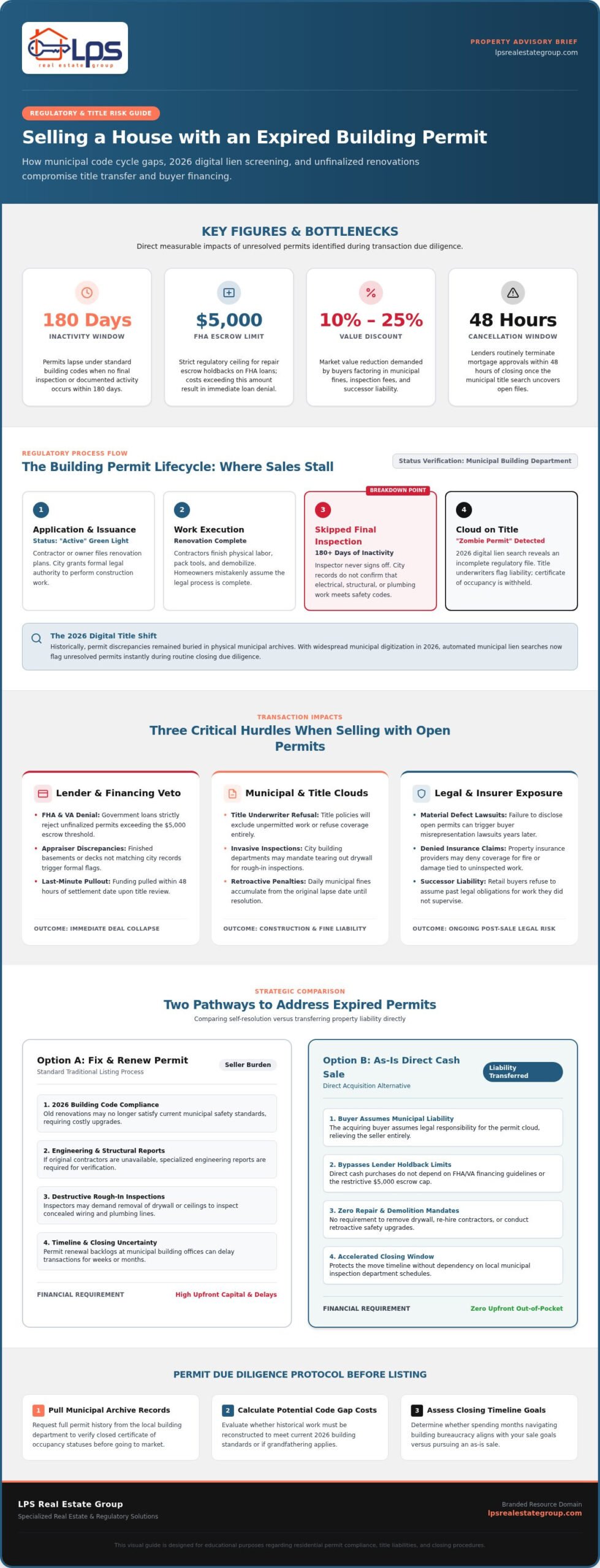
Comparing Your Options: Fix the Permit vs. Sell As-Is
Deciding how to move forward requires a realistic look at your bank account and your calendar. If you choose to fix the permit, you aren’t just paying for the paperwork. You are committing to a timeline that often stretches between 2 to 8 weeks for simple fixes; however, it can easily hit 3 to 6 months if structural issues arise. During this time, your holding costs, which include mortgage payments, property taxes, and utility bills, continue to drain your equity while the house sits off the market.
Retail buyers typically operate with a move-in ready mindset. They are often frightened by any mention of a building department, seeing it as a sign of hidden defects. Most will include a permit contingency in their offer. This clause requires you to close all open files before they sign the final papers, which puts the entire burden of resolution back on you. In contrast, a professional buyer views a permit cloud as a manageable project. They have the cash and the contractor relationships to handle the bureaucracy after the sale.
The True Cost of a Permit Resolution
Closing an expired permit isn’t always as simple as paying a renewal fee. You have to account for contractor coordination, municipal penalties, and potential re-inspections. If the original work was covered by drywall, an inspector might require destructive testing. This means cutting holes in your walls to verify electrical or plumbing work. These surprises can quickly lead to a bill exceeding $10,000 when you factor in labor and materials. You should determine if you have the liquidity to handle these sudden costs before you start the process.
Selling As-Is on the MLS: What to Expect
If you list on the traditional market, transparency is your best defense. You must write a detailed disclosure that explains the situation clearly. This protects you from future lawsuits and helps filter out buyers who can’t handle the complexity. You can learn more about this process in our guide on Selling Your House As-Is: The Complete 2026 Homeowner’s Guide. Keep in mind that on the MLS, your pool of buyers will likely be limited to those with significant cash reserves. Traditional lenders will remain hesitant when selling a house with an expired building permit to a typical family.
If the thought of managing contractors and city inspectors feels like too much, we can help. You can request a fair as-is property acquisition offer today and let us take the permit burden off your plate entirely.
Selling to a Direct Cash Buyer: The Stress-Free Alternative
If the technical steps for resolving permit issues feel like a full-time job you didn’t apply for, there is a simpler way forward. Selling a house with an expired building permit to a direct buyer allows you to bypass the bureaucracy entirely. Instead of spending months haggling with contractors or waiting for city inspectors to return your calls, you can transfer the property and its associated legal burdens to a professional who is equipped to handle them. This route is designed for homeowners who value their time and peace of mind above the traditional retail process.
When you work with a specialist in as-is property acquisition, the liability for unpermitted work or lapsed inspections shifts to the buyer at the moment of closing. You won’t need to perform a rough-in inspection or hire an engineer to certify old work. Because cash buyers don’t rely on bank financing, they aren’t bound by the strict FHA or conventional loan requirements that often derail traditional sales. This means the deal won’t collapse 48 hours before closing because of a zombie permit discovered during a title search.
The LPS Real Estate Group Approach
We approach every situation with the mindset of a compassionate advisor rather than a high-pressure salesperson. We understand that life happens. Sometimes a contractor disappears, or a family emergency takes priority over a final inspection sign-off. Our team listens to your specific permit situation without judgment and works collaboratively to find a fair outcome. We take the time to explain how we calculate our offers, ensuring you feel fully informed at every stage of the narrative.
Our goal is to provide a sense of relief to those facing complex title clouds. You can explore more about how this works in our guide on Companies That Buy Houses for Cash: A Homeowner’s 2026 Guide to Selling Fast. When we evaluate a property, we look at the potential costs of bringing it up to 2026 codes so you don’t have to worry about those financial surprises yourself. By assuming the risk of corrective work, we allow you to focus on your move instead of the building department.
From Offer to Closing in Days, Not Months
The traditional market is often unpredictable, but a direct sale offers a guaranteed closing date. You can choose a timeline that works for your move, whether that’s in two weeks or two months. We handle the paperwork with the building department post-closing, allowing you to walk away with your equity and leave the stress of selling a house with an expired building permit behind you. By avoiding expensive retrofits, holding costs, and municipal penalties, many homeowners find that a direct offer is the most financially logical path to their next chapter.
Take the Next Step Toward a Successful Sale
Dealing with municipal records and building inspectors can feel like an uphill battle. You now understand that while these unresolved files create clouds on your title, they don’t have to end your plans. You can choose to invest the months required to bring old work up to 2026 standards, or you can opt for a more direct solution. The most important thing is to choose the path that best fits your financial goals and your timeline. Transparency is your greatest asset, whether you are fixing the issue yourself or seeking a buyer who understands the complexity.
Selling a house with an expired building permit is a situation we handle every day. At LPS Real Estate Group, we are specialists in complex title and permit issues. We provide a transparent process where no repairs or inspections are required from you. We’re ready to take on the permit liability so you can close on your own timeline and move forward with peace of mind. You don’t have to face the building department alone; we’re here to help you find the fresh start you deserve.
Get a Fair Cash Offer for Your House As-Is
Frequently Asked Questions
Can I sell a house with an expired permit without fixing it?
Yes, it’s possible to sell without fixing the permit, but your pool of buyers will change. Traditional buyers often walk away because their lenders won’t approve a loan on a property with unresolved code issues. You can still reach a successful closing by targeting cash investors or professional firms. These buyers accept the property as-is and take on the responsibility of closing the permit after the sale is complete.
Will an expired permit show up on a title search?
Yes, most title searches in 2026 include a municipal lien and permit search. While old paper records were once easy to miss, digital portals now make every expired permit visible to title agents and attorneys. These unresolved files appear as a “cloud” on the title. Because title insurance underwriters see this as a risk, they typically won’t issue a policy until the permit is officially closed or the buyer assumes the risk.
How much does it cost to close an expired building permit in 2026?
Total costs depend on your local municipality’s fee schedule. Typically, you’ll pay a reactivation fee of 50% to 100% of the original permit price. If the work is ancient, penalties can double or triple the base cost. Beyond the city fees, you must account for the expense of hiring a contractor to oversee the final inspection and any repairs required to bring the construction up to current 2026 safety standards.
Can a buyer get a mortgage on a house with unpermitted work?
It’s nearly impossible for a buyer to secure a standard mortgage in this situation. Lenders for FHA, VA, and conventional loans require proof that all work was completed to code. If an appraiser flags unpermitted additions, the bank will likely pause the loan. This is why selling a house with an expired building permit usually requires a cash buyer who doesn’t need to meet a bank’s strict “subject to” repair requirements.
Do I have to disclose an expired permit to potential buyers?
Yes, you have a legal obligation to disclose any known material defects to potential buyers. An expired permit is a matter of public record and directly affects the home’s legal status. If you don’t disclose it, you risk a lawsuit for fraudulent concealment or misrepresentation after the deal closes. Providing a clear, written disclosure at the start protects you and ensures you are working with a buyer who understands the property’s history.
What happens if I ignore an expired permit and try to sell anyway?
Ignoring the issue usually leads to a failed sale. Most buyers discover the expired permit during their due diligence or when the title company runs a municipal search. When this happens at the last minute, the buyer’s mortgage is often rejected, and the deal falls through. Your property will then go back on the market with a “failed sale” history, which can make other buyers suspicious and lead to lower offers.
Can I be fined by the city after I sell the house for an old permit?
Municipal fines generally follow the property, so the new owner becomes responsible for them. However, you aren’t necessarily off the hook. If the buyer discovers the permit after closing and can prove you didn’t disclose it, they may sue you to cover the costs of the fines and repairs. Selling to an as-is professional buyer with full disclosure is the safest way to ensure you aren’t pulled back into legal disputes later.
How does a cash buyer handle expired permits differently than a traditional buyer?
A cash buyer provides a level of certainty that a traditional buyer simply can’t offer. Because they aren’t waiting for a bank’s approval, they can move forward despite title clouds. When selling a house with an expired building permit to a firm like LPS Real Estate Group, you transfer the permit liability to us. We handle the city inspections and repairs post-closing, allowing you to move on without the stress of bureaucracy.