

What if the fastest way to stop the financial drain of a difficult rental isn’t a long, expensive legal battle, but simply walking away with a check in hand? Dealing with property damage or the constant anxiety of legal repercussions can make you feel trapped in your own investment. It’s exhausting to watch your rental income disappear while you remain responsible for the mortgage and taxes.
You probably feel like your options are limited, especially with strict regulations like California’s AB 1482 or local notice requirements making it harder to clear a property for sale in 2026. However, you don’t have to wait for a lease to expire or spend months in housing court to find relief. You can sell house with bad tenants directly and skip the stress of traditional showings and uncooperative occupants.
This guide will show you how to navigate current legal hurdles while protecting your financial interests. We’ll explore how to hand off the tenant problem to a professional buyer so you can close quickly, receive cash, and finally move on with peace of mind.
Key Takeaways
- Identify how 2026 rental regulations and specific lease types dictate your legal options when preparing for a sale.
- Understand why traditional listings often fail when uncooperative tenants neglect property maintenance or interfere with potential buyers.
- Discover the financial benefits of choosing to sell house with bad tenants directly to an as-is buyer rather than pursuing a costly eviction.
- Evaluate the practical risks and rewards of modern “Cash for Keys” strategies compared to the lengthy timelines of formal legal proceedings.
- Learn how a compassionate expert can take over the management of difficult occupants, allowing you to walk away with a fair cash offer.
Understanding the Burden of Selling a House with Bad Tenants in 2026
Owning a rental property is often marketed as a hands-off way to build wealth. However, when you need to sell house with bad tenants, that dream can quickly turn into a grueling daily struggle. In 2026, the definition of a “bad tenant” has expanded beyond simple late payments. It now includes chronic lease violations, unauthorized occupants, and physical neglect that actively destroys your equity. What was once a source of passive income often becomes an active nightmare that consumes your evenings and weekends with stress and paperwork.
The 2026 rental market presents unique challenges for landlords. Courts in many regions remain backlogged, and legal fees are climbing, making traditional evictions slower and more expensive than in previous years. Understanding the basics of Landlord-Tenant Law is essential for any owner, but even a perfect legal standing doesn’t stop the financial bleed while you wait for a court date. Many landlords find that “waiting it out” only leads to further property devaluation and a deeper financial hole.
The True Cost of a Problematic Tenancy
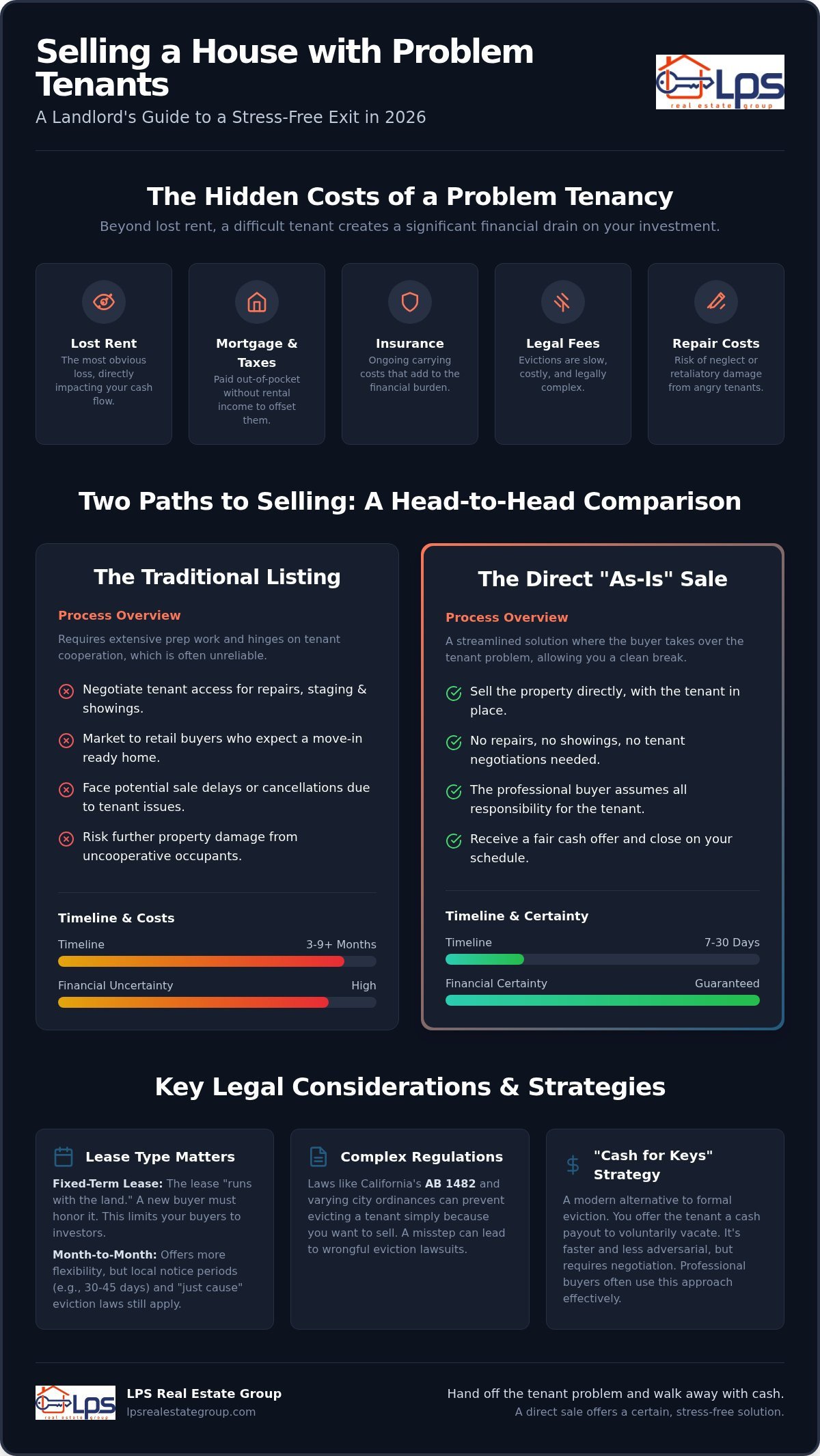
Every month a non-paying tenant stays in your property, you aren’t just losing rent. You are also paying the mortgage, insurance, and property taxes out of your own pocket. When you add in the cost of legal representation and the inevitable repairs needed after a difficult move-out, the numbers become staggering. A distressed tenancy is a financial liability rather than an investment. It’s a hole in your portfolio that consumes capital without providing a return. This “opportunity cost” means your money is stuck in a failing asset instead of growing in a healthy, stress-free environment.
When the Relationship Turns Adversarial
There is a specific point where a landlord-tenant relationship shifts from professional to combative. You might notice the tenant stops responding to maintenance requests or refuses to allow scheduled inspections. If you mention your intent to sell, the risk of retaliatory damage increases significantly. Some tenants may intentionally damage floors, walls, or appliances to lower the home’s value or deter buyers.
If you find yourself dreading every phone notification, it’s a clear sign that professional intervention is necessary. Trying to sell house with bad tenants through traditional channels often backfires. These occupants can sabotage showings, leave the home in a state of disarray, or simply refuse to leave, making the property nearly impossible to market to retail buyers who want a move-in-ready home. Recognizing these signs early allows you to seek an exit strategy that protects your remaining equity before the situation worsens.
Navigating the Legal Landscape: Tenant Rights vs. Seller Goals
Selling a property is stressful, but doing so with uncooperative occupants adds a layer of legal complexity that can feel paralyzing. You want to move forward with your life, yet the law ensures tenants aren’t displaced without specific protections. In 2026, the hierarchy of rights is more localized than ever. While federal and state laws provide a baseline, city-specific ordinances often dictate the actual timeline of your sale.
For instance, if your property is in Utah, state law might suggest a 15-day notice for month-to-month tenancies. However, if that home is in Salt Lake City, you’re looking at a 30-day requirement. In Moab, that requirement jumps to 45 days. Missing these details doesn’t just delay your closing; it can open the door to “wrongful eviction” lawsuits that cost far more than the sale is worth. Understanding these boundaries helps you set realistic expectations for your exit strategy.
Fixed-Term Leases vs. At-Will Agreements
The type of contract you have in place fundamentally changes who will buy your home. A common legal principle is that the lease “runs with the land.” This means a buyer inherits the tenant and must honor the existing terms until the lease expires. If you try to sell house with bad tenants who are on a fixed-term lease, retail buyers who want to move in immediately will likely walk away. You’re effectively restricted to selling to investors who are comfortable managing the transition.
Month-to-month or “at-will” agreements offer more flexibility, but they aren’t a free pass. In California, for example, AB 1482 prevents you from evicting a tenant just because you want to sell. You may need to negotiate a voluntary buyout or wait for a specific “just cause” to arise. Always review your original contract for a “termination upon sale” clause. These can sometimes shorten notice periods to 30 or 60 days if the property changes hands.
Complying with 2026 Notice Requirements
The “Right of Entry” for showings and inspections is often the biggest hurdle. Most jurisdictions require 24 to 48 hours of written notice before you or a realtor can enter. The reality, however, is that a hostile tenant may simply refuse to unlock the door. While this is a breach of the lease, forcing entry is risky. It often leads to harassment allegations or retaliatory damage to the property.
Disclosure is your best defense against post-sale litigation. You have a legal obligation to tell potential buyers about non-payment, active lease violations, or existing disputes. If the legal weight of these requirements feels like too much to carry, a direct as-is property acquisition allows you to hand off these responsibilities to a professional buyer who specializes in complex situations.
The Reality of Traditional Listings: Why Bad Tenants Kill Retail Sales
Most landlords hope to list their property on the open market to attract the highest possible price. However, if you try to sell house with bad tenants through a traditional real estate agent, you will likely face a harsh reality check. Retail buyers are looking for a dream home, not a legal project or a renovation nightmare. When a tenant is uncooperative, they can effectively hold your equity hostage by ruining the presentation of the property.
First impressions are everything in a traditional sale. If a tenant refuses to clean, leaves trash in the yard, or allows odors to permeate the home, your asking price will drop instantly. This “smell test” is often the first thing that sends a qualified buyer back to their car. Beyond the physical state of the home, there is the sabotage factor. A hostile occupant might intentionally tell prospective buyers about non-existent structural issues or complain about the neighborhood just to kill the deal and stay in the home longer.
Why Retail Buyers Run Away
First-time homebuyers are especially sensitive to risk. They are often terrified of “inheriting a lawsuit” or spending their first six months of ownership in housing court. If a tenant acts aggressively during a showing, the emotional connection a buyer needs to make a high-value offer is severed immediately. Most families want a move-in-ready space where they feel safe and welcomed. In these high-friction situations, choosing to sell house as is to a professional buyer is often the only way to bypass the need for a tenant’s cooperation.
The Appraisal and Inspection Bottleneck
Even if you find a buyer willing to take the risk, the bank usually becomes the final roadblock. Lenders require a full appraisal and often a detailed home inspection before they approve a mortgage. If a tenant refuses to grant entry to the appraiser, the entire deal can collapse at the 11th hour. Banks simply won’t lend on a property they can’t physically verify, and most will require the home to be “broom-clean” before closing.
Time is your enemy in a traditional sale. If a tenant causes a delay of even a few weeks, the buyer’s mortgage rate could expire. In a fluctuating market, a higher interest rate might mean the buyer no longer qualifies for the loan. This leaves you right back at the beginning, still responsible for the mortgage on a property you can’t show or sell effectively. Working with a buyer who uses their own capital removes these financing hurdles entirely, ensuring the deal closes regardless of the tenant’s behavior.
Strategic Options for Landlords: Cash Offers and Creative Solutions
If you’ve reached the point where you’re ready to sell house with bad tenants, you need a strategy that prioritizes your financial safety and mental health. There isn’t a one-size-fits-all solution, but there are several paths you can take to reclaim your time. You don’t have to be the one to solve every tenant dispute yourself. Instead, you can choose an exit strategy that minimizes your exposure to further losses.
The traditional eviction route is often a landlord’s first instinct. In 2026, however, this path is increasingly complex. If your property is in California and the tenant has lived there for more than a year, you must provide a 60-day notice and have “just cause” under AB 1482. Even in Utah, while the state minimum is 15 days, Salt Lake City requires 30 days and Moab requires 45. These varying timelines allow “professional tenants” to stay in place while your legal bills mount. It’s a trap that can cost you months of rental income and thousands in attorney fees.
The ‘Cash for Keys’ Framework
A “Cash for Keys” agreement is a popular alternative. This is a negotiated buyout where you pay the tenant to leave by a specific date. To protect yourself, you must have a formal, written contract that clearly outlines the expectations. Never pay the tenant until the property is completely vacant and you have the keys in your hand. Paying too early is a common mistake that leaves you with no leverage if they decide to stay. If the negotiation feels too confrontational, you can involve a cash home buyer. They often have the experience to handle these delicate conversations as part of the sale, saving you the emotional burden.
The Direct Buyout Advantage
The most effective way to solve a difficult tenancy is to hand the responsibility to a professional. A direct buyout allows you to sell house with bad tenants as-is. This means the buyer takes over the lease, the occupants, and any existing disputes. You don’t have to worry about cleaning up after a neglectful tenant or managing the “Right of First Refusal” if your local laws require it. This strategy offers a fast closing and the certainty of a cash offer. It’s a clean break from the daily anxiety of property management. If you’re ready to walk away from the stress, you can explore a direct property acquisition and move on with your life.
The LPS Real Estate Group Approach: A Stress-Free Exit Strategy
Most landlords we work with aren’t looking for a fight. They’re simply looking for a way to protect their investment and regain their peace of mind. At LPS Real Estate Group, we understand that you might feel like the “bad guy” when trying to resolve a difficult tenancy. Our approach is built on the role of a compassionate expert. We step into the situation with professional authority and deep empathy, ensuring that every individual is treated with respect while we work toward a clear resolution.
When you decide to sell house with bad tenants to us, our evaluation process is designed to be as low-impact as possible. We don’t need multiple walkthroughs or a tenant’s permission for a two-hour home inspection. We evaluate the property’s potential and the specific tenant situation simultaneously. This allows us to provide a fair offer that accounts for the current occupancy without requiring you to “fix” the tenant’s behavior before we close.
Choosing companies that buy houses for cash provides a level of certainty that the retail market simply can’t match. We take over the lease and the full legal liability the moment we close. If the tenant is a non-payer or a squatter, that becomes our responsibility to manage through our localized legal resources. You walk away with your cash and the relief that the problem is finally off your plate.
Certainty in Uncertain Situations
Transparency is the foundation of our business. We don’t use high-pressure tactics or hide fees in the fine print. Our goal is to provide a steady, methodical transition that respects your timeline. Because we operate as a professional firm with local expertise, we understand the nuances of 2026 notice requirements in your specific city. Whether it’s navigating a complex buyout or managing a holdover tenant, we handle the logistics so you don’t have to.
Taking the First Step Toward Relief
The path to a stress-free closing is straightforward. It starts with a simple conversation where we listen to the details of your situation. You don’t need to worry about repairs, cleaning, or even communicating the sale to a hostile occupant. We’ve seen every type of “nightmare” tenant, and we have the patience and experience to handle them with integrity. You can sell house with bad tenants today and start your next chapter without the weight of a distressed asset holding you back.
Get a fair cash offer from LPS Real Estate Group today.
Reclaiming Your Peace of Mind and Your Equity
Navigating the legal, financial, and emotional hurdles of a difficult property doesn’t have to be your permanent reality. You’ve seen how the 2026 rental market and traditional listing process can often work against landlords, but you also have the power to choose a different path. By prioritizing your financial health, you can stop the cycle of lost rent and property damage today. The most effective way to sell house with bad tenants is to partner with a team that specializes in these complex situations.
You don’t need to worry about making repairs, cleaning up after neglectful occupants, or managing uncooperative individuals when you have a direct buyer ready to step in. We handle the difficult conversations and the legal transitions so you can walk away with cash and a clean slate. LPS Real Estate Group provides the certainty of a closing in as little as 7 days, allowing you to stop being the middleman in a stressful dispute.
When you’re ready to move forward, request a no-obligation cash offer for your tenant-occupied property. You deserve a solution that puts your needs first and handles every detail with integrity. Relief is closer than you think.
Frequently Asked Questions
Can I sell my house if the tenant is in the middle of a fixed-term lease?
Yes, you can sell your property at any time, but the existing lease remains in effect. The new owner must honor the terms until the lease expires because the contract “runs with the land.” This often makes it difficult to find a traditional buyer who wants to move in immediately. However, professional investors often prefer these properties because they are prepared to manage the transition or wait for the lease to end.
What if the tenant refuses to allow potential buyers into the house for showings?
You have a legal right to enter for showings if you provide proper notice, which is usually 24 to 48 hours in most jurisdictions. If a tenant still refuses, forcing your way in can lead to harassment claims or retaliatory property damage. To avoid this friction, many owners choose to sell house with bad tenants to a direct buyer who doesn’t require repeated walkthroughs or public open houses.
Is it better to evict a bad tenant before selling or sell with them in place?
The best choice depends on your timeline and budget. Eviction in 2026 is often a slow and expensive process due to court backlogs and strict local protections. If you choose to sell house with bad tenants to a professional buyer, you can transfer the legal burden and the cost of the “problem” to someone else immediately. This is usually the fastest way to walk away with cash and peace of mind.
How much value does a bad tenant take away from my home’s selling price?
A difficult tenant can significantly lower your home’s value by creating a “distressed” environment. Between property neglect, odors, and the risk of sabotage during showings, you might see a much lower appraisal or fewer offers from families. While exact figures depend on the property, the cost of repairs and the “risk premium” buyers demand can take a large chunk out of your equity.
What are the legal risks of offering ‘cash for keys’ to a problem tenant?
The primary risk is a tenant taking your money and still refusing to leave. You must have a legally binding, written agreement that specifies the move-out date and the condition of the property. Never provide the funds until the property is completely empty and you have the keys in your hand. Some local ordinances also have specific rules about how these buyouts must be documented to be valid.
Can a cash buyer really take over my house if the tenant hasn’t paid rent in months?
Yes, a professional cash buyer can acquire your property regardless of the tenant’s payment status. We specialize in taking over properties with non-paying occupants or squatters. Once the sale is finalized, the legal responsibility for the tenant transfers to us. This allows you to receive your equity and stop worrying about the months of lost rental income and mounting mortgage payments.
Do I have to pay a real estate commission when selling to a direct buyer?
No, you typically don’t pay any real estate commissions when selling to a direct buyer. Because there isn’t an agent involved in a “middleman” role, you save the standard 5% to 6% fee. Most direct buyers also cover the closing costs. This ensures the offer you receive is much closer to the actual amount of cash you’ll have in your pocket at the end of the transaction.
What happens to the security deposit when I sell a tenant-occupied house?
When you sell, you’re legally required to either transfer the security deposit to the new owner or return it to the tenant. Most states require this transition to happen within 30 days of the sale. We handle the paperwork for this transfer during the closing process. This ensures you stay compliant with local landlord-tenant laws without having to coordinate directly with an uncooperative tenant.