
Did you know that nearly half of all potential buyers will walk away from a home purchase the moment they discover a mold problem, even if it has already been professionally fixed? It’s a frustrating reality that makes selling a house with mold as is feel like an impossible task. You might be staring at remediation estimates that reach as high as $30,000, or perhaps you’re losing sleep over the complex legal requirements of disclosure. It is natural to feel overwhelmed when traditional buyers seem to disappear the moment they see a damp spot.
We understand that you want a fair outcome without the headache of managing contractors or the fear of future lawsuits. Finding a path forward doesn’t have to be a financial nightmare. This guide will show you how to handle the 2026 real estate market with confidence. We will cover the latest state disclosure laws, explain why cash buyers are increasingly looking for properties exactly like yours, and provide a clear path to a stress-free sale. You don’t have to let mold define your financial future or your peace of mind.
Key Takeaways
- Understand your legal obligations regarding “latent defects” and why full transparency is your best defense against future liability.
- Evaluate the true cost of remediation versus the simplicity of selling a house with mold as is to determine which path best protects your financial interests.
- Learn why traditional financing often fails for mold-affected homes and how cash acquisitions provide a more reliable alternative for homeowners.
- Discover how to compile the necessary documentation and disclosure statements to ensure a smooth, legally sound transaction without the stress.
- Find out how a direct as-is purchase eliminates the need for inspections, appraisals, and the headache of managing expensive contractors.
Understanding Mold and Your Legal Disclosure Obligations
Real estate law identifies mold as a latent defect. This means it is a hidden problem that isn’t immediately obvious but could harm the home’s value or the health of its occupants. Before you begin selling a house with mold as is, you need to grasp the legal weight of this classification. It is more than just a cleaning hurdle; it is a material fact that influences the entire transaction and your future liability.
Honesty is your best protection against future litigation. While it feels risky to admit the property has issues, failing to disclose known mold can lead to expensive lawsuits or a judge rescinding the sale entirely. Transparency creates a clean break. It allows you to walk away from the closing table knowing the buyer was fully informed and you are no longer responsible for the property’s condition.
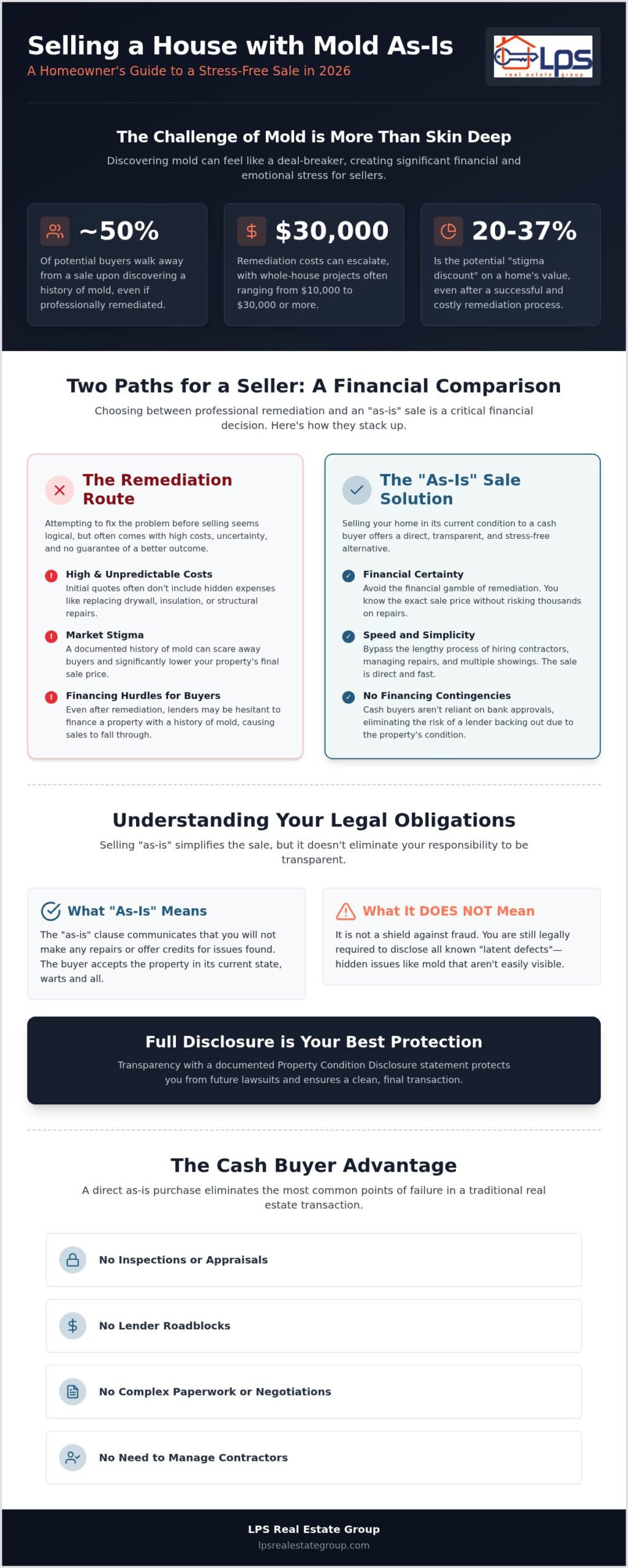
An “As-Is” clause is a helpful tool, but it isn’t a “get out of jail free” card. It simply states that you won’t be performing repairs or offering price reductions for discovered issues. It does not override your legal duty to be truthful. When you are selling a house with mold as is, this clause is standard, but it must always be paired with a comprehensive disclosure statement to be effective.
Federal and State Disclosure Frameworks
Most real estate transactions involve a formal Property Condition Disclosure. This form requires you to answer specific questions about the home’s history. You might wonder if you can claim ignorance. However, legal standards often look at what a homeowner should have reasonably known. To understand the risks, it helps to review What is Indoor Mold? and how it spreads through a structure. If there were visible water stains or a persistent musty smell, claiming ignorance might not hold up in court. A professional inspection report can serve as a valuable piece of evidence that you acted in good faith and provided all available information.
The Difference Between Surface Mold and Systemic Issues
It helps to distinguish between minor cosmetic issues and systemic failures. Surface mold on a window sill is relatively simple. Systemic mold, which often hides behind drywall or in crawlspaces, usually points to larger problems like foundation leaks or roof damage. You should document these issues clearly. Providing a buyer with an inspection report or a repair estimate allows them to see the full scope of the work needed. This transparency helps you attract professional buyers who specialize in these types of properties and are comfortable taking on the repairs themselves.
Remediation vs. Selling As-Is: A Financial Comparison
Deciding whether to repair your home or sell it in its current state is a significant financial crossroad. It requires a cold, hard look at the numbers. While fixing the problem might seem like the way to preserve your equity, the math often tells a different story. The financial burden of remediation frequently extends far beyond the initial quote you receive from a contractor. You have to account for the actual work, the hidden structural repairs, and the potential loss in market value even after the mold is gone.
Professional mold remediation in 2026 carries a national average cost between $2,300 and $2,400. However, for properties with systemic issues, these costs quickly escalate. A whole-house project often ranges from $10,000 to $30,000. These figures usually only cover the removal of the mold itself. They don’t include the “hidden” expenses like tearing out contaminated drywall, replacing saturated insulation, or reconstructive carpentry. If the home becomes uninhabitable during the process, you must also factor in the cost of temporary housing.
Even after spending thousands on repairs, you face the “Stigma Discount.” Data shows that a history of mold can decrease a home’s resale value by 20% to 37%. Buyers are naturally cautious about the health risks of mold exposure. In fact, up to 50% of potential buyers will walk away from a purchase if they discover a mold history, regardless of whether it was professionally remediated. When selling a house with mold as is, you bypass this uncertainty by finding a buyer who accepts the property’s history from the start.
The High Cost of Professional Remediation
Professional work is a multi-stage process. It involves setting up negative pressure containment, using industrial air scrubbers, and careful physical removal. Many homeowners try a DIY approach to save money, but these efforts often fail professional clearance tests. This failure can lead to even higher costs when a professional has to redo the work. Additionally, a history of mold claims can cause your homeowners insurance premiums to spike, adding a long-term financial drain to an already expensive situation.
Benefits of Choosing an As-Is Sale
Choosing an as-is sale provides immediate liquidity. You don’t have to drain your savings or take out loans to fund renovations. This path eliminates “scope creep,” which is when a small repair turns into a massive project once the walls are opened. For a broader perspective on these advantages, you can read our guide on selling your house as-is. If you prefer to avoid the stress of contractors altogether, requesting a direct offer from a cash buyer can help you move forward with total transparency and peace of mind.
Why Traditional Buyers and Lenders Avoid Moldy Homes
Traditional lenders view mold as a red flag that signals deeper, systemic neglect. If you are selling a house with mold as is to a retail buyer, the transaction often hits a wall during the appraisal phase. Banks usually won’t release funds for a property that doesn’t meet basic health and safety standards. This creates a catch-22. The buyer wants the home, but their bank won’t allow the purchase until the mold is gone. For a homeowner, this means being stuck in a loop of failed contracts and mounting stress.
Real estate agents also feel this pressure. Many are hesitant to list a distressed property because they know it will sit on the market longer than a “move-in ready” home. They worry about the liability of showing a house with potential health risks. This hesitation can leave you feeling like your property is untellable through traditional channels, but it’s important to remember that the hurdle isn’t the house itself; it’s the strict requirements of the traditional mortgage system.
Financing Roadblocks for Retail Buyers
FHA and VA loans are particularly strict. Their inspectors look for any condition that could jeopardize the occupant’s health. If mold is present, the loan is typically denied until professional remediation is completed and cleared. Some buyers try the 203(k) renovation loan, but this is a difficult path involving high interest rates and complex oversight that many families find exhausting. Recent 2026 updates from Fannie Mae and Freddie Mac show a trend toward even tighter scrutiny. The elimination of “limited reviews” means lenders are looking closer at every detail, making it harder to secure financing for properties with deferred maintenance. A property’s “Clue Report”-a history of insurance claims-can also make the home uninsurable, which effectively makes it unmortgageable for a standard buyer.
The Emotional Barrier of Mold
Beyond the money, there is a powerful emotional hurdle. The smell of mold is often the first thing a buyer notices. It triggers an immediate “flight” response. Families are naturally worried about mycotoxins and long-term health risks. You are legally required to disclose mold, and once that disclosure is made, many “fixer-upper” enthusiasts who are fine with outdated kitchens will still draw the line at systemic issues. They fear the unknown costs and the health implications for their children. This is why selling a house with mold as is often requires a different strategy. In early 2026, the share of all-cash home purchases stayed near 29%, reflecting a growing market of direct home buyers who can bypass bank hurdles and handle the cleanup themselves.
How to Prepare Your Mold-Affected Home for an As-Is Sale
Preparation for an as-is sale is not about concealment; it’s about clarity. When you’re selling a house with mold as is, your primary objective isn’t to hide the damage or perform temporary fixes. Instead, you want to define the scope of the problem so the right buyer can price the property accurately from the start. This approach protects you from future legal claims and ensures the sale doesn’t fall apart during a final walk-through. A well-documented home is much easier to sell than one shrouded in mystery.
Documenting the Issue Transparently
Over-disclosing is your strongest legal shield. If you have old inspection reports, laboratory results, or quotes from remediation specialists, gather them into a single folder. Photos are essential tools here. Use them to show the damp areas and the specific source of moisture, whether it was a slow roof leak or a sudden pipe burst. This level of transparency builds immediate trust with professional buyers who are used to seeing distressed properties. If the home was inherited, you should also take time to understand the cost to sell a house in probate, as these legal factors can influence your closing timeline and final net proceeds.
You don’t need to perform a full $25,000 remediation to make the home sellable to a professional. However, a basic safety cleaning can be beneficial. Focus on improving ventilation by opening windows when the weather allows or using dehumidifiers to stabilize the air. Removing water-damaged carpet or ruined furniture can also make the property safer for professional walkthroughs. This shows you’re acting in good faith without requiring you to manage a massive renovation project or hire expensive contractors.
Finding and Vetting As-Is Cash Buyers
Traditional buyers usually can’t close on these properties because of the lending hurdles we discussed earlier. You need a specialist who understands the math of selling a house with mold as is. Look for firms with a clear track record and always ask for “Proof of Funds” before signing a contract. A reputable buyer won’t hesitate to show they have the liquidity ready to close. National firms often provide more stability and reach, while local buyers might have a deeper understanding of regional humidity issues. Both options typically offer a closing within days rather than the months required for a retail sale.
Finding a partner who respects your situation and understands these complexities makes the process much smoother. If you want to avoid the stress of listings and showings, you can get a direct cash offer from a buyer who specializes in as-is acquisitions. This ensures a fair price and a clean break from the property without the need for any repairs.
Selling to LPS Real Estate Group: A Stress-Free Path Forward
Facing a property with systemic mold can feel like carrying a heavy weight you can’t put down. LPS Real Estate Group offers a way to set that weight aside. Our “As-Is” promise means exactly that. We specialize in selling a house with mold as is, purchasing properties regardless of water damage, air quality issues, or structural decay. You won’t have to hire a single contractor or spend a weekend scrubbing walls. We take on the remediation work ourselves after the sale, allowing you to move on with your life and your equity intact.
We provide the certainty that traditional real estate transactions often lack. When you work with us, you aren’t waiting on a bank’s appraisal or a lender’s approval. We use our own capital to buy your home, which eliminates the risk of the deal falling through at the last minute. This direct approach is designed to give you peace of mind and a clear, predictable path to a fresh start.
A Simple Three-Step Closing Process
We believe that selling a distressed property should be straightforward and transparent. Our process is built around three manageable steps:
- Step 1: Consultation. We start with a simple conversation. We listen to your specific needs and conduct a transparent assessment of the property’s current condition.
- Step 2: Fair Cash Offer. You receive a competitive, no-obligation cash offer. We don’t use high-pressure tactics; we want you to feel fully informed and comfortable with the numbers.
- Step 3: Choose Your Date. If the offer works for you, you pick the closing date. We can close in as little as a few days or work around your specific moving schedule.
Why Homeowners Choose LPS Over Traditional Listings
Traditional listings often fail when selling a house with mold as is because of the financing and insurance hurdles we explored earlier. LPS provides a reliable alternative. There are no commissions, no hidden fees, and no closing costs. The offer you see is the amount you receive when the papers are signed. This speed and transparency are vital for those facing foreclosure or managing the complexities of an inherited home in probate.
For more insights into how this process works in the current market, you can read our definitive 2026 homeowner’s guide. We pride ourselves on a commitment to empathy and professional integrity. We treat every homeowner as a partner, ensuring that your circumstances are respected and your transition is handled with the care it deserves.
Moving Forward with Confidence and Clarity
Dealing with a property affected by mold can feel like an endless cycle of expensive repair quotes and buyer rejections. However, you’ve now seen that a difficult property doesn’t have to mean a difficult sale. By prioritizing transparent disclosure and understanding the limitations of traditional lending standards, you can protect your legal interests and your financial well-being. The key is choosing a path that removes the uncertainty of remediation and the stress of managing contractors.
When you decide that selling a house with mold as is is the right choice for your situation, you deserve a partner who values honesty as much as you do. We are here to listen and provide a solution that fits your specific timeline. Our team offers A+ rated customer service and maintains transparent communication throughout the entire process. You don’t have to worry about repairs, cleaning, or hidden fees. We can often close in as little as 7 days, allowing you to walk away with cash in hand and a clean slate.
Get a fair as-is cash offer for your mold-affected home today. You have the information you need to make the best decision for your future, and we’re ready to help you take that next step whenever you’re ready.
Frequently Asked Questions
Can a buyer sue me after the sale if they find more mold?
A buyer can sue you if they can prove you intentionally withheld information about a material defect. When selling a house with mold as is, your best defense is a detailed disclosure form. Be honest about every leak or damp spot you’ve noticed. While an “as-is” contract protects you from making repairs, it doesn’t excuse you from the legal requirement to be truthful about the property’s history.
Do I need to hire a mold inspector before selling as-is?
You aren’t legally required to hire an inspector before an as-is sale. Many homeowners choose to skip this step to save money and avoid managing more contractors. However, if you want a clear record for your disclosure statement, a professional report can be a useful tool. Professional cash buyers usually conduct their own walkthroughs, so they don’t require you to provide a pre-sale inspection or laboratory clearance.
Will homeowners insurance cover mold remediation before a sale?
Insurance coverage depends on the source of the moisture. Most policies cover mold only if it was caused by a sudden, accidental event like a burst pipe or a failing water heater. If the mold grew slowly due to high humidity or a long-term roof leak, your claim will likely be denied. It’s best to check your specific policy language before counting on insurance to fund any remediation work.
How much does mold devalue a home in 2026?
Data from 2026 indicates that mold can reduce a property’s value by 20% to 37%. This devaluation happens because buyers perceive the home as a health risk and a financial liability. Even if you spend thousands on repairs, the property may still sell for less than a home with a clean history. This is why many owners find that selling a house with mold as is is the most predictable financial outcome.
Is it better to clean surface mold myself before an inspection?
Cleaning surface mold right before an inspection can be interpreted as an attempt to hide a larger problem. It is much safer to leave the area as it is and point it out to the buyer. This transparency builds trust and protects you from future claims of concealment. If you feel the need to tidy up, focus on removing ruined furniture or debris rather than scrubbing away the evidence.
What happens if mold is found during the buyer’s home inspection?
If a traditional buyer’s inspector finds mold, the sale often stalls. Lenders typically won’t approve a mortgage for a property with a health and safety hazard. The buyer will likely demand professional remediation or a significant credit to handle the work themselves. In many cases, the deal falls through entirely if the bank refuses to issue the loan. This is a common hurdle in the retail market.
Can I sell a house with black mold to a traditional buyer?
You can try, but it’s a difficult path. Traditional buyers rely on bank financing, and lenders have strict standards for habitability. Black mold often triggers an automatic denial for FHA or VA loans. Even with a conventional mortgage, the appraisal will likely flag the issue as a safety risk. Most successful sales of these properties involve cash buyers who don’t need to satisfy a lender’s rigid health requirements.
How long does it take to sell a moldy house for cash?
Selling to a cash buyer is the fastest way to move on from a distressed property. Unlike the traditional market, which can take months, a cash transaction often closes in 7 to 14 days. This speed is possible because there are no bank appraisals, no lender inspections, and no waiting for mortgage approvals. It’s a straightforward process that allows you to get your funds and leave the property’s problems behind.