

Yes, selling a house with squatters in Florida is possible, though the occupants may affect how the sale proceeds. Florida’s adverse-possession period is 7 years, and simply staying in a property doesn’t automatically give someone ownership. Whether a sheriff’s removal process applies depends on the occupant’s status and the circumstances.
It’s understandable to feel that you must wait until the property is empty before selling. This guide explains how Florida’s removal process works, what can affect the timeline, and which conditions matter in an adverse-possession claim. It also covers selling a house with squatters in Florida while occupants remain, including to a cash buyer. The right path depends on the facts, so start by understanding the legal distinctions that may shape your next step.
Key Takeaways
- Learn which conditions a squatter must meet to make an adverse-possession claim, and why time in the property alone doesn’t establish ownership.
- Understand how the occupant’s relationship to the owner and any pending legal dispute can affect Florida’s removal process and timing.
- See when an eviction, unlawful-detainer case, or expedited removal route may apply, and which self-help actions to avoid.
- Compare waiting for removal with selling the property as-is to a cash investor, including what to consider before choosing a path.
1. Could a squatter actually take ownership through adverse possession?
Florida’s statutory period for adverse possession is 7 years. That does not mean an unlawful occupant becomes an owner after simply staying that long. The person claiming ownership must meet legal requirements, and the property owner can take steps to recover possession before a claim succeeds.
Across the United States, adverse possession laws exist in all 50 states, but requirements differ. Common requirements include actual, open, notorious, exclusive, hostile, and continuous possession throughout the required period. In this context, hostile means without the owner’s permission, not necessarily aggressive conduct. A lawful rental or other permitted occupancy is different from an unauthorized occupation.
Continuity matters: an interruption in an occupant’s possession may affect an adverse-possession claim. A vacant property alone does not prove that someone possessed it continuously or exclusively. The claim depends on the occupant’s conduct and whether every required element is met for Florida’s statutory period.
A notice to vacate demands that an occupant leave, but the notice itself does not transfer ownership or restore possession. If the person stays, owners should use a lawful removal process rather than changing locks, cutting utilities, or removing belongings. Self-help eviction, including those actions, is illegal in all 50 states. Restoring possession means regaining control through the applicable legal process.
What are Florida’s laws on squatters and adverse possession? Florida generally requires 7 years for adverse possession, along with the applicable possession requirements; unauthorized occupancy alone does not establish ownership. Can a buyer take over a Florida property’s eviction case after closing? The sale does not by itself settle who controls an existing case; the case status, sale documents, and court procedure shape the next steps.
Squatters can affect a Florida home’s sale price, title review, financing, and insurance because the property is occupied and possession may be disputed. Buyers may factor the removal process into an offer, while title, lending, or insurance decisions can depend on the occupancy and sale details. Documenting the occupant’s status and any pending case helps clarify what a buyer would acquire.
2. How long does it take to remove a squatter before selling?
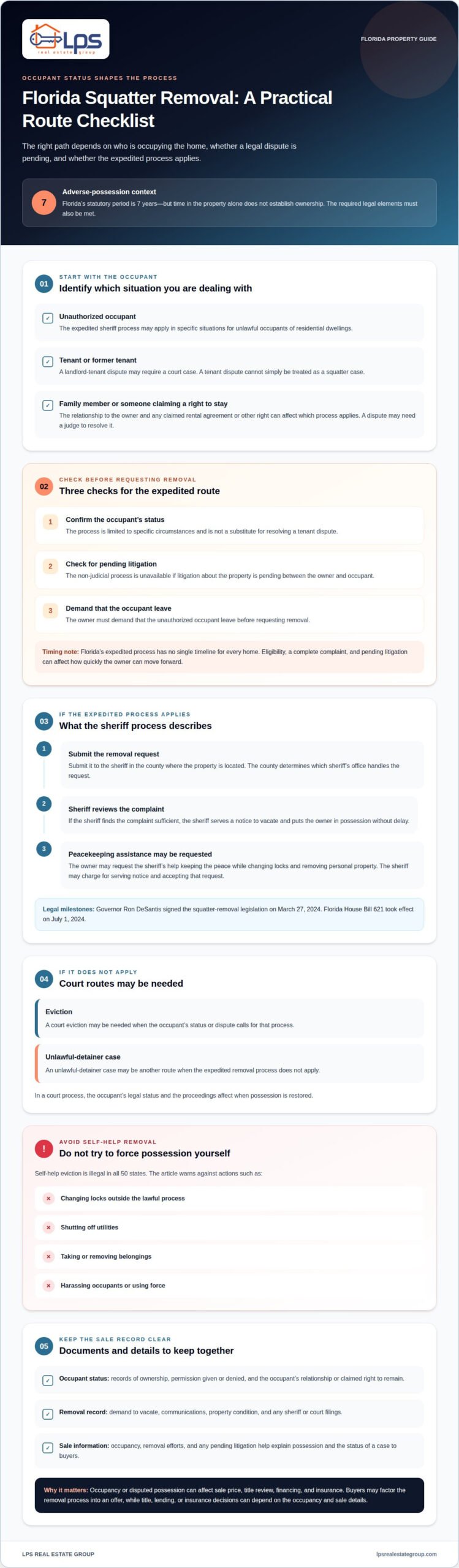
Florida’s expedited process can shorten the route to possession, but it has no single timeline for every home. Eligibility, a complete complaint, and any pending litigation affect how quickly the owner can move forward. Florida Governor’s Office states Governor Ron DeSantis signed the squatter-removal legislation on March 27, 2024.
The non-judicial process applies only in specific situations. The available removal process may depend on the occupant’s relationship to the owner and the circumstances. The process is also unavailable if litigation about the property is pending between the owner and occupant. Before requesting removal, the owner must demand that the unauthorized occupant leave. A tenant dispute cannot simply be treated as a squatter case.
If the sheriff finds the complaint sufficient, the sheriff serves a notice to vacate and puts the owner in possession without delay. The owner may request the sheriff’s help keeping the peace while changing locks and removing personal property. The sheriff may charge for serving notice and accepting that request. These steps differ from a court eviction, where the occupant’s legal status and court proceedings affect when possession is restored.
Don’t try self-help removal. Changing locks, shutting off utilities, taking belongings, harassing occupants, or using force can create legal risk. Self-help eviction is illegal in all 50 states. Keep records of the demand to vacate, communications, property condition, and any sheriff or court filings. Those documents can clarify the removal process before a listing or sale proceeds.
What disclosures must a Florida seller make when selling a house occupied by squatters? Buyers should receive clear information about occupancy, removal efforts, and any pending litigation. These details help explain possession and the status of any case.
What Florida county or local rules affect selling a property with squatters? Submit the removal request to the sheriff in the county where the property is located. The county determines which sheriff’s office handles it, while the occupant’s status and any pending litigation shape the process.
If waiting for possession no longer fits your plans, you can review as-is property sale options while considering your next step.
3. Do Squatters Have Rights?
An occupant’s lack of permission does not automatically remove legal protections. Florida distinguishes unauthorized squatters from tenants, former tenants, and family members, and that status determines which removal process may apply. A landlord-tenant dispute may require a court case rather than the expedited process for unlawful occupants.
Florida House Bill 621 took effect on July 1, 2024, providing a sheriff removal process for unlawful occupants of residential dwellings. Florida Statutes Section 82.036 sets out a process that can avoid filing a formal lawsuit when its requirements apply. If the sheriff finds a removal complaint sufficient, the sheriff serves notice to vacate and puts the owner in possession without delay.
When the expedited process does not apply, property owners may need a court eviction or unlawful-detainer case. The distinction matters: an occupant who claims a rental agreement or another right to remain may create a dispute for a judge to resolve. Keep records of ownership, permission given or denied, communications, and the occupant’s status. These facts help clarify which procedure is appropriate.
Self-help is not a lawful shortcut. Don’t use force, change locks, shut off utilities, remove belongings, or harass an occupant to secure a vacant property. Use the sheriff process or court procedure that matches the situation. Florida’s Act also allows a civil claim by someone wrongly removed, including statutory damages equal to three times the dwelling’s fair market rent.
What does it cost to evict squatters in Florida, including court and attorney fees? There is no single total. Costs depend on whether the sheriff’s process applies or a court case is needed, as well as service and attorney fees. The required steps, disputed facts, and court proceedings all affect the expense.
A practical sequence for property owners is to document the occupant’s status, demand that an unauthorized occupant leave, and determine whether a tenant relationship or pending litigation exists. Then follow the applicable sheriff or court process. An attorney can help assess contested possession claims. Avoid actions that could create a separate legal dispute.
4. Selling to a cash investor
A cash buyer may consider a Florida home with an unauthorized occupant, so waiting for removal is not the only sale path. When selling a house with squatters in Florida, the property can be considered in its current condition, but the occupant’s status and any active case remain important to the transaction. A sale does not, by itself, remove an occupant or resolve a possession dispute.
Before discussing an offer, organize documents showing your authority to sell and the property’s circumstances. Useful records include proof of ownership, notices or communications with the occupant, sheriff or court filings, and details of pending litigation. For an inherited property, gather estate documents showing who can act for the estate. Clear records help a buyer understand the situation.
Review the proposed terms carefully. Confirm in writing how the property will be handled at closing, how known occupancy issues are described, and who is responsible for next steps. Do not assume a buyer automatically takes over an eviction case. The occupant’s legal status and case documents matter, so state responsibilities in the agreement and resolve open questions before signing.
Florida law also makes certain actions risky. Knowingly presenting a false document that claims real-property rights is a first-degree misdemeanor under the Act. Specified unauthorized sales listings or rentals of residential property can be a first-degree felony, punishable by up to 30 years in prison and a $10,000 fine. Don’t misrepresent ownership or advertise a home as yours to sell if you lack authority.
A cash sale may suit an owner who wants to avoid preparing a vacant home for a typical listing, especially when repairs or an unresolved occupant complicate the property. The decision about selling a house with squatters in Florida may look different if you can regain possession and prefer to sell an empty home. Compare timing, contract obligations, and responsibility for the occupant, not just the proposed terms.
If you’re weighing an as-is sale while an occupant remains, discuss your property sale options.
LPS Real Estate Group: Cash Home Buying
LPS Real Estate Group buys homes as-is through cash purchases and creative offers, without requiring repairs or cleaning. There are no agent commissions, fees, or hidden costs. If occupants remain or repairs are unfinished, share the property’s condition, occupancy details, and any open legal case so the relevant facts can be considered. Selling the property does not itself remove occupants or resolve a court matter.
For owners facing foreclosure concerns, LPS Real Estate Group also offers Foreclosure Prevention Purchase. Creative Finance Solutions provide another way to consider a property sale. Compare your priorities, the current possession status, and the proposed terms before deciding whether to wait or move forward.
Contact LPS Real Estate Group to discuss your property and possible next steps.
Choose the next step that fits your priorities
Before deciding whether to wait or sell, write down what matters most: ending the ownership burden, resolving the occupancy issue first, or protecting another financial goal. A clear priority can focus discussions about timing, possession, and sale terms when selling a house with squatters in Florida. Keep the relevant property and case documents together so you can explain the situation accurately.
LPS Real Estate Group buys homes as-is through cash purchases and creative offers. There are no repairs to complete, agent commissions, fees, or hidden costs. A Foreclosure Prevention Purchase may also be relevant when foreclosure concerns are part of the decision. A direct sale is worth discussing, but it does not by itself resolve an occupant’s legal status.
Take the next step at a pace that feels right for your situation. Contact LPS Real Estate Group to discuss the property and your options. A clear conversation can help you move forward with greater confidence.
Frequently Asked Questions
Can you sell a house with squatters in it?
Yes, you can sell a Florida home while occupants remain, but the agreement should accurately describe the occupancy and possession terms. For example, buyer and seller can state in writing who will handle pending removal steps after closing. Transferring the property does not make occupants leave, so do not promise vacant possession unless you can deliver it.
Do Squatters Have Rights?
An unauthorized occupant does not gain ownership simply by entering a home, but their status affects how the owner may remove them. Someone who was a tenant, former tenant, or family member may not qualify for Florida’s expedited squatter process. Identifying any rental agreement, permission, or family relationship helps distinguish an occupancy dispute from unlawful entry.
How long does it take to remove a squatter before selling?
There is no single removal timeline for every Florida property. If the sheriff finds an eligible complaint sufficient, the law directs the sheriff to serve notice and put the owner in possession without delay. A pending dispute or an occupant excluded from that process may require court proceedings, so the occupant’s relationship to the owner and the case status matter.
Can I just change the locks or shut off the utilities?
No. Changing locks, shutting off utilities, or taking an occupant’s belongings can constitute unlawful self-help eviction; self-help eviction is illegal in all 50 states. Florida also permits a civil claim by someone wrongfully removed, including statutory damages equal to three times the dwelling’s fair market rent. Keep communications and property records, and use the lawful removal route instead.
Could a squatter actually take ownership through adverse possession?
A claim is possible, but Florida’s adverse-possession period is 7 years, and the time alone doesn’t automatically transfer ownership. The claimant must satisfy the legal requirements, including possession without the owner’s permission. Permission can undermine a hostile-possession claim, while a break in possession can restart the claim period. An owner should document the occupancy and any permission granted.
Do the new 2024 to 2026 fast-track laws apply to former tenants?
Florida’s expedited squatter-removal process excludes current or former tenants involved in a legal dispute. It also does not apply when the occupant is an immediate family member of the owner or litigation about the property is pending between the parties. Do not treat a former tenant’s situation as a straightforward unauthorized-occupant removal.