

What if selling your rental property didn’t require a single awkward conversation with your tenants or a trip to the local eviction court? If you’re currently facing the emotional exhaustion of tenant confrontations or the fear of property damage, you’re not alone. Many owners feel stuck when selling a rental property with tenants, especially with the 2026 eviction court backlog making traditional legal routes feel impossibly slow. It’s a heavy burden to carry when a property meant for your future starts to drain your present energy and your bank account.
We believe you deserve a clean break without the stress of managing repairs or chasing down late rent. This guide will show you how to navigate this process legally and profitably. You’ll learn how to bypass the typical hurdles of tenant-occupied sales, from avoiding costly renovations to securing a fair price even with non-paying occupants. We’ll walk through the specific strategies that allow you to step away from the stress of management and move into your next chapter with quiet confidence.
Key Takeaways
- Understand the financial and emotional impact of problematic tenants in 2026 and why waiting for court dates might not be your best option.
- Learn the critical legal differences between fixed-term leases and tenants at will to ensure your sale remains compliant and protected.
- Discover why selling a rental property with tenants through a direct cash sale can bypass the hurdles of sabotaged curb appeal and failed traditional showings.
- Follow a clear roadmap to organize your documentation and accurately assess your property’s value despite existing tenant liabilities.
- Explore how as-is property acquisitions and creative finance solutions can provide a clean exit without requiring you to make a single repair.
The Reality of Managing a Problematic Rental Property in 2026
Being a landlord in 2026 feels different than it did even a few years ago. While the rental market remains massive, the emotional weight of managing a difficult property can become overwhelming. You might find yourself staring at your phone, dreading a notification from a tenant who hasn’t paid rent in months. This isn’t just a business problem; it’s a mental health issue. The constant, low-level anxiety permeates your weekends and family time. When you’re considering selling a rental property with tenants, it’s often because your emotional bank account has finally hit zero.
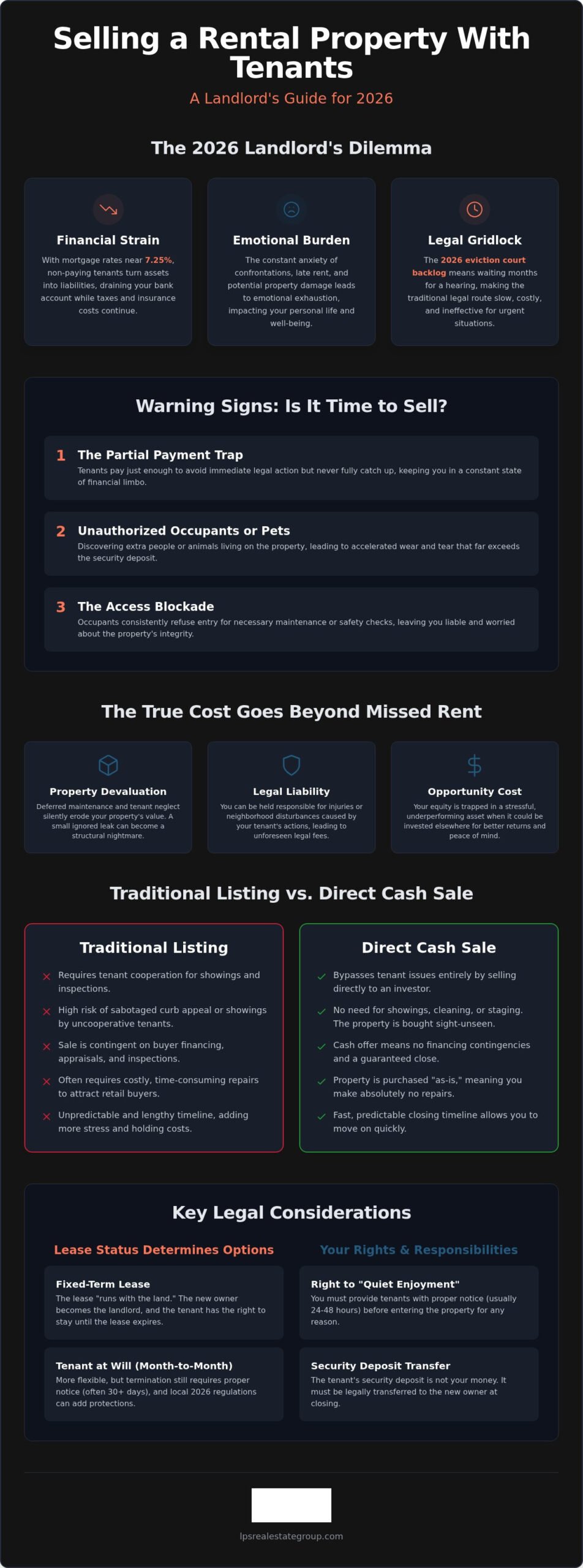
The financial reality is equally stark. With average 30-year mortgage rates hovering around 7.25% in late 2026, the margin for error has narrowed significantly. The “death spiral” of a non-performing asset is real. You remain responsible for the mortgage, property taxes, and insurance, but the income stream has dried up. Traditional property management often hits a wall in these scenarios. Most managers are excellent at processing checks, but they aren’t equipped for high-conflict mediation or the complex legal battles required for truly problematic occupants. They follow standard landlord-tenant law protocols that, while necessary, don’t account for the 2026 court backlogs that can leave owners waiting half a year for a single hearing.
Signs It Is Time to Liquidate Your Rental
Before deciding to liquidate, some owners find that switching from long-term leases to a managed short-term model can alleviate tenant friction and improve cash flow; you can learn more about BnB Booking to see if this specialized approach fits your goals.
Recognizing the point of no return is the first step toward finding relief. If you see these patterns, it’s time to consider a different path:
- The Partial Payment Trap: Tenants pay just enough to avoid immediate legal action but never actually catch up, keeping you in a state of financial limbo.
- Unauthorized Occupants: Discovering extra people or pets that increase wear and tear far beyond what a security deposit can ever cover.
- The Access Blockade: Occupants who refuse entry for safety checks or necessary maintenance, leaving you worried about the property’s structural integrity.
The Hidden Costs of Keeping a Bad Tenant
The true cost of a bad tenant goes far beyond the missed rent. Every month a problematic occupant stays, your property’s value may be eroding through neglect. Deferred maintenance is a silent killer; a small leak ignored by a tenant can become a structural nightmare by the time you regain possession. There’s also the weight of legal liability. If a tenant’s actions lead to an injury or a neighborhood disturbance, you are often the one held responsible. Finally, consider the opportunity cost. Your equity is trapped in a stressful situation when it could be working for you elsewhere. Selling a rental property with tenants allows you to stop the bleeding and regain your peace of mind without waiting for a court date that may be months away. For those seeking strategic advice on managing their portfolio through such challenges, you can discover MaddisonV Properties to explore professional investment and management solutions.
Navigating the Legal Landscape of Tenant-Occupied Sales
Understanding the legalities of selling a rental property with tenants starts with one core principle: the lease usually survives the sale. In legal terms, the lease “runs with the land,” meaning the new owner simply steps into your shoes as the landlord until the contract expires. If you have a fixed-term lease in place, the tenant has the right to stay until the end of that period regardless of who owns the deed. A “Tenant at Will” situation is more flexible, typically allowing for termination with a 30-day notice, though 2026 local regulations in many areas now require longer lead times to protect occupants from sudden displacement.
An Estoppel Certificate is a legally binding document signed by the tenant that confirms the current lease terms and any outstanding balances, ensuring the new buyer has an accurate record of the tenancy. Balancing your right to sell with the tenant’s right to “quiet enjoyment” requires a delicate touch. While you have the absolute right to liquidate your asset, you must provide proper notice, usually 24 to 48 hours, before any entry for inspections or showings. Ignoring these boundaries can lead to legal delays that stall your closing for months.
Reviewing Your Current Lease Agreement
Your first step is to carefully check your contract for a “Termination on Sale” clause. While these are rare, they can provide a much simpler path to a vacant delivery. You must also plan for the transfer of security deposits. These funds don’t belong to you; they are the tenant’s money held in trust and must be credited to the buyer at the time of closing. Meticulous documentation of every interaction is vital. Keeping a log of all notices and responses helps protect you against claims of retaliatory eviction if the relationship with the occupant is already strained.
Communication Strategies for Uncooperative Tenants
When tenants refuse to cooperate with showings or sabotage the process, the “Cash for Keys” method often becomes the most practical solution. In 2026, this strategy involves offering a financial incentive for the tenant to vacate voluntarily before the sale. The pros include a faster closing and a vacant property that’s easier to market. The cons are the immediate out-of-pocket cost and the risk that the tenant might not leave by the agreed-upon date.
Start the process by drafting a formal Notice of Intent to Sell. This document sets a professional tone and clearly outlines what the tenant should expect. Maintaining these boundaries is difficult when emotions are high, but it’s the best way to ensure a smooth transition. If the legal hurdles and tenant negotiations feel like too much to handle, exploring as-is property acquisition can help you bypass these complications and move on with your life.
Traditional Listing vs. Direct Cash Sale: A 2026 Comparison
Choosing how to exit your investment property depends largely on your timeline and your tolerance for conflict. In a traditional sale, the goal is to maximize the price by appealing to a family who wants to move in. However, when selling a rental property with tenants who are uncooperative, that goal becomes nearly impossible to reach. Traditional buyers are often scared away by the prospect of inheriting a legal battle. They want a “turnkey” experience, not a six-month wait for an eviction court to clear its 2026 backlog. This creates a situation where your property sits on the market, losing value while you continue to pay the mortgage and taxes without rental income.
The math of a traditional listing also looks different when you account for the hidden costs of a tenant-occupied sale. You’ll typically pay 5% to 6% in agent commissions and another 1% to 3% in closing costs. If a tenant has caused damage, you’ll also face a choice: pay for repairs out of pocket or accept a much lower offer from the few buyers willing to take on a project. In contrast, a direct cash buyout focuses on the net amount you actually keep. While the offer might be lower than a “perfect” MLS price, the lack of commissions, repairs, and months of carrying costs often makes it the more profitable path in the long run.
The Nightmare of the Traditional Showing
Traditional sales rely on curb appeal and a welcoming interior. A hostile tenant can effectively sabotage this by refusing entry for inspections or appraisals. Even if they let people in, a messy home or a tenant who makes negative comments to prospective buyers can kill a deal instantly. Perhaps most importantly, many conventional lenders won’t approve a mortgage for a buyer if the property has a non-paying occupant or significant deferred maintenance. This limits your buyer pool to other investors anyway, but without the speed of a direct sale.
Why Investors Prefer the Burden
Professional buyers view a difficult tenancy as a logistical hurdle rather than a deal-breaker. They have the legal teams and experience to handle post-sale transitions, which removes the burden from your shoulders. Because they specialize in selling your house as is, they don’t require you to clean, paint, or negotiate with the occupants for repairs. This approach condenses a stressful six-month ordeal into a simple 10 to 14 day process, allowing you to walk away with your equity and your peace of mind intact.
Step-by-Step Guide to Selling with Tenants in Place
Selling a rental property with tenants doesn’t have to be a legal marathon. While some traditional advisors suggest you must evict a problematic occupant before even thinking about a sale, the reality of 2026 court delays makes that a risky financial gamble. A methodical approach to a direct sale provides a clean exit in weeks rather than months. By following a structured path, you can protect your equity and your sanity simultaneously.
- Gather all documentation: Collect your original lease agreement, security deposit records, and a detailed log of all rent payments. If there has been a history of non-payment, these records are essential for the buyer’s underwriting process.
- Determine the as-is value: Understand that your property has two values: the “perfect” market price if it were vacant and renovated, and the “as-is” value that accounts for current tenant liability and needed repairs.
- Reach out to specialists: Contact companies that buy houses for cash. These entities specialize in taking over difficult tenancies, meaning you don’t have to wait for the tenant to cooperate with a single showing.
- Review the transition plan: A professional buyer should explain exactly how they will handle the tenant after the sale. This ensures you aren’t left with any lingering legal loose ends.
- Close and transfer the headache: Once the paperwork is signed, the responsibility for the tenant, the repairs, and the future legalities shifts entirely to the new owner.
Documenting the Condition of the Property
If a tenant refuses to let you in for a professional appraisal, use whatever recent photos or videos you have to justify your as-is pricing. It’s also vital to maintain a clear paper trail regarding any unpermitted work the tenant may have performed. If they’ve modified the electrical system or built unauthorized structures, documenting this early allows a cash buyer to factor those risks into their offer without surprise deductions later. Accurate records protect you from claims that you misrepresented the property’s state.
Closing the Deal Without Tenant Interference
The final step is ensuring the legal transfer is airtight. We recommend choosing a title company that is deeply experienced in tenant-occupied transfers. They will ensure the “Assignment of Lease” is properly executed, which officially moves the landlord’s rights and duties to the buyer. This process allows you to walk away with your cash and zero remaining landlord duties. If you’re ready to see how a direct buyout can work for your specific situation, you can get a fair cash offer today and leave the tenant nightmare behind.
How LPS Real Estate Group Resolves Your Tenant Nightmares
At LPS Real Estate Group, we understand that you aren’t just selling a building; you’re looking for an exit from a stressful situation that has likely consumed your time and energy. We’ve built our business on the belief that selling a rental property with tenants should be a straightforward, respectful process for everyone involved. Our goal is to provide a sense of relief by taking over the logistical and emotional burdens that come with problematic occupants, allowing you to move forward with quiet confidence.
Our Transparency First promise serves as the foundation of every partnership we build. You won’t find hidden fees or surprise deductions at the closing table. We specialize in creative real estate exit strategies that provide liquidity even when you’re dealing with non-paying occupants. This methodical approach ensures you receive a fair offer based on the actual condition of the property and the current tenancy, without the uncertainty of a traditional listing.
Taking the as-is advantage means we acquire the house exactly as it stands today. If a tenant has caused damage or left behind a mess, you don’t need to lift a finger or hire a contractor. We also respect that your timeline is unique. Whether you need to close in as little as 7 days to stop a financial drain or prefer a 30-day window to organize your records, we move at your pace. This speed is a vital alternative to the 2026 court timelines that often leave landlords waiting months for a resolution.
A Compassionate Approach to a Stressful Situation
We believe that a compassionate expert should act as a buffer between you and a difficult tenant. Our team handles the hard conversations and the move-out negotiations so you don’t have to. We’ve successfully resolved many landlord situations that felt impossible, from squatters to chronic non-payment. By acting as a listener first and a service provider second, we ensure that every individual’s circumstances are handled with integrity and patience.
Your Next Steps to Freedom
The path to your next chapter begins with a simple, no-pressure consultation. During our initial conversation, we’ll listen to your specific challenges and review the property details you have available. We focus on finding a solution that does the right thing for your financial future while providing the clean break you’ve been searching for. If you’re ready to leave the stress behind, you can get your fair cash offer from LPS Real Estate Group today and regain your peace of mind.
Your Path to a Stress-Free Exit in 2026
Reclaiming your peace of mind starts with recognizing that you don’t have to carry the burden of a problematic rental forever. Throughout this guide, we’ve explored how selling a rental property with tenants can be a strategic move rather than a management failure. You now understand that you can bypass the 2026 eviction court backlog and the emotional exhaustion of tenant confrontations by choosing a direct path forward. The financial drain of non-payment and property neglect stops the moment you decide to prioritize your own stability and financial health.
We’re here to ensure that your transition is handled with the integrity and care you deserve. When you partner with us, there are no repairs needed and you’ll pay no commissions or closing costs. We take the lead on the difficult conversations, handling both the tenants and the complex legal paperwork so you can focus on your future. You’ve worked hard for your equity; it’s time to let it work for you again without the constant stress of property management. You deserve a clean break and a fresh start.
Get a Fair Cash Offer for Your Tenant-Occupied Property
We look forward to helping you find the best way forward for your unique situation. Better days are just a consultation away.
Frequently Asked Questions
Can I sell my house if the tenant is in the middle of a fixed-term lease?
Yes, you can sell your property at any time, but the lease agreement generally “runs with the land.” This means the new owner must honor the existing contract until it expires. When selling a rental property with tenants on a fixed-term lease, the buyer simply becomes the new landlord. This is why many traditional buyers are hesitant, as they may want to move in themselves, making investors a more practical choice.
Do I have to tell my tenant that I am selling the house?
Transparency is both a legal requirement and a best practice for a smooth transition. Most states require you to provide formal notice of your intent to sell, especially since you will need to coordinate entry for inspections or appraisals. Keeping the lines of communication open helps prevent the tenant from feeling blindsided. This reduces the risk of them sabotaging the sale process or refusing to cooperate with necessary visits.
What happens to the security deposit when I sell the rental property?
The security deposit is technically the tenant’s money held in trust, so it must be transferred to the new owner during the closing process. Usually, this is handled as a credit to the buyer on the settlement statement. You don’t just hand over a check to the tenant; instead, the new landlord takes over the legal responsibility for returning those funds, minus any lawful deductions, when the tenant eventually vacates the property.
Can a buyer back out if they find out the tenant is bad during escrow?
Traditional buyers often include contingencies in their contracts that allow them to withdraw if they discover significant issues during the due diligence period. If a buyer learns about a “bad” tenant, such as one who is non-paying or hostile, they may view the property as too high of a risk. This is a common reason why conventional sales fail. Professional investment firms expect these challenges and won’t back out because of tenant behavior.
Is it better to evict a tenant before selling or sell with them in place?
This depends on your financial situation and timeline. In 2026, many landlords find that evicting first is too slow due to significant court backlogs. While a vacant house might fetch a higher price on the open market, the months of lost rent and legal fees often negate that gain. Selling a rental property with tenants in place to an as-is buyer allows you to stop the financial drain immediately without waiting for a judge.
How much does a bad tenant devalue a house in 2026?
While there isn’t a single fixed percentage, a problematic tenant can significantly impact the perceived value. Traditional buyers may discount their offer by the estimated cost of a future eviction and repairs for potential damage. In 2026, the primary “devaluation” comes from the limited buyer pool. Most families won’t consider a home they cannot move into immediately, leaving only investors who require a discount for taking on the liability.
What if the tenant refuses to allow the appraiser or inspector inside?
You generally have a legal right to enter for inspections if you provide proper notice, typically 24 to 48 hours. However, a tenant who physically blocks entry can cause a traditional sale to collapse. If you are facing this blockade, a direct cash sale is often the best path forward. Professional buyers can frequently make offers based on exterior inspections and existing documentation, bypassing the need for the tenant’s active cooperation during the process.
Can I sell a house with a squatter who never had a lease?
It is entirely possible to sell a property occupied by a squatter. While this situation is a nightmare for traditional buyers and lenders, specialized investment firms are equipped to handle the legal removal process after the closing. You can walk away with your equity and let the new owner manage the legal complexities. This provides a clean exit for owners who don’t have the stomach for a lengthy and confrontational legal battle.