

A low appraisal doesn’t automatically end a home purchase, but it can create a gap between the lender’s loan and the agreed price. Knowing what to do after a low home appraisal means weighing your options: challenge the valuation, negotiate with the seller, bring more cash to closing, or use protections in your contract. The seller isn’t required to lower the price.
It’s understandable to feel unsettled when an appraisal changes the numbers you planned around. Your next move depends on the size of the gap, your appraisal contingency, and how much extra cash you can comfortably put toward the purchase.
This guide explains how a low appraisal can affect financing, what an appraisal contingency may allow, and how to request a reconsideration of value. It also covers negotiating a price adjustment and how covering an appraisal gap can change your cash to close, helping you make a more informed decision about the purchase.
Key Takeaways
- Understand how a lower valuation can change the lender’s loan amount and create a funding gap.
- Learn what information can support a reconsideration of value and how to approach the request.
- Review how your appraisal contingency may affect your choices and earnest money if the deal cannot proceed.
- Explore ways to negotiate the price or cover an appraisal gap, and see how each can affect cash needed at closing.
1. What Does a Low Appraisal Mean?
A low appraisal means the appraiser’s estimated value is below the purchase price. Mortgage lenders use the appraised value to determine how much they’ll lend, so a shortfall can increase the buyer’s cash needed at closing. To decide what to do after a low home appraisal, compare the report’s value with the agreed price and planned loan.
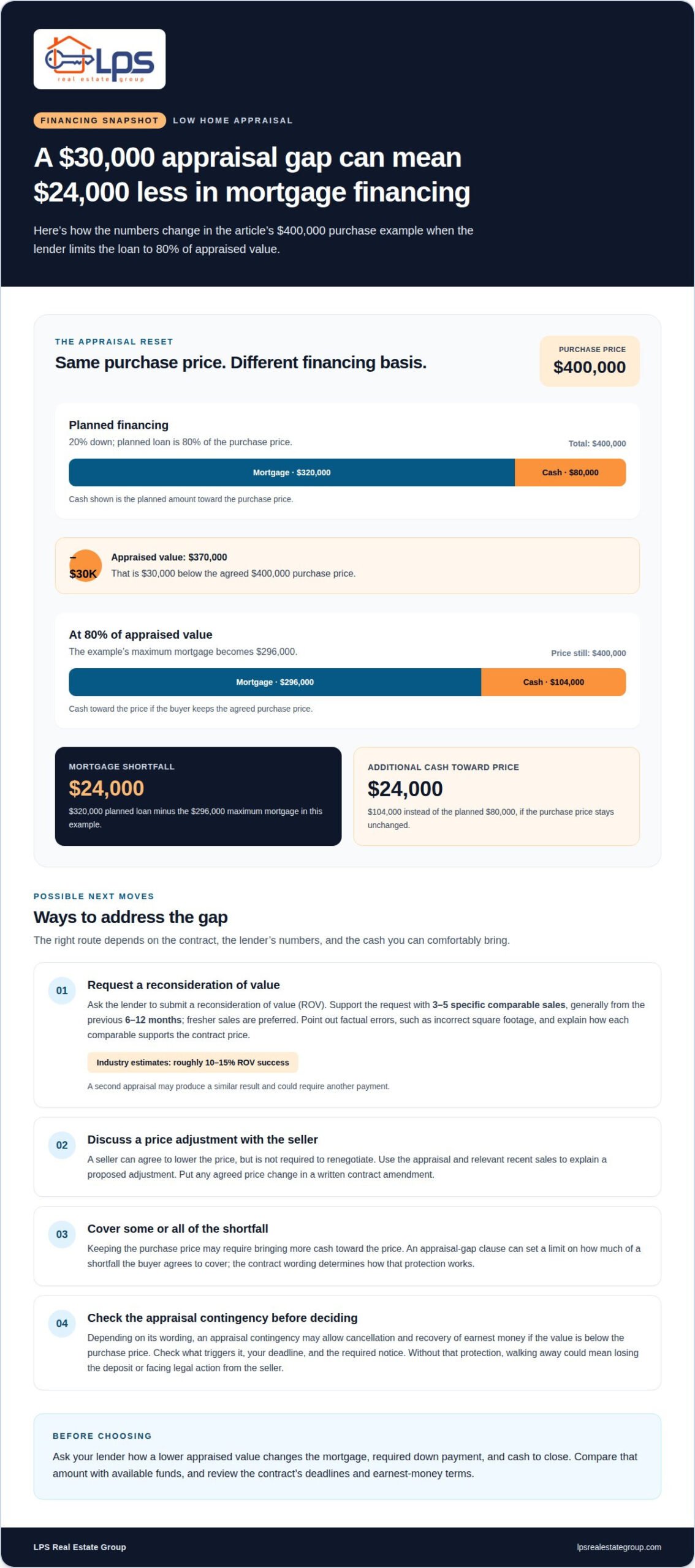
For example, a buyer planning 20% down on a $400,000 home expects to borrow $320,000, an 80% loan-to-value ratio. If the home appraises at $370,000 and the lender limits the loan to 80% of appraised value, the maximum mortgage is $296,000. Keeping the purchase price would require $104,000 toward the price, rather than the planned $80,000.
FHA, VA, and conventional appraisals have different details. An FHA appraisal is valid for 180 days. If a VA appraiser expects the value to fall below the contract price, the listing agent has 48 hours to submit additional comparable sales before the Notice of Value. For conventional loans, Fannie Mae Selling Guide B4-1.3-05 defines the reconsideration of value process. The uniform ROV framework adopted in May 2024 requires lenders to accept and process borrower-initiated requests across loan types.
For buyers deciding what to do after a low home appraisal, a reconsideration of value (ROV) may be an option. Ask the lender to submit the request, then provide 3–5 specific comparable sales the appraiser may have missed, misused, or misweighted. Use sales generally from the previous 6–12 months, with fresher sales preferred. Identify factual errors, such as incorrect square footage, and explain how each comparable supports the contract price. Appraisers generally report at least three comparable sales. A second appraisal may produce a similar result and could require another payment. Industry estimates put ROV success at roughly 10–15%.
In a refinance, a low appraisal can reduce the loan available under the lender’s loan-to-value limit. The borrower can consider an ROV or adjust the refinance amount; a purchase contingency doesn’t apply to a refinance.
2. Should You Waive the Appraisal Contingency?
Waiving an appraisal contingency can make an offer more appealing, but it shifts more risk to buyers. The contract’s wording matters: an appraisal contingency may let a buyer cancel and recover earnest money if the appraised value is below the purchase price. Without that protection, walking away could mean losing the deposit or facing legal action from the seller.
Read the contingency language before deciding. Check what triggers it, how much time you have to act, and what notice the contract requires. In a neighborhood where sale prices are changing quickly, the appraised value may be harder to predict, but you still need a plan for a lower result. Base your decision on the maximum cash you can bring, not just the offer you hope to secure.
An appraisal-gap clause is different from waiving the contingency. It sets a limit on how much of a shortfall the buyer agrees to cover. For example, a $400,000 offer with up to $20,000 in gap coverage means the buyer would bring $20,000 if the appraisal is $380,000. If it appraises at $390,000, the gap is $10,000. The clause can preserve protection beyond its stated limit, depending on the contract language.
Before choosing an approach, work through the numbers with your lender. Ask how a lower appraised value would affect the mortgage, required down payment, and cash to close. Compare that amount with your available funds, and review the contract’s earnest-money terms. Also check whether the appraisal accurately reflects comparable sales and key property details. You may be able to request a reconsideration, but you still need to understand and meet your contractual deadlines.
Waiving protection may not suit a buyer who needs the appraisal contingency to limit financial exposure. If foreclosure pressure also affects a property you own, a foreclosure-prevention purchase may be relevant as a separate sale option.
3. Can a seller lower the price after a low appraisal?
Yes. A seller can agree to lower the purchase price, but isn’t obligated to renegotiate after a low appraisal. The buyer and seller can discuss a price reduction or another arrangement. The buyer may be able to cancel if the contract’s appraisal contingency allows it, but the contract terms and notice requirements control.
Appraisals can fall below the contract price when comparable sales support a lower value, market prices shift, or the appraiser’s selected properties differ from the buyer’s expectations. Closed sales may reflect contracts written 60–120 days earlier, so recorded prices can lag in a rapidly changing market. Differences in condition, square footage, or neighborhood features can also affect which homes make accurate comparisons.
The frequency varies by market. Estimates put 10%–20% of appraisals below the contract price. For example, a home with a $550,000 purchase price and a $510,000 appraisal has a $40,000 gap. The lender may not cover the full contract amount, so the parties need to decide whether to change the price or funding plan.
Meeting in the middle is one option, not a required outcome. With a $20,000 shortfall, the seller might reduce the price by $10,000 while the buyer brings another $10,000 in cash. This shares the difference, but the buyer still needs funds for the agreed amount. Sellers can also consider concessions, which must appear on the closing disclosure and generally fit lender limits of 3%–9%, depending on loan type and down payment.
To negotiate, use the appraisal and relevant recent sales to explain the proposed adjustment. Focus the discussion on the gap, the buyer’s available cash, and the lender’s financing limit. Put any agreed price change or concession in a written contract amendment. If the seller declines, the buyer’s next step depends on the contract: proceed with available funds, use an applicable contingency, or walk away under its terms.
4. Appraisal gaps and their effect on cash to close
An appraisal gap is the difference between the agreed purchase price and the lower appraised value. Because lenders use the appraisal to set the mortgage amount, buyers who keep the contract price may need more cash to close. The gap is separate from closing costs and the planned down payment.
Consider a $500,000 purchase with a $480,000 appraisal. If the lender funds 80% of appraised value, the loan would be $384,000.
Paying above the appraised value means using cash for the portion the lender won’t finance under its calculation. The risk is having less savings after closing and owning a home valued below the amount paid. That could make a later sale or refinance more difficult if the value hasn’t risen enough to support the remaining mortgage.
Before agreeing to cover a gap, compare the lender’s revised loan amount with your available funds and the purchase agreement’s appraisal contingency. A real estate agent can help communicate a revised offer, request a price adjustment, or document a buyer’s gap commitment. Put any change in writing, then confirm your updated cash needed for closing with the lender. A smaller mortgage can also affect the down payment calculation, so use the lender’s figures rather than simply adding the gap to your original estimate.
If the seller won’t adjust and the required cash exceeds your budget, revisit the contingency and contract deadlines before deciding to proceed or walk away. For homeowners facing foreclosure pressure alongside a property sale, explore a foreclosure-prevention purchase as another way to address the situation.
LPS Real Estate Group: Cash Home Buying
If a low appraisal has stalled negotiations or the buyer can’t cover the cash gap, LPS Real Estate Group offers a direct, as-is purchase as an alternative to a sale dependent on mortgage financing. There’s no need to prepare the home for a traditional listing: LPS buys properties as-is, with no repairs, commissions, or hidden costs.
Every situation is different. If foreclosure pressure, an inherited property, or another complicated circumstance is part of the decision, LPS Real Estate Group also offers foreclosure prevention purchases, probate and inherited property buyouts, and creative finance solutions. These options are alternatives to completing the current buyer’s mortgage-dependent purchase, not a way to change that appraisal or loan.
If you’re weighing a sale after a low appraisal, contact LPS Real Estate Group to discuss your property and possible next steps.
Choose the next step that fits your plans
The right answer to what to do after a low home appraisal depends on whether this purchase still makes sense for your finances and plans. Before committing more cash, consider how that choice would affect your savings and ability to handle future expenses. If the numbers no longer work, review the purchase agreement to understand your options and communicate clearly with the other party.
A sale may be a better path for homeowners who need to move forward without relying on the buyer’s mortgage appraisal. LPS Real Estate Group offers cash home buying, foreclosure prevention purchase, and as-is property acquisition. These options may be relevant when a financed sale stalls or a property needs to be sold as-is.
You deserve a decision grounded in your circumstances, not pressure to keep a deal alive at any cost. Contact LPS Real Estate Group today to discuss your property and possible next steps. Take the time you need to choose a path that feels workable.
Frequently Asked Questions
What happens if the appraisal is lower than the offer?
The lender may calculate its mortgage using the lower appraised value, leaving a difference between the loan and the agreed price. The buyer and seller can discuss changing the price, and the buyer can review the contract for applicable protections. If the appraisal contains factual errors or overlooked comparable sales, the buyer can ask the lender to submit a reconsideration request.
What causes low appraisals?
A valuation may be lower when available comparable sales point below the contract price or the property’s recorded details need correction. For example, gross living area measures above-grade space and excludes garages and basements, so a measurement discrepancy can matter. For a condo, the appraisal considers the project as well as the unit. Unsafe or unsanitary deficiencies can also affect the report.
Can a seller lower the price after a low appraisal?
Yes, a seller can agree to reduce the price, but the buyer cannot require a reduction solely because of the appraisal. The parties can document a revised price in a written amendment. If the seller accepts a lower amount, make sure the updated terms are reflected in the purchase agreement, then use them to plan the rest of the transaction.
Can you finance an appraisal gap?
The lender doesn’t automatically add the appraisal gap to the mortgage, because the loan calculation relies on the appraised value. A buyer can use additional cash toward the down payment to cover the difference. Other options include negotiating a price change or using an applicable contract contingency. Ask the lender to explain the revised loan amount and cash-to-close calculation.
Should You Waive the Appraisal Contingency?
Waive the appraisal contingency only if you understand the contract’s consequences and can manage the added financial risk. Without this contingency, a buyer who can’t complete the purchase may risk earnest money or legal action from the seller. Compare the possible shortfall with the funds available after other closing costs, and read the agreement’s deadlines and notice terms before deciding.
What Does a Low Appraisal Mean?
A low appraisal means the appraiser’s opinion of the property’s value is below the price agreed in the purchase contract. It doesn’t automatically establish the home’s exact value in every context, but it can limit the mortgage the lender will provide. The resulting difference may require a price change, more buyer cash, or another decision under the contract.