

An expired listing isn’t a verdict on your home. It’s a decision point, and knowing what to do when your real estate listing expires starts with reviewing your agreement and checking the property’s current listing status. Don’t assume every contract or MLS handles the next steps the same way.
If you’re unsure whether price, presentation, or marketing held your sale back, you’re not alone. After months of preparation and showings, repeating the same approach without a clear plan can feel discouraging. Before relaunching, look at what happened and identify what you could change.
This guide covers immediate steps to take, including reviewing your listing agreement for continuing obligations. You’ll learn how to assess pricing, presentation, buyer feedback, and marketing before deciding whether a new listing makes sense. It also compares relaunching with other practical options, including a direct as-is sale for owners who would rather not prepare for another listing cycle. There’s no single right route for every seller, but understanding the trade-offs can help you choose your next step.
Key Takeaways
- Understand what an expired listing changes, and review your agreement before making assumptions about your next steps.
- To decide what to do when your real estate listing expires, look for patterns in buyer feedback, pricing, and marketing rather than treating the outcome as a personal failure.
- Compare a revised listing, a direct sale, and holding the property based on the exposure, preparation, showings, and flexibility each involves.
- Use your previous listing experience to build a clearer plan, separating essential repairs from improvements that may be optional.
- If you prefer not to repeat a listing cycle, consider whether an as-is sale or creative finance solution fits your circumstances.
What Does It Mean When a Real Estate Listing Expires?
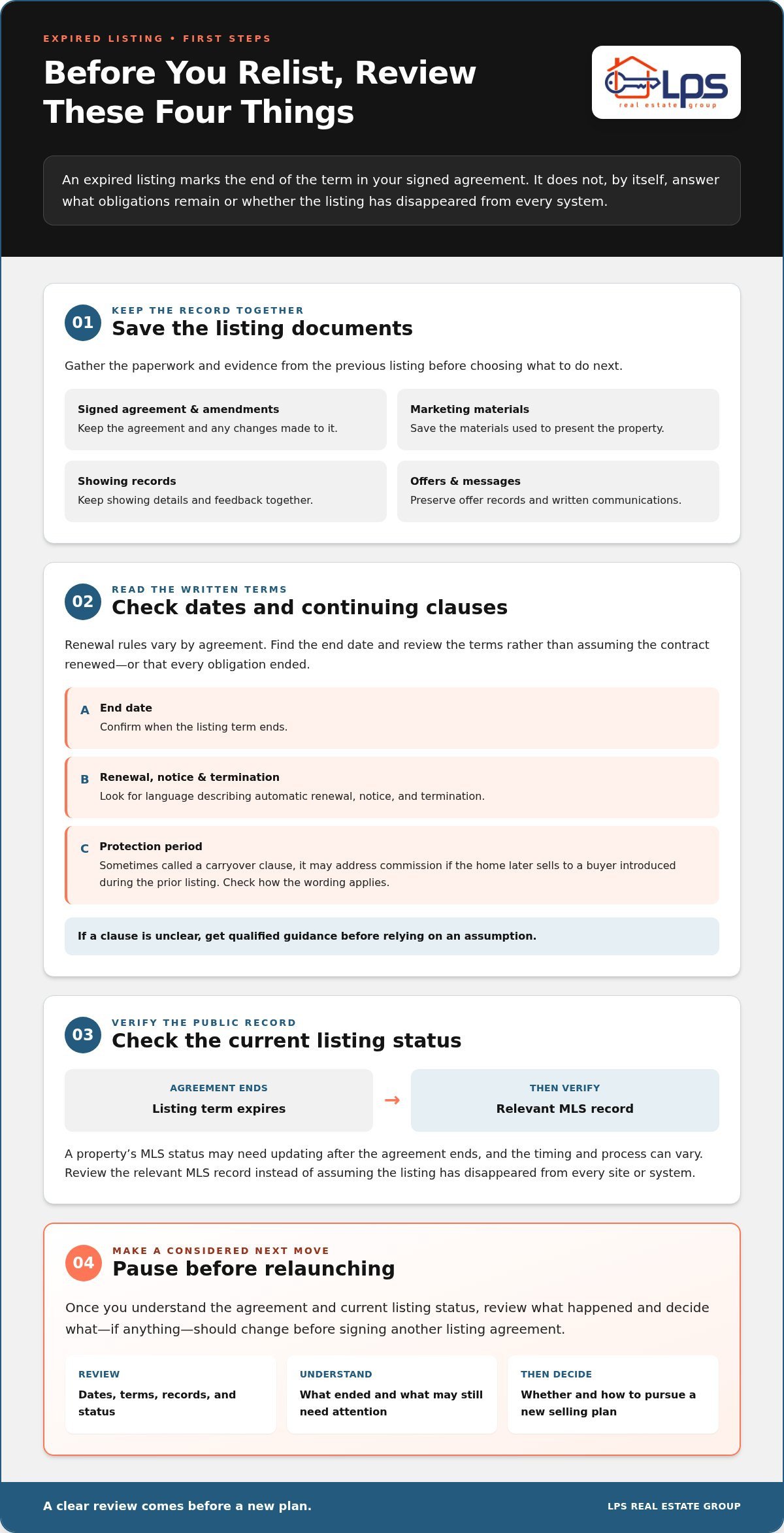
A listing expires when the term specified in the signed listing agreement ends without a completed sale. The agreement’s dates and terms matter. Expiration does not prove the property sold, nor does it prevent you from selling it later. It marks the end of that listing term; any remaining obligations or next steps depend on the paperwork and applicable rules.
The home’s public listing status may also need attention. A property marketed through a Multiple Listing Service (MLS) may have its status updated after the agreement ends, but the timing and process can vary. Review the relevant MLS record rather than assuming the listing has disappeared from every site or system.
Start with a calm review instead of rushing into another agreement. Save the listing details, showing feedback, offers, and messages. Read the paperwork, note relevant dates and continuing terms, and gather the documents in one place. This gives you a clearer picture of what has ended and what still needs attention before you choose a new selling plan.
Does an expired listing agreement automatically renew?
There isn’t one renewal rule that applies to every agreement. Whether a listing renews depends on its written terms and applicable rules. Find the end date, then look for language about automatic renewal, notice, and termination. If a clause is unclear, get qualified guidance before relying on an assumption. Knowing what you signed can prevent confusion as you consider your next step.
What should you check before relisting the property?
Before signing another listing agreement, review any protection-period clause, sometimes called a carryover clause. It may address commission if the home later sells to a buyer introduced during the prior listing. Check the wording and whether it applies to buyers who showed interest. Don’t assume expiration automatically removes every obligation.
Then review the listing’s current status in the relevant MLS record, and keep written communications and documents together. Use this checklist:
- Save the signed agreement, amendments, marketing materials, and showing or offer records.
- Review the end date, renewal and termination language, and any protection-period terms.
- Check how the listing is currently displayed or recorded.
- Pause before relaunching so you can decide what should change, if anything.
These are useful first steps when deciding what to do when your real estate listing expires. Once you understand the agreement and listing status, you can assess the previous sale effort with a clearer picture and choose a route that fits your priorities.
Why Did Your Real Estate Listing Expire Without Selling?
An unsold listing isn’t a reason to blame yourself. It’s a reason to look for clues. Price, presentation, access, marketing, and changes in buyer demand can all affect interest. As Redfin explains in its overview of what an expired listing means, there can be more than one reason a home doesn’t sell during its listing term.
Start with evidence rather than a guess. Compare showing volume, online engagement, buyer comments, and offers. Inquiries, showings, and offers are observable signals; possible explanations, such as pricing or access, are hypotheses to test against feedback and market comparisons. For example, limited showings may point to a visibility or price concern, while frequent showings without offers may suggest buyers saw a mismatch between the home and its asking terms. Neither pattern proves a single cause.
Was the asking price aligned with buyer expectations?
Review recent comparable sales alongside homes that competed with yours during the listing period. Note whether similar properties sold, stayed on the market, or reduced their asking prices. Account for changes in the market since your listing began, too. An appraisal or online estimate can provide a reference, but it doesn’t establish what buyers are willing to offer now. Reassess the price using current evidence rather than treating the original launch figure as fixed.
Consider the response after any past price changes. If interest increased after a reduction, that may suggest the earlier price was limiting buyer attention. If the response stayed quiet, price may not be the only issue to investigate. Compare more than one signal before deciding what to adjust.
Did presentation, access, or marketing limit interest?
Review the listing photos and description for accuracy, clarity, and whether they showed the home’s useful features. Consider the property’s condition and whether showing availability made it difficult for interested buyers to visit. Then read buyer feedback as a group. One comment may reflect an individual preference; repeated notes about the same concern deserve a closer look.
Separate practical changes from costly projects. Correcting inaccurate listing details, improving photo choices, or making showings easier may be more manageable than a major renovation. Focus on changes that address a pattern in the evidence before deciding whether to relaunch. If another listing cycle doesn’t fit your priorities, compare a direct home sale as a different route, including an as-is option that may avoid preparing the property for listing. Offer terms depend on the property and circumstances.
Should You Relist, Change Agents, or Choose Another Selling Route?
There isn’t one best answer for every owner. Compare your options against the same priorities: how much exposure you want, what preparation the home needs, how you feel about showings, how much flexibility you need, and how predictable you want the next steps to be. A relaunch may bring broad market exposure, but it also means another listing process. A direct sale may reduce the need for listing preparation and repeated showings. Holding the property avoids an immediate sale, but you remain responsible for ownership costs and decisions.
- Revised listing: A new marketing period can reach buyers through the market, but may involve preparation, access for showings, and continued uncertainty about timing or offers.
- Direct sale: A direct buyer can offer an alternative to another listing cycle. Review the proposed terms in light of the property and your needs, since terms and outcomes depend on individual circumstances.
- Hold: Keeping the property may give you time to reconsider, but you’ll continue managing ownership responsibilities and future decisions.
Changing agents is a separate decision from choosing how to sell. It may make sense if communication, marketing, or the plan for addressing buyer feedback didn’t meet your needs. If you consider a new listing agreement, read its terms carefully before signing. For more context on direct-sale paths, see this guide to cash home buyer options.
When does relisting make sense after expiration?
Relisting may suit you if the previous attempt revealed issues you can address, such as a price that no longer fits comparable sales or presentation that didn’t show the home clearly. A stronger relaunch should be meaningfully different: updated photos, accurate positioning, and a showing plan that works for you. Simply putting the same listing back on the market without considering what you learned may not address the reasons buyers held back.
When might a direct, as-is sale fit better?
A direct, as-is sale may fit if you’d rather avoid pre-sale repairs or limit the disruption of repeated showings. LPS Real Estate Group buys homes directly from owners and offers as-is acquisitions and creative finance solutions. Compare any offer with your property’s condition, priorities, and the terms presented. Read more in this guide to selling a house as-is.
Ultimately, deciding what to do when your real estate listing expires means choosing a route that fits your timeline, the home’s condition, and the effort you’re prepared to take on. A relaunch, direct sale, or hold each has trade-offs. Clear priorities can help you compare them without assuming any option guarantees a particular result.
How to Prepare a Stronger Plan After an Expired Listing
A useful next plan starts with the record of what happened, not a rushed decision to repeat the same process. Gather the listing agreement, disclosures, showing feedback, offers, and marketing records, along with the time on market, price changes, inquiries, and completed showings. Keep these documents and performance details together so you can compare the first attempt with any new option.
Use this sequence to turn that information into a decision:
- Review the agreement and disclosures. Note relevant terms, dates, and property details that may affect your next step.
- Summarize the listing activity. Record when interest rose or slowed, what feedback repeated, and whether price changes affected inquiries or showings.
- Separate evidence from questions. A quiet period or a single buyer comment can be a clue, but it doesn’t prove why the home didn’t sell. Write down unresolved questions for further review.
- Sort property work by priority. Address essential repairs or safety concerns separately from optional cosmetic improvements. A renovation isn’t automatically necessary; consider whether a change responds to buyer feedback or makes the home easier to present.
- Set your decision criteria. Decide what matters most: timing, acceptable terms, privacy, access for showings, and how much preparation you’re willing to take on.
How can you compare a revised listing plan with an offer?
Compare likely net proceeds, not just a possible asking price or an offer amount. For a revised listing, account for expected selling expenses, preparation, and carrying costs while the home remains yours. For an offer, review the proposed terms and any costs or work that remain your responsibility. The outcome of either route depends on the property and the specific terms.
Look beyond the headline number. Consider timing, contingencies, access requirements, and the work needed before closing. A higher potential sale price may come with more preparation or uncertainty; a direct offer may involve different trade-offs. Compare what each option asks of you as well as what it may provide. For a broader overview, read this guide to selling a house fast for cash.
These steps can make deciding what to do when your real estate listing expires feel more manageable. If a direct sale fits your priorities, explore selling your home directly as an alternative to another listing cycle.
Choose Your Next Step: Relaunch or Sell Directly
Once you’ve reviewed why the listing didn’t sell, choose between a relaunch with meaningful changes and a route that better fits your priorities. A revised listing may make sense if you’re ready to adjust the price, presentation, or showing plan. If another round of preparation and showings doesn’t suit your situation, consider a direct sale instead. Neither path guarantees a particular result, so compare the practical trade-offs before deciding.
What does a direct-sale conversation involve?
A direct-sale conversation starts with the property and your preferred outcome. Share relevant details, such as the home’s condition and your circumstances, so the possible paths can be considered in context. LPS Real Estate Group buys homes directly and offers as-is purchases and creative finance solutions. The aim is to understand your situation and outline a relevant option, not assume the same approach fits every owner.
How do you decide which route is right for you?
Match the options to what matters most: desired timing, how much preparation you can take on, your comfort with showings, and the terms you would consider acceptable. A direct sale may avoid preparing the home for listing, while a relaunch may offer broader market exposure but require renewed effort and access. The right balance depends on your circumstances.
Put the options side by side in writing. Compare likely proceeds after relevant expenses, the work you’d handle, access or showing needs, and any conditions attached to a proposed path. Include what remains uncertain rather than treating an estimate or potential offer as a guaranteed outcome.
- Consider a relaunch if you can make meaningful changes based on the previous listing and are comfortable with another market attempt.
- Consider a direct sale if avoiding listing preparation or repeated showings matters more, and the proposed terms fit your needs.
Expiration is a point to reassess, not a reason to rush. If a direct option could suit your priorities, discuss your property options and compare a potential path with your other choices.
Choose a Next Step That Fits Your Situation
An expired listing gives you a chance to reassess, not a reason to rush into another agreement. Review what the first attempt showed, check your priorities, and decide whether a relaunch with meaningful changes or a different selling route better suits your property and needs. That’s the practical starting point for deciding what to do when your real estate listing expires.
LPS Real Estate Group buys residential properties directly from owners and offers as-is purchases and creative finance solutions. These options may be relevant if you’d prefer not to prepare for another listing cycle. The company also works with complex situations, including probate and foreclosure prevention. Consider any proposed path in light of the property and your circumstances.
Compare your options with LPS Real Estate Group. Discuss your property and explore a direct-sale option to decide whether it fits your next step.
Frequently Asked Questions
Can I relist my house immediately after the listing expires?
You may be able to pursue a new listing after the previous term ends, but timing and obligations depend on your signed agreement and applicable rules. Review renewal provisions and any protection-period clause, especially if buyers were introduced to the property during the prior listing. Check the current listing status before publishing a new one. Then use what you learned from the first attempt to make a clear, meaningful change to the plan.
Should I use the same real estate agent after my listing expires?
That depends on your experience and whether you feel confident in a revised plan. Review communication, pricing decisions, marketing, showing feedback, and the proposed adjustments. For example, if access for showings was difficult, a useful new plan should address access rather than simply repeat the previous approach. You can continue with the same agent or consider a change. Either way, compare specific plans and understand the terms of any new agreement before committing.
Why did my house not sell while it was listed?
A home may remain unsold for several reasons, including price, presentation, showing access, condition, marketing, or buyer demand during that period. Look at inquiries, completed showings, feedback, competing listings, and offers together. Few inquiries and many showings without offers can suggest different issues, but neither pattern proves a single cause. Treat buyer comments as clues, not definitive answers, and use the combined evidence to decide what to adjust or whether another route may suit you better.
Do I have to make repairs before relisting my home?
No, repairs aren’t automatically required before relisting. Review inspection concerns and repeated buyer feedback to separate issues that may affect a buyer’s confidence from optional improvements. For instance, a recurring concern about a visible defect may deserve attention, while a cosmetic update may not be essential. You can also compare a revised listing with an as-is sale, where a buyer considers the property in its current condition. The right choice depends on your priorities and the proposed terms.
Can I sell my house without listing it again on the MLS?
Yes, you can explore a direct sale without starting another traditional MLS listing. LPS Real Estate Group buys residential properties directly from owners and offers as-is acquisitions and creative finance solutions. These routes have different trade-offs in exposure, preparation, showings, timing, and terms. Compare likely proceeds after relevant expenses and the responsibilities involved, rather than focusing only on a headline offer. Review the written terms and consider whether the approach fits your circumstances.
Will my home sell for less if I accept a direct cash offer?
Not necessarily, because the outcome depends on the property, offer terms, and costs involved in each sale route. Compare a direct offer with a traditional listing by considering likely proceeds after preparation, repairs, selling expenses, and carrying costs. Also weigh contingencies, showing requirements, and the work involved. A direct buyer may consider the home as-is, while a market listing may involve more exposure and preparation. The best comparison is the one that reflects your priorities and full costs.