
The most famous name in real estate might actually be the most complicated way to sell your home in 2026. While many homeowners assume an institutional giant offers the simplest path, the reality of trying to sell to zillow vs local buyer has changed significantly over the last few years. You might expect a streamlined process, but often find yourself navigating a maze of service fees and automated assessments that don’t account for your specific situation.
It’s understandable to feel a sense of dread when thinking about property repairs or the possibility of hidden closing costs eating into your equity. You want a fair price and a guaranteed closing date without the “as-is” confusion that often comes with corporate algorithms. We believe you deserve a transition that’s defined by transparency and respect rather than fine print and automated offers.
This guide clarifies the critical differences between selling to a national platform and partnering with a direct local buyer. You will learn how to bypass the stress of traditional listings and choose the fastest, most profitable strategy for your unique property. We will look at the real costs involved and show you how to secure a clean sale with zero repairs and total peace of mind.
Key Takeaways
- Understand the fundamental difference between volume-based corporate platforms and local investment firms that prioritize personalized, human-centric solutions.
- Calculate your true net proceeds when you sell to zillow vs local buyer by factoring in service fees and the risk of price drops after a corporate inspection.
- Learn why a true “as-is” sale with a local buyer can save you from the stress of repairs that institutional platforms often require before closing.
- Discover how local experts navigate complex hurdles like probate, foreclosure, and liens that typically cause national platforms to walk away from a deal.
- Identify the specific scenario for your property to ensure you choose the fastest path to a fair price and a guaranteed closing date.
Institutional Platforms vs. Local Buyers: Defining the 2026 Landscape
The real estate market in 2026 offers two distinct paths for homeowners looking for a quick exit. Deciding whether to sell to zillow vs local buyer requires understanding that these entities operate on entirely different business philosophies. Institutional platforms rely on massive scale and automated speed, while local buyers focus on specialized property solutions and individual circumstances. The choice isn’t just about who pays more; it’s about which model is equipped to handle the specific reality of your home.
Zillow no longer buys homes directly, a shift that occurred after the company shuttered its “Zillow Offers” program years ago. Today, Zillow functions as a marketplace that facilitates cash offers through a partnership with an iBuyer (Instant Buyer) like Opendoor. This means your experience is often dictated by a corporate algorithm rather than a person who has actually walked through your front door. For many, this “one size fits all” digital approach feels cold and inflexible, especially if the property has unique challenges.
How Institutional Buyers Work
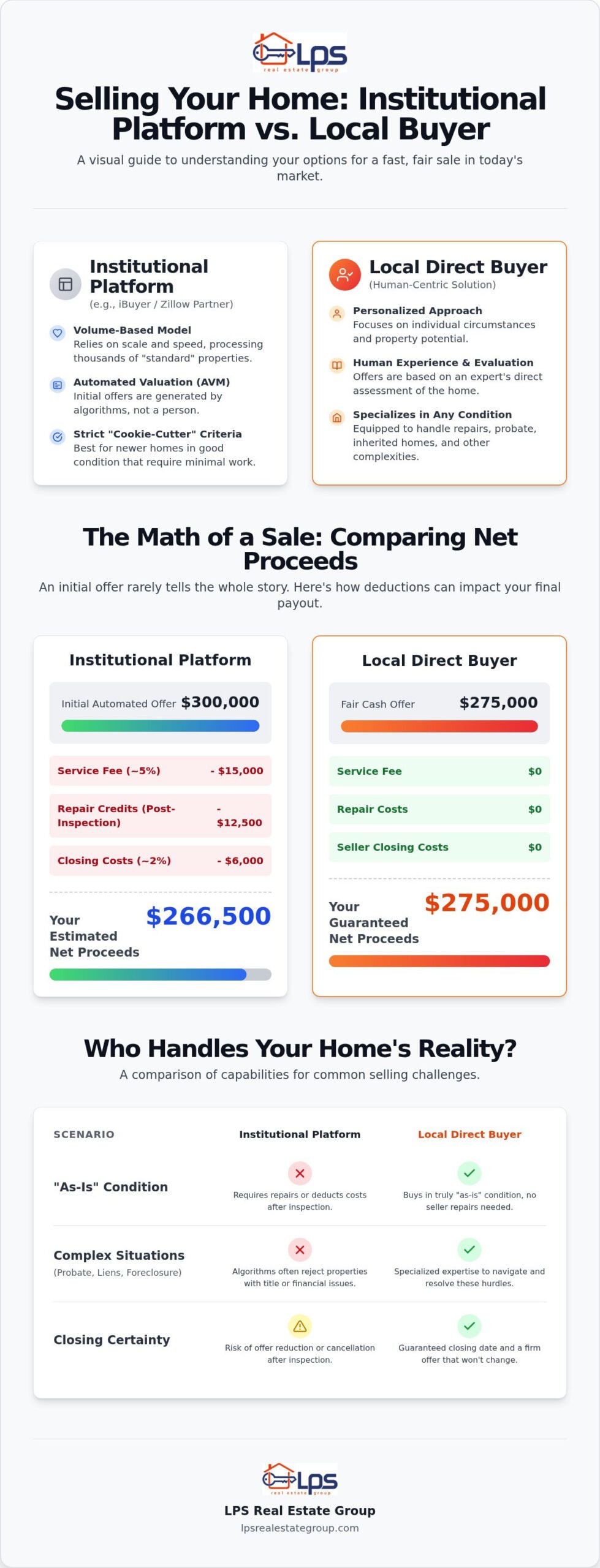
Institutional platforms use Automated Valuation Models (AVMs) to generate initial offers in seconds. While this feels efficient, it’s a rigid system built for “cookie-cutter” houses. These buyers typically have strict criteria, focusing on homes that are relatively new and need very little work. If your property needs significant repairs or has structural issues, the algorithm often flags it for rejection. Even when an offer is made, you’ll likely face a service fee of 5% or more, alongside deductions for every repair the corporate inspector identifies during their walkthrough.
The Local Direct Buyer Advantage
A local buyer operates with a different set of tools. Instead of a computer program, they use human experience to evaluate a home’s potential. This human-centric evaluation is vital if you’re dealing with a property that isn’t currently financeable by traditional banks. Local firms specialize in as-is property acquisition and complex situations like probate or inherited homes. They look past the peeling paint or the outdated systems to find a fair path forward. The choice to sell to zillow vs local buyer often comes down to whether you want a support ticket or a direct conversation with a decision-maker. This partnership approach provides a sense of relief for those who need a guaranteed closing date without the stress of meeting institutional standards.
Working with a local expert means your specific situation is respected. You aren’t just a number in a database; you’re a neighbor looking for a transparent solution. This methodical, patient approach, practiced by local specialists like 富盛地產|有巢氏太平中山富盛店, ensures you feel fully informed at every stage of the sale.
The Math of a Sale: Comparing Net Proceeds and Fees
When you sit down to compare your options, the sticker price on a contract rarely tells the whole story. Deciding whether to sell to zillow vs local buyer requires a hard look at your actual net proceeds rather than just the initial offer. Institutional buyers often lead with a high number to capture your interest, but that gross figure is frequently subject to significant reductions before you ever reach the closing table. Understanding these deductions is the first step toward finding a path that protects your equity.
It’s helpful to distinguish between an investor discount and a service fee. An investor discount reflects the cost of taking on a property’s risks and repairs immediately. In contrast, institutional platforms charge a service fee for the convenience of their technology and automated process. While a service fee might look smaller on paper, it’s often just the first of many subtractions that can leave you with less cash than you expected.
Institutional Fee Structures
Major national iBuyers typically charge a service fee of 5% or more. This is separate from the standard 1% to 3% you might pay in closing costs. You also need to account for holding costs during the inspection period. While the platform evaluates your property, you’re still responsible for taxes, insurance, and utilities. These small leaks in your equity add up quickly over a 30 or 60 day closing window.
The “repair credit” trap is perhaps the most stressful part of the institutional model. After you accept an initial automated offer, the platform sends an inspector to your home. They look for every flaw and translate those into credits that are deducted from your final payout. Because these platforms prioritize houses that meet specific institutional standards, even minor cosmetic issues can trigger large deductions that weren’t in your original budget.
Direct Cash Buyer Financials
Local investment firms approach the transaction with a focus on simplicity and transparency. There are no service fees or hidden convenience charges to worry about. Most direct buyers provide a zero commission promise because they aren’t acting as agents; they are the principals in the sale. Additionally, many local buyers choose to cover 100% of the closing costs, which removes another layer of financial anxiety for the seller.
By eliminating service fees, commissions, and expensive repair credits, a lower gross offer from a local buyer can frequently result in higher net proceeds than a higher corporate offer that gets chipped away at every stage. If you’re looking for a clear, straightforward path without the math games, requesting an as-is property acquisition can provide the financial clarity you need to move forward with confidence.
Property Condition: True “As-Is” vs. Institutional Standards
The term “as-is” is often used loosely in real estate, but its meaning shifts depending on who is signing the contract. When you evaluate whether to sell to zillow vs local buyer, the standard for property condition is one of the most significant points of divergence. For an institutional platform, “as-is” usually comes with a long list of caveats and requirements. For a local buyer, it typically means exactly what it says: the property is purchased in its current state, regardless of its flaws.
We understand that many homeowners face situations where a property has fallen into disrepair. Whether it’s a hoarding situation, fire damage, or years of deferred maintenance, the prospect of preparing a home for a corporate inspection can be overwhelming. A local partner approaches these challenges with empathy and a focus on finding a solution rather than a reason to decline the purchase. This methodical approach ensures that you feel supported rather than judged throughout the process.
Institutional Inspection Hurdles
Institutional buyers operate with a “pass/fail” mentality. Their business model depends on flipping homes quickly, which means they prefer properties that are nearly market-ready. If a home has a roof nearing the end of its lifespan, an aging HVAC system, or foundation concerns, the platform will often reject the deal entirely. These automated systems aren’t designed to manage major renovations or complex code violations. If a sale falls through after an institutional inspection, it can stigmatize your property, making future buyers wonder what hidden issues caused the corporate giant to walk away.
The Local Solution for Distressed Homes
A local investment group sees potential where an algorithm only sees risk. These buyers specialize in acquiring properties that do not meet institutional standards. This includes homes with significant structural damage or properties that haven’t been updated in decades. The advantage here is the total removal of physical and emotional labor. You don’t need to clean, paint, or even sweep the floors. You can walk away with your proceeds and leave the heavy lifting to the buyer. This is a collaborative effort to find the best outcome for a property that others might reject.
Choosing this path provides a sense of stability for those dealing with complex property issues. If you want to understand the full scope of this process, reading a guide on selling your house as-is can help demystify the steps involved. By partnering with someone who values the human side of the business, you ensure that your property’s condition doesn’t become a barrier to a fair and timely closing.
Solving Complex Situations: Probate, Foreclosure, and Liens
When legal or financial hurdles are attached to a property, the automated systems of national platforms often grind to a halt. The decision to sell to zillow vs local buyer often rests on whether your property has a “clean” history or a complicated one. Institutional buyers are designed for simple, high-volume transactions. They typically walk away the moment they encounter a lien, a pending auction, or a complex estate situation, leaving the homeowner back at square one without a viable exit strategy.
We recognize that these situations are often accompanied by significant personal stress. Whether you are dealing with a difficult divorce, a mounting tax debt, or the loss of a loved one, you need a partner who acts as a trusted advisor rather than a distant corporation. A local buyer provides the logistical support to navigate these hurdles, working alongside you to find a fair path forward that respects your circumstances. This methodical approach ensures that you feel supported rather than judged throughout the process.
Foreclosure Prevention and Short Sales
If you are facing a looming auction date, time is your most valuable asset. A direct buyer can often step in and stop a foreclosure in a matter of days, providing a sense of relief that corporate algorithms cannot offer. National platforms generally have a rigid debt-to-value ceiling. If your debt exceeds what their computer says the house is worth, they won’t offer a solution. In contrast, local experts can utilize creative finance solutions to satisfy lenders and protect your credit. Learning how to sell a house in pre-foreclosure through a direct purchase can provide the clarity you need to avoid a total loss at auction.
Navigating Probate and Estate Sales
Inherited properties come with their own set of unique challenges. You might be coordinating with multiple heirs or trying to understand the requirements of a local estate attorney. Corporate platforms aren’t equipped to sit down with a family and work through these complexities. They want a clean title and a single signature. Local firms specialize in probate and inherited property buyouts, offering the patience required to wait for the legal process to conclude. If you are unsure of the next steps, reviewing a guide on how to sell an inherited property can help you manage the expectations of all parties involved.
Every complex situation deserves a personalized strategy that prioritizes the human side of the transaction. Choosing to sell to zillow vs local buyer in these instances often means the difference between a deal that collapses and one that closes. If you are currently facing legal or financial pressure, you can explore foreclosure prevention purchase options to see how a direct partnership can resolve even the most difficult property hurdles.
The Decision Framework: Choosing Your Best Exit Strategy
Deciding whether to sell to zillow vs local buyer depends entirely on your property’s condition and your personal timeline. There is no universal “right” choice; there is only the choice that best fits your current needs. If your home is in pristine condition and you have the luxury of time, an institutional platform might offer a convenient tech-driven experience. To explore how AI-powered tools can help you evaluate these digital options, you can learn more about the latest property platforms. However, if you are facing property hurdles or need a guaranteed result, a local partner often provides the most reliable path forward.
The “Pretty House” scenario is where national platforms excel. These buyers look for homes built after 2000 that require nothing more than a fresh coat of paint. If your home fits this narrow criteria and you don’t mind a 5% service fee, the automated process can work well. In contrast, the “Problem Solver” scenario is where a local investment group shines. This includes homes with structural issues, properties in probate, or situations where you need to stop a foreclosure immediately. These buyers specialize in as-is property acquisition and creative finance solutions that corporate algorithms simply aren’t programmed to handle.
The Speed and Certainty Audit
When you evaluate your options, consider the value of certainty. Institutional sales often involve a 30 to 45 day closing window. During this time, the risk of “buyer fall-through” is real. If the platform’s secondary inspection reveals issues their algorithm missed, they may drop the price or cancel the contract entirely. A local buyer typically operates on a 7 to 14 day window. Because they use a non-contingent cash offer, the price you agree upon is the price you receive at closing. For many, the peace of mind that comes with a 7-day closing is worth more than a slightly higher corporate offer that might never materialize.
Before you commit, use this checklist to vet any local cash home buyer:
- Proof of Funds: Can they provide a recent bank statement showing they have the cash to close?
- Transparent Contracts: Is the agreement simple and free of hidden “marketing” or “convenience” fees?
- Direct Communication: Are you speaking with the person who is actually making the decision to buy?
- Flexible Terms: Will they let you choose your own closing date and leave unwanted items behind?
Partnering with LPS Real Estate Group
We believe that every homeowner deserves a transition defined by honesty and straightforwardness. Our “Transparency First” approach removes the mystery from the offer, ensuring you understand exactly how the numbers work before you sign anything. We act as a compassionate expert, listening to your needs first and providing a service second. Our process is designed to be low-stress and predictable:
- Consultation: We discuss your property and your goals to see if we are a good fit.
- Fair Offer: We provide a direct cash offer based on the actual condition of your home.
- Your Closing Date: You choose the day you want to move and receive your proceeds.
If you are ready to move past the stress of repairs and uncertain timelines, we are here to help. Get your fair cash offer from LPS Real Estate Group today and discover the relief that comes with a guaranteed, human-centric sale.
Securing Your Future with Financial Clarity
Choosing between the institutional approach and a personalized partnership depends on your specific goals for your home sale. While corporate platforms cater to a narrow slice of the market, the decision to sell to zillow vs local buyer often comes down to who can handle your property’s unique reality. You’ve seen that hidden fees and rigid inspection standards can complicate what should be a simple process, especially when a property needs significant care.
A local expert provides the empathy and expertise required for complex situations like probate or foreclosure. We focus on as-is acquisitions and direct cash purchases to ensure you receive a fair price without the stress of repairs or uncertain closing dates. If you’re ready for a transparent solution, you can request your no-obligation cash offer from LPS Real Estate Group today. We are here to act as your trusted advisor, providing the stability you need to move forward into your next chapter with peace of mind. You don’t have to navigate this transition alone; help is just a conversation away.
Frequently Asked Questions
Do institutional buyers like Zillow pay a fair price for homes?
Institutional buyers like Zillow no longer buy homes directly; they now facilitate offers through partners like Opendoor. These platforms use automated algorithms to determine value, which often misses the unique features of your home. While the initial number looks high, the final payout is frequently reduced by service fees and repair credits. You’ll likely find that the net proceeds are lower than you anticipated after all corporate deductions are applied.
How much are the typical fees when selling to a local cash buyer?
Local buyers typically operate without commissions, service fees, or hidden convenience charges. When you compare the cost to sell to zillow vs local buyer, you’ll find that institutional platforms often charge 5% or more just for the transaction. Most local investors also cover 100% of the closing costs, ensuring that the number you see on the purchase agreement is exactly what you receive at the closing table.
What happens if my house needs major repairs like a new roof or foundation work?
Major repairs are not a barrier when working with a local direct buyer. They specialize in as-is property acquisition and see potential in homes that institutional platforms would immediately reject. If your house has foundation issues or a failing roof, a local buyer will factor those into their offer and handle the work themselves. This allows you to avoid the stress and high cost of professional renovations before you can sell.
Can I sell my house to a local buyer if I am facing foreclosure?
Yes, a local buyer can step in to stop a foreclosure by purchasing the property directly. They understand the urgency of an auction date and can often close in just a few days to protect your credit. Unlike national platforms that have strict debt limits, a local partner can explore creative finance solutions to resolve complex debt. This provides a clear, manageable path forward during a very stressful financial situation.
How long does it actually take to close with a local buyer vs. Zillow?
A local buyer can usually close within 7 to 14 days because they don’t have to wait for corporate committees or algorithmic approvals. Selling through an institutional platform typically takes 30 to 60 days, as they require extensive inspections and internal processing. If speed is your priority, the local path offers a much more predictable timeline. You get a guaranteed closing date that allows you to plan your move with total confidence.
Will a local buyer handle the probate process for me?
While a buyer isn’t a replacement for a lawyer, a local firm specializing in probate buyouts can simplify the logistical side of the sale. They are comfortable working with multiple heirs and understand the patience required for the legal system to move forward. National platforms usually walk away from probate properties because they are too complex. A local partner stays with you throughout the process to ensure every heir is respected.
What is the difference between a cash offer and a creative finance offer?
A cash offer provides a single payment for the full purchase price at the time of closing. Creative finance solutions are tailored strategies for situations where a property has high debt or unique financial hurdles. This might include the buyer assuming mortgage payments or other flexible arrangements. These options provide a way to sell when a traditional cash offer wouldn’t satisfy the existing liens or mortgage balance on the property.
Do I need to clean or stage my house for a local direct buyer?
You don’t need to lift a finger to prepare your home for a local buyer. There’s no need for professional cleaning, staging, or even basic repairs. You can take what you want and leave the rest behind, including furniture or old appliances. This as-is approach is designed to be low-stress, allowing you to walk away from the property without the physical or emotional burden of a traditional deep clean.