
Is the traditional real estate market actually the safest place for your equity when you’re facing a tight deadline or a complex property situation? Many homeowners assume that a public listing is the only path to a fair outcome, but for those dealing with the stress of an inherited home or the threat of foreclosure, the standard route often leads to more exhaustion than results. It’s a common frustration to watch a listing stall while you manage repairs from afar or worry about your next mortgage payment. This is where direct home buyers offer a different perspective by focusing on speed and certainty rather than just a sign in the yard.
You’ll discover exactly how these professional buyers operate and whether a cash offer or a creative finance strategy provides more value for your specific situation than a traditional sale. We’re going to compare the 2026 market reality, including current commission trends and new federal reporting requirements, so you can choose the path that brings you the most peace of mind. By the end of this comparison, you’ll know if the convenience of an as-is sale outweighs the traditional process for your unique goals.
Key Takeaways
- Understand how a direct sale removes the need for public marketing, repair costs, and the stress of repeated home showings.
- Compare your actual “Net Take Home” profit by looking past the sticker price to include commissions, fees, and seller concessions.
- Learn how direct home buyers provide a higher level of certainty, helping you avoid the 15-20% of retail contracts that fail due to financing issues.
- Identify which type of buyer fits your needs, from high-tech algorithmic companies to professional investors who specialize in complex probate or foreclosure situations.
- Explore how creative finance strategies can help you maximize your equity and achieve a fair price without the long wait of a traditional listing.
What is a Direct Home Buyer? Defining the 2026 Market
A direct home buyer is a person or a company that buys your house without using a real estate agent as an intermediary. This means you skip the traditional listing phase entirely. There is no need to post on the Multiple Listing Service (MLS), host weekend open houses, or prepare your home for professional photography. Essentially, direct home buyers act as a liquidity provider for homeowners seeking non-traditional real estate exits.
The market has changed significantly leading into 2026. The industry has moved away from simple “fix and flip” models toward sophisticated portfolio building and creative financing. Modern buyers often look to hold properties long-term as rentals or incorporate them into diverse investment funds. This shift means they’re often more interested in the long-term potential of a home than a quick renovation profit. These buyers provide tailored solutions that might include taking over existing debt or using structured payments to help you maximize your equity.
The Core Difference: Principal vs. Agent
When you work with an agent, you’re hiring a representative who looks for a buyer on your behalf in exchange for a commission. In contrast, a direct home buyer is the actual customer. Cutting out the middleman changes the timeline from months of waiting to a matter of days. Since there’s no bank appraisal or third-party approval needed in many cases, the process moves quickly. Another major shift involves liability. When you sell to a professional buyer, they typically take on all property risks “as-is.” This means you aren’t responsible for repairs that might be discovered after the sale, providing a clean break from the property.
Common Situations That Require a Direct Sale
While anyone can sell directly, certain situations make this path more practical. Properties with severe structural damage or code violations often fail traditional bank inspections. This makes them nearly impossible to sell on the retail market where buyers rely on standard mortgages. Time-sensitive exits, such as a sudden job relocation or the need to stop an impending auction, also benefit from the speed of a direct offer. You don’t have to wait for a buyer to get their financing in order because the funds are already available.
Complexity is another major factor. You might be researching What is an iBuyer to see if a tech-driven offer works for your suburban home. However, for more complicated legal hurdles, such as learning how to sell an inherited property, a local investment group often provides more personalized care. These direct home buyers understand the nuances of probate and can help resolve title issues that would otherwise stall a traditional listing. They act as partners in solving the logistical puzzles that come with distressed or inherited real estate.
Direct Buyer vs. Real Estate Agent: The 2026 Comparison
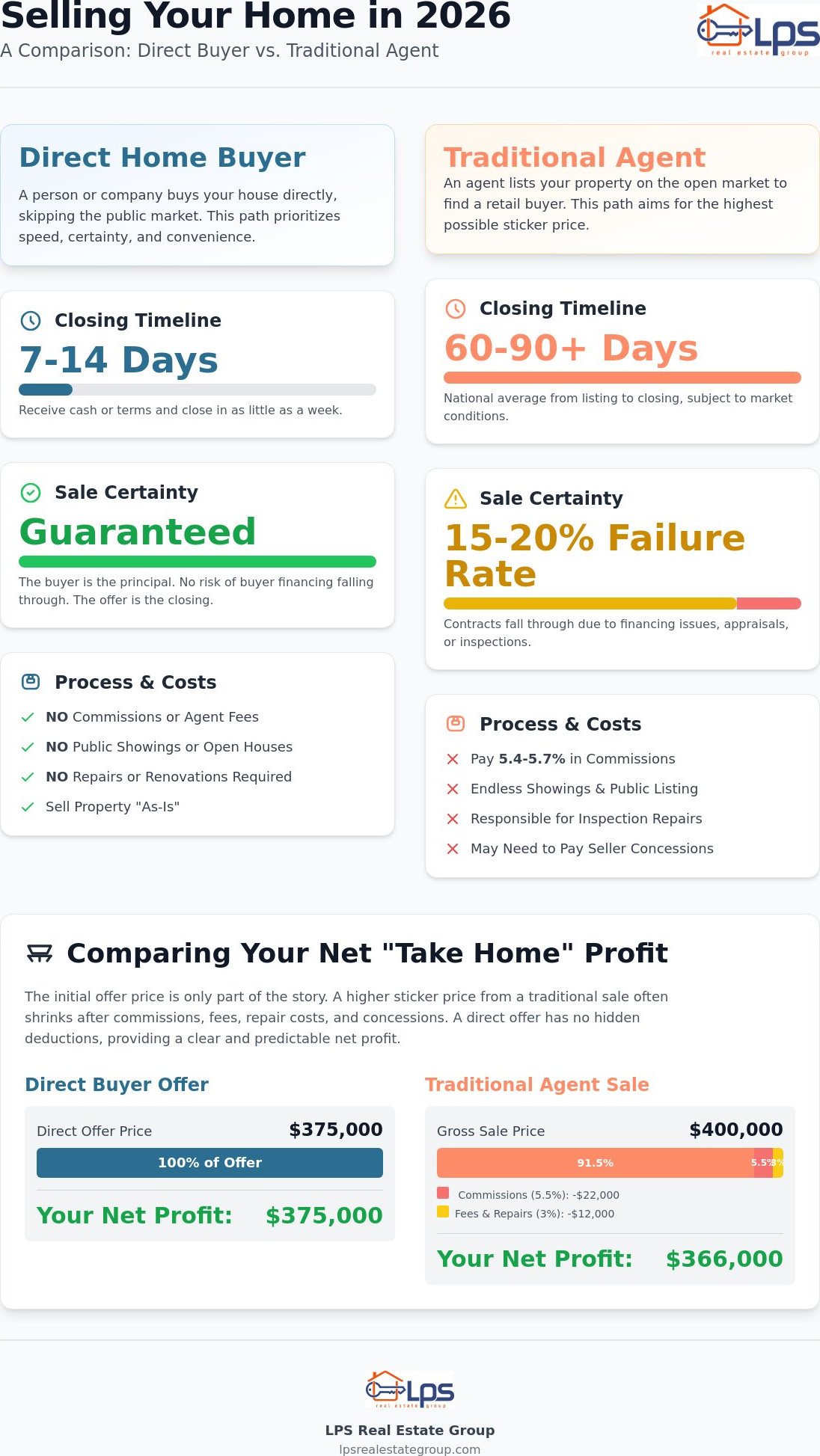
When you prepare to sell your property, the first number you see is often the gross sales price. However, it’s vital to remember that the highest price on paper isn’t always the most money in your pocket. A traditional sale involves a long chain of deductions that can significantly eat into your equity. Analyzing your “Net Take Home” pay requires looking at the total picture, including commissions, concessions, and the costs of time itself. While a retail buyer might offer a higher starting number, direct home buyers provide a streamlined path that often results in a similar or more predictable net outcome without the months of uncertainty.
The “Certainty Factor” is a major differentiator in the 2026 market. Currently, approximately 15% to 20% of traditional retail contracts fall through before closing, mostly due to buyer financing issues or inspection disputes. This can be devastating if you’ve already committed to a new home or are trying to avoid a legal deadline. Comparing timelines reveals a stark contrast. A direct sale typically closes within 7 to 14 days, whereas the national average for a retail sale sits between 60 and 90 days. For many, the speed of a guaranteed close is worth more than the speculative top-dollar price of a public listing.
The Hidden Costs of a Traditional Listing
A traditional sale carries expenses that many homeowners overlook until they see the final settlement statement. National data from mid-2026 shows that the average real estate commission remains between 5.44% and 5.70%. When you add the 1% to 3% in seller closing costs, you’re already looking at nearly 9% of your equity disappearing. Beyond these fees, picky retail buyers often demand expensive repairs or upgrades before they’ll even consider an offer. You also have to factor in holding costs. With the average 30-year mortgage rate at 6.43%, every month your house sits on the market is another month of interest, taxes, insurance, and utilities that you’ll never recover.
The Transparency of a Direct Offer
Working with professional buyers removes these layers of complexity. Most direct home buyers offer a transparent, “what you see is what you get” price. There are zero commissions to pay, and the buyer typically covers all standard closing costs. Because these are often cash transactions, there are no appraisal contingencies that could force a price reduction at the last minute. This process allows for a calm transition, often including flexible move-out dates so you can move when you’re ready. If you’re weighing your options, you might find it helpful to look at a step-by-step guide to selling your house to see how much work the traditional path truly requires. If the traditional route feels overwhelming, you can always explore a simpler alternative that prioritizes your peace of mind.
Types of Direct Buyers: iBuyers vs. Professional Investors
It’s a mistake to assume that all direct home buyers operate the same way. In the 2026 market, the industry has split into two very different categories: high-tech iBuyers and local professional investment groups. Understanding which one you’re dealing with is the first step toward a successful sale. While both offer a faster alternative to the MLS, their criteria for which houses they’ll actually purchase are worlds apart. One relies on algorithms and strict data sets, while the other focuses on personal circumstances and property potential.
iBuyers are large, tech-driven companies that use “buy boxes” to filter properties. They typically only purchase “pretty” houses in specific, high-demand zip codes. If your home was built after 2000 and requires very little work, an iBuyer might be an option. However, their limitations are strict. Most iBuyers will automatically reject a home if it needs more than $10,000 in repairs or has any unique title issues. They also charge a service fee, which verified data from 2026 shows typically ranges between 5% and 10% of the purchase price. This fee often mirrors a traditional commission, meaning the convenience comes at a clear cost.
Professional investment groups, like LPS Real Estate Group, act as problem-solvers rather than just transactional engines. We look at the houses that iBuyers won’t touch, including distressed properties, inherited homes, or houses with structural damage. Our approach is a hybrid of professional speed and personalized care. We don’t just look at a spreadsheet; we look at your specific goals to see if a cash offer or a creative finance solution serves you better. This flexibility is essential when the situation is more complex than a simple move.
When an iBuyer Makes Sense
- Your property is in near-perfect condition and fits a standard suburban profile.
- You’re comfortable with a tech-heavy process that involves minimal human interaction.
- You don’t have complex liens, solar panel leases, or title hurdles to clear.
- You’re willing to pay a service fee for the benefit of an instant, algorithmic offer.
When a Professional Investment Firm is Better
- The property has major deferred maintenance, such as a failing roof or foundation issues.
- You’re navigating a difficult legal or financial transition and need to know how to sell a house in pre-foreclosure without losing your dignity.
- You’ve inherited a property from afar and need a buyer who can handle the clean-out and probate logistics.
- You need a partner who listens to your needs and creates a custom closing timeline that works for your family.
Choosing the right type of buyer depends on the “health” of your property and the urgency of your situation. If your home has “character” or your life has recently become complicated, a professional investment firm offers the empathy and expertise that an algorithm simply can’t provide. We prioritize the human side of the transaction, ensuring you feel supported from the first consultation to the final signature.
Evaluating the Offer: Is it Fair for Your Situation?
When you receive a proposal from a direct home buyer, your first instinct is likely to compare it to the highest price you’ve seen on a real estate app. However, a fair offer isn’t just about the top-line number; it’s about the net value after all stressors and expenses are removed. Professional direct home buyers look at your property through the lens of “As-Is” value, which accounts for the immediate relief of walking away without making a single repair. A legitimate proposal should be transparent, showing you exactly how the buyer arrived at their figure based on current local data and the specific hurdles your property presents.
It’s also important to distinguish between a predatory lowball and a professional investment. A predatory offer often comes with high-pressure tactics or vague terms. In contrast, a professional proposal includes a clear breakdown of the closing process and respects your need for time to think. In many 2026 scenarios, a “Subject-To” offer might actually be the best way to move forward. This strategy allows a buyer to take over your existing mortgage payments, which can preserve your credit score and potentially net you a higher price than a standard cash buyout.
The Math Behind a Fair Cash Offer
Most professional buyers use the After Repair Value (ARV) formula to determine their offer. They start with what the house could sell for if it were in perfect condition, then subtract the estimated cost of repairs and a small margin for the risk of the renovation. In 2026, holding costs are a significant factor in this math. With the average 30-year fixed mortgage rate sitting at 6.43%, the cost of capital for the buyer is higher than in previous years. A fair offer reflects these market realities while ensuring you still walk away with a meaningful amount of equity without the work of a traditional sale.
Beyond Cash: The Power of Creative Exit Strategies
Sometimes, a straight cash offer isn’t the best fit, especially if you have little equity or want to maximize your long-term gain. Creative finance solutions provide more flexibility than a standard retail listing ever could. For example, seller financing allows you to act as the “bank,” receiving monthly payments that provide passive income over several years. If you’re facing foreclosure, a “Subject-To” arrangement can stop the auction immediately by catching up on back payments and continuing the monthly installments. These strategies turn a stressful exit into a structured, manageable plan that protects your financial future. If you want to see what a transparent proposal looks like for your property, you can request a fair offer assessment today.
Choosing Your Path: How to Start the Direct Sale Process
Selling your home shouldn’t feel like a mystery. When you decide to explore a sale outside the traditional market, the process should be as straightforward and transparent as possible. Professional direct home buyers aim to replace the typical stress of the unknown with a clear, logical path forward. This journey starts with a simple conversation about your specific needs rather than a high-pressure sales pitch. We’ve refined our approach to ensure you feel like a partner in the process, not just another transaction on a spreadsheet.
The path to a successful closing follows a steady, predictable sequence designed to give you total clarity. It begins with a no-obligation consultation where we listen to your goals and assess the property’s condition. From there, we provide a transparent breakdown of your options. While many competitors only discuss cash offers, we include creative finance strategies that might bridge an equity gap or provide you with a higher net price over time. You’ll then receive a “Net Sheet” that shows you exactly what you’ll walk away with at the closing table, after every cost is accounted for. Finally, you choose your closing date. Whether you need to move in as little as 7 days or require several months to coordinate your next move, the timeline stays under your control.
The LPS Real Estate Group Advantage
We don’t just buy houses; we provide tailored exit strategies for complex lives. Our team understands that every situation is different, which is why we focus on transparency from the very first meeting. We want you to understand every line of the contract so there are no surprises on moving day. For a deeper dive into how we handle various property challenges, you can read our Definitive 2026 Homeowner’s Guide. This resource explains our commitment to doing the right thing for every seller we serve.
Taking the Next Step with Confidence
It’s important to remember that there is never any pressure to accept an offer that doesn’t feel right for your family. Our role is to act as a trusted advisor, providing you with the data and options you need to make an informed choice. If you decide to move forward, we handle all the heavy lifting, including the paperwork, title work, and coordination with attorneys. This methodical approach ensures that your transition is as low-stress as possible. If you’re ready to see how direct home buyers can help you move forward, contact us today for a compassionate, no-pressure evaluation of your property.
Choosing the Best Path for Your Property’s Future
Deciding how to sell your home is a significant financial and emotional choice. You now understand that while a traditional listing might promise the highest sticker price, the hidden costs of commissions, repairs, and time often bridge the gap between retail and direct offers. By working with direct home buyers, you gain the certainty of a guaranteed close and the flexibility of as-is acquisitions. Whether you’re navigating a complex probate case or simply need a fast, reliable exit, the right strategy is the one that prioritizes your peace of mind and long-term stability.
Since our founding in 2018, LPS Real Estate Group has focused on ethical acquisitions with a compassionate, human-centric approach. We specialize in creative finance and probate buyouts, offering a national reach while maintaining the personalized care of a trusted advisor. We’re here to listen to your needs and help you find the most beneficial path forward without any high-pressure tactics. You deserve a solution that respects your circumstances and handles your equity with integrity. Get Your Fair, No-Obligation Offer from LPS Real Estate Group today and take the first step toward a stress-free transition.
Frequently Asked Questions
How do direct home buyers determine their offer price?
Professional direct home buyers determine their offer by calculating the After Repair Value, which is what the home would be worth if it were fully renovated. From that number, they subtract the estimated costs for materials and labor, daily holding costs such as taxes and insurance, and a margin for the risk of the project. This formula ensures the offer is grounded in current 2026 market data while accounting for the convenience of a fast, cash-based exit.
Is selling to a direct buyer faster than a traditional sale?
Yes, selling directly is significantly faster than the traditional route. While the national average for a retail sale in 2026 sits between 60 and 90 days, a direct sale can often close in as little as 7 to 14 days. This speed is possible because there are no bank appraisals, public showings, or lengthy mortgage approval periods for the buyer. It’s a practical path for those who need to move quickly due to a job change or financial deadline.
Do I need to clean or repair my house before a direct buyer sees it?
You don’t need to lift a finger to clean or repair the property. Professional buyers specialize in “as-is” acquisitions, meaning they take the house exactly as it stands today. You can even leave behind unwanted furniture, trash, or items you no longer need. This approach removes the physical and financial stress of preparing a home for picky retail buyers who often demand a perfect, market-ready appearance before making an offer.
What are the risks of selling to a direct home buyer?
The primary risk is working with an inexperienced or predatory individual who may try to change their offer price at the last minute. To protect yourself, always look for established firms with a transparent process and an ethical track record. While the offer price might be lower than a retail listing, you should weigh that against the thousands you save on commissions, repairs, and the 1% to 3% in closing costs usually paid by sellers.
Can a direct buyer help me if I am facing foreclosure?
Yes, a professional buyer can often stop a foreclosure by purchasing the property before the scheduled auction date. They can provide a cash buyout to pay off the lender in full or use creative finance strategies to catch up on late payments and take over the monthly installments. This can help save your credit score and provide a much-needed fresh start during a difficult time without the stress of an impending eviction.
Do direct home buyers charge any hidden fees or commissions?
Legitimate direct home buyers do not charge commissions or hidden service fees. Unlike a traditional sale where you pay roughly 6% in agent fees, a direct offer is typically a net number. The buyer also usually covers all standard closing costs. This transparency allows you to see exactly how much money you’ll have in your pocket at the end of the transaction without any surprises or deductions at the closing table.
What happens if my house is in probate or has multiple heirs?
Selling a probate property is a common specialty for professional investment groups. They can help navigate the legal requirements and coordinate with multiple heirs to ensure everyone is on the same page. This is especially helpful if the heirs live in different states or if the estate doesn’t have the funds to maintain the property during the legal process. They act as a calm, helpful partner through the logistical complexity.
Can I sell a house with a tenant still living in it to a direct buyer?
You can absolutely sell a property with tenants still in place. Many modern buyers are looking to build long-term rental portfolios and are happy to take over existing lease agreements. This means you don’t have to go through the stressful process of evicting tenants or waiting for a lease to end before you sell. It provides a seamless transition for both you and the people living in the home while you receive your equity.