

What if you could keep the nearly 6% of your home’s equity that usually disappears into a realtor’s pocket? With the national average commission sitting at 5.70% in 2026, selling a median-priced home of $405,400 means handing over more than $23,000 at the closing table. It’s natural to want to sell house without an agent to maximize your net profit. Yet, the anxiety of managing strangers in your home, the fear of legal errors in the paperwork, and the burden of making market-ready repairs can quickly become exhausting.
We believe you deserve a process that’s both profitable and transparent. This guide provides a clear, step-by-step roadmap to help you handle the current real estate landscape on your own terms. You’ll learn how to manage the logistical hurdles of a private sale, compare the actual costs versus the potential savings, and explore simpler, more predictable alternatives that bypass the stress of the traditional market altogether.
Key Takeaways
- Learn how to reclaim your home’s equity by bypassing traditional commissions, which can save you tens of thousands of dollars at the closing table.
- Master the essential 2026 checklist to sell house without an agent, including how to price your property accurately using a competitive market analysis.
- Identify the most effective high-ROI repairs and staging techniques that make your home stand out to buyers without the need for a full renovation.
- Understand the legal and emotional challenges of private sales, from managing difficult negotiations to ensuring all property disclosures are handled correctly to avoid future liability.
- Discover how a direct acquisition can provide a simple, as-is solution that eliminates the need for showings, repairs, or agent fees entirely.
What Does it Mean to Sell a House Without an Agent?
Choosing to sell house without an agent is a significant decision that places you in the driver’s seat of your financial future. This process, widely known as For Sale By Owner (FSBO), involves the homeowner taking on every responsibility typically handled by a licensed professional. By 2026, homeowners have access to more digital tools than ever, making this path a popular choice for those with high-demand properties or tight moving timelines. It is a path defined by independence and a desire for transparency.
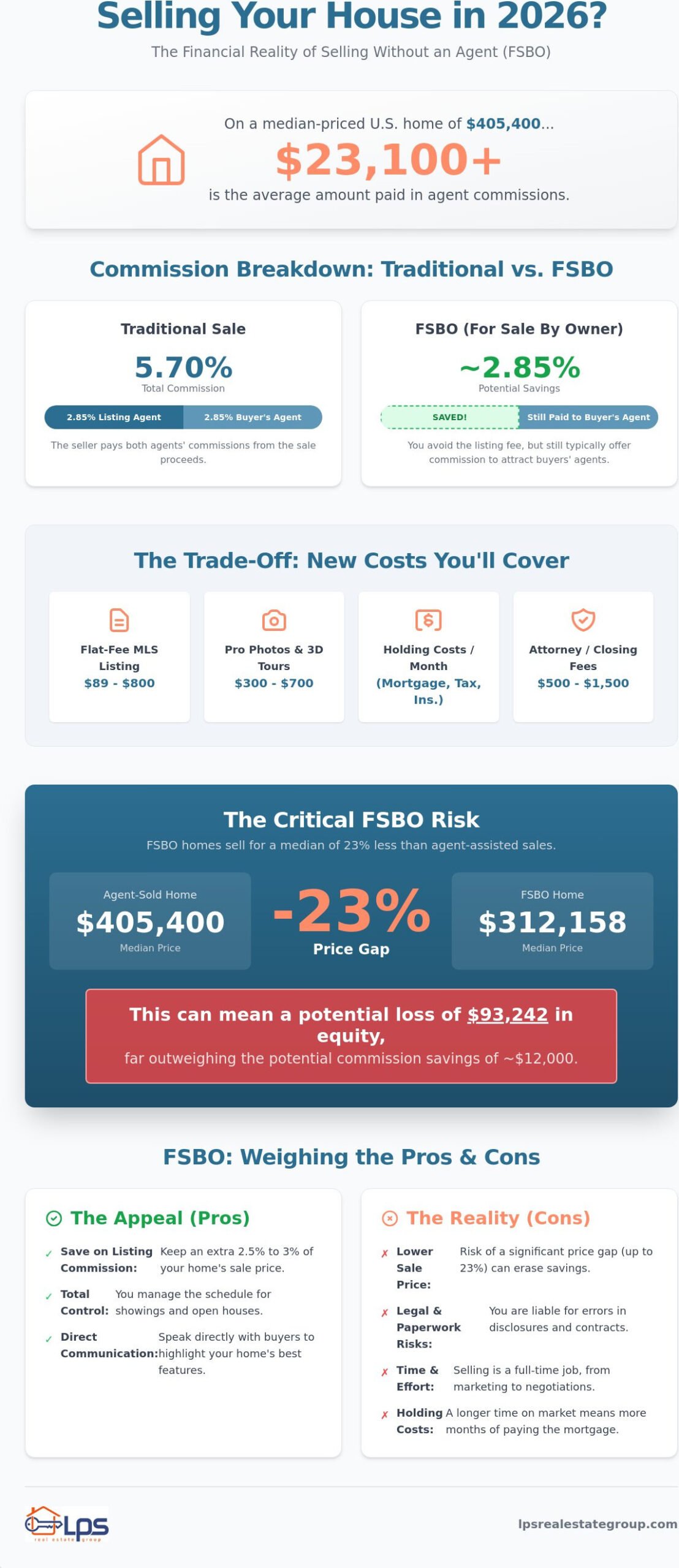
The core appeal of this strategy is simple: financial preservation. In a traditional sale, you might pay a total commission of around 5.70%. By removing the listing agent, you aim to save the 2.5% to 3% fee usually paid to the professional representing the seller. On a home priced at the 2026 median of $405,400, that is over $12,000 staying in your pocket. However, a realistic approach is vital. Even without a listing agent, most successful FSBO sellers still offer a commission of 2.5% to 3% to the buyer’s agent. This ensures your home remains attractive to the 90% of buyers who still use professional representation.
The Benefits of the FSBO Approach
Taking the lead on your sale offers a level of control that a traditional listing cannot match. You decide exactly when the house is shown, ensuring that visits fit your family’s schedule rather than an agent’s calendar. You also speak directly with potential buyers. This direct line of communication allows you to share the unique history and hidden charms of your home that a third party might overlook. Most importantly, the savings are substantial. For an average home, avoiding the listing commission can save between $10,000 and $30,000, which can be used for your next down payment or moving expenses.
Common Misconceptions About Selling Yourself
Many homeowners believe that going solo means they must do everything entirely alone. This is a common myth. In reality, you will still need a professional team; you just choose them yourself. Most states require a real estate attorney or a specialized escrow officer to handle the legal transfer of the deed and ensure the paperwork is filed correctly. Another misconception is that FSBO homes simply don’t sell. They do sell, but the data suggests they may require more time on the market. Without the broad reach of an agent’s network, you must be prepared to be your own marketing department, managing everything from digital listings to the “For Sale” sign in the yard.
The Financial Breakdown: Commissions vs. FSBO Costs
While the prospect of saving on commissions is the primary reason many choose to sell house without an agent, it is important to look at the full financial picture. A traditional sale involves a total commission of roughly 5.70%, which covers both the listing and buyer’s agents. In contrast, selling your house yourself means you take on the financial burden of marketing and administration. You are essentially trading your time and out-of-pocket cash for the potential to keep more equity.
Data shows a significant gap between DIY results and professional listings. According to Ridley (March 15, 2026), FSBO homes sell for a median of 23% less than those sold with an agent. This “FSBO discount” often wipes out the commission savings you intended to keep. Additionally, you must account for holding costs. Every month your home stays on the market, you pay for the mortgage, property taxes, insurance, and utilities. If a DIY sale takes three months longer than a professional one, those monthly expenses directly reduce your final take-home amount. In many cases, accepting a direct cash offer can actually net you more than a slow FSBO sale once you subtract the months of holding costs and the price of major repairs.
The True Cost of Marketing a FSBO Home
To get your home in front of buyers, you’ll need to pay for visibility. A flat-fee MLS service in 2026 typically costs between $89 and $800 just to appear on major sites like Zillow and Realtor.com. Because 2026 buyers expect high-quality visuals, professional photography and 3D tours are no longer optional. These services generally range from $300 to $700. You also need to budget for yard signage, printed flyers for open houses, and potentially paid social media ads to reach local buyers who aren’t searching the major portals.
Legal and Closing Expenses
Saving on commissions doesn’t mean you can skip the legal requirements. You’ll likely need a real estate attorney to draft the purchase agreement and ensure all state-mandated disclosures are met. In 2026, flat fees for a standard residential closing usually fall between $500 and $1,500. You are also responsible for the title search and insurance costs, which are standard in almost every transaction. If you find these logistics overwhelming, you might prefer an as-is property acquisition that handles the heavy lifting for you. This allows you to avoid the complex paperwork while still bypassing the traditional agent model.
The 2026 FSBO Checklist: Step-by-Step Guidance
If you decide to sell house without an agent, your success depends on a disciplined, methodical approach. While the process can feel daunting, breaking it into manageable steps helps maintain your peace of mind. As you prepare, reviewing resources like Fidelity’s guide to selling your house can provide a solid foundation for the road ahead. Following a structured plan ensures that no critical detail is overlooked during the transition.
- Conduct a competitive market analysis: Instead of relying on automated online estimates, look at homes similar to yours that sold within a five-mile radius in the last 90 days. This provides a realistic baseline for what buyers are actually willing to pay in the current market.
- Perform high-ROI repairs: Focus your energy on tasks that provide the most visual impact. Fresh neutral paint, basic landscaping, and thorough decluttering often yield the highest returns in the eyes of 2026 buyers.
- List on the MLS: Use a flat-fee listing service to ensure your home appears on the major search portals. This is the most efficient way to gain exposure to the 90% of buyers who start their search online.
- Vet every inquiry: Before you open your doors, confirm the buyer has a current pre-approval letter. This simple step protects your time and ensures you are only dealing with those who have the financial backing to finish the deal.
- Negotiate terms: Be prepared to discuss more than just the price. You’ll need to weigh the impact of inspection contingencies, appraisal gaps, and the buyer’s desired closing timeline.
Vetting Buyers and Managing Showings
Managing showings requires you to act as a professional gatekeeper. In 2026, high interest rates mean you must distinguish between “looky-loos” and serious, qualified buyers immediately. Always ask for a pre-approval letter before scheduling a private tour. For safety, never host a showing alone. Consider using a digital lockbox with a tracking log and ensure a friend or family member knows when you have visitors. This structured approach helps you maintain control while filtering out those who aren’t ready to make a commitment.
Navigating the Paperwork and Escrow
The closing process is where the technical details matter most. While many states offer standardized purchase agreements, having an attorney review your contract can prevent costly legal errors. You’ll need to manage the inspection period carefully, as buyers often use this time to request repairs or price credits. Staying calm and objective during these negotiations is essential for keeping the deal on track. If the prospect of managing repairs and paperwork feels like too much, you can explore other paths in our How to Sell Your House for Cash: The Complete 2026 Guide. This resource explains how to bypass the traditional market hurdles while still achieving a fair outcome.
Challenges and Risks of Selling Without an Agent
Choosing to sell house without an agent is often driven by a desire to protect your hard earned equity. However, the logistical reality is that you’re essentially taking on a second job for the next 30 to 90 days. You’ll be the one answering calls at dinner time, vetting strangers, and managing every showing. This emotional toll is compounded when you deal with aggressive buyers who may try to bully you on price because they know you don’t have professional representation. It takes a thick skin to hear a stranger critique your home during a tour while you’re trying to remain professional.
Legal liability is another quiet risk that many homeowners overlook. Failing to disclose a material defect, even unintentionally, can lead to expensive lawsuits long after you’ve moved out. This is particularly challenging if your home isn’t in perfect condition. Most traditional buyers are looking for a move in ready experience. If your roof is aging or the HVAC is on its last legs, you’ll likely find that buyers walk away or demand massive price drops after the inspection report comes back. Financing for these buyers often depends on a clean appraisal, which can be difficult to achieve when a house needs work.
Handling Complex Legal Situations
The stakes are even higher when the property involves more than just a standard title. If you are How to Sell an Inherited Property, you may be balancing the needs of multiple heirs or navigating the specific requirements of the probate court. Similarly, if you’re trying to figure out How to Sell a House in Pre-Foreclosure, the pressure of a ticking clock makes the DIY process feel almost impossible. These situations require a level of expertise and speed that goes beyond a standard listing.
When FSBO Becomes Overwhelming
Listing burnout is a real phenomenon for many DIY sellers. If your house sits for more than 60 days, it begins to look stale to potential buyers. They start to wonder what’s wrong with the property; this often leads to low ball offers that net you less than you’d hoped. Many homeowners find themselves listing with an agent out of sheer frustration after months of wasted effort and high holding costs. If you’re feeling the weight of these challenges, you don’t have to navigate this alone. You can skip the repairs, the showings, and the legal stress by choosing to get a fair cash offer from LPS Real Estate Group today.
The Direct Buyer Alternative: FSBO Results Without the Work
Many homeowners set out to sell house without an agent because they want to protect their equity. But as we’ve explored in the previous sections, the labor involved in a DIY sale can quickly become a full-time burden. Direct acquisition offers a third path. It allows you to skip the traditional market entirely while still avoiding agent commissions. When you sell directly to a group like LPS Real Estate Group, you’re choosing a streamlined process that prioritizes your peace of mind over the chaos of open houses and picky buyers.
The “As-Is” advantage is perhaps the most significant relief for sellers. In a standard FSBO scenario, you’re often forced to spend thousands on repairs just to attract a buyer who might still ask for more credits after an inspection. We buy houses exactly as they stand today. Whether you’re dealing with structural issues, outdated interiors, or complex financial binds like tax liens and low equity, we provide creative finance solutions. These options are designed to help you move forward when a traditional sale feels out of reach due to a lack of funds for repairs or a difficult title situation.
Why Direct Buying Beats Traditional FSBO for Many
The primary difference between a direct sale and a traditional DIY listing is the level of certainty. In 2026, many FSBO deals fall through because of appraisal gaps or high interest rates affecting buyer financing. A direct cash purchase eliminates these contingencies. You don’t have to worry about a bank saying “no” at the last minute. Speed is another major factor. While the average FSBO listing takes 60 to 90 days to close, a direct acquisition can be completed in as little as 7 to 14 days. If you’re comparing your options, it’s helpful to research Companies That Buy Houses for Cash to see how they differ from the standard market approach.
The LPS Real Estate Group Approach
We pride ourselves on being compassionate experts rather than just a transaction focused business. Our process is built on transparency and active listening. Every offer we make is grounded in current 2026 market data, ensuring you receive a fair and honest assessment of your property’s value. We treat you as a partner, respecting your timeline and your unique circumstances, whether you’re navigating probate or simply want a clean break from a stressful property. Even if you’re fully committed to the DIY path, we invite you to get a no-obligation offer from us to use as a baseline for your journey. It gives you a guaranteed “floor” price to keep in mind while you test the open market.
Your Path to a Successful Sale
Deciding to sell house without an agent is a bold step toward financial independence. You’ve now seen the full landscape of the 2026 market, from the potential commission savings to the significant time commitment required to manage a private listing. While the DIY path offers control, it also demands that you act as your own marketer, negotiator, and legal coordinator. It’s a journey that requires patience and careful attention to detail to ensure you reach the finish line safely.
If the weight of repairs, showings, and paperwork feels like too much, remember that you have a reliable alternative. At LPS Real Estate Group, we are compassionate experts who specialize in helping homeowners navigate complex probate and foreclosure situations with ease. We provide a simple, transparent way to move forward with zero commissions, zero closing costs, and no repairs required. Our team values your integrity and aims to make your transition as calm and predictable as possible.
Get a Fair, No-Obligation Cash Offer from LPS Real Estate Group Today
You don’t have to carry the burden of a stressful sale alone. Whether you choose to list yourself or seek a direct solution, you’re now equipped to make the best decision for your future and your family. We’re here to listen and help whenever you’re ready to take that next step.
Frequently Asked Questions
Is it legal to sell my house without a realtor?
It is completely legal to sell your property without a licensed realtor in every state. Homeowners have the right to represent themselves in a real estate transaction. While you don’t need a realtor, you must still comply with state and federal disclosure laws to avoid future liability. Many sellers choose to sell house without an agent to save on fees, but they often hire a real estate attorney to ensure the legal transfer is handled correctly.
How do I price my home accurately for FSBO?
Accuracy starts with a Competitive Market Analysis (CMA) of homes similar to yours that sold within the last 90 days. Avoid relying solely on automated online estimates, which can be inaccurate by thousands of dollars. Look at the final sale prices of “comparables” in your immediate neighborhood. Pricing slightly below the highest recent sale can often spark more interest, helping you maximize your final net profit through multiple offers.
Do I still have to pay the buyer’s agent commission?
You aren’t legally required to pay a buyer’s agent, but most successful FSBO sellers still offer a commission of 2.5% to 3%. Since over 90% of buyers use an agent, offering this compensation ensures your home is shown to the widest possible audience. If you refuse to pay this fee, agents may steer their clients toward other listings where their professional services are compensated by the seller.
What legal documents are required for a FSBO sale?
You will need several key documents, including a legally binding purchase agreement, lead-based paint disclosures for older homes, and a property condition disclosure. You’ll also need the deed, recent tax bills, and any relevant HOA documents. Because these forms vary by state, many homeowners find it helpful to have a local professional review the paperwork to ensure every legal requirement is met before the closing date.
Can I sell my house ‘As-Is’ without an agent?
You can certainly list your home “As-Is,” but traditional buyers often struggle to get financing for properties needing major repairs. Most mortgage lenders require an appraisal that meets specific safety and habitability standards. If you want to sell house without an agent and avoid the repair process entirely, a direct cash buyer is often a more predictable route than testing the open market with a distressed property.
What is the biggest mistake FSBO sellers make?
The most common error is overpricing the property based on emotional value rather than market data. When a house is priced too high, it sits on the market and becomes “stale,” leading buyers to assume something is wrong with it. This often results in the seller eventually accepting a much lower offer than they would have received if they had priced the home correctly from the first day.
Is a real estate attorney required for a FSBO closing?
Whether an attorney is required depends on your state’s specific laws. In many parts of the country, a real estate attorney must oversee the closing and the filing of the deed. Even in states where they aren’t mandatory, hiring one is a wise investment. They provide a layer of protection that ensures the contract is fair and that the title is cleared of any liens or encumbrances before the property changes hands.
How long does it take to sell a house by owner?
On average, a FSBO sale takes between 60 and 90 days from listing to closing. This timeline is often longer than an agent-assisted sale because you are managing the marketing and vetting process yourself. Factors like your local market demand, the condition of your home, and your pricing strategy will all influence how quickly you find a qualified buyer and move through the escrow period.