

What if you could skip the stressful open houses, keep your home’s interior private from curious neighbors, and still walk away with a fair deal? For many homeowners in 2026, the most strategic way to regain control is to sell house without listing on MLS. You shouldn’t have to choose between your personal privacy and a successful sale.
We understand the weight of preparing a home for the public eye, especially when repairs are needed or life feels a bit cluttered. It’s natural to feel frustrated by the prospect of losing nearly 10% of your home’s sale price to standard commissions and closing costs. This guide provides the proven paths to selling your property privately, helping you avoid the public spotlight while maintaining total control over the process. We’ll walk through how to secure a certain closing date and skip the endless cleaning, so you can move forward with peace of mind.
Key Takeaways
- Understand why off-market listings are a growing trend for sellers who want to avoid public databases and maintain their home’s privacy.
- Explore the most effective ways to sell house without listing on MLS, from managing the process yourself to partnering with a professional buyer.
- Learn how to calculate your home’s fair market value using recent local data to ensure you receive a fair and transparent offer.
- Identify the hidden costs of traditional sales, such as agent commissions and monthly upkeep, to see how much equity you can actually keep.
- Discover the benefits of an as-is acquisition that removes the burden of cleaning or repairs while providing a guaranteed closing date.
What Does It Mean to Sell a House Without Listing on the MLS?
The traditional way of selling a home usually starts with a sign in the yard and a digital broadcast to the world. At the heart of this process is the Multiple Listing Service (MLS), a suite of services that real estate brokers use to facilitate cooperation and share property data. While this system was designed to maximize visibility, it also means your home’s interior, your asking price, and the history of your sale become public record almost instantly. Choosing to sell house without listing on MLS is a strategic decision to keep that information private while maintaining full control over who enters your home.
In 2026, we’re seeing a significant shift toward ‘equity-first’ selling. Many homeowners now prioritize keeping their hard-earned equity rather than spending it on the 9-10% total costs often associated with a traditional sale. It is a perfectly legal and increasingly common path. The For Sale By Owner (FSBO) movement has matured into a sophisticated option for those who want to avoid the standard 5.70% commission rates while keeping their property’s details confidential. Beyond the financial aspect, the psychological relief of a private sale is undeniable. You don’t have to worry about neighbors browsing through photos of your bedrooms or strangers walking through your living room during an open house. It’s a quieter, more respectful way to handle a major life transition.
The Difference Between Public and Private Sales
When you list on the MLS, your property data is automatically pushed to thousands of real estate websites within minutes. This creates a ‘days on market’ counter that everyone can see. If your home doesn’t sell quickly, that public timer can work against you; it often signals to buyers that they can offer less. A private sale removes this pressure. You can negotiate on your own terms without the ticking clock of a public listing affecting your perceived value. You decide who sees the property and when, ensuring your financial and property status remains between you and the buyer.
Common Reasons Homeowners Skip the Public Market
There are many practical reasons to avoid the traditional route. You might be selling a house in probate or dealing with an inherited property where the emotional weight is already heavy enough. In these situations, the last thing you want is the ‘show-ready’ requirement of a traditional agent. Selling house without listing on MLS allows you to skip the expensive repairs, the deep cleaning, and the constant interruptions of walkthroughs. It’s about choosing certainty and speed over the unpredictable nature of the open market, allowing you to close on a date that fits your schedule.
The 3 Primary Paths to an Off-Market Home Sale
When you decide to sell house without listing on MLS, you aren’t just avoiding a public database. You’re choosing a different experience entirely, one that prioritizes your peace of mind over mass market exposure. There isn’t a one-size-fits-all approach to an off-market sale. Instead, three distinct paths exist, each offering a different balance of speed, personal effort, and financial outcome. Understanding these options is the first step toward a successful, private transaction.
Path 1: The FSBO (For Sale By Owner) Approach
The For Sale By Owner path is the choice for those who want total control over every detail. You act as your own representative, which means you keep the equity that would otherwise go toward a 5.70% agent commission. However, this path requires a significant time investment. Without the reach of the MLS, you’ll need to find your own buyers through social media, local signage, or word of mouth. The biggest hurdle isn’t just finding a buyer; it’s the vetting process. You’re responsible for verifying that a potential buyer is actually qualified to close, which can be a stressful task if you aren’t familiar with real estate legalities and disclosure requirements.
Path 2: Selling to a Professional Direct Buyer
For many homeowners, the most reliable off-market route is working with companies that buy houses for cash. This path removes the uncertainty of buyer financing and the stress of property inspections. When selling your house as is, you can skip the expensive repairs and the deep cleaning that traditional buyers expect. It’s a straightforward transaction where the buyer handles the heavy lifting, providing a certain closing date that works for your timeline. This is often the preferred choice for those facing complex situations like probate or foreclosure, as it offers immediate liquidity without the public spotlight.
A third option is a “pocket listing,” where a real estate agent shares your home only within their private network. While this keeps the sale off the public internet, it still usually involves traditional commissions and agent fees. It’s a middle ground that offers some privacy but limits your pool of potential buyers to one agent’s circle. To help you decide, consider these key differences:
- FSBO: High potential for savings, but requires the most time and carries the highest legal risk for the seller.
- Direct Buyer: The fastest timeline and zero preparation work, providing a guaranteed exit with total privacy.
- Pocket Listing: Maintains some privacy while using an agent, though it doesn’t eliminate commissions or the need for showings.
If you’re feeling overwhelmed by these choices, reaching out for a private property assessment can help you understand which path aligns best with your goals.
Step-by-Step: How to Sell Your House Privately in 2026
Taking the path less traveled in real estate requires a clear map. While the traditional route relies on an agent to manage the timeline, choosing to sell house without listing on MLS puts you in the driver’s seat. This shift in control is empowering, but it also means you must be diligent with your preparations. By following a logical sequence, you can ensure your private sale is as smooth and secure as any public transaction.
- Determine your property’s fair market value. Use recent local data from public records to see what similar homes in your immediate area have actually sold for, not just what they are asking.
- Decide on your exit strategy. Consider whether your priority is the highest possible price through a private individual or the speed and ease of a direct cash offer.
- Prepare your documentation. Gather your property title, necessary disclosures, and any specific records related to probate or taxes to prevent delays.
- Screen potential buyers. Before allowing anyone into your home, request a ‘Proof of Funds’ letter for cash sales or a formal pre-approval for financed offers.
- Navigate the closing process. Partner with a reputable title company or real estate attorney to handle the escrow and legal transfer of the deed.
Pricing and Preparation Without Public Data
Finding accurate ‘comparables’ can feel challenging without access to agent-only databases. However, you can find reliable data by looking at local tax assessments and recently recorded sales on public real estate portals. It’s helpful to remember the ‘Price vs. Convenience’ trade-off. In an off-market sale, you might trade a small percentage of the final price for the massive convenience of skipping repairs. Most private buyers are looking for a straightforward deal; they often prefer to handle renovations themselves rather than waiting for you to finish them.
Vetting Buyers and Managing the Contract
When you sell house without listing on MLS, verifying the buyer’s financial strength is your most important safety net. For cash transactions, a bank statement or a certified letter from a financial institution is the industry standard. Once you have a qualified buyer, you’ll need a standard purchase agreement. These templates are often available through legal service websites or your local title company. One significant advantage of working with professional direct buyers is that they frequently cover all closing costs. This simplifies your math significantly, as the number on the contract is exactly what you’ll see on your closing statement without hidden deductions.
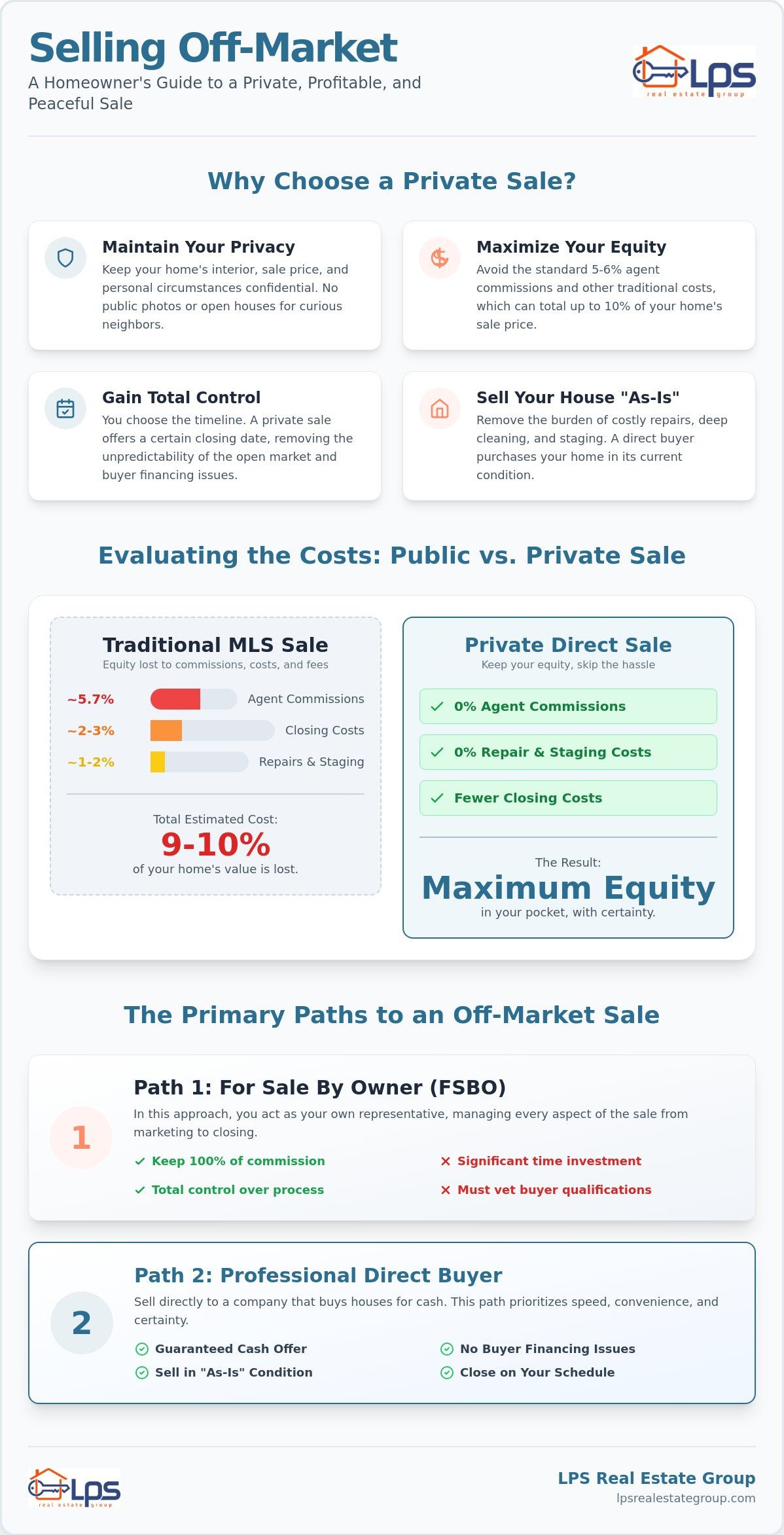
Evaluating the Costs: MLS Listing vs. Private Sale
When you look at the final sale price of a home, it’s easy to assume that’s the amount the seller takes home. However, the traditional process includes several layers of deductions that can significantly erode your equity. Understanding the difference between your gross sale price and your “net walkaway” figure is essential when you decide to sell house without listing on MLS. By looking at the full financial picture, you can determine which path truly serves your long-term goals.
A traditional sale on the public market typically involves a total cost of 9-10% of the home’s value. This includes the national average real estate commission of 5.70%, plus seller closing costs that usually range from 1% to 3%. Beyond these fixed fees, you must account for “holding costs.” If your home sits on the market for the standard 60-90 days, you are still responsible for mortgage interest, property taxes, insurance, and utilities. These monthly expenses don’t stop just because you’re waiting for a buyer, and they can easily add up to thousands of dollars in lost equity.
The Reality of Commissions and Fees
By bypassing the traditional agent model, you immediately eliminate the largest expense of a home sale. While you’ll still encounter standard transaction fees and administrative costs during a private transfer, these are much smaller than the thousands paid to brokerages. On a $400,000 home sale, skipping the traditional commission can save you between $20,000 and $24,000 in agent fees alone. This allows you to keep more of your property’s value rather than distributing it to intermediaries.
Speed as a Financial Factor
Time is a currency that many sellers overlook. A traditional MLS listing often comes with a 30-120 day timeline, during which the deal is never truly certain. Some industry professionals report that up to 15% of traditional contracts fall through because of buyer financing issues or inspection disputes. A fair cash offer for house removes this risk by providing a certain closing date in as little as 7-14 days. This speed eliminates months of holding costs and provides the liquidity you need to move forward without delay. When you factor in the money saved on mortgage interest and the lack of repair concessions, a direct sale often results in a higher net walkaway than a public offer that looks better on paper.
If you’re ready to see how the numbers work for your specific property, you can get a transparent property evaluation from LPS Real Estate Group to compare your options accurately.
The LPS Real Estate Group Advantage: A Private, Direct Solution
LPS Real Estate Group isn’t just another buyer; we’re a dedicated partner for those who prioritize privacy and simplicity. We understand that the decision to sell house without listing on MLS often comes from a desire to avoid the public spectacle of traditional real estate. Our approach is built on “quiet confidence.” We don’t need aggressive marketing or high-pressure tactics to prove our value. Instead, we rely on transparency and empathy to help you navigate what can often be a stressful life transition.
Whether you’re dealing with a cluttered interior or a property that needs significant structural work, our “As-Is” promise remains the same. You don’t need to lift a paintbrush or hire a cleaning crew. We see the potential in your property exactly as it stands today. This is particularly helpful for those facing urgent or complex financial hurdles. For instance, we offer specialized guidance on how to sell a house in pre-foreclosure, providing creative finance solutions that protect your equity and your future.
A Tailored Exit Strategy for Every Homeowner
We recognize that every property has a story, and some stories are more complex than others. Our team is experienced in handling the nuances of probate, inherited properties, and difficult title issues internally. This means you won’t be bounced between different agents or departments. You’ll speak directly with decision-makers who listen first and provide solutions second. Our evaluation process is entirely “No Pressure.” We want you to feel fully informed about your options, ensuring you have a clear path forward that respects your unique circumstances.
Your Next Steps Toward a Private Sale
Moving forward is a simple, methodical process designed to respect your time and your home. When you reach out to us, we’ll start with a calm conversation to understand your goals. If it feels like a good fit, we’ll schedule a brief, respectful walkthrough. We aren’t there to judge the condition; we’re there to understand how we can best help you sell house without listing on MLS. After our visit, we provide a fair, transparent offer with no hidden fees or deductions.
The most important part of our partnership is that you control the calendar. You can choose to close next week if you need immediate liquidity, or we can wait several months if you need more time to transition. Our goal is to provide the relief you need on a timeline that works for you, handled with the integrity you deserve.
Take Control of Your Property Sale Today
Choosing to sell house without listing on MLS is a strategic decision that prioritizes your peace of mind and protects your equity. You’ve discovered that avoiding the public market doesn’t mean sacrificing fairness. It means eliminating the stress of constant showings and the high costs of traditional commissions. Whether you’re managing a complex probate situation or simply want a quiet transaction, the direct path offers a level of control that the traditional market cannot match.
At LPS Real Estate Group, we handle the heavy lifting so you don’t have to. We specialize in professional as-is acquisitions with zero repairs required and provide direct cash offers for immediate liquidity. Our team has deep expertise in resolving sensitive title, probate, and foreclosure issues with the care they deserve. We’re here to act as a compassionate partner, ensuring every step of your sale is handled with integrity and transparency.
Request your private, no-obligation cash offer from LPS Real Estate Group today.
Moving forward should feel like a relief, not a burden. We look forward to helping you reach your goals with confidence.
Frequently Asked Questions
Is it legal to sell a house without listing it on the MLS?
Yes, it is perfectly legal to sell your property through a private transaction. The Multiple Listing Service is a private database used by brokers, not a government requirement or a legal necessity for transferring property ownership. Many homeowners choose to sell house without listing on MLS to maintain their privacy and avoid public records of their home’s interior.
Will I get a lower price if I don’t list my home publicly?
You won’t necessarily walk away with less money just because you skip the public market. While a public listing might attract a higher gross offer, you must subtract the 5.70% average commission and 1% to 3% in closing costs. When you factor in the savings on repairs and holding costs, the net amount you keep from a private sale is often very competitive.
How do I find cash buyers if my house isn’t on the market?
You can find reputable cash buyers by researching professional property acquisition groups that specialize in off-market deals. These companies are specifically structured to buy houses directly from owners, bypassing the need for public marketing. Reaching out to a trusted advisor like LPS Real Estate Group allows you to receive a fair evaluation without the house ever appearing on a public website.
Do I still need a real estate attorney for a private sale?
It depends on where you live, as 18 states currently require an attorney to be present at closing. Even in states where it isn’t a legal requirement, partnering with an attorney or a reputable title company is a smart move. They ensure that the deed transfer is recorded correctly and that all legal disclosures are handled with integrity, giving you peace of mind.
Can I sell my house without an agent and without paying closing costs?
Yes, this is a common benefit when you sell house without listing on MLS to a professional direct buyer. Most direct buyers will structure the offer so they cover all traditional seller closing costs. This transparency means the price you see on the purchase agreement is the exact amount you’ll receive at the closing table, with no hidden deductions.
What happens if I want to sell a house that needs major repairs without the MLS?
Selling a distressed property is often much easier off-market than through traditional channels. Public buyers usually require inspections and bank-mandated repairs that can stall a sale for months. Direct buyers specialize in as-is acquisitions, meaning they take on the burden of all future renovations, allowing you to walk away from the property exactly as it sits today.
How do I handle the paperwork for an off-market sale?
The paperwork for a private sale is straightforward and typically managed by the title company or attorney handling the closing. They will prepare the settlement statement, the deed, and any required tax documents. If you work with a professional buyer, they often coordinate this entire process, providing a clear checklist so you know exactly what to expect at every stage.
Can I sell a house in probate without listing it on the MLS?
Yes, private sales are an excellent solution for families navigating the probate process. Selling off-market allows you to handle the estate’s assets quietly and efficiently without the stress of managing public showings. Professional buyers are often experienced in working with executors and heirs to resolve title issues and provide immediate liquidity during a difficult transition.