
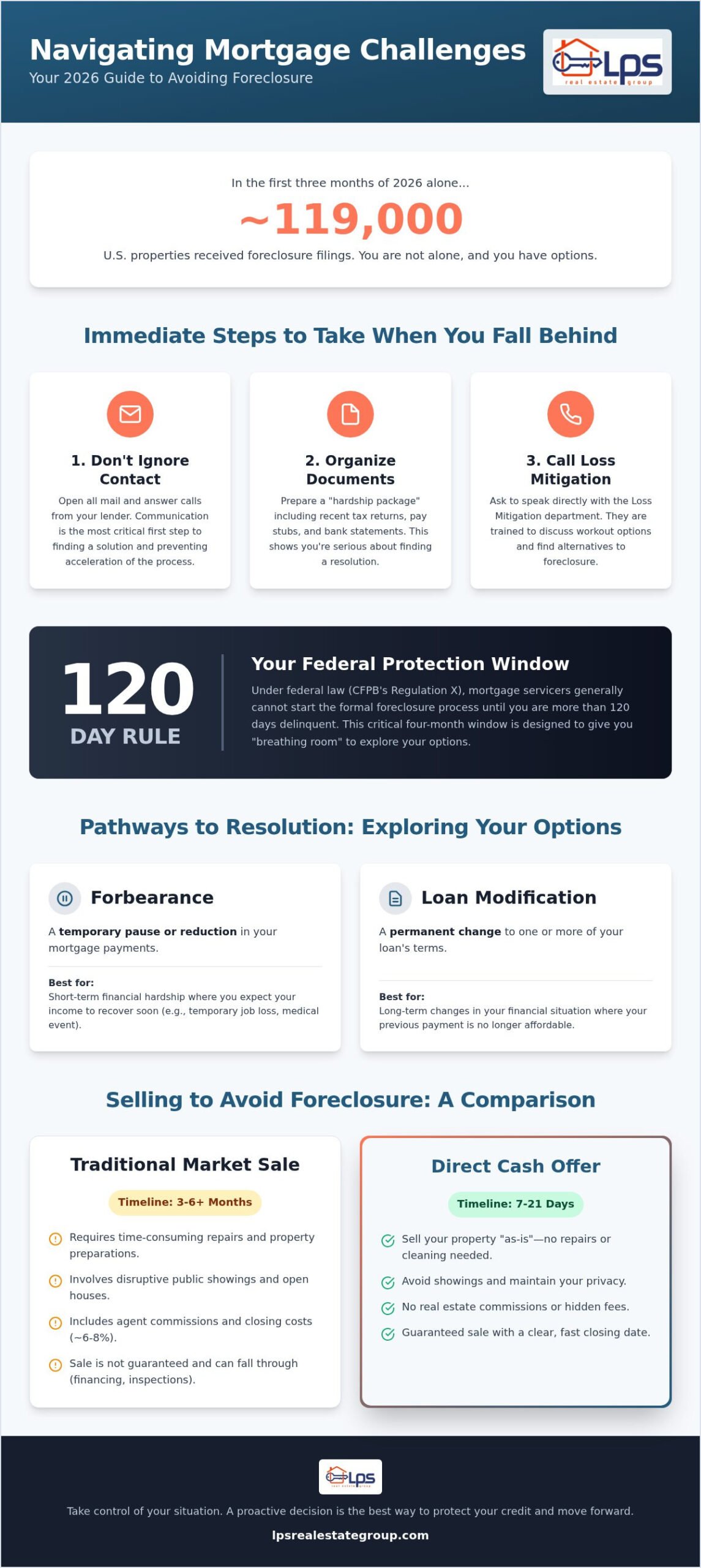
Did you know that nearly 119,000 properties in the U.S. received foreclosure filings in just the first three months of 2026? If you’re currently staring at a stack of missed payment notices, you aren’t alone, and the weight of that uncertainty is incredibly heavy. It’s exhausting to deal with constant calls from debt collectors while trying to decipher complex legal letters that seem designed to confuse you. You deserve a clear path forward that protects your dignity and your credit score, whether that means finding a way to stay or choosing to sell house to avoid foreclosure on your own terms.
We understand that you’re looking for honest answers, not high-pressure tactics. You likely feel that time is running out, but there are still several viable routes to explore. This guide provides a straightforward look at your 2026 options, including federal 120-day protection rules, new state-specific extensions, and direct sale solutions that can stop the foreclosure clock. We’ll break down these complex processes into manageable steps so you can move forward with a clear plan and true peace of mind.
Key Takeaways
- Learn why opening your mail and maintaining communication with your lender is the most critical step to stopping the foreclosure process before it accelerates.
- Understand the difference between temporary relief and permanent loan restructuring through loss mitigation programs designed to help you stay in your home.
- Discover how you can sell house to avoid foreclosure even if you are months behind on payments, allowing you to protect your credit and move forward with dignity.
- Compare the timelines of traditional sales versus direct cash offers to find the fastest way to resolve delinquency before a bank auction occurs.
- Find out how an as-is property acquisition can simplify your transition by eliminating the need for expensive repairs, deep cleaning, or traditional real estate commissions.
Immediate Steps to Take When You Fall Behind on Mortgage Payments
Falling behind on a mortgage payment feels like a heavy weight that only gets heavier with each passing day. It’s a stressful experience, but it’s also a common hurdle that many homeowners face. With 30-year fixed mortgage rates averaging around 6.75% in July 2026, the financial landscape is challenging for many families. If you’ve missed a payment, the first thing to know is that your situation doesn’t define your future. You still have options, and taking action early is the best way to maintain control over your home and your credit score.
The “Golden Rule” of mortgage delinquency is simple but difficult: never ignore the mail or the phone calls. While it’s tempting to hide from the problem, silence is what leads to the legal process of foreclosure moving faster. Lenders are required by 2026 federal regulations to provide specific communication channels and early intervention notices. These letters often contain information about programs that could help you stay in your home or provide a timeline if you decide to sell house to avoid foreclosure. Opening that mail is the first step toward a solution.
To prepare for these conversations, you should begin organizing your financial documents into what’s called a “hardship package.” This typically includes your last two years of tax returns, your two most recent pay stubs, and recent bank statements. Having these ready shows the lender you’re serious about finding a resolution. It also helps you see your own financial picture clearly so you can decide if a loan modification is realistic or if a fresh start through a sale is the better path forward.
Communicating with Your Loan Servicer
When you call your lender, don’t just speak with the first person who answers. Ask to be transferred directly to the “Loss Mitigation” department. These professionals are trained to handle delinquency and have the authority to discuss workout options. You’ll need to explain your situation clearly. For example, you might state that your current financial strain is a temporary hardship caused by a recent medical event rather than a permanent change in your long-term income. Always keep a detailed log of every call, including the date, the time, and the name of the representative you spoke with. This record is vital if any disputes arise later.
Understanding the 120-Day Rule
Federal law, specifically the CFPB’s Regulation X, provides a significant safety net known as the 120-day rule. Under this regulation, mortgage servicers generally cannot start the formal foreclosure process until you are more than 120 days delinquent. This four-month window is designed to give you “breathing room” to explore loss mitigation or to sell house to avoid foreclosure on your own terms. While this federal rule provides a baseline, some states have additional protections. For instance, California’s Assembly Bill 2424 can provide homeowners with up to 90 additional days to sell their home if they have a valid listing or purchase agreement. It’s wise to consult a professional to see how these specific 2026 rules apply to your local area.
Understanding 2026 Mortgage Assistance and Loss Mitigation Programs
Lenders use a process called “loss mitigation” to find alternatives to taking back a property through the legal system. This isn’t just a courtesy; it’s a practical business decision. Foreclosure often results in a significant financial loss for the bank because of legal fees, property maintenance, and the loss of interest income. Because of this, most servicers are willing to listen if you present a clear plan and show a willingness to cooperate. If the paperwork feels overwhelming, you can get help from housing counselors who are HUD-approved. These advisors provide free guidance to help you identify which programs fit your specific financial situation without the pressure of a sales pitch.
The goal of these programs is to bridge the gap between your current financial struggle and a stable future. However, it’s vital to distinguish between temporary relief and permanent restructuring. One keeps you in the home while you recover, while the other changes the terms of your debt forever. Understanding these differences helps you avoid agreements that might sound good today but become unmanageable tomorrow.
Forbearance vs. Loan Modification
Forbearance is a temporary pause or reduction in your mortgage payments. It’s an excellent tool if you’re facing a short-term crisis, like a medical leave or a temporary job loss, where you expect your income to return to normal soon. The “catch” with forbearance is that it isn’t debt forgiveness. You must eventually repay those skipped amounts, often through a lump sum, a repayment plan, or by adding the balance to the end of your loan. In contrast, a loan modification is a permanent change to your mortgage contract. The lender might lower your interest rate or extend the length of the loan to make your monthly bills more affordable for the long term.
Repayment Plans and Partial Claims
If you’ve already recovered from a financial setback and have extra room in your budget, a repayment plan might be the simplest fix. This adds a portion of your overdue balance to your regular monthly payment until you’re caught up. For those with FHA-insured loans, a “Partial Claim” is another powerful option. This allows the lender to create an interest-free second loan to pay off your arrears, which you don’t pay back until you sell the home or finish the mortgage. Being honest about your actual monthly budget is vital here. If the proposed new payment is still too high, it might be more beneficial to sell house to avoid foreclosure and protect the equity you’ve worked hard to build.
Common Myths About Selling a House to Avoid Foreclosure
When you’re facing a financial crisis, misinformation can be just as dangerous as the debt itself. You’ve likely heard conflicting advice from neighbors, social media, or even well-meaning friends. These myths often create a sense of paralysis, making you feel like your situation is hopeless when it isn’t. Understanding the reality of how banks and the real estate market operate will help you regain your footing. It’s time to clear away the confusion so you can focus on a practical path forward.
The most persistent myth is that your bank wants to take your house. In reality, lenders are in the business of collecting interest, not managing real estate. Foreclosure is a costly, time-consuming failure for them. They often lose tens of thousands of dollars on legal fees and property maintenance before a home even reaches auction. Another common misconception is that you must be current on your payments to list your home. You can actually choose to sell house to avoid foreclosure at any point during the delinquency period, even if you haven’t made a payment in months. Lenders generally prefer a successful sale over the long, expensive legal process of seizing the property.
The Truth About Credit Scores and Delinquency
Many homeowners believe that once they miss a payment, their credit is ruined forever. While late payments do lower your score, the way you exit the situation determines how quickly you can recover. A successful sale allows you to settle the debt and move on with a “paid in full” or “settled” status on your mortgage line. This is significantly better than a foreclosure judgment, which is a public record that can prevent you from buying or even renting a home for many years. A foreclosure judgment acts as a permanent stain on your financial history that signals a total loss to future creditors. By taking control now, you’re protecting your ability to buy another home in the future.
Navigating the ‘As-Is’ Reality
You might feel that you can’t sell your house because it needs a new roof, fresh paint, or major repairs. This is a myth that keeps many people trapped in houses they can no longer afford. You don’t need to spend money you don’t have on renovations to resolve a mortgage crisis. Professional acquisition firms and direct buyers specialize in purchasing properties in their current condition. They handle the heavy lifting, meaning you don’t have to worry about clean-outs or expensive contractors. If you’re wondering how this works, you can read more in Selling Your House As-Is: The Complete 2026 Homeowner’s Guide. This approach allows you to sell house to avoid foreclosure quickly, bypassing the traditional market entirely and stopping the clock before the bank takes further action.
Comparing Your Options: Traditional Listing vs. Selling for Cash
Choosing how to move forward depends entirely on your remaining timeline and your financial goals. A traditional listing on the open market is the standard choice for most homeowners, but it requires a stable environment and plenty of time. When you need to sell house to avoid foreclosure, your primary enemy is the calendar. If a traditional sale takes 60 to 90 days and your auction is scheduled in 30, the math simply doesn’t work. A direct cash offer can stop a scheduled foreclosure auction at the eleventh hour, providing a guaranteed exit when the bank refuses to wait any longer.
Many homeowners fall into the “Equity Trap.” This happens when you hold out for a high-market price to maximize your return, only to have the bank’s legal clock run out before a buyer closes. If you wait too long for a perfect offer, you risk losing 100% of your equity to the bank. For those with low equity, a traditional sale might actually cost you money because of commissions and closing fees. Creative finance solutions offer a way out by restructuring how the debt is handled, allowing you to settle the mortgage and protect your credit score even when you have very little cash left in the home.
Avoiding the Stress of the MLS
The burden of keeping a house “show-ready” is exhausting when you’re already dealing with a financial crisis. Traditional buyers expect a pristine home, and managing open houses while you’re packing or speaking with debt collectors adds unnecessary layers of anxiety. There’s also the significant risk of buyer financing falling through. With 2026 mortgage rates remaining elevated, many retail buyers struggle to secure loans at the last minute. You can read more about managing this specific timeline in How to Sell a House in Pre-Foreclosure: A Compassionate 2026 Guide. A direct sale removes these hurdles because there are no bank appraisals or inspections to worry about.
The ‘Clean Break’ Strategy
Walking away with your credit intact provides the fresh start you need to rebuild. A “clean break” strategy focuses on certainty rather than gambling on the highest possible price. The psychological benefit of knowing exactly when your mortgage debt will be settled is immense. Transparency is the most important factor when choosing a partner for this transition. You deserve a clear, straightforward offer that accounts for your specific needs without hidden fees or last-minute changes. If you are ready to see what’s possible for your property, you can explore your direct sale options to find a path that prioritizes your peace of mind.
How LPS Real Estate Group Helps You Move Forward with Certainty
At LPS Real Estate Group, we understand that you aren’t just looking for a buyer; you’re looking for a way out of an incredibly stressful situation. We pride ourselves on being a compassionate partner that listens to your needs before discussing numbers. Many homeowners feel overwhelmed by the logistical demands of a traditional sale, especially when time is short. We handle the heavy lifting by offering as-is property acquisition. This means you don’t have to worry about expensive repairs, deep clean-outs, or paying real estate commissions. Our goal is to provide a simple, direct path so you can sell house to avoid foreclosure without the typical hurdles of the retail market.
Our direct acquisition process is designed for speed and clarity. It starts with an initial consultation where we learn about your specific goals and the current status of your mortgage. From there, we provide a fair offer based on the property’s condition and your timeline. Because we use creative finance solutions, we can often solve complex problems that traditional buyers or agents can’t touch, such as houses with little to no equity. This flexibility allows us to tailor a solution that protects your financial future and stops the foreclosure clock immediately.
A Transparent Path to Foreclosure Prevention
Transparency is the foundation of everything we do. We work closely with your loan servicer to ensure the transition is handled correctly and that all legal requirements are met. This coordination is vital to preventing errors that could lead to a missed auction date. Our no-pressure consultation is a safe space to ask questions and explore your options without feeling rushed. If you’re researching your choices, our guide on Companies That Buy Houses for Cash: A Homeowner’s 2026 Guide to Selling Fast can help you understand how professional buyers operate in the 2026 market.
Your Next Steps Toward Relief
Requesting a fair cash offer is a straightforward process with no obligation. We only need basic information about the property and your current situation to begin crafting a solution. This initial step doesn’t cost anything, but it can provide the clarity you need to stop worrying about the next debt collector’s call. Remember that even if you’re deep into the delinquency period, there is still a way out of the mortgage cycle. By choosing to sell house to avoid foreclosure now, you’re choosing to take back control of your life and your credit, ensuring a much brighter financial path ahead.
Taking Control of Your Financial Future
You’ve learned that mortgage delinquency is a hurdle, not a dead end. By understanding your rights under 2026 regulations and looking past common myths, you can choose a path that preserves your dignity. Whether you find a way to stay through loss mitigation or decide that a fresh start is the best option, the most important step is simply taking action. You don’t have to face this alone or feel pressured into a traditional sale that doesn’t fit your urgent timeline.
Choosing to sell house to avoid foreclosure can provide the immediate relief you need to stop the clock and protect your credit. LPS Real Estate Group is here to act as your compassionate partner. We offer a direct acquisition process with a fast closing in as little as seven days. There are no repairs or cleaning required, and you’ll pay zero commissions or closing costs. You can Get a Compassionate Cash Offer and Stop the Foreclosure Stress Today. You’ve carried this weight long enough; it’s time to step into a lighter and more certain future.
Frequently Asked Questions
How many months can I be behind on my mortgage before foreclosure starts?
You are typically protected by federal law for 120 days of delinquency before a lender can officially start the legal foreclosure process. This four month window is designed to give you enough time to apply for loss mitigation or make a plan to move forward. While the bank may send you notices and call you during this time, they generally cannot file the first legal notice in court until you’ve missed your fourth payment.
Can I sell my house to avoid foreclosure if I am already in the legal process?
Yes, you can sell your property at any point until the auction is finalized and the deed has been transferred. Many homeowners choose to sell house to avoid foreclosure even after they’ve received a summons or a notice of sale. The key is to find a buyer who can close quickly enough to pay off the mortgage balance before the scheduled auction date, which stops the legal clock immediately.
What is a ‘hardship letter’ and do I really need one to stop foreclosure?
A hardship letter is a written document that explains to your lender why you’ve fallen behind on your payments. It’s a required part of most loss mitigation applications, such as loan modifications or short sales. While the letter itself doesn’t legally stop a foreclosure, it’s a vital tool for humanizing your situation and showing the bank that you are acting in good faith to resolve the debt.
Is it better to do a short sale or sell to a cash buyer?
The best option depends on your equity and your timeline. A short sale is necessary if you owe more than the home is worth, but it requires bank approval and can take several months to complete. Selling to a cash buyer is much faster and more certain if you have equity or if your auction date is approaching quickly. Cash sales don’t require lender approval unless you are settling for less than the full loan amount.
Will the bank stop calling if I tell them I am selling the house?
Simply telling the bank you’re selling won’t stop the collection calls, but providing a signed purchase contract often will. Lenders are more likely to pause their legal proceedings if you can show them a written agreement from a buyer with a firm closing date. It’s helpful to have your buyer or an authorized representative speak with the bank’s loss mitigation department to confirm the details of the pending sale.
What happens to my equity if the house goes to a foreclosure auction?
You risk losing most or all of your equity if the home is sold at a public auction. Foreclosure auctions often result in lower sale prices, and the bank will subtract their legal fees, late penalties, and interest from the proceeds first. While any remaining money technically belongs to you, it’s rare for homeowners to receive much back. Choosing to sell house to avoid foreclosure on the open market or to a direct buyer usually preserves more of your hard earned equity.
Can I stay in my home after I sell it to a direct buyer?
Many direct buyers offer flexible “post-occupancy” agreements that allow you to stay in the home for a short period after the sale is finalized. This can provide much needed breathing room to find your next home without the pressure of moving out on the day of closing. If this is a priority for you, it’s important to discuss these terms early in the process so they can be included in the purchase agreement.
How much does it cost to get help for mortgage delinquency?
Legitimate help for mortgage delinquency should not cost you anything upfront. HUD-approved housing counselors provide their services for free, and professional cash buyers don’t charge commissions or closing fees. You should be very cautious of any company that asks for an upfront fee to “save” your home or negotiate with your lender. These are often signs of a scam, as real solutions should simplify your finances, not add new costs.