

What if the exit strategy your bank recommends is actually the one that causes the most long term damage? Many homeowners view a short sale as a responsible compromise, but the reality in 2026 is often a grueling nine month wait that leaves your credit in tatters and your mailbox full of tax forms for forgiven debt. You’re likely looking for a way to avoid short sale headaches and find a path that respects your time and your financial future.
We understand the weight of an underwater mortgage and the anxiety that comes with it. You shouldn’t have to choose between a slow, bank-driven process and total foreclosure. This guide will show you how to bypass the stress and credit damage of a short sale by using faster, more reliable alternatives. We’ll explore how direct property acquisitions and creative finance solutions can provide a clean break from mortgage debt, allowing you to move forward with your life in weeks rather than months.
Key Takeaways
- Understand why traditional short sales often take 3 to 9 months and how to regain control of the selling process from your lender.
- Discover how to avoid short sale delays by exploring direct property acquisitions that provide immediate liquidity and a faster closing timeline.
- Learn about creative finance solutions that allow you to resolve an underwater mortgage without the stress of bank-negotiated deficiency judgments.
- Use a simple 5-step decision framework to calculate your exact mortgage gap and choose the most effective strategy for your specific timeline.
- Explore how to protect your credit score and navigate the 2026 tax implications of mortgage debt for a truly clean financial break.
What is a Short Sale and Why Do Homeowners Want to Avoid It?
To understand why so many people want to avoid short sale scenarios, we first need to look at what they actually represent. What is a Short Sale? Simply put, it’s a real estate transaction where the lender agrees to accept a payoff amount that is lower than the actual balance remaining on the mortgage. This usually happens when a homeowner is “underwater,” meaning the property’s market value has dipped below the debt owed. It requires the bank to sign off on the loss, which gives them nearly total control over your timeline and your future.
In 2026, this situation is becoming more common for those who purchased homes at peak prices with minimal down payments. While home prices nationally rose about 2.2% between 2025 and 2026, localized market shifts and rising insurance premiums have pushed many into financial distress. When you owe more than the home is worth, you can feel trapped, but a bank-led short sale isn’t always the best exit strategy.
The Short Sale Process: A Timeline of Uncertainty
The biggest hurdle in a short sale isn’t finding a buyer; it’s waiting for the bank. Most traditional sales close in 30 to 45 days, but a short sale can drag on for three to nine months. You’re required to submit a massive Borrower Response Package (BRP) that documents every detail of your financial hardship. If the bank finds a single error or decides the offer is too low, they can reject the entire package. This uncertainty is especially dangerous if you have a house in pre-foreclosure. The bank’s slow pace doesn’t always stop the foreclosure clock, which creates a high-pressure environment for the homeowner.
The Hidden Impact on Your Future Financial Life
Many homeowners mistakenly believe a short sale “saves” their credit. While it’s often better than a foreclosure, it still results in a significant drop in your credit score. Most lenders report the account as “settled for less than the full balance,” which can prevent you from qualifying for a new mortgage for two to four years. It’s a long time to wait if you want to get back into the housing market.
The tax implications in 2026 are also a major concern for anyone trying to avoid short sale pitfalls. The Qualified Principal Residence Indebtedness (QPRI) exclusion expired on January 1, 2026. This means that if the bank forgives a portion of your debt, the IRS may treat that forgiven amount as taxable income. Unless you qualify for an exception like insolvency, you might end up with a massive tax bill at the end of the year. This shift has made faster, direct alternatives much more attractive for homeowners who need a clean financial break.
The Real Challenges of Navigating a Traditional Short Sale
The primary difficulty of a short sale is the complete loss of agency. While you are technically the seller, the lender acts as the ultimate decision maker. They dictate the final sale price, the closing date, and which costs they are willing to cover. If they feel the market value is higher than the offer on the table, they will simply say no, even if that offer is the best you’ve received in months. This disconnect often leads homeowners to look for ways to avoid short sale proceedings entirely so they can regain control over their own lives.
One of the most dangerous aspects is the deficiency judgment trap. This is the bank’s legal right to pursue you for the remaining balance after the sale is complete. A deficiency waiver is a written agreement from the lender stating they will not pursue the homeowner for the unpaid balance remaining after the sale is finalized. Without this specific waiver in your closing documents, you might sell the house and still owe tens of thousands of dollars to the bank.
Furthermore, traditional buyers often suffer from “short sale fatigue.” Most families want to move into a home within 30 to 45 days. When they see a listing that requires bank approval, they know they might be waiting until 2027 to get the keys. This causes the most qualified buyers to walk away, leaving you with a property that sits on the market while your stress levels rise. If you’re tired of the stalemate, you might consider a more direct path like exploring a cash home buying solution that handles the property exactly as it is.
Why Banks Are Difficult to Negotiate With
Negotiating with a bank isn’t like negotiating with a person. You are often dealing with a “servicer” who manages the loan and an “investor” who actually owns the debt. These two parties often have different goals and internal rules. A servicer might agree to a price, only for the investor to deny it weeks later. This is why many lenders deny requests at the last minute; the internal bureaucracy simply can’t align. Additionally, banks rarely pay for repairs. If your home needs a new roof or has plumbing issues, the bank expects you to sell it as-is, but they still want a high market price. This often leaves the homeowner stuck with a distressed property that no traditional buyer wants to touch.
Psychological Toll on the Homeowner
The mental burden of this process is often the hardest part. You’re living in limbo, never knowing if you should start packing or if you’ll be in the home for another six months. The bank requires invasive documentation, including years of tax returns, bank statements, and “hardship letters” that force you to relive your most difficult financial moments. To avoid short sale anxiety, many homeowners are now choosing paths that offer more certainty. This constant state of alert makes many people feel like they’re stuck in a house that has become a source of anxiety rather than a sanctuary.
How to Avoid a Short Sale: Better Alternatives for 2026
While many banks present a short sale as your only choice, several agile alternatives exist in 2026 that offer more speed and less stress. If you want to avoid short sale complications, you need to look beyond the traditional listing model. These exit strategies focus on homeowner certainty rather than bank bureaucracy. By choosing a path that doesn’t rely on months of lender negotiations, you can protect your credit and your mental well-being.
Direct Cash Purchases vs. Short Sales
A direct cash purchase is often the most straightforward way to settle with a lender. Unlike a short sale, where the bank dictates a “List Price Guidance” and waits for months to approve an offer, a cash buyer provides an immediate solution. This eliminates the need for appraisals or traditional financing hurdles that often kill deals at the last minute. Working with companies that buy houses for cash allows you to close in a fraction of the time, providing the liquidity needed to satisfy the lender and move on. You don’t have to worry about the buyer’s mortgage falling through or the bank demanding a higher price than the market will bear.
The Power of Creative Finance Solutions
Creative finance is a powerful tool for homeowners who owe more than their home is worth. One common method is “Subject-To,” where a buyer takes over your existing mortgage payments. This is a highly effective way to avoid short sale damage because the loan stays in your name but is paid by the new owner, which can actually help stabilize or even improve your credit over time as payments are made consistently. These creative real estate exit strategies are becoming preferred options in 2026 because they solve the “underwater” problem without requiring a formal, painful bank negotiation. It’s a partnership that prioritizes a clean break for the seller.
Choosing the right path depends on your specific goals for your credit and your timeline. Here are the primary alternatives to consider:
- Direct Cash Sale: Best for those who need to close within two to three weeks and want a guaranteed exit without repairs.
- Subject-To: Ideal for protecting your credit while walking away from the mortgage responsibility, even with little to no equity.
- Leaseback: A great fit for families who need to stay in their home as tenants while they search for their next residence.
- Deed in Lieu: A last-resort option that is faster than a short sale but still carries a heavy credit penalty similar to a foreclosure.
Each of these options provides more control than a traditional short sale. Instead of waiting for a bank’s permission to move on with your life, these strategies allow you to set the terms and the timeline. This shift from being a passive participant to an active decision-maker is often the first step toward true financial relief.
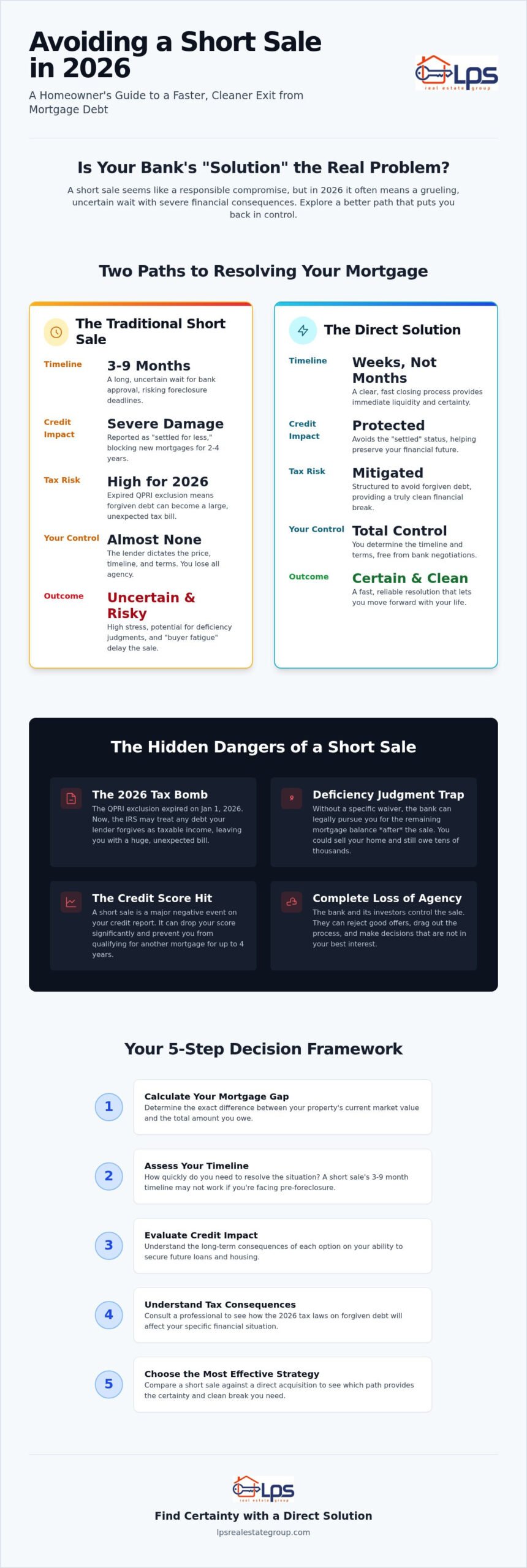
Evaluating Your Exit Strategy: A 5-Step Decision Framework
Deciding on the right path forward shouldn’t feel like a guessing game. While the bank might push you toward a specific outcome, you have the right to evaluate all your options side by side. This framework is designed to help you avoid short sale pitfalls by identifying the most logical and least stressful solution for your unique financial situation. In the first half of 2026, foreclosure filings increased by 21% compared to the previous year, so having a clear plan is more urgent than ever.
- Step 1: Calculate your ‘Short’ amount. You need to know exactly how much you owe compared to what the house is worth today.
- Step 2: Determine your timeline. Check if you have a foreclosure sale date scheduled. If you have less than 30 days, your options change significantly.
- Step 3: Review your credit goals. Decide if you need a clean break now or if you’re willing to stay involved through creative finance to protect your score long term.
- Step 4: Get a direct ‘As-Is’ offer. This establishes a realistic baseline for what you could walk away with today without doing any repairs.
- Step 5: Consult with a compassionate expert. Talk to someone who understands both the numbers and the human side of the transaction to weigh the pros and cons fairly.
Assessing Your Equity and Debt
The first step in any plan is gathering accurate data. Start by requesting a formal payoff statement from your lender. This document provides the exact amount needed to satisfy the loan, including interest and fees. It’s also vital to understand the “as-is” market value of your home, which is what a buyer would pay for it in its current condition, rather than its potential value after expensive renovations. To calculate your net proceeds, subtract the total mortgage payoff amount and all closing costs from the final sale price of the property.
Choosing the Right Partner for Your Exit
Who you work with determines the speed and transparency of your exit. A traditional listing agent’s goal is to find a buyer on the open market, which can take months and involves commissions. In contrast, a direct investment firm acts as the buyer, providing a faster and more certain outcome. Be wary of red flags like companies that ask for upfront fees or pressure you into signing documents you don’t understand. Choosing a path like selling your house as-is can save you thousands in upfront costs and eliminate the need for stressful inspections. If you’re ready to see what a direct solution looks like for your home, you can get a fair assessment of your options here.
Finding Certainty with LPS Real Estate Group’s Direct Solutions
The psychological weight of a six month bank negotiation is a burden no homeowner should carry alone. While traditional methods leave you waiting for a lender’s permission to move on, our approach focuses on giving you back your agency. We believe in “quiet confidence” and radical transparency. This means we’ll sit down with you to explore every possible path, even if the best solution for your specific needs doesn’t involve selling to us. Our goal is to provide relief and clarity so you can avoid short sale stress and the long term credit damage that often follows it.
We specialize in handling the heavy lifting that banks and traditional buyers won’t touch. When you work with us, you don’t have to worry about expensive repairs, invasive inspections, or paying traditional real estate commissions. We take properties exactly as they are. This is particularly helpful for those facing complex life transitions like probate or divorce, where the physical state of the home is the last thing you want to manage. We also offer creative finance structures that can resolve “underwater” mortgage issues without the need for a formal, bank-led short sale.
The LPS Real Estate Group Process
Our process is designed to be methodical and low-stress. It begins with a simple, no-obligation consultation where we listen to your story first. We want to understand your timeline and your goals before we talk about numbers. Once we have a clear picture of your situation, we provide a fair cash offer or a creative finance solution within 24 to 48 hours. This speed is critical when you’re trying to stop a foreclosure in its tracks. Because we are direct buyers, we can close on your timeline, whether that’s in two weeks or two months, giving you the certainty that a traditional buyer simply cannot offer.
Start Your Stress-Free Chapter Today
Waiting is often the biggest enemy of a successful exit. As the foreclosure clock ticks, your pool of available strategies begins to shrink. Taking early action allows us to deploy a wider range of creative tools to protect your credit and ensure a clean break from your mortgage debt. We’ve helped numerous homeowners find the breathing room they thought was lost, turning a high-pressure situation into a manageable transition. You don’t have to stay stuck in a cycle of bank bureaucracy and uncertainty. You can choose a path that prioritizes your future and your peace of mind starting right now.
Get your fair cash offer and avoid a short sale today.
Take Control of Your Financial Future
You don’t have to wait for a lender’s permission to move on with your life. The traditional bank-led process is often slow, invasive, and potentially damaging to your long term credit. By choosing to avoid short sale delays through direct cash acquisitions or creative finance solutions, you can secure a faster exit and a cleaner financial break. These alternatives prioritize your timeline and your peace of mind, allowing you to settle mortgage debts without the nine month wait often required by traditional lenders.
LPS Real Estate Group is here to act as your trusted advisor during this transition. We are direct cash buyers with no hidden fees, and we specialize in foreclosure prevention and creative finance strategies that traditional buyers simply can’t offer. Our team maintains a focus on transparency and homeowner empathy, ensuring that you’re heard and respected every step of the way. If you’re ready to stop the stress and start your next chapter, Get a Fair Cash Offer and Move Forward Today. There is always a way forward, and we’re ready to help you find it.
Frequently Asked Questions
Can I avoid a short sale if I am already in foreclosure?
Yes, you can still avoid short sale proceedings even if a foreclosure auction date has been scheduled. The key is speed; a direct property acquisition can often close in as little as two weeks, providing the lender with a concrete solution that stops the foreclosure process in its tracks. Taking action early gives you the best chance to negotiate a payoff before the bank moves forward with a sale.
Will a cash offer cover my entire mortgage if I am underwater?
A cash offer is based on the current “as-is” market value of your property. If your mortgage balance is higher than this value, the cash offer might not cover the full amount, but it can be used to negotiate a “short payoff” with your lender. Alternatively, creative finance solutions like Subject-To allow a buyer to take over your existing payments, resolving the debt without needing an immediate cash payoff for the full balance.
How does a direct sale to an investor affect my credit compared to a short sale?
A direct sale often has a much milder impact on your credit score than a traditional short sale. Short sales are typically reported as “settled for less than the full balance,” which can lower your score significantly for years. In contrast, creative solutions like Subject-To keep the mortgage active and ensure payments are made on time, which can actually help stabilize or improve your credit over the long term.
Do I have to pay taxes on the debt forgiven in a short sale in 2026?
In 2026, the IRS generally treats forgiven mortgage debt as taxable income. The Qualified Principal Residence Indebtedness (QPRI) exclusion expired on January 1, 2026, meaning the tax breaks homeowners previously enjoyed are no longer automatically available. You should speak with a tax professional to see if you qualify for other exceptions, such as insolvency, to avoid short sale tax surprises at the end of the year.
How long does it take to sell a house to a direct buyer like LPS Real Estate Group?
We typically provide a fair assessment and an offer within 24 to 48 hours of our initial consultation. Because we don’t rely on traditional bank financing or lengthy appraisals, we can close on your timeline, often in as little as 14 days. This is significantly faster than the three to nine month timeline common with bank-negotiated short sales.
What happens if my lender refuses to approve a short sale or a direct payoff?
If your lender is being difficult, you still have viable exit strategies. Creative finance solutions allow a buyer to take over your mortgage responsibilities “subject to” the existing loan. This approach doesn’t always require the bank’s formal approval of a discounted payoff, providing a reliable workaround when the bank’s internal bureaucracy stalls your progress.
Can I stay in my home after selling it through a creative finance agreement?
Yes, staying in your home is a possibility through a structured leaseback agreement. We can often arrange a deal where you sell the property to resolve the mortgage debt but remain in the home as a tenant. This gives you the breathing room to find your next residence without the stress of an immediate move during a difficult time.
What are the closing costs when selling to a direct cash home buyer?
When you sell your house directly to us, you typically pay zero closing costs. We handle the title insurance, escrow fees, and recording costs ourselves. This transparency ensures that the offer we provide is the actual amount used to satisfy your mortgage, with no hidden fees or traditional real estate commissions eating into your results.