

A house sale during a divorce isn’t just a real estate transaction; it’s a tactical exit strategy designed to preserve your sanity and your equity. You’re likely facing intense emotional stress and the heavy pressure to liquidate assets so you can finally find some peace. When you need to sell house during divorce, the process can feel like an uphill battle against time and conflict. It’s completely normal to feel overwhelmed by the fear of your home sitting on the market for months while legal fees continue to climb.
We’re here to help you find a clear path forward that prioritizes your well-being. This guide explains how to navigate property division with minimal stress, comparing traditional listings with direct cash offers for a truly clean break. You’ll discover how 2026 market trends and current mortgage rates, which are averaging about 6.5 percent, influence your timing. We’ll also break down the IRS “2-out-of-5-year” rule and other ways to protect your equity, ensuring you have the resources you need to start your next chapter with confidence.
Key Takeaways
- Learn why viewing your home as a tactical asset rather than an emotional burden is the first step toward a peaceful resolution.
- Understand the three primary ways to divide property equity, from buyouts to deferred sales, to see which fits your unique financial goals.
- Compare the privacy and speed of a direct cash sale against a traditional listing when you need to sell house during divorce without public conflict.
- Discover the essential steps for a smooth transition, including how to secure a neutral valuation to ensure a fair split for both parties.
- Explore how an “As-Is” property acquisition can eliminate the need for costly repairs or cleaning, allowing for a faster and more certain closing.
Navigating the Complexities of Selling a House During Divorce in 2026
Dividing a life is never simple, and the family home often sits at the very center of that complexity. It’s more than just bricks and mortar; it’s a repository for years of shared history and emotional investment. However, when you need to sell house during divorce, viewing the property as a tactical financial asset rather than an emotional anchor is essential for your future stability. The “matrimonial home” frequently becomes the biggest hurdle in settlements because it’s usually the most valuable and least liquid asset a couple owns. Unlike a bank account, you can’t simply divide a physical structure down the middle, which often leads to gridlock during negotiations.
Choosing a “clean break” sale can provide the immediate liquidity both parties need to move forward. High-conflict separations often benefit from neutral, third-party decision-making to prevent the sale from becoming a weapon in a legal battle. By prioritizing a straightforward transaction, you can protect your equity from being consumed by rising legal fees and the ongoing costs of maintaining a shared residence.
The Emotional vs. Financial Value of the Home
Sentimental attachment is powerful, but it can cloud your judgment during a time when clarity is most needed. Holding onto a house for the sake of the past often delays the emotional healing process by keeping you tied to a space that no longer serves your current reality. To help with Understanding Property Division, it helps to realize that marital property is essentially any asset acquired by either spouse during the marriage that is subject to distribution by a court. Shifting your perspective to see the house as a financial tool allows you to prioritize your long-term security over temporary comfort.
Why Timing Matters in a 2026 Divorce Sale
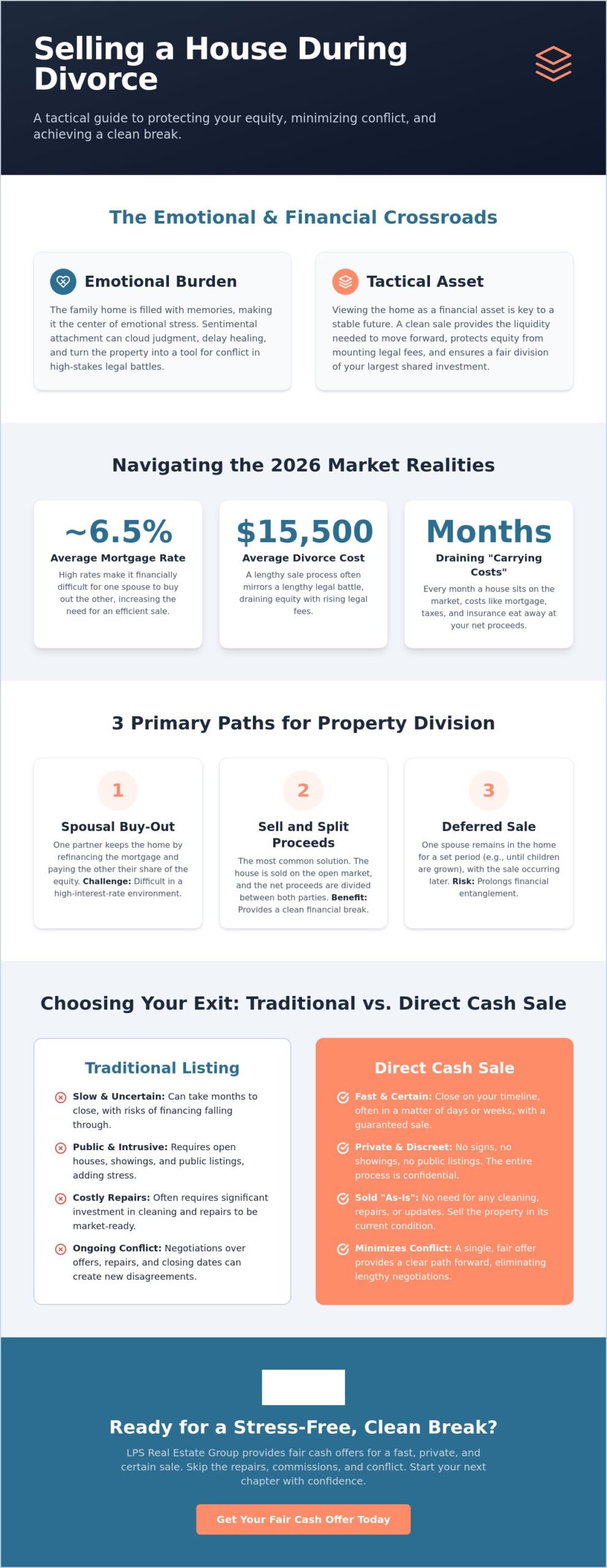
The housing market in 2026 presents specific challenges that make timing a critical factor. With 30-year fixed mortgage rates currently averaging between 6.44% and 6.54%, the cost of one spouse buying out the other has risen significantly. This financial pressure makes a traditional buyout less feasible for many couples. If a house sits on the market for months, the “carrying costs,” such as mortgage payments, property taxes, and insurance, can quickly drain the equity you’ve worked hard to build. A lengthy sale process also tends to mirror a lengthy legal battle. With the average cost of a divorce rising to $15,500 in 2026, every month spent in disagreement is a month where your net proceeds from the sale could be shrinking. Choosing an efficient exit strategy helps you avoid these financial traps.
Understanding Your Legal Rights and Property Division Options
The legal framework for property division varies depending on where you live. Most states follow the principle of equitable distribution. In these areas, a judge divides assets based on what’s considered fair, which doesn’t always mean a 50/50 split. Other regions operate under community property laws, where assets acquired during the marriage are typically divided equally. When you decide to sell house during divorce, understanding these legal frameworks is your first step toward a fair resolution. Regardless of the specific laws, you generally have three main paths: one spouse buys the other out, you sell and split the proceeds, or you agree to a deferred sale where one person stays in the home for a set period, often until children reach adulthood.
A Quitclaim Deed is a common tool used to transfer ownership interest from one spouse to the other. It’s a straightforward document, but it comes with a significant catch. While it removes a name from the property title, it doesn’t remove that person from the mortgage. You’ll still be financially responsible for the debt unless the remaining spouse refinances the loan. If you’re struggling to agree on what the property is actually worth, obtaining a fair cash offer for house can provide a neutral, data-driven baseline. This concrete number can simplify negotiations and help both parties move past the valuation hurdle without expensive third-party appraisals.
The Buy-Out Option: Pros and Cons
A buyout allows one spouse to keep the home, but it requires the ability to refinance the mortgage solo. This is a tall order in 2026. With 30-year fixed mortgage rates currently averaging about 6.5%, the monthly cost of a new loan is often much higher than the original joint mortgage. The spouse staying in the home must prove they can handle these payments on a single income. Additionally, “cash-out” refinances, which are used to pay the departing spouse their share of the equity, typically come with even higher interest rates. If the numbers don’t add up, a buyout may not be financially feasible, leaving a sale as the only realistic way to protect everyone’s credit and financial future.
Forced Sale vs. Mutual Agreement
It’s incredibly stressful when one partner refuses to sell. If you can’t reach an agreement, the court can order a “partition sale.” This is a forced sale where the court takes control of the process. It’s usually the least desirable outcome because court-ordered sales can be slow and often result in a lower price. When you consider that the national average cost to sell a house is currently 9% to 10% of the sale price, adding extra legal fees for a partition action can devastate your equity. Reaching a mutual agreement outside of the courtroom gives you control over the timeline and the final proceeds. If you’re looking for a way to avoid public conflict, you might find that direct property acquisitions offer a more private and predictable path forward than a traditional listing.
Traditional Listing vs. Direct Cash Sale: Which Path Minimizes Conflict?
Choosing how to sell house during divorce is a decision that impacts your mental health just as much as your bank account. A traditional listing puts your private life on the public market. Every showing requires both spouses to coordinate schedules, keep the home in pristine condition, and potentially cross paths during a time of high tension. For many, the constant intrusion of open houses and the “For Sale” sign in the yard only serves to prolong the emotional weight of the separation.
In contrast, a direct sale offers a level of privacy that an MLS listing simply cannot match. You don’t have to worry about neighbors asking questions or strangers walking through your bedrooms. This approach allows you to sell my house fast for cash, often closing in as little as 7 to 14 days. Compare this to the 6 to 12 months it often takes to finalize a traditional sale during a divorce, and the benefit of a clean break becomes clear. Rapid liquidity helps you settle shared debts and provides the funds needed for separate security deposits or down payments without waiting for a buyer’s mortgage approval.
The Stress of the Traditional Market
Traditional sales are frequently derailed by repair negotiations. If an inspector finds a roof leak or a faulty furnace, the question of who pays for the fix often triggers a new round of legal back-and-forth. These arguments can stall the entire divorce process. Furthermore, the risk of a buyer’s financing falling through is a constant threat. In the 2026 market, where mortgage rates remain a hurdle for many buyers, a sale that collapses at the last minute effectively restarts the divorce clock, adding months of unnecessary stress and legal fees. This same challenge applies to landlords who need to sell house with bad tenants, where uncooperative occupants can make showings and negotiations even more complicated.
The Certainty of a Direct Purchase
A direct purchase removes the “contingency” risk that plagues traditional home sales. Since the sale doesn’t depend on a third-party bank appraisal or a buyer selling their own home first, you get a certain closing date. This allows both spouses to plan their move-out with actual confidence. There are also significant financial advantages to this path:
- No Commissions: You avoid the average 5.4% to 5.5% real estate commission.
- Zero Closing Costs: You aren’t responsible for the typical 1% to 3% in seller closing costs.
- As-Is Sale: You leave the property exactly as it is, meaning no money or time is spent on repairs or deep cleaning.
By eliminating these expenses, you can often walk away with a similar net amount to a traditional sale but without the months of conflict and uncertainty. This steady, methodical approach ensures that both parties are treated fairly and can move forward with their lives as quickly as possible.
Steps to Prepare for a Smooth Property Division
To reach a successful resolution, you need a clear, methodical roadmap. When you decide to sell house during divorce, the process moves much more smoothly if both parties agree to a structured set of steps. This reduces the need for back and forth communication between attorneys, which can quickly drive up costs. Following a logical progression helps you maintain control over the outcome rather than leaving it to a court’s timeline.
- Step 1: Get a neutral, professional valuation. Hire an appraiser who has no prior relationship with either spouse. This ensures the baseline price is fair and unbiased.
- Step 2: Decide on an exit strategy. Evaluate if a traditional listing, a direct cash sale, or creative finance solutions make the most sense for your specific timeline and financial needs.
- Step 4: Formalize the agreement. Ensure every detail of the sale, including the division of proceeds and responsibility for utility bills, is documented in a signed settlement or court order.
- Step 5: Execute the sale. Close the transaction and distribute the equity according to your legal decree.
Eliminating the Need for Repairs
Traditional real estate advice often suggests painting, decluttering, or upgrading the kitchen to get the best price. However, when spouses can barely communicate, coordinating a renovation is often impossible. This is why “as-is” has become the gold standard for divorce sales in 2026. You avoid the “who pays for what” argument regarding a leaky roof or an aging HVAC system. Selling to a direct buyer removes the repair hurdle entirely, as the property is purchased in its current condition with no work required from you.
Managing Communication During the Sale
High-conflict separations make even simple logistics feel like a battle. Using a neutral third party, such as a professional home buyer, can facilitate the transaction without the emotional friction of a traditional market. Instead of managing dozens of showings and buyer demands, you have a single, transparent offer to present to both attorneys. This clarity makes it much easier for legal teams to approve the sale quickly. If you want to simplify this process and avoid the stress of public listings, you can explore a compassionate as-is property acquisition to help you close this chapter with dignity and speed.
How LPS Real Estate Group Facilitates a Stress-Free Divorce Sale
LPS Real Estate Group specializes in navigating the sensitive logistics of property division. We understand that when you need to sell house during divorce, you’re looking for a partner who values integrity as much as efficiency. Our “As-Is” property acquisition model is designed specifically for these high-stress situations. You won’t need to spend a single dollar on repairs, nor will you need to spend weekends deep-cleaning for open houses. We take the property exactly as it stands, allowing you to focus on your personal well-being instead of a renovation checklist.
Transparency is the foundation of our process. We provide a straightforward path to liquidity without the hidden fees or surprise costs that often plague traditional transactions. Whether your situation requires a fast closing in 10 days or a more patient timeline of two months to coordinate moving logistics, we adapt to your needs. This flexibility ensures that the sale supports your legal and personal requirements rather than dictating them. Our goal is to provide a sense of relief by being a reliable, human-centric partner during a complex time.
A Neutral Path to a Clean Break
Conflict often arises from a lack of certainty. We provide a stable, guaranteed sale that can be vital when court-mandated deadlines are looming. By acting as a neutral buyer, we work professionally with both parties and their respective legal counsel to ensure the outcome is fair and transparent. This “quiet confidence” helps de-escalate tensions, as both spouses can rely on a firm closing date and a clear financial figure to finalize their settlement. It’s about doing the right thing for everyone involved, ensuring that the property division doesn’t become a source of further dispute.
Taking the First Step Toward Your New Chapter
Requesting a no-obligation offer from us can serve as a powerful tool in your negotiations. It provides a concrete, data-backed baseline that your legal team can use to move the division process forward. Our three-step process is built for simplicity: reach out to us, receive your offer, and choose the closing date that fits your transition. We believe that peace of mind is the most valuable asset you can gain during a divorce. By removing the hurdles of a traditional sale, we help you secure the cash you need to start your next chapter with confidence and stability.
Securing Your Future with a Clean Break
Transitioning through a divorce is one of life’s most challenging experiences, but your property division doesn’t have to be a source of ongoing conflict. By prioritizing a tactical exit strategy, you protect your financial equity and your mental well-being. The right approach allows both parties to move forward without the weight of an unsold home. When you decide to sell house during divorce, choosing a path that offers certainty and privacy can make all the difference in your emotional recovery; as you start your new chapter, you might explore Daily Admission and Membership Fees at premier recreation clubs like Ten Mens Club to support your wellness and social life.
LPS Real Estate Group provides a steady, transparent alternative to the traditional market. We offer direct cash purchases with zero commissions, and we buy properties exactly as they are. You won’t need to coordinate repairs or handle stressful showings during this sensitive time. Our flexible closing dates are designed to match your specific legal timeline, ensuring a smooth transition for everyone involved.
Get a fair, no-obligation cash offer to simplify your divorce property division today. You deserve the peace of mind that comes with a certain and peaceful closing. Take this first step toward your new beginning with confidence; we’re ready to listen and help whenever you’re prepared to move forward.
Frequently Asked Questions
Do I have to sell my house before the divorce is final?
You aren’t legally required to sell your home before the final decree, but many couples choose to do so for a clean break. Selling early provides liquid cash that can be used for separate housing and legal fees. If you wait, the court will include the property in the final settlement, which might dictate the terms of the sale anyway. Moving forward early often helps simplify the remaining negotiations.
Can my spouse force me to sell the house if I want to stay?
Yes, a spouse can petition the court for a partition sale if you cannot reach an agreement. If the court determines that the house is a marital asset and cannot be fairly divided, a judge may order the property to be sold. This is usually a last resort. It’s generally more beneficial for both parties to agree on a buyout or a voluntary sale to maintain control over the process.
How is the profit from a house sale divided in a divorce?
The division of proceeds depends on whether you live in a community property or equitable distribution state. In community property states, profits are typically split 50/50. In equitable distribution states, a judge decides a fair split based on factors like the length of the marriage and each spouse’s financial contribution. The final distribution is formally documented in your divorce decree to ensure transparency and fairness for both parties.
What happens if we can’t agree on a listing price for the house?
If you can’t agree on a price, hiring a neutral, third-party appraiser is the most reliable path forward. Their professional valuation provides an unbiased number that both legal teams can accept. Another option is to use a mediator to help both parties reach a compromise. Having a concrete, data-driven baseline prevents the listing price from becoming a point of emotional conflict or a reason for the property to sit on the market.
Is it better to sell the house or have one person buy the other out?
The best choice depends on your financial stability and the current market. A buyout allows one person to stay, but it requires refinancing at current rates, which are averaging around 6.5% in 2026. If the remaining spouse cannot qualify for a solo mortgage, selling the house is usually the more practical option. It ensures a clean break and provides both parties with immediate liquidity to start their next chapter.
Who is responsible for the mortgage payments while the house is for sale?
Both spouses remain legally responsible for the mortgage until the house is sold or refinanced, regardless of who is living there. If payments are missed, it will damage the credit scores of both individuals. Often, couples agree to share the costs or have one spouse pay in exchange for a larger share of the final sale proceeds. It’s vital to have this agreement documented in writing by your legal counsel.
Can I sell my house “as-is” during a divorce to avoid repair costs?
Yes, you can sell house during divorce in its current condition to avoid the stress and expense of renovations. Choosing an “as-is” sale eliminates arguments over who should pay for repairs or manage contractors. This approach is particularly helpful in high-conflict situations where spouses cannot agree on home improvements. It allows for a faster closing and a more predictable exit for both parties without the need for additional investment.
How long does it typically take to sell a house during a divorce?
A traditional sale through the MLS typically takes between 6 and 12 months when you factor in preparations, showings, and buyer financing. However, if you need a faster resolution, a direct cash sale can be completed in as little as 7 to 14 days. The timeline often depends on how quickly both spouses can reach an agreement and sign the necessary legal documents. Choosing a certain closing date helps both parties plan their future moves.
One Response